Species · Flowering plants
Pyramidal Orchid Anacamptis pyramidalis
The scientific name of the Pyramidal Orchid is Anacamptis pyramidalis. It is a species of flowering plant in the family Orchidaceae (orchid), order Asparagales.
- Scientific name
- Anacamptis pyramidalis (L.) Rich.
- Common name
- Pyramidal Orchid
- Genus
- Anacamptis
- Family
- Orchidaceae (Orchid)
- Order
- Asparagales
- Class
- Liliopsida
- Recorded in
- 54 countries
- Name status
- accepted in the Catalogue of Life

Overview
The Pyramidal Orchid is a perennial herbaceous, tuberous terrestrial flowering plant belonging to the genus Anacamptis and the family Orchidaceae. It is native to southwestern Eurasia, extending from western Europe through the Mediterranean region eastwards to Iran. It is distinguished by its compact pyramidal inflorescence of pink to purple flowers, with white flowers occurring rarely.
Written 26 November 2026 from the sources listed below. Each statement was checked against the passage it cites; statements that could not be supported were removed.
Appearance
The Pyramidal Orchid has an erect, unbranched stem. Its basal leaves are linear-lanceolate with parallel venation, while its shorter cauline leaves are barely visible on the stem.[1][2][3]
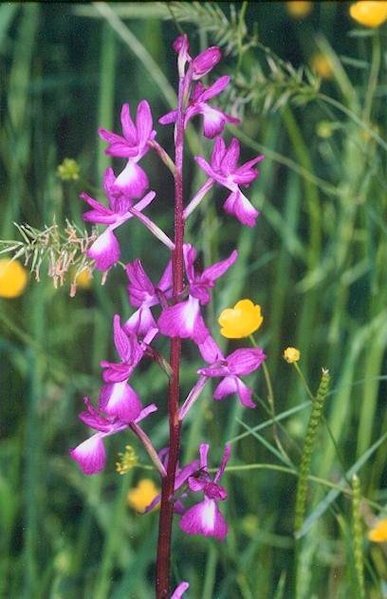
Its hermaphroditic flowers are arranged in a compact pyramidal inflorescence. They range in colour from pink to purple, with white flowers occurring rarely, and have six tepals consisting of three sepals and three petals.[4][5][6]
The lower petal, or labellum, is large and trilobate and bears two small lateral flaps. Each flower has a tubular spur at its back measuring approximately 1.5 centimetres.[7][8][9]
The flowers have a scent described as foxy.[10]
The plant produces small, rich pink or occasionally pure white flowers in a crowded, conical spike. It is a tuberous terrestrial orchid with lance-shaped leaves.[11][12]
The plant typically reaches a height of 10–25 centimetres and can reach a maximum height of 60 centimetres. Its basal leaves can grow up to 25 centimetres long.[13][14][15]
Habitat
The Pyramidal Orchid grows in sunny locations on loamy or clay soils and can also grow in very alkaline soils. Its habitats include meadows, grassland, sand dunes, maquis and dry, exposed slopes.[16][17][18][19]
The species grows at elevations from sea level to at least 1,600 metres.[20]
The species is recommended for fertile, well-drained, gritty, humus-rich, neutral or alkaline soil in partial shade.[21]
Reproduction and life cycle
Butterflies and moths pollinate the flowers. Their morphology is adapted to pollination by Lepidoptera, particularly species of Euphydryas, Melanargia, Melitaea, Pieris and Zygaena.[22][23]
Pairs of pollinia attach to visiting insects' proboscises as part of the species' pollination mechanism.[24]
The species can be propagated by separating offsets in spring.[25]
Behaviour
The Pyramidal Orchid can successfully colonise disturbed soils in the United Kingdom.[26]
Uses
The dried and ground tubers of species of Orchis and Anacamptis can be processed into a powder called salep. Salep is used in drinks, cereals and bread-making.[27][28]
Salep is used in ice cream in Turkey and was historically used medicinally in diets for children and convalescents.[29][30]
Classification of the Pyramidal Orchid
| Kingdom | Plantae |
|---|---|
| Subkingdom | Pteridobiotina |
| Phylum | Tracheophyta |
| Class | Liliopsida |
| Order | Asparagales |
| Family | Orchidaceae (Orchid) |
| Genus | Anacamptis |
| Species | Anacamptis pyramidalis (L.) Rich. |
Where the Pyramidal Orchid is found
Checklists and occurrence records place Anacamptis pyramidalis in 54 countries across Africa, Asia and Europe. GBIF holds 314,382 georeferenced records of it.
Countries
- Albania 71
- Algeria 68
- Andorra 3
- Armenia 42
- Austria 1,405
- Azerbaijan 58
- Belgium 1,820
- Bosnia and Herzegovina 65
- Bulgaria 152
- Croatia 914
- Cyprus 355
- Czechia 195
- Denmark 409
- Estonia 322
- France 171,499
- Georgia 201
- Germany 9,489
- Greece 1,971
- Guernsey 54
- Hungary 247
- Iran 10
- Iraq 11
- Ireland 2,279
- Isle of Man 242
- Israel 915
- Italy 7,785
- Jersey 82
- Jordan 4
- Kosovo 13
- Lebanon 60
- Liechtenstein 238
- Luxembourg 3,804
- Malta 282
- Montenegro 101
- Morocco 15
- North Macedonia 55
- Palestinian Territory 61
- Poland 32
- Portugal 3,879
- Romania 114
- Russia 517
- San Marino 3
- Serbia 97
- Slovakia 109
- Slovenia 298
- Spain 11,605
- Sweden 3,920
- Switzerland 18,169
- Syria 36
- The Netherlands 16,482
- Tunisia 7
- Turkey 358
- Ukraine 1,181
- United Kingdom 52,278
Regions and cities with the most records
- England, United Kingdom 46,058
- Auvergne-Rhône-Alpes, France 38,310
- Occitanie, France 36,709
- Provence-Alpes-Côte d'Azur, France 16,259
- Bourgogne-Franche-Comté, France 13,132
- Grand Est, France 10,496
- Haarlem, The Netherlands 9,028
- Heemstede, The Netherlands 9,021
- Zandvoort, The Netherlands 9,016
- Zaandam, The Netherlands 8,996
- Velserbroek, The Netherlands 8,992
- Zaanstad, The Netherlands 8,991
- Assendelft, The Netherlands 8,990
- IJmuiden, The Netherlands 8,985
- Velsen-Noord, The Netherlands 8,983
- Beverwijk, The Netherlands 8,980
- Heemskerk, The Netherlands 8,978
- Krommenie, The Netherlands 8,971
- Castricum, The Netherlands 8,970
- Heiloo, The Netherlands 8,918
- Hillegom, The Netherlands 7,246
- Hoofddorp, The Netherlands 6,862
- Île-de-France, France 6,846
- Geneva, Switzerland 6,472
- Vernier, Switzerland 6,362
- Onex, Switzerland 6,325
- Meyrin, Switzerland 6,287
- Carouge, Switzerland 6,253
- Annemasse, France 5,963
- Centre-Val de Loire, France 5,432
- Hauts-de-France, France 4,673
- Geneva, Switzerland 4,190
- Maastricht, The Netherlands 3,869
- Visé, Belgium 3,802
- Vernon, France 3,773
- Manosque, France 3,759
1 more country has a few records outside this range
These countries hold a few records of Anacamptis pyramidalis but lie outside the range the checklists give for it. Such records are often zoo or garden specimens, museum material or vagrants, so the species is not counted as occurring there.
A number beside a place is its count of GBIF occurrence records. A place without a number comes from a checklist alone. Records show where a species has been observed or collected, which can include escapes and vagrants.
Common names
English
- Pyramidal Orchid
Names in 28 other languages
- Basque
- Orkidea piramidala
- Bulgarian
- Обикновен анакамптис
- Catalan
- flor caputxina
- Chinese
- 金字塔蘭
- Croatian
- Crvena vratiželja
- Czech
- rudohlávek jehlancovitý
- Danish
- Almindelig horndrager, Horndrager
- Dutch
- Hondskruid
- Estonian
- püramiid-koerakäpp
- Finnish
- kartiokalkkikämmekkä
- French
- Anacamptide pyramidale, Anacamptis en pyramide, Orchis pyramidal
- German
- Kammstendel, Pyramiden-Knabenkraut, Pyramidenhundswurz, Pyramidenorchis, Spitzorchis
- Greek
- Ανακαμπτίς η πυραμοειδής
- Hebrew
- בן-סחלב צריפי
- Hungarian
- Vitézvirág, tornyos vitézvirág
- Irish
- Magairlín na stuaice
- Italian
- Orchidea piramidale
- Luxembourgish
- Pyramiden-Hondswuerzel
- Polish
- Koślaczek stożkowaty
- Portuguese
- Satirião-menor
- Russian
- Анакамптис пирамидальный
- Slovak
- červenohlav ihlanovitý
- Slovenian
- piramidasti pilovec
- Spanish
- orquídea piramidal
- Swedish
- klotyxne, salep, salepsrot
- Turkish
- Sivri salep
- Ukrainian
- Плодоріжка пірамідальна
- Welsh
- Tegeirian Ber, Tegeirian Bera, Tegeirian Coch yr Haf, Tegeiriau Bera
Synonyms
7 other scientific names have been used for this species and are now treated as synonyms of Anacamptis pyramidalis.
- Aceras pyramidale (L.) Rchb.f.
- Aceras pyramidale var. duquesnei (Rchb.fil.) Gillet & Magne
- Anacampterorchis × duquesnei (Rchb.fil.) Soca
- Anacamptis pyramidalis f. platyglossa Krösche
- Anacamptis pyramidalis f. stenoloba Krösche
- Orchis pyramidalis L.
- Orchis pyramidata Linnaeus, 1759
Subspecies and varieties
Related species
-
 Green-Winged OrchidAnacamptis morio
-
 Bug OrchidAnacamptis coriophora
-
 Loose-flowered OrchidAnacamptis laxiflora
-
 Eurasian Marsh OrchidAnacamptis palustris
-
 Pink-butterfly OrchidAnacamptis papilionacea
-
 Holy OrchidAnacamptis sancta
-
 Fan-lipped OrchidAnacamptis collina
-
 Bory's AnacamptisAnacamptis boryi
Compare
Questions and answers
What is the scientific name of the Pyramidal Orchid?
The scientific name of the Pyramidal Orchid is Anacamptis pyramidalis. Written with its author, the full name is Anacamptis pyramidalis (L.) Rich..
Which family does the Pyramidal Orchid belong to?
Anacamptis pyramidalis belongs to the family Orchidaceae, in the order Asparagales and the class Liliopsida.
Where is the Pyramidal Orchid found?
Checklists and occurrence records place Anacamptis pyramidalis in 54 countries, including France, United Kingdom, Switzerland, The Netherlands, Spain and Germany.
Sources
Passages the profile rests on
- The plant has an erect, unbranched stem. Source passage: “The stem is erect and unbranched.” — English Wikipedia
- Its basal leaves are linear-lanceolate and have parallel venation. Source passage: “The basal leaves are linear-lanceolate with parallel venation” — English Wikipedia
- Its cauline leaves are shorter than the basal leaves and barely visible on the stem. Source passage: “the cauline ones are shorter and barely visible on the stem.” — English Wikipedia
- Its hermaphroditic flowers are arranged in a compact pyramidal inflorescence. Source passage: “The arrangement of hermaphroditic flowers in a compact pyramidal shape” — English Wikipedia
- The flowers range in colour from pink to purple, with white flowers occurring rarely. Source passage: “The colour of the flower varies from pink to purple, or rarely white” — English Wikipedia
- The flowers have six tepals consisting of three sepals and three petals. Source passage: “The flowers have six tepals, being three small sepals and three petals.” — English Wikipedia
- The lower petal, or labellum, is large and trilobate. Source passage: “the third and lower (labellum) is large and trilobate.” — English Wikipedia
- Each flower has a tubular spur at its back measuring approximately 1.5 centimetres. Source passage: “At the back of the flower there is a tubular spur of about 1.5 centimetres (0.59 in) long” — English Wikipedia
- The labellum bears two small lateral flaps. Source passage: “while the labellum bears two lateral small flaps.” — English Wikipedia
- The flowers have a scent described as foxy. Source passage: “the scent is described as "foxy".” — English Wikipedia
- The plant produces small, rich pink or occasionally pure white flowers in a crowded, conical spike. Source passage: “small, rich pink, or occasionally pure white, flowers in a crowded, conical spike” — rhs.org.uk
- The species is a tuberous terrestrial orchid with lance-shaped leaves. Source passage: “A tuberous, terrestrial orchid with lance-shaped leaves” — rhs.org.uk
- The plant typically reaches a height of 10–25 centimetres. Source passage: “This hardy plant reaches on average 10–25 centimetres (3.9–9.8 in) of height” — English Wikipedia
- The plant can reach a maximum height of 60 centimetres. Source passage: “with a maximum of 60 centimetres (24 in).” — English Wikipedia
- Its basal leaves can grow up to 25 centimetres long. Source passage: “up to 25 centimetres (9.8 in) long” — English Wikipedia
- The species grows in sunny locations on loamy or clay soils. Source passage: “Anacamptis pyramidalis requires a sunny spot on diverse soils: loamy or clay.” — English Wikipedia
- The species can grow in very alkaline soils. Source passage: “It can even grow on very alkaline soil.” — English Wikipedia
- Its habitats include meadows, grassland, sand dunes and maquis. Source passage: “It can be found on meadows, in grassland, sand dunes, maquis” — English Wikipedia
- The species also inhabits dry, exposed slopes. Source passage: “as well as dry and well exposed slopes” — English Wikipedia
- The species grows at elevations from sea level to at least 1,600 metres. Source passage: “at an altitude of 0–1,600 metres or more (0–5,250 ft approx.)” — English Wikipedia
- The species is recommended for fertile, well-drained, gritty, humus-rich, neutral or alkaline soil in partial shade. Source passage: “Best in fertile, well-drained, gritty, humus-rich, neutral or alkaline soil in partial shade.” — rhs.org.uk
- Butterflies and moths pollinate the flowers. Source passage: “The flowers are pollinated by butterflies and moths.” — English Wikipedia
- The flower morphology is adapted to pollination by Lepidoptera, particularly species of Euphydryas, Melanargia, Melitaea, Pieris and Zygaena. Source passage: “especially Euphydryas, Melanargia, Melitaea, Pieris and Zygaena species.” — English Wikipedia
- The species has a pollination mechanism in which pairs of pollinia attach to visiting insects' proboscises. Source passage: “its pairs of pollinia attach themselves to an insect's proboscis” — English Wikipedia
- The species can be propagated by separating offsets in spring. Source passage: “Propagate by separating offsets in spring” — rhs.org.uk
- The species can successfully colonise disturbed soils in the United Kingdom. Source passage: “In the UK, Anacamptis pyramidalis is a very successful coloniser of disturbed soil” — English Wikipedia
- The dried and ground tubers of species of Orchis and Anacamptis can be processed into a powder called salep. Source passage: “The dried and ground tuber (from various species of Orchis and Anacamptis) can be made into a fine white powder, called salep.” — English Wikipedia
- Salep is used in drinks, cereals and bread-making. Source passage: “It is used in drinks, cereals and in making bread.” — English Wikipedia
- Salep is used in ice cream in Turkey. Source passage: “In Turkey it is used in ice-creams.” — English Wikipedia
- Salep was historically used medicinally in diets for children and convalescents. Source passage: “It was also used medicinally in diets for children and convalescents.” — English Wikipedia
- The species is especially common on the Isle of Wight in southern England. Source passage: “This orchid is especially common on the Isle of Wight in the South of England” — English Wikipedia
- The species is rare in Germany. Source passage: “In Germany, it is rare” — English Wikipedia
Data
- Catalogue of Life, 2026-10-16 XR cc by
- Global Biodiversity Information Facility CC BY 4.0
- Wikidata CC0
- GeoNames CC BY 4.0
- Wikimedia Commons per image; credit shown with each image
- Within the Catalogue of Life, this name comes from The World Checklist of Vascular Plants (WCVP) cc by
References
- De Orchid. Eur.: 33 (1817) where the name was published
This species in other databases
- Catalogue of Life 66JD2
- Wikidata Q158118
- iNaturalist 83085
- World Flora Online wfo-0000968551
- GRIN 511262
Page built on 27 November 2026. See how the catalog is made and all sources and licences.
Cite this page
ScientificNames.org. (2026). Anacamptis pyramidalis (Pyramidal Orchid). Retrieved November 27, 2026, from https://scientificnames.org/species/anacamptis-pyramidalis
“Anacamptis pyramidalis (Pyramidal Orchid).” ScientificNames.org, 2026, scientificnames.org/species/anacamptis-pyramidalis. Accessed 27 Nov. 2026.
ScientificNames.org. “Anacamptis pyramidalis (Pyramidal Orchid).” Accessed November 27, 2026. https://scientificnames.org/species/anacamptis-pyramidalis.
@misc{scientificnames_anacamptis_pyramidalis_pyramidal_orchid,
  author = {{ScientificNames.org}},
  title = {Anacamptis pyramidalis (Pyramidal Orchid)},
  year = {2026},
  url = {https://scientificnames.org/species/anacamptis-pyramidalis},
  note = {Accessed 2026-11-27}
}