Species · Other invertebrates
Hook Worm Ancylostoma duodenale
The scientific name of the Hook Worm is Ancylostoma duodenale. It is a species of animal in the family Ancylostomatidae (hookworms), order Rhabditida. The name dates from 1843.
- Scientific name
- Ancylostoma duodenale (Dubini, 1843) Creplin, 1845
- Common name
- Hook Worm
- Genus
- Ancylostoma
- Family
- Ancylostomatidae (Hookworms)
- Order
- Rhabditida
- Class
- Chromadorea
- Environment
- terrestrial
- Recorded in
- 8 countries
- Name status
- accepted in the Catalogue of Life

Overview
Hook Worm is an invertebrate in the family Ancylostomatidae, order Rhabditida, and class Chromadorea. Adult worms inhabit the small intestine, particularly the jejunum, of their definitive hosts. The adult worm has a small, cylindrical, S-shaped body and two powerful ventral teeth in its buccal capsule.
Written 26 November 2026 from the sources listed below. Each statement was checked against the passage it cites; statements that could not be supported were removed.
Appearance
The adult worm has a small, cylindrical body with greyish-white or pinkish-white coloration. Its anterior end bends to produce an S-shaped body.[1][2][3]
Both sexes have two powerful ventral teeth in the buccal capsule, with smaller pairs of teeth located deeper inside. Adult males possess a copulatory bursa and needle-like spicules with distally fused small tips.[4][5]
The female's vulva is situated approximately one-third of the body length from the posterior end. Infective third-stage larvae have a pointed tail and retain a protective sheath.[6][7]
Adult males measure approximately 8–11 mm in length, while adult females measure approximately 10–13 mm. Infective third-stage larvae measure approximately 500–700 µm in length.[8][9][10]
Habitat
Adult worms inhabit the small intestine, particularly the jejunum, of their definitive hosts. They typically reside in the distal jejunum and attach themselves to the intestinal wall.[11][12]
Juvenile stages develop in warm regions where the soil is loose, humus-rich, well-drained, and adequately aerated. Eggs develop in neutral-pH soils in shady environments such as coffee, banana, and sugar plantations.[13][14]
Warm, humid mines provide suitable conditions for egg and juvenile development.[15]
Diet
Hookworm eggs obtain nutrients through absorption from the host's feces.[16]
Behaviour
Infective larvae respond to soil vibrations, heat, and carbon dioxide when locating potential hosts. They use mechanosensory, thermosensory, and chemosensory receptors to detect environmental signals and generally remain stationary until signals associated with a potential host are detected.[17][18][19]
Adult worms can move between locations along the host's intestine. Adult males detach from intestinal attachment sites to search for females, while females remain attached.[20][21]
Infective larvae can penetrate human skin, commonly through bare feet.[22]
Reproduction and life cycle
Adult worms mate and produce eggs in the host's small intestine. Adult females can produce between 10,000 and 30,000 eggs per day.[23][24]
Eggs are passed out of the host in feces and hatch into larvae after approximately one to two days under favorable environmental conditions. Infective third-stage larvae develop after two molts within approximately 5 to 10 days.[25][26][27]
Adult worms develop approximately six weeks after the initial infection.[28]
Classification of the Hook Worm
| Kingdom | Animalia |
|---|---|
| Phylum | Nematoda |
| Class | Chromadorea |
| Subclass | Chromadoria |
| Order | Rhabditida |
| Suborder | Rhabditina |
| Infraorder | Rhabditomorpha |
| Family | Ancylostomatidae (Hookworms) |
| Genus | Ancylostoma (Hookworm) |
| Species | Ancylostoma duodenale (Dubini, 1843) Creplin, 1845 |
Where the Hook Worm is found
Checklists and occurrence records place Ancylostoma duodenale in 8 countries. GBIF holds 348 georeferenced records of it.
Countries
Regions and cities with the most records
- Mono, Benin 192
- Toviklin, Benin 191
- Dogbo, Benin 190
- Lokossa, Benin 115
- Atlantique, Benin 28
- Kouffo, Benin 24
- Allada, Benin 22
- Klouékanmè, Benin 21
- Abomey-Calavi, Benin 17
- Athiémé, Benin 17
- Ganvié, Benin 17
- Godomè, Benin 17
- Zinvié, Benin 16
- Sé, Benin 14
- Kouandé, Benin 12
- Northern Territory, Australia 11
- Comé, Benin 10
- Abū an Numrus, Egypt 9
- Al Khuşūş, Egypt 9
- Al Ḩawāmidīyah, Egypt 9
- Awsīm, Egypt 9
- Cairo, Egypt 9
- Cairo, Egypt 9
- Giza, Egypt 9
- Kirdāsah, Egypt 9
- Qalyub, Egypt 9
- Queensland, Australia 9
- Shubrā al Khaymah, Egypt 9
- Sarawak, Malaysia 7
- Al Qanāţir al Khayrīyah, Egypt 5
- Djakotomé, Benin 5
- Ouidah, Benin 5
- Manshīyat al Qanāţir, Egypt 4
4 more countries have a few records outside this range
These countries hold a few records of Ancylostoma duodenale but lie outside the range the checklists give for it. Such records are often zoo or garden specimens, museum material or vagrants, so the species is not counted as occurring there.
A number beside a place is its count of GBIF occurrence records. A place without a number comes from a checklist alone. Records show where a species has been observed or collected, which can include escapes and vagrants.
Common names
English
- Hook Worm
Names in 5 other languages
- Afrikaans
- Mynwurm
- Korean
- 두비니구충
- Polish
- tęgoryjec dwunastnicy
- Russian
- Свайник двенадцатиперстной кишки
- Tamil
- கொக்கிப்புழு
Related species
-
 Ancylostoma braziliense
- Ancylostoma ceylanicum
- Ancylostoma caninum
- Ancylostoma (Ancylostoma) ailuropodae
- Ancylostoma (Ancylostoma) ctenomyos
- Ancylostoma martinezi
- Ancylostoma tubaeforme
-
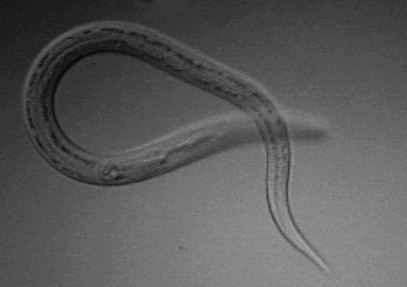 New World HookwormNecator americanus
Compare
Questions and answers
What is the scientific name of the Hook Worm?
The scientific name of the Hook Worm is Ancylostoma duodenale. Written with its author, the full name is Ancylostoma duodenale (Dubini, 1843) Creplin, 1845.
Which family does the Hook Worm belong to?
Ancylostoma duodenale belongs to the family Ancylostomatidae, in the order Rhabditida and the class Chromadorea.
Where is the Hook Worm found?
Checklists and occurrence records place Ancylostoma duodenale in 8 countries, including Benin, Australia, Egypt, Malaysia, India and Uganda.
What environment do hookworms live in?
Adult worms inhabit the small intestine of their definitive hosts. Eggs and juvenile stages develop in warm, humid environments, including suitable soils and warm, humid mines.[11][13][14][15]
Sources
Passages the profile rests on
- The adult worm has a small, cylindrical body with a greyish-white coloration. Source passage: “A. duodenale is small, cylindrical worm, greyish-white in color.” — English Wikipedia
- The worm has an S-shaped body resulting from a bend at its anterior end. Source passage: “Ancylostoma duodenale is an S-shaped worm because of its flexure at the frontal end.” — animaldiversity.org
- The adult worm has a pinkish-white coloration. Source passage: “The worm is pinkish-white.” — animaldiversity.org
- Both sexes possess two powerful ventral teeth in the buccal capsule, with smaller pairs of teeth located deeper inside. Source passage: “Both male and female hookworms have two powerful ventral teeth in the adult forms of the parasite, one along each side of the buccal capsule; smaller pairs of teeth are located deeper in the capsule.” — animaldiversity.org
- Adult males possess a copulatory bursa and needle-like spicules with distally fused small tips. Source passage: “This species is dimorphic, with the males having bursa characteristics and needle-like spicules with small tips, which are distally fused.” — animaldiversity.org
- The female's vulva is situated approximately one-third of the body length from the posterior end. Source passage: “Females have a vulva located approximately one-third of the body length from the posterior end.” — animaldiversity.org
- The infective third-stage larvae have a pointed tail and retain a protective sheath. Source passage: “They have a pointed tail and are ensheathed” — cdc.gov
- Adult males measure approximately 8–11 mm in length. Source passage: “Males are 8–11 mm long” — English Wikipedia
- Adult females measure approximately 10–13 mm in length. Source passage: “Females are 10–13 mm long” — English Wikipedia
- Infective third-stage larvae measure approximately 500–700 µm in length. Source passage: “Infective, third-stage (L3), filariform larvae are 500—700 µm long.” — cdc.gov
- Adult worms inhabit the small intestine, particularly the jejunum, of their definitive hosts. Source passage: “It lives in the small intestine especially the jejunum of definitive hosts, generally humans” — English Wikipedia
- Adult worms typically reside in the distal jejunum and attach themselves to the intestinal wall. Source passage: “Adult worms live in the lumen of the small intestine, typically the distal jejunum, where they attach to the intestinal wall” — cdc.gov
- Juvenile stages develop in warm regions where the soil is loose, humus-rich, well-drained, and adequately aerated. Source passage: “Juveniles of the species reside in the warmer regions of the world where the soil is preferably humus and loose with reasonable water drainage and good aeration.” — animaldiversity.org
- The eggs develop in neutral-pH soils located in shady environments such as coffee, banana, and sugar plantations. Source passage: “Therefore they must live in areas with soils of neutral pHs and in shady areas, such as coffee, banana, and sugar plantations where the feces will remain intact long enough for them to develop into juveniles.” — animaldiversity.org
- Warm, humid mines provide suitable conditions for egg and juvenile development. Source passage: “This hookworm is well known in mines because of the consistency in temperature and humidity that provides an ideal habitat for egg and juvenile development.” — English Wikipedia
- Hookworm eggs obtain nutrients through absorption from the host's feces. Source passage: “Hookworm eggs derive their nutrition from the host feces via absorption.” — animaldiversity.org
- Infective larvae respond to soil vibrations, heat, and carbon dioxide when locating potential hosts. Source passage: “These infective filariform larvae are able to sense vibrations in the soil, heat, or carbon dioxide” — English Wikipedia
- Infective larvae use mechanosensory, thermosensory, and chemosensory receptors to detect environmental signals. Source passage: “They do so by using neurons with dendritic processes that resemble cilia, which are mechanosensory, thermosensory and chemosensory.” — animaldiversity.org
- Infective larvae generally remain stationary until they detect environmental signals associated with a potential host. Source passage: “The larvae of the infective stage are usually stationary, until they sense vibrations in the soil as heat or carbon dioxide.” — animaldiversity.org
- Adult worms can move between locations along the host's intestine. Source passage: “The adult worms can move from one place to another along the intestine once inside of the host” — animaldiversity.org
- Adult males detach from intestinal attachment sites to search for females, while females remain attached. Source passage: “Adult females remain attached and the males detach to find their mates.” — animaldiversity.org
- The infective larvae can penetrate human skin, commonly through bare feet. Source passage: “On contact with the human host, typically bare feet, the larvae penetrate the skin” — cdc.gov
- Adult worms mate and produce eggs in the host's small intestine. Source passage: “Finally, the adult worms develop in the small intestine where they mate, and produce eggs that are sent off in the feces of the host to begin the process once more.” — animaldiversity.org
- Adult females can produce between 10,000 and 30,000 eggs per day. Source passage: “females can lay 10,000 to 30,000 eggs per day.” — English Wikipedia
- Eggs are passed out of the host in feces. Source passage: “Eggs are passed in the stool” — cdc.gov
- Eggs hatch into larvae after approximately one to two days under favorable environmental conditions. Source passage: “under favorable conditions (moisture, warmth, shade), larvae hatch in 1 to 2 days” — cdc.gov
- The infective third-stage larvae develop after two molts within approximately 5 to 10 days. Source passage: “after 5 to 10 days (and two molts) they become filariform (third-stage) larvae that are infective” — cdc.gov
- Adult worms develop approximately six weeks after the initial infection. Source passage: “Adults form about 6 weeks after the initial infection.” — animaldiversity.org
- Adult worms feed on blood obtained from the intestinal walls of their hosts. Source passage: “Young and adult worms feed on blood from the walls of the host's intestine” — animaldiversity.org
- Humans are the principal definitive hosts of the species. Source passage: “Humans are the principal host for both A. duodenale and N. americanus.” — cdc.gov
Data
- Catalogue of Life, 2026-10-16 XR cc by
- Global Biodiversity Information Facility CC BY 4.0
- Wikidata CC0
- GeoNames CC BY 4.0
- Wikimedia Commons per image; credit shown with each image
- Within the Catalogue of Life, this name comes from Nemys, World Database of Nematodes cc by
This species in other databases
- Catalogue of Life 9WT5V
- Wikidata Q2520810
- iNaturalist 1462234
- WoRMS urn:lsid:marinespecies.org:taxname:1613473
Page built on 29 November 2026. See how the catalog is made and all sources and licences.
Cite this page
ScientificNames.org. (2026). Ancylostoma duodenale (Hook Worm). Retrieved November 29, 2026, from https://scientificnames.org/species/ancylostoma-duodenale
“Ancylostoma duodenale (Hook Worm).” ScientificNames.org, 2026, scientificnames.org/species/ancylostoma-duodenale. Accessed 29 Nov. 2026.
ScientificNames.org. “Ancylostoma duodenale (Hook Worm).” Accessed November 29, 2026. https://scientificnames.org/species/ancylostoma-duodenale.
@misc{scientificnames_ancylostoma_duodenale_hook_worm,
  author = {{ScientificNames.org}},
  title = {Ancylostoma duodenale (Hook Worm)},
  year = {2026},
  url = {https://scientificnames.org/species/ancylostoma-duodenale},
  note = {Accessed 2026-11-29}
}