Species · Other invertebrates
New World Hookworm Necator americanus
The scientific name of the New World Hookworm is Necator americanus. It is a species of animal in the family Ancylostomatidae (hookworms), order Rhabditida. The name dates from 1902.
- Scientific name
- Necator americanus Stiles, 1902
- Common name
- New World Hookworm
- Genus
- Necator
- Family
- Ancylostomatidae (Hookworms)
- Order
- Rhabditida
- Class
- Chromadorea
- Environment
- terrestrial
- Recorded in
- 17 countries
- Name status
- accepted in the Catalogue of Life
Overview
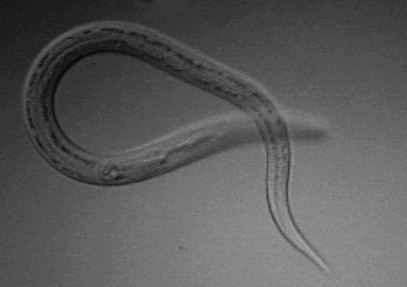
New World Hookworm is an obligate internal parasite of humans in the family Ancylostomatidae, order Rhabditida and class Chromadorea. Adult worms inhabit the small intestine of human hosts and occur exclusively in tropical and temperate regions. The species has two pairs of cutting plates in its adult mouth and infective larvae that penetrate human skin.
Written 26 November 2026 from the sources listed below. Each statement was checked against the passage it cites; statements that could not be supported were removed.
Appearance
Adult New World Hookworms have cylindrical bodies protected by a cuticle composed of three main outer layers. Their anterior ends have a dorsal curve that gives hookworms their common name.[1][2]
The adult mouth has two pairs of cutting plates, with one pair positioned dorsally and the other ventrally. Adult males have fused spicules located on the bursa.[3][4]
Adult males measure approximately 7–9 mm in length, while adult females measure approximately 9–11 mm. The eggs are oval-shaped with thin shells and measure approximately 56–74 by 36–40 μm.[5][6][7][8]
The infective third-stage larvae measure 500–700 μm in length.[9]
Habitat
Adult worms inhabit the small intestine of human hosts and occur exclusively in tropical and temperate regions. The free-living larval stages inhabit contaminated soil and fecal material.[10][11][12]
The eggs require moist, warm, shaded environmental conditions to hatch. Juveniles mature optimally at temperatures between 23 and 30 °C.[13][14]
Eggs and juveniles cannot survive freezing temperatures or soil desiccation.[15]
Diet
Adult worms feed on the blood of their human hosts.[16]
Behaviour
Infective larvae penetrate human skin, commonly when people walk barefoot on contaminated ground. After penetrating the skin, they travel through blood vessels to the heart and lungs, then ascend the respiratory tract and are swallowed before reaching the intestine.[17][18][19]
Adult worms attach to the intestinal wall using their cutting plates and feed from the resulting blood loss. They can move to new intestinal feeding and reproduction sites rather than remaining permanently attached to one location.[20][21]
The species does not appear to infect humans through oral or transmammary transmission. It appears to infect male hosts more frequently than female hosts, although this pattern may reflect differences in labor division.[22][23]
Reproduction and life cycle
The species has separate male and female individuals, and mating takes place in the host's intestine. Female worms begin producing eggs at least five weeks after reaching maturity and can produce approximately 10,000 eggs per day.[24][25][26][27]
The eggs leave the human host in feces and hatch within one to two days under favorable environmental conditions. Rhabditiform larvae undergo two molts over approximately five to ten days before becoming infective filariform larvae.[28][29][30]
Uses
Necator americanus has been proposed as a potential alternative to Trichuris suis in helminthic therapy.[31]
Similar species
Ancylostoma duodenale is another human hookworm species that commonly infects humans alongside New World Hookworm.[32]
Classification of the New World Hookworm
| Kingdom | Animalia |
|---|---|
| Phylum | Nematoda |
| Class | Chromadorea |
| Subclass | Chromadoria |
| Order | Rhabditida |
| Suborder | Rhabditina |
| Infraorder | Rhabditomorpha |
| Family | Ancylostomatidae (Hookworms) |
| Genus | Necator |
| Species | Necator americanus Stiles, 1902 |
This name was added to the Catalogue of Life from a contributing dataset by automated merging and has not yet been reviewed by its editors.
Where the New World Hookworm is found
Checklists and occurrence records place Necator americanus in 17 countries. GBIF holds 278 georeferenced records of it.
Countries
- Australia 14
- Bangladesh 34
- Brazil 6
- Cambodia 6
- China 28
- Colombia 59
- Gabon 8
- India 4
- Malaysia 17
- Mexico 6
- Nigeria 3
- Papua New Guinea 15
- Philippines 3
- Puerto Rico 8
- Taiwan 5
- Thailand 8
- United States 54
Regions and cities with the most records
- Meta Department, Colombia 59
- Northern Territory, Australia 10
- East New Britain Province, Papua New Guinea 9
- Kokopo, Papua New Guinea 9
- Atlanta, United States 6
- Belvedere Park, United States 6
- Brookhaven, United States 6
- Candler-McAfee, United States 6
- Chamblee, United States 6
- Decatur, United States 6
- East Point, United States 6
- Forest Park, United States 6
- Georgia, United States 6
- Mableton, United States 6
- North Decatur, United States 6
- North Druid Hills, United States 6
- Sandy Springs, United States 6
- Smyrna, United States 6
- District of Columbia, United States 5
- Kentucky, United States 4
- Ubon Ratchathani, Thailand 4
- Ubon Ratchathani, Thailand 4
- Veracruz, Mexico 4
- Warin Chamrap, Thailand 4
- Clarksville, United States 3
- Highview, United States 3
- Jeffersonville, United States 3
- Louisville, United States 3
- Mato Grosso, Brazil 3
- New Albany, United States 3
- Newburg, United States 3
- Okolona, United States 3
- Saint Matthews, United States 3
- Shively, United States 3
- Valley Station, United States 3
A number beside a place is its count of GBIF occurrence records. A place without a number comes from a checklist alone. Records show where a species has been observed or collected, which can include escapes and vagrants.
Common names
English
- New World Hookworm
- Old World Hookworm
Names in 2 other languages
- Korean
- 아메리카구충
- Russian
- Некатор американский
Synonyms
One other scientific name has been used for this species and is now treated as a synonym of Necator americanus.
- Uncinaria americanus Stiles, 1902
Related species
-
 Hook WormAncylostoma duodenale
-
 Ancylostoma braziliense
- Uncinaria stenocephala
- Ancylostoma ceylanicum
- Uncinaria sanguinis
-
 Bunostomum trigonocephalum
- Bunostomum phlebotomum
- Globocephalus urosubulatus
Compare
Questions and answers
What is the scientific name of the New World Hookworm?
The scientific name of the New World Hookworm is Necator americanus. Written with its author, the full name is Necator americanus Stiles, 1902.
Which family does the New World Hookworm belong to?
Necator americanus belongs to the family Ancylostomatidae, in the order Rhabditida and the class Chromadorea.
Where is the New World Hookworm found?
Checklists and occurrence records place Necator americanus in 17 countries, including Colombia, United States, Bangladesh, China, Malaysia and Papua New Guinea.
What other names does the New World Hookworm have?
Necator americanus is also known in English as Old World Hookworm.
What does a hookworm eat?
Adult New World Hookworms feed on the blood of their human hosts.[16]
Sources
Passages the profile rests on
- Adult Necator americanus has a cylindrical body protected by a cuticle composed of three main outer layers. Source passage: “As a nematode, Necator americanus has a cylindrical body, and a cuticle with three main outer layers made of collagen and other compounds” — animaldiversity.org
- The anterior end of the worm has a dorsal curve that gives hookworms their common name. Source passage: “The common name "hookworm" comes from the dorsal curve at the anterior end.” — animaldiversity.org
- The adult mouth has two pairs of cutting plates, with one pair positioned dorsally and the other ventrally. Source passage: “The mouth of the adults has two pair of cutting plates, one dorsal and the other ventral.” — animaldiversity.org
- Adult males have fused spicules located on the bursa. Source passage: “The males of the species are characterized by fused spicules found on the bursa.” — animaldiversity.org
- The eggs are oval-shaped and have thin shells. Source passage: “N. americanus eggs have a thin shell and are oval shaped” — English Wikipedia
- Adult males measure approximately 7–9 mm in length. Source passage: “Males are usually 7–9 mm long” — English Wikipedia
- Adult females measure approximately 9–11 mm in length. Source passage: “females are about 9–11 mm long.” — English Wikipedia
- The eggs measure approximately 56–74 by 36–40 μm. Source passage: “measuring roughly 56–74 by 36–40 μm.” — English Wikipedia
- The infective third-stage larvae measure 500–700 μm in length. Source passage: “Infective, third-stage (L3), filariform larvae are 500—700 µm long.” — cdc.gov
- Adult worms inhabit the small intestine of human hosts. Source passage: “It is an obligatory parasitic nematode that lives in the small intestine of human hosts.” — English Wikipedia
- Adult specimens occur exclusively in tropical and temperate regions. Source passage: “Adult N. americanus are found exclusively in tropical and temperate regions.” — animaldiversity.org
- The free-living larval stages inhabit contaminated soil and fecal material. Source passage: “These released rhabditiform larvae grow in the feces and/or the soil” — cdc.gov
- The eggs require moist, warm, shaded environmental conditions to hatch. Source passage: “Eggs require a moist, warm and shaded environment to hatch.” — animaldiversity.org
- Juveniles mature optimally at temperatures between 23 and 30 °C. Source passage: “Optimal temperatures for juveniles to mature are from 23 to 30 deg C.” — animaldiversity.org
- Eggs and juveniles cannot survive freezing temperatures or soil desiccation. Source passage: “Eggs and juveniles die below freezing or with soil dessication.” — animaldiversity.org
- Adult worms feed on the blood of their human hosts. Source passage: “Adult N. americanus feed from the blood of their hosts.” — animaldiversity.org
- Infective larvae penetrate human skin, commonly when people walk barefoot on contaminated ground. Source passage: “On contact with the human host, typically bare feet, the larvae penetrate the skin” — cdc.gov
- After penetrating the skin, infective larvae travel through blood vessels to the heart and lungs. Source passage: “the larvae penetrate the skin and are carried through the blood vessels to the heart and then to the lungs.” — cdc.gov
- The larvae reach the intestine after ascending the respiratory tract and being swallowed. Source passage: “They penetrate into the pulmonary alveoli, ascend the bronchial tree to the pharynx, and are swallowed .” — cdc.gov
- Adult worms attach to the intestinal wall using their cutting plates and feed from the resulting blood loss. Source passage: “The worm will attach itself to the intestinal wall and use its cutting plates to cause bleeding.” — animaldiversity.org
- Adult worms can move to new intestinal feeding and reproduction sites rather than remaining permanently attached to one location. Source passage: “Necator americanus does not permanently attach itself to the wall. This allows movement to new sites for feeding and reproduction within the host.” — animaldiversity.org
- The species does not appear to infect humans through oral or transmammary transmission. Source passage: “N. americanus does not appear to be infective via the oral or transmammary route.” — cdc.gov
- The species appears to infect male hosts more frequently than female hosts, although this pattern may reflect differences in labor division. Source passage: “Necator americanus appears to prefer male hosts to female hosts. However, this may be due to the division of labor in areas of high infestation.” — animaldiversity.org
- The species has separate male and female individuals. Source passage: “gonochoric/gonochoristic/dioecious (sexes separate)” — animaldiversity.org
- Mating takes place in the host's intestine. Source passage: “Mating occurs in the intestine of the host.” — animaldiversity.org
- Female worms begin producing eggs at least five weeks after reaching maturity. Source passage: “Egg production in females occurs five weeks or more after the female matures.” — animaldiversity.org
- Females can produce approximately 10,000 eggs per day. Source passage: “Females are capable of producing 10,000 eggs per day.” — animaldiversity.org
- The eggs leave the human host in feces. Source passage: “The eggs are the passed out with the feces.” — animaldiversity.org
- The eggs hatch within one to two days under favorable environmental conditions. Source passage: “under favorable conditions (moisture, warmth, shade), larvae hatch in 1 to 2 days” — cdc.gov
- Rhabditiform larvae undergo two molts over approximately five to ten days before becoming infective filariform larvae. Source passage: “after 5 to 10 days (and two molts) they become filariform (third-stage) larvae that are infective .” — cdc.gov
- Necator americanus has been proposed as a potential alternative to Trichuris suis in helminthic therapy. Source passage: “Necator americanus has been proposed as an alternative to Trichuris suis in helminthic therapy.” — English Wikipedia
- Ancylostoma duodenale is another human hookworm species that commonly infects humans alongside Necator americanus. Source passage: “Since N. americanus and Ancylostoma duodenale (also known as Old World hookworm) are the two species of hookworms that most commonly infest humans” — English Wikipedia
- Humans are the principal hosts of Necator americanus. Source passage: “Humans are the principal host for both A. duodenale and N. americanus.” — cdc.gov
- The species is an obligate internal parasite of humans. Source passage: “Necator americanus adults are obligate internal parasites of humans .” — animaldiversity.org
Data
- Catalogue of Life, 2026-10-16 XR cc by
- Global Biodiversity Information Facility CC BY 4.0
- Wikidata CC0
- GeoNames CC BY 4.0
- Wikimedia Commons per image; credit shown with each image
- iNaturalist per image; credit shown with each image
- Within the Catalogue of Life, this name comes from World Register of Marine Species cc by
This species in other databases
- Catalogue of Life CH8DP
- Wikidata Q2433913
- iNaturalist 341125
- WoRMS urn:lsid:marinespecies.org:taxname:1762642
- ITIS 63962
Page built on 27 November 2026. See how the catalog is made and all sources and licences.
Cite this page
ScientificNames.org. (2026). Necator americanus (New World Hookworm). Retrieved November 27, 2026, from https://scientificnames.org/species/necator-americanus
“Necator americanus (New World Hookworm).” ScientificNames.org, 2026, scientificnames.org/species/necator-americanus. Accessed 27 Nov. 2026.
ScientificNames.org. “Necator americanus (New World Hookworm).” Accessed November 27, 2026. https://scientificnames.org/species/necator-americanus.
@misc{scientificnames_necator_americanus_new_world_hookworm,
  author = {{ScientificNames.org}},
  title = {Necator americanus (New World Hookworm)},
  year = {2026},
  url = {https://scientificnames.org/species/necator-americanus},
  note = {Accessed 2026-11-27}
}