Species · Birds · Extinct
Glaucous Macaw Anodorhynchus glaucus
The scientific name of the Glaucous Macaw is Anodorhynchus glaucus. It is an extinct species of bird in the family Psittacidae (macaws), order Psittaciformes. The name dates from 1816.
- Scientific name
- Anodorhynchus glaucus (Vieillot, 1816)
- Common name
- Glaucous Macaw
- Genus
- Anodorhynchus
- Family
- Psittacidae (Macaws)
- Order
- Psittaciformes
- Class
- Aves
- Red List category
- CR Critically Endangered
- Name status
- accepted in the Catalogue of Life

Overview
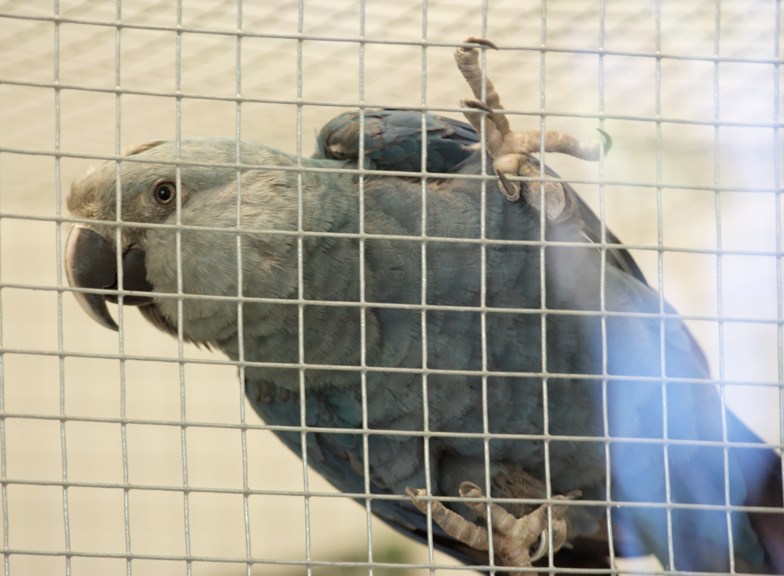
Anodorhynchus glaucus formerly occurred in northern Argentina, southern Paraguay, northeastern Uruguay, Brazil and the Chaco and Llano regions of Bolivia near Santa Cruz de la Sierra. It has predominantly pale turquoise-blue plumage, a large greyish head, a long tail, a large bill and a yellow, bare eye ring.
Written 26 November 2026 from the sources listed below. Each statement was checked against the passage it cites; statements that could not be supported were removed.
Appearance
The Glaucous Macaw has predominantly pale turquoise-blue plumage and a large greyish head. It has a long tail, a large bill and a yellow, bare eye ring.[1][2][3]
Half-moon-shaped lappets occur along the mandible. The species measures approximately 70 cm in length.[4][5]
Habitat
Suitable habitat for the Glaucous Macaw remains in El Palmar National Park in Entre Ríos, Argentina, and in southern Brazil.[6][7]
Behaviour
Glaucous Macaws were captured alive as adults for the wild bird trade. The species became rare during the nineteenth century.[8][9]
Only two possible reports of wild Glaucous Macaws were received during the twentieth century. Ornithological expeditions to southwestern Paraguay during the 1990s found no evidence of the species.[10][11]
The species was last recorded in the 1870s. A search conducted in 1992 concluded that Glaucous Macaws were extinct throughout their former range.[12][13]
Conservation
The Glaucous Macaw is classified as Critically Endangered (Possibly Extinct) in the 2019 IUCN assessment. A 2018 study also recommended classifying the species as Critically Endangered – Possibly Extinct.[14][15]
The species is experiencing a continuing decline in the number of mature individuals and in the area, extent or quality of its habitat.[16][17]
Conservation sites have been identified throughout its range, but the species is not recorded as occurring in any protected area in the IUCN assessment. It is included in international legislation and subject to international management or trade controls.[18][19][20][21]
Similar species
The Glaucous Macaw is closely related to Lear's macaw (Anodorhynchus leari) and the hyacinth macaw (Anodorhynchus hyacinthinus).[22][23]
Classification of the Glaucous Macaw
| Kingdom | Animalia |
|---|---|
| Phylum | Chordata |
| Subphylum | Vertebrata |
| Infraphylum | Gnathostomata |
| Parvphylum | Osteichthyes |
| Megaclass | Tetrapoda |
| Class | Aves (Bird) |
| Order | Psittaciformes (Parrot) |
| Family | Psittacidae (Macaws) |
| Genus | Anodorhynchus (Blue Macaws) |
| Species | Anodorhynchus glaucus (Vieillot, 1816) |
Where the Glaucous Macaw is found
Checklists place Anodorhynchus glaucus in South America.
Range as the checklists state it
South America
A number beside a place is its count of GBIF occurrence records. A place without a number comes from a checklist alone. Records show where a species has been observed or collected, which can include escapes and vagrants.
Common names
English
- Glaucous Macaw
Names in 29 other languages
- Arabic
- مكاو أزرق مخضر
- Bulgarian
- Сив ара
- Catalan
- guacamai glauc
- Chinese
- 淺藍綠金剛鸚鵡, 灰綠麥鷍, 蓝绿金刚鹦鹉
- Croatian
- tirkizna ara
- Czech
- ara tyrkysový
- Danish
- Havblå Ara
- Dutch
- Blauwgrijze Ara
- Esperanto
- glaŭka arao
- Estonian
- türkiis-siniaara
- Finnish
- parana-ara, parananara, paranánara
- French
- Ara glauque, Guhaa glauque
- German
- Meerblauer Ara, Türkis-Ara, Türkisara
- Hebrew
- ארת ענק גלאוקוס
- Hungarian
- tengerkék arara, tengerkék jácintara
- Italian
- Ara glauca
- Japanese
- ウミアオコンゴウインコ
- Lithuanian
- blausioji mėlynoji ara
- Norwegian
- asurara
- Polish
- modroara turkusowa
- Portuguese
- arara-azul-pequena, arara-celeste, arara-glauca
- Russian
- Серо-голубой ара, Серо-голубой гиацинтовый ара, Сероголубой гиацинтовый ара
- Serbian
- Morskoplava ara
- Slovak
- ara sivá
- Spanish
- Ara Azul, Guacamaya glauca, Guacamayo Violáceo, Guacamayo azul, Guacamayo glauco, Guacamayo oliváceo
- Swedish
- blågrön ara
- Turkish
- Türkuaz Ara
- Ukrainian
- Сіро-блакитний гіацинтовий ара, ара лазуровий
- Welsh
- macaw llwydlas
Synonyms
3 other scientific names have been used for this species and are now treated as synonyms of Anodorhynchus glaucus.
- Andorhychus glaucus Vieillot, LJP, 1816
- Andorhynchus glaucus Vieillot, LJP, 1816
- Macrocercus glaucus Vieillot, 1816
Related species
-
 Hyacinth MacawAnodorhynchus hyacinthinus
-
 Lear's MacawAnodorhynchus leari
-
 Spix's MacawCyanopsitta spixii
-
 Grey ParrotPsittacus erithacus
-
 Scarlet MacawAra macao
-
 Blue-and-yellow MacawAra ararauna
-
 Sun ConureAratinga solstitialis
-
 Green ParakeetPsittacara holochlorus
Compare
Questions and answers
What is the scientific name of the Glaucous Macaw?
The scientific name of the Glaucous Macaw is Anodorhynchus glaucus. Written with its author, the full name is Anodorhynchus glaucus (Vieillot, 1816).
Which family does the Glaucous Macaw belong to?
Anodorhynchus glaucus belongs to the family Psittacidae, in the order Psittaciformes and the class Aves.
What is the conservation status of the Glaucous Macaw?
The IUCN Red List category recorded for Anodorhynchus glaucus is Critically Endangered (CR).
Sources
Passages the profile rests on
- The glaucous macaw has predominantly pale turquoise-blue plumage and a large greyish head. Source passage: “It is mostly pale turquoise-blue with a large, greyish head.” — English Wikipedia
- The glaucous macaw has a long tail and a large bill. Source passage: “It has a long tail and a large bill.” — English Wikipedia
- The glaucous macaw has a yellow, bare eye ring. Source passage: “It has a yellow, bare eye ring” — English Wikipedia
- The glaucous macaw has half-moon-shaped lappets along the mandible. Source passage: “half moon-shaped lappets bordering the mandible.” — English Wikipedia
- The glaucous macaw measures approximately 70 cm in length. Source passage: “The glaucous macaw is 70 cm (28 in) long.” — English Wikipedia
- Suitable habitat for the glaucous macaw remains in El Palmar National Park in Entre Ríos, Argentina. Source passage: “Although suitable habitat remains in El Palmar National Park, in the Argentine province of Entre Ríos,” — English Wikipedia
- Suitable habitat for the glaucous macaw also remains in southern Brazil. Source passage: “as well as southern Brazil,” — English Wikipedia
- Glaucous macaws were captured alive as adults for the wild bird trade. Source passage: “trapping of live adults for the wild bird trade” — English Wikipedia
- The species became rare during the nineteenth century. Source passage: “It became rare during the 19th century” — English Wikipedia
- Only two possible reports of wild glaucous macaws were received during the twentieth century. Source passage: “only two possible reports of wild birds were received in the 20th century.” — English Wikipedia
- Ornithological expeditions to southwestern Paraguay during the 1990s found no evidence of the species. Source passage: “Expeditions by ornithologists to southwestern Paraguay during the 1990s failed to turn up any evidence of the species.” — English Wikipedia
- The species was last recorded in the 1870s according to the document. Source passage: “with the species last recorded in the 1870s.” — English Wikipedia
- A search conducted in 1992 concluded that glaucous macaws were extinct throughout their former range. Source passage: “A search conducted by Joe Cuddy and Tony Pittman in 1992 concluded that the birds were extinct in their former range.” — English Wikipedia
- The glaucous macaw is classified as Critically Endangered (Possibly Extinct) in the 2019 IUCN assessment. Source passage: “Critically Endangered (Possibly Extinct) D” — iucnredlist.org
- A 2018 study recommended classifying the glaucous macaw as Critically Endangered – Possibly Extinct. Source passage: “recommended uplisting the species to Critically Endangered – Possibly Extinct.” — English Wikipedia
- The glaucous macaw is experiencing a continuing decline in the number of mature individuals. Source passage: “Continuing decline of mature individuals” — iucnredlist.org
- The glaucous macaw is experiencing a continuing decline in the area, extent or quality of its habitat. Source passage: “Continuing decline in area, extent and/or quality of habitat” — iucnredlist.org
- Conservation sites have been identified throughout the glaucous macaw's range. Source passage: “Conservation sites identified : Yes, over entire range” — iucnredlist.org
- The glaucous macaw is not recorded as occurring in any protected area in the IUCN assessment. Source passage: “Occurs in at least one protected area : No” — iucnredlist.org
- The glaucous macaw is included in international legislation. Source passage: “Included in international legislation : Yes” — iucnredlist.org
- The glaucous macaw is subject to international management or trade controls. Source passage: “Subject to any international management / trade controls : Yes” — iucnredlist.org
- The glaucous macaw is closely related to Lear's macaw (Anodorhynchus leari). Source passage: “closely related to Lear's macaw (A. leari)” — English Wikipedia
- The glaucous macaw is closely related to the hyacinth macaw (Anodorhynchus hyacinthinus). Source passage: “and the hyacinth macaw (A. hyacinthinus).” — English Wikipedia
Data
- Catalogue of Life, 2026-10-16 XR cc by
- Wikidata CC0
- Wikimedia Commons per image; credit shown with each image
- iNaturalist per image; credit shown with each image
- Within the Catalogue of Life, this name comes from The Integrated Taxonomic Information System cc0
References
- Dickinson, Edward C., ed. (2003). The Howard and Moore Complete Checklist of the Birds of the World, 3rd Edition.
- Dickinson, E. C., and L. Christidis, eds. (2014). The Howard and Moore Complete Checklist of the Birds of the World, 4th Edition, Vol. 2 Passerines.
This species in other databases
Page built on 27 November 2026. See how the catalog is made and all sources and licences.
Cite this page
ScientificNames.org. (2026). Anodorhynchus glaucus (Glaucous Macaw). Retrieved November 27, 2026, from https://scientificnames.org/species/anodorhynchus-glaucus
“Anodorhynchus glaucus (Glaucous Macaw).” ScientificNames.org, 2026, scientificnames.org/species/anodorhynchus-glaucus. Accessed 27 Nov. 2026.
ScientificNames.org. “Anodorhynchus glaucus (Glaucous Macaw).” Accessed November 27, 2026. https://scientificnames.org/species/anodorhynchus-glaucus.
@misc{scientificnames_anodorhynchus_glaucus_glaucous_macaw,
  author = {{ScientificNames.org}},
  title = {Anodorhynchus glaucus (Glaucous Macaw)},
  year = {2026},
  url = {https://scientificnames.org/species/anodorhynchus-glaucus},
  note = {Accessed 2026-11-27}
}