Species · Birds
Lear's Macaw Anodorhynchus leari
The scientific name of the Lear's Macaw is Anodorhynchus leari. It is a species of bird in the family Psittacidae (macaws), order Psittaciformes. The name dates from 1856.
- Scientific name
- Anodorhynchus leari Bonaparte, 1856
- Common name
- Lear's Macaw
- Genus
- Anodorhynchus
- Family
- Psittacidae (Macaws)
- Order
- Psittaciformes
- Class
- Aves
- Red List category
- EN Endangered
- Recorded in
- 2 countries
- Name status
- accepted in the Catalogue of Life

Overview
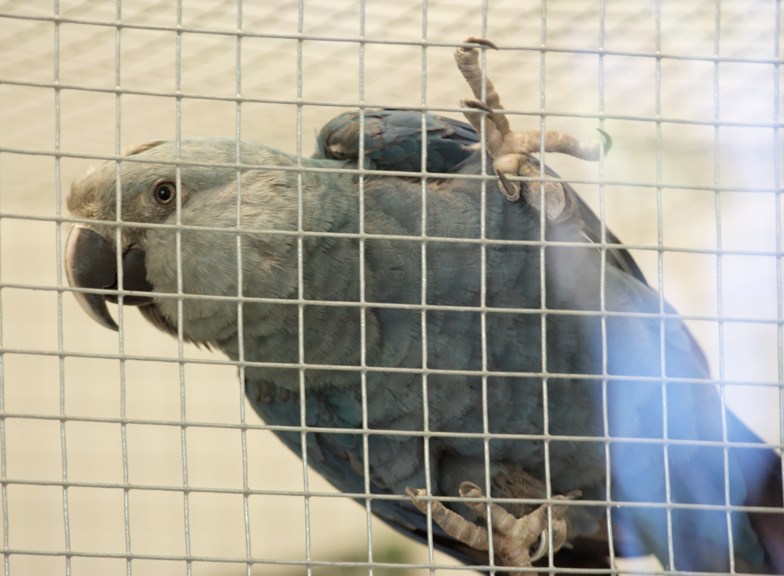
The species is endemic to northeastern Bahia, Brazil. It is distinguished by predominantly dark metallic-blue plumage with a faint green tinge and pale-yellow skin beside the base of its beak.
Written 26 November 2026 from the sources listed below. Each statement was checked against the passage it cites; statements that could not be supported were removed.
Appearance
Lear's Macaw has predominantly dark metallic-blue plumage with a faint green tinge on its body, tail and wings. Its head is slightly paler.[1]
It has pale-yellow skin beside the base of its beak and orange-yellow eye rings. Its large beak is blackish, and its feet are dark grey.[2][3]
Habitat
Lear's Macaw inhabits dry, desert-like shrubby vegetation known as caatinga. It requires pre-existing natural cavities in sandstone cliffs for nesting.[4][5]
The species is endemic to northeastern Bahia, Brazil. Two known colonies occur at Toca Velha and Serra Branca, south of the Raso da Catarina plateau in northeastern Bahia.[6][7]
It has been recorded in the municipalities of Campo Formoso, Canudos, Euclides da Cunha, Jeremoabo, Monte Santo, Novo Triunfo, Paulo Afonso, Santa Brígida and Sento Sé.[8]
Diet
Lear's Macaw primarily eats the nuts of the licuri palm, Syagrus coronata, consuming as many as 350 nuts daily.[9]
Its diet also includes seeds of Melanoxylon, Jatropha mollissima, Dioclea, Spondias tuberosa, Schinopsis brasiliensis and maize. It also feeds on Agave flowers.[10][11]
The species raids maize crops cultivated by local subsistence farmers.[12]
Behaviour
Lear's Macaw generally searches for food in groups. A flock selects a tall tree as a base from which to inspect potential feeding areas.[13][14]
A pair of birds initially descends to inspect the palms before returning to the flock's observation point.[15]
Reproduction and life cycle
The breeding season begins with the summer rains at the beginning of the year and continues until May. Young birds begin fledging and leaving their nests by May.[16][17]
A breeding pair lays two or three eggs per year. Egg incubation lasts approximately 29 days.[18][19]
The average number of surviving chicks per breeding pair is two. Young birds can remain with their parents for up to one year.[20][21]
Juveniles reach sexual maturity at approximately two to four years of age.[22]
Conservation
Lear's Macaw is listed as endangered and included in CITES Appendix I.[23]
The species faces habitat loss associated with agricultural development. Historical hunting and trapping for the aviary trade during the 1990s are also identified as threats.[24][25]
The Canudos Biological Station was established in 1991 to protect sandstone cliffs used by the species for roosting and nesting.[26]
A 2010 breeding-season survey recorded 114 nests and probable nests. Approximately 80 percent of monitored nests showed successful reproduction.[27][28]
Similar species
Lear's Macaw resembles the larger hyacinth macaw and the slightly smaller glaucous macaw.[29]
The hyacinth macaw differs through its darker plumage, absence of a greenish tinge and differently shaped yellow facial skin patch.[30]
The glaucous macaw has paler plumage and a greyer head than Lear's Macaw.[31]
Classification of the Lear's Macaw
| Kingdom | Animalia |
|---|---|
| Phylum | Chordata |
| Subphylum | Vertebrata |
| Infraphylum | Gnathostomata |
| Parvphylum | Osteichthyes |
| Megaclass | Tetrapoda |
| Class | Aves (Bird) |
| Order | Psittaciformes (Parrot) |
| Family | Psittacidae (Macaws) |
| Genus | Anodorhynchus (Blue Macaws) |
| Species | Anodorhynchus leari Bonaparte, 1856 |
Where the Lear's Macaw is found
Checklists and occurrence records place Anodorhynchus leari in 2 countries across South America. GBIF holds 898 georeferenced records of it.
Countries
Regions and cities with the most records
1 more country has a few records outside this range
These countries hold a few records of Anodorhynchus leari but lie outside the range the checklists give for it. Such records are often zoo or garden specimens, museum material or vagrants, so the species is not counted as occurring there.
Range as the checklists state it
South America
A number beside a place is its count of GBIF occurrence records. A place without a number comes from a checklist alone. Records show where a species has been observed or collected, which can include escapes and vagrants.
Common names
English
- Lear's Macaw
- Indigo Macaw
Names in 31 other languages
- Arabic
- ماكاو لير, ماكاو نيلي
- Bulgarian
- Ара Леара, Индигов ара
- Catalan
- guacamai de Lear
- Chinese
- 李爾氏金剛鸚鵡, 青蓝金刚鹦鹉, 靛藍麥鷍
- Croatian
- kobaltasta ara
- Czech
- ara kobaltový
- Danish
- Indigoara
- Dutch
- Lears Ara
- Esperanto
- Leara papago, indiga arao
- Estonian
- indigo-siniaara
- French
- Ara de Lear, Guhaa de Lear
- German
- Lear-Ara, Learara
- Hebrew
- ארת ענק ליר
- Hungarian
- kis jácintara, kobaltkék ara
- Italian
- Ara indaco
- Japanese
- コスミレコンゴウインコ
- Lithuanian
- mažoji mėlynoji ara
- Persian
- مکائو لیر
- Polish
- ara błękitna, modroara błękitna
- Portuguese
- arara-azul-de-lear, arara-azul-pequena, arara-índigo
- Russian
- Индиговый ара, Малый гиацинтовый ара
- Serbian
- Mala plava ara
- Slovak
- ara kobaltová
- Spanish
- Guacamaya añil, Guacamayo Cobalto, Guacamayo de Lear
- Tamil
- கருநீல ஐவண்ணக்கிளி
- Turkish
- Lear Arası
- Ukrainian
- ара синій
- Welsh
- macaw indigo
- mrj
- Изи гиацинт ара
- nav
- Shádiʼááhdę́ę́ʼ tsídii yáłtiʼí dootłʼizhgo bízdílidígíí
- pnb
- نیلا میکاع
Related species
-
 Hyacinth MacawAnodorhynchus hyacinthinus
-
 Glaucous MacawAnodorhynchus glaucus
-
 Spix's MacawCyanopsitta spixii
-
 Grey ParrotPsittacus erithacus
-
 Scarlet MacawAra macao
-
 Blue-and-yellow MacawAra ararauna
-
 Sun ConureAratinga solstitialis
-
 Green ParakeetPsittacara holochlorus
Compare
Questions and answers
What is the scientific name of the Lear's Macaw?
The scientific name of the Lear's Macaw is Anodorhynchus leari. Written with its author, the full name is Anodorhynchus leari Bonaparte, 1856.
Which family does the Lear's Macaw belong to?
Anodorhynchus leari belongs to the family Psittacidae, in the order Psittaciformes and the class Aves.
Where is the Lear's Macaw found?
Checklists and occurrence records place Anodorhynchus leari in 2 countries: Brazil and Argentina.
What is the conservation status of the Lear's Macaw?
The IUCN Red List category recorded for Anodorhynchus leari is Endangered (EN).
What other names does the Lear's Macaw have?
Anodorhynchus leari is also known in English as Indigo Macaw.
Why is the lear macaw endangered?
Lear's Macaw faces habitat loss associated with agricultural development. Historical hunting and trapping for the aviary trade during the 1990s are also identified as threats.[24][25]
Sources
Passages the profile rests on
- The species has predominantly dark metallic-blue plumage with a faint green tinge on its body, tail and wings, while its head is slightly paler. Source passage: “The body, tail, and wings are dark metallic blue with a faint, often barely visible, tinge of green, and the head is a slightly paler shade.” — English Wikipedia
- The species has pale-yellow skin beside the base of its beak and orange-yellow eye rings. Source passage: “It has an area of pale-yellow skin adjacent to the base of its beak, and orange-yellow eye rings.” — English Wikipedia
- The species has a large blackish beak and dark-grey feet. Source passage: “It has a large, blackish beak and dark grey feet.” — English Wikipedia
- The species inhabits dry, desert-like shrubby vegetation known as caatinga. Source passage: “It inhabits a dry desert-like shrubby environment known as caatinga” — English Wikipedia
- The species requires pre-existing natural cavities in sandstone cliffs for nesting. Source passage: “Lear's macaw also requires pre-existing natural cavities found in the sandstone cliffs in which to nest.” — English Wikipedia
- The species is endemic to northeastern Bahia, Brazil. Source passage: “Anodorhynchus leari is endemic to northeast Bahia, Brazil.” — datazone.birdlife.org
- Two known colonies occur at Toca Velha and Serra Branca, south of the Raso da Catarina plateau in northeastern Bahia. Source passage: “It is known from two colonies at locations known as Toca Velha and Serra Branca, south of the Raso da Catarina plateau in northeast Bahia.” — English Wikipedia
- The species has been recorded in the municipalities of Campo Formoso, Canudos, Euclides da Cunha, Jeremoabo, Monte Santo, Novo Triunfo, Paulo Afonso, Santa Brígida and Sento Sé. Source passage: “the municipalities of Campo Formoso, Canudos, Euclides da Cunha, Jeremoabo, Monte Santo, Novo Triunfo, Paulo Afonso, Santa Brígida and Sento Sé” — English Wikipedia
- The species primarily eats the nuts of the licuri palm, Syagrus coronata, consuming as many as 350 nuts daily. Source passage: “The primary diet of Lear's macaw are the nuts (as many as 350 per day) of the palm Syagrus coronata” — English Wikipedia
- The species also consumes seeds of Melanoxylon, Jatropha mollissima, Dioclea, Spondias tuberosa, Schinopsis brasiliensis and maize. Source passage: “the seeds of Melanoxylon, Jatropha mollissima, Dioclea, Spondias tuberosa, Schinopsis brasiliensis and Zea mays are also eaten” — English Wikipedia
- The species also feeds on Agave flowers. Source passage: “as well as the flowers of Agave.” — English Wikipedia
- The species raids maize crops cultivated by local subsistence farmers. Source passage: “their habit of raiding the plots of local subsistence farmers to consume maize (Zea mays).” — English Wikipedia
- The species generally searches for food in groups. Source passage: “The macaw usually forages in groups.” — English Wikipedia
- A flock selects a tall tree as a base from which to inspect potential feeding areas. Source passage: “A tall tree is selected by the flock as base to carefully inspect the feeding area.” — English Wikipedia
- A pair of birds initially descends to inspect the palms before returning to the flock's observation point. Source passage: “First a pair descends to the level of the palms to assess the suitability, the pair then returns to base” — English Wikipedia
- The breeding season begins with the summer rains at the beginning of the year and continues until May. Source passage: “The mating season starts at the beginning of the summer rains, at the start of the year, and extends up to May” — English Wikipedia
- Young birds begin fledging and leaving their nests by May. Source passage: “when the young begin to fledge and leave the nest.” — English Wikipedia
- A breeding pair lays two or three eggs per year. Source passage: “A pair of Lear's macaw lay two or three eggs per year.” — English Wikipedia
- Egg incubation lasts approximately 29 days. Source passage: “The eggs are incubated for approximately 29 days.” — English Wikipedia
- The average number of surviving chicks per breeding pair is two. Source passage: “the average survival rate is two per pair.” — English Wikipedia
- Young birds can remain with their parents for up to one year. Source passage: “The young remain with their parents for up to a year.” — English Wikipedia
- Juveniles reach sexual maturity at approximately two to four years of age. Source passage: “Juveniles reach sexual maturity around 2–4 years of age.” — English Wikipedia
- The species is listed as endangered and included in CITES Appendix I. Source passage: “This species is currently listed as an endangered species (CITES I).” — English Wikipedia
- The species faces habitat loss associated with agricultural development. Source passage: “reduction of food resources due to habitat loss caused by the historical expansion of agricultural development in the region” — English Wikipedia
- Historical hunting and trapping for the aviary trade during the 1990s are identified as threats to the species. Source passage: “As well as habitat loss, Lear's macaw may have historically suffered from hunting, and more recently, trapping for the aviary trade in the 1990s.” — English Wikipedia
- The Canudos Biological Station was established in 1991 to protect sandstone cliffs used by the species for roosting and nesting. Source passage: “Fundação Biodiversitas bought and created the Canudos Biological Station in 1991 to protect the sandstone cliffs of Toca Velha used by the macaws to roost and nest.” — English Wikipedia
- A 2010 breeding-season survey recorded 114 nests and probable nests. Source passage: “During the 2010 season, 114 nests and probable nests were counted.” — English Wikipedia
- Approximately 80 percent of monitored nests showed successful reproduction. Source passage: “Of the nests which were monitored, some 80% of the nests showed successful reproduction” — English Wikipedia
- The Lear's macaw resembles the larger hyacinth macaw and the slightly smaller glaucous macaw. Source passage: “Lear's macaw is similar to the larger hyacinth macaw and the slightly smaller glaucous macaw.” — English Wikipedia
- The hyacinth macaw differs from the Lear's macaw through its darker plumage, absence of a greenish tinge and differently shaped yellow facial skin patch. Source passage: “The hyacinth macaw can be distinguished by its darker plumage, lack of greenish tinge, and a differently shaped patch of yellow skin adjacent to the base of the bill.” — English Wikipedia
- The glaucous macaw has paler plumage and a greyer head than the Lear's macaw. Source passage: “The glaucous macaw is paler and has a more greyish head.” — English Wikipedia
Data
- Catalogue of Life, 2026-10-16 XR cc by
- Global Biodiversity Information Facility CC BY 4.0
- Wikidata CC0
- GeoNames CC BY 4.0
- Wikimedia Commons per image; credit shown with each image
- Within the Catalogue of Life, this name comes from The Integrated Taxonomic Information System cc0
References
- Peters, James L. (1937). Check-List of Birds of the World, Vol. 3.
- Dickinson, Edward C., ed. (2003). The Howard and Moore Complete Checklist of the Birds of the World, 3rd Edition.
- Gill, Frank, & and Minturn Wright. (2006). Birds of the World: Recommended English Names.
- Dickinson, E. C., and L. Christidis, eds. (2014). The Howard and Moore Complete Checklist of the Birds of the World, 4th Edition, Vol. 2 Passerines.
This species in other databases
Page built on 27 November 2026. See how the catalog is made and all sources and licences.
Cite this page
ScientificNames.org. (2026). Anodorhynchus leari (Lear's Macaw). Retrieved November 27, 2026, from https://scientificnames.org/species/anodorhynchus-leari
“Anodorhynchus leari (Lear's Macaw).” ScientificNames.org, 2026, scientificnames.org/species/anodorhynchus-leari. Accessed 27 Nov. 2026.
ScientificNames.org. “Anodorhynchus leari (Lear's Macaw).” Accessed November 27, 2026. https://scientificnames.org/species/anodorhynchus-leari.
@misc{scientificnames_anodorhynchus_leari_lears_macaw,
  author = {{ScientificNames.org}},
  title = {Anodorhynchus leari (Lear's Macaw)},
  year = {2026},
  url = {https://scientificnames.org/species/anodorhynchus-leari},
  note = {Accessed 2026-11-27}
}