Species · Reptiles
Allison's Anole Anolis allisoni
The scientific name of the Allison's Anole is Anolis allisoni. It is a species of reptile in the family Anolidae (anoles), order Squamata. The name dates from 1928.
- Scientific name
- Anolis allisoni Barbour, 1928
- Common name
- Allison's Anole
- Genus
- Anolis
- Family
- Anolidae (Anoles)
- Order
- Squamata
- Class
- Reptilia
- Red List category
- LC Least Concern
- Recorded in
- 5 countries
- Name status
- accepted in the Catalogue of Life

Overview
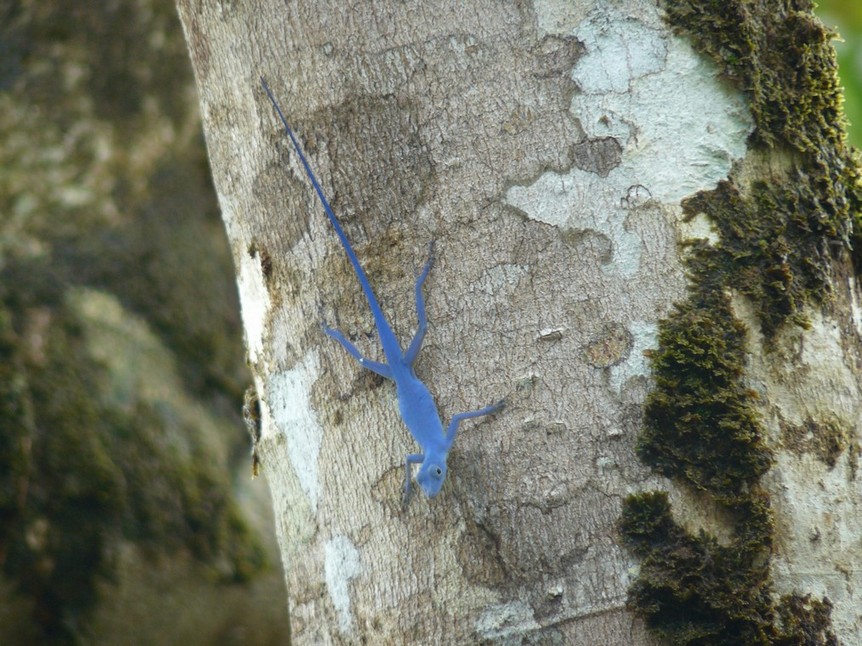
Anolis allisoni, also known commonly as Allison's anole or Cuban blue anole is a species of lizard in the family Dactyloidae. The species is endemic to Cuba (except the west and the far southeast), the Bay Islands and Cayos Cochinos off the mainland of Honduras, and Half Moon Caye off the mainland of Belize. There is also a single doubtful record from Cozumel, Mexico.
Classification of the Allison's Anole
| Kingdom | Animalia |
|---|---|
| Phylum | Chordata |
| Subphylum | Vertebrata |
| Infraphylum | Gnathostomata |
| Parvphylum | Osteichthyes |
| Megaclass | Tetrapoda |
| Class | Reptilia (Reptile) |
| Order | Squamata (Snakes) |
| Suborder | Iguania (Iguanas) |
| Family | Anolidae (Anoles) |
| Genus | Anolis (Anoles) |
| Species | Anolis allisoni Barbour, 1928 |
Where the Allison's Anole is found
Checklists and occurrence records place Anolis allisoni in 5 countries across North America. GBIF holds 1,971 georeferenced records of it.
Countries
Regions and cities with the most records
- Matanzas Province, Cuba 141
- Camagüey, Cuba 120
- Cienfuegos Province, Cuba 96
- Ciego de Ávila Province, Cuba 84
- Florida, United States 82
- Villa Clara Province, Cuba 75
- Granma Province, Cuba 64
- Holguín Province, Cuba 64
- Camagüey, Cuba 49
- Las Tunas Province, Cuba 49
- Sancti Spíritus Province, Cuba 49
- Cárdenas, Cuba 42
- Town 'n' Country, United States 42
- Tampa, United States 29
- Trinidad, Cuba 27
- Cienfuegos, Cuba 25
- Belize District, Belize 23
- Ciego de Ávila, Cuba 22
- Jobabo, Cuba 22
- Holguín, Cuba 20
- Bonita Springs, United States 19
- Morón, Cuba 13
- Santa Clara, Cuba 12
- Guanabacoa, Cuba 11
- Las Tunas, Cuba 11
- Regla, Cuba 11
- San Miguel del Padrón, Cuba 11
- San José de las Lajas, Cuba 10
- Palm Harbor, United States 9
- Sancti Spíritus, Cuba 9
- Bayamo, Cuba 8
- Cabaiguán, Cuba 7
- Jagüey Grande, Cuba 7
- Arroyo Naranjo, Cuba 6
- Fontanar, Cuba 6
- Jesús Menéndez, Cuba 6
Range as the checklists state it
Cuba, Honduras (Guanaja, Roatán, Cayos Cochinos), Belize, Islas de la Bahia, Mexico (Quintana Roo, Campeche)
A number beside a place is its count of GBIF occurrence records. A place without a number comes from a checklist alone. Records show where a species has been observed or collected, which can include escapes and vagrants.
Common names
English
- Allison's Anole
- Cuban Blue Anole
Names in 7 other languages
- Czech
- Anolis modrý
- Danish
- Cubansk Blå Anole
- German
- Allisons Anolis
- Italian
- Anolide di Allison
- Japanese
- アリソンアノール
- Russian
- Анолис Аллисона
- Spanish
- Abaniquillo de cabeza azul, Abanquillo de Allison, Anolis de cabeza azul, Lagartija de cabeza azul
Related species
-
 Green AnoleAnolis carolinensis
-
 Brown AnoleAnolis sagrei
-
 Knight AnoleAnolis equestris
-
 Crested AnoleAnolis cristatellus
-
 Western Bearded AnoleAnolis barbatus
- Water AnoleAnolis aquaticus
-
 Blue AnoleAnolis gorgonae
-
 Graham's AnoleAnolis grahami
Compare
Questions and answers
What is the scientific name of the Allison's Anole?
The scientific name of the Allison's Anole is Anolis allisoni. Written with its author, the full name is Anolis allisoni Barbour, 1928.
Which family does the Allison's Anole belong to?
Anolis allisoni belongs to the family Anolidae, in the order Squamata and the class Reptilia.
Where is the Allison's Anole found?
Checklists and occurrence records place Anolis allisoni in 5 countries: Cuba, Honduras, Mexico, United States and Belize.
What is the conservation status of the Allison's Anole?
The IUCN Red List category recorded for Anolis allisoni is Least Concern (LC).
What other names does the Allison's Anole have?
Anolis allisoni is also known in English as Cuban Blue Anole.
Sources
Data
- Catalogue of Life, 2026-10-16 XR cc by
- Global Biodiversity Information Facility CC BY 4.0
- Wikidata CC0
- English Wikipedia CC BY-SA 4.0
- GeoNames CC BY 4.0
- Wikimedia Commons per image; credit shown with each image
- Within the Catalogue of Life, this name comes from The Reptile Database cc by
References
- Barbour, T. (1928). Reptiles from the Bay Islands. Proc. New England Zool. Club 10: 55-61.
- Ruibal, R. (1961). Thermal relations of five species of tropical lizards. Evolution 15: 98-111.
- Ruibal, R. and Williams, E.E. (1961). Two sympatric Cuban anoles of the carolinensis group. Bull. Mus. Comp. Zool. Harvard 125 (7): 183-208.
- Ruibal, R. (1964). An annotated checklist and key to the anoline lizards of Cuba. Bull. Mus. Comp. Zool. Harvard 130 (8): 475-520.
- Ruibal, R., & Philibosian, R. (1970). Eurythermy and niche expansion in lizards. Copeia 1970 (4): 645-653.
- Wilson, L. D., & HAHN, D. E. (1973). The herpetofauna of the Islas de la Bahía, Honduras. Bulletin of the Florida State Museum 17: 93-150.
- Williams, E. E., & Rand, A. S. (1977). Species recognition, dewlap function and faunal size. American Zoologist 17: 261-270.
- Pérez-Beato, O., & Berovides Alvarez, V. (1986). Límites de variatión de la coloración en Anolis allisoni: éHibridación o polimorfismo? Poeyana (327): 1-5.
- Zimmerman, Linda C.; andC. Richard Tracy. (1989). Interactions between the Environment and Ectothermy and Herbivory in Reptiles. Physiological Zoology, 62(2): 374–409.
- Vergner, I., & Polak, P. (1990). Beobachtungen am Kuba-Rotkehlanolis, Anolis porcatus Gray, 1840 und Bemerkungen zu Anolis allisoni Barbour, 1928. Herpetofauna 12 (69): 6-10.
- Schwartz, A., & Henderson, R. W. (1991). Amphibians and Reptiles of the West Indies. University of Florida Press, Gainesville, 720 Pp.
- Liner, E. A. (1994). Scientific and common names for the Amphibians and Reptiles of Mexico in English and Spanish. Herpetological Circular 23: 1-113.
- Lee, J. C. (1996). The amphibians and reptiles of the Yucatán Peninsula. Comstock, Cornell University Press, Ithaca, 500 Pp.
- Nieto-Montes de Oca,A. et al. (1999). Geographic distribution: Anolis allisoni. Herpetological Review 30 (4): 233.
- Rodríguez Schettino, Lourdes (ed.). (1999). The iguanid lizards of Cuba. University Press of Florida, 428 Pp.
- Lee, J. C. (2000). A field guide to the amphibians and reptiles of the Maya world. Cornell University Press, Ithaca,.
- Köhler, G. (2000). Reptilien und Amphibien Mittelamerikas, Bd 1: Krokodile, Schildkröten, Echsen. Herpeton Verlag, Offenbach, 158 Pp.
- Van Beest, P. and Haberham, Z.L. (2003). Een gebruikaanwijzing voor één van de meest interssante groepen terrarumdieren: Anolissen Deel I. Lacerta 61 (2): 53-64.
- Poe, S. (2004). Phylogeny of anoles. Herpetological Monographs 18: 37-89.
- Kunz, K. (2005). Photogenic herpetofauna. Notes on Cuban Synanthropic species. Reptilia (GB) (43): 47-53.
- Losos, J. B. (2007). Detective Work in the West Indies: Integrating Historical and Experimental Approaches to Study Island Lizard Evolution. BioScience 57 (7): 585-597.
- Diener, E. (2008). Freilandbeobachtungen an einigen Saumfingerarten (Anolis sensu lato) in Honduras. Iguana Rundschreiben 21 (2): 10-19.
- Köhler, G. (2008). Reptiles of Central America. 2nd Ed. Herpeton-Verlag, 400 Pp.
- Losos, J. B. (2009). Lizards in an Evolutionary Tree: Ecology and Adaptive Radiation of Anoles. Berkeley: University of California Press, 528 Pp.
- Beolens, B., & Michael Watkins, a. M. G. (2011). The Eponym Dictionary of Reptiles. Johns Hopkins University Press, Baltimore, USA.
This species in other databases
Page built on 25 November 2026. See how the catalog is made and all sources and licences.
Cite this page
ScientificNames.org. (2026). Anolis allisoni (Allison's Anole). Retrieved November 25, 2026, from https://scientificnames.org/species/anolis-allisoni
“Anolis allisoni (Allison's Anole).” ScientificNames.org, 2026, scientificnames.org/species/anolis-allisoni. Accessed 25 Nov. 2026.
ScientificNames.org. “Anolis allisoni (Allison's Anole).” Accessed November 25, 2026. https://scientificnames.org/species/anolis-allisoni.
@misc{scientificnames_anolis_allisoni_allisons_anole,
  author = {{ScientificNames.org}},
  title = {Anolis allisoni (Allison's Anole)},
  year = {2026},
  url = {https://scientificnames.org/species/anolis-allisoni},
  note = {Accessed 2026-11-25}
}