Species · Amphibians
Sarisarinama Rocket Frog Anomaloglossus moffetti
The scientific name of the Sarisarinama Rocket Frog is Anomaloglossus moffetti. It is a species of amphibian in the family Aromobatidae (rocket frogs), order Anura. The name dates from 2008.
- Scientific name
- Anomaloglossus moffetti Barrio-Amorós & Brewer-Carias, 2008
- Common name
- Sarisarinama Rocket Frog
- Genus
- Anomaloglossus
- Family
- Aromobatidae (Rocket Frogs)
- Order
- Anura
- Class
- Amphibia
- Red List category
- NT Near Threatened
- Name status
- accepted in the Catalogue of Life
Overview
The Sarisarinama Rocket Frog (Anomaloglossus moffetti) is an amphibian in the family Aromobatidae, formally described in 2008 by Barrio-Amorós and Brewer-Carias. The species is endemic to Bolívar, Venezuela, and has been recorded exclusively within Jaua-Sarisariñama National Park. It has black flanks with silver-white spots, white or yellow stripes along its sides, and yellow or orange undersides.
Written 27 November 2026 from the sources listed below. Each statement was checked against the passage it cites; statements that could not be supported were removed.
Appearance
The frog has black flanks with silver-white spots, sometimes bordered by brown-orange stripes. A white or yellow stripe runs along each side of its body.[1][2]
The skin beneath each eye is light brown or orange, and the upper lip has small blue spots.[3][4]
Adult females can reach 26.9 mm in snout-vent length.[5]
Habitat
The species has been found in cascading streams and in the spray zones of waterfalls. It has been recorded on the Sarisariñama-tepui flatland at 1,108 meters above sea level.[6][7][8]
The species has been recorded exclusively within Jaua-Sarisariñama National Park. It is endemic to Bolívar, Venezuela, and is suspected to occur in Brazil.[9][10][11]
Reproduction and life cycle
Tadpoles of this species have not been observed by scientists. Scientists infer that the tadpoles develop in streams and are thought to swim there.[12][13][14]
Conservation
Climate change is identified as a principal threat to the species. It may directly alter temperature and humidity, while climate-related changes to vegetation on the tepui are also considered a threat.[15][16][17]
The species would have difficulty migrating to a new range if its current habitat changes. Fungal, bacterial, and viral diseases can kill this species.[18][19]
Classification of the Sarisarinama Rocket Frog
| Kingdom | Animalia |
|---|---|
| Phylum | Chordata |
| Subphylum | Vertebrata |
| Infraphylum | Gnathostomata |
| Parvphylum | Osteichthyes |
| Megaclass | Tetrapoda |
| Class | Amphibia (Amphibians) |
| Order | Anura (Frogs) |
| Superfamily | Dendrobatoidea |
| Family | Aromobatidae (Rocket Frogs) |
| Subfamily | Anomaloglossinae |
| Genus | Anomaloglossus |
| Species | Anomaloglossus moffetti Barrio-Amorós & Brewer-Carias, 2008 |
Common names
English
- Sarisarinama Rocket Frog
- Sarisariñama Rocket Frog
Names in 1 other language
- Spanish
- Sapito Niñera de Sarisariñama, Sapito ninera de Sarisarinama
Related species
-
 Beebe's Rocket FrogAnomaloglossus beebei
-
 Eastern Tepui Rocket FrogAnomaloglossus roraima
-
 Guiana Rocket FrogAnomaloglossus baeobatrachus
-
 Stephen's Rocket FrogAnomaloglossus stepheni
-
 Kaie Rock FrogAnomaloglossus kaiei
-
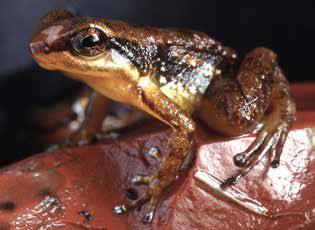 Cueva Del Fantasma Rocket FrogAnomaloglossus breweri
-
 La Escalera Rocket FrogAnomaloglossus parkerae
-
 Degranville's Rocket FrogAnomaloglossus degranvillei
Compare
Questions and answers
What is the scientific name of the Sarisarinama Rocket Frog?
The scientific name of the Sarisarinama Rocket Frog is Anomaloglossus moffetti. Written with its author, the full name is Anomaloglossus moffetti Barrio-Amorós & Brewer-Carias, 2008.
Which family does the Sarisarinama Rocket Frog belong to?
Anomaloglossus moffetti belongs to the family Aromobatidae, in the order Anura and the class Amphibia.
What is the conservation status of the Sarisarinama Rocket Frog?
The IUCN Red List category recorded for Anomaloglossus moffetti is Near Threatened (NT).
What other names does the Sarisarinama Rocket Frog have?
Anomaloglossus moffetti is also known in English as Sarisariñama Rocket Frog.
Sources
Passages the profile rests on
- The frog has black flanks with silver-white spots, sometimes bordered by brown-orange stripes. Source passage: “The flanks are black with silver-white spots, sometimes bordered by brown-orange stripes.” — English Wikipedia
- The frog has a white or yellow stripe along each side of its body. Source passage: “There is a white or yellow stripe on each side of the body.” — English Wikipedia
- The skin beneath each eye is light brown or orange. Source passage: “There is light brown or orange color under each eye.” — English Wikipedia
- The upper lip has small blue spots. Source passage: “There are small blue spots on the upper lip.” — English Wikipedia
- Adult females can reach 26.9 mm in snout-vent length. Source passage: “The adult female frog can reach 26.9 mm in snout-vent length.” — English Wikipedia
- The species has been found in cascading streams. Source passage: “This has been found in cascading streams and in the spray areas of waterfalls.” — English Wikipedia
- The species has been found in the spray zones of waterfalls. Source passage: “in the spray areas of waterfalls.” — English Wikipedia
- The species has been recorded on the Sarisariñama-tepui flatland at 1,108 meters above sea level. Source passage: “It was found on the Sarisariñama-tepui flatland 1108 meters above sea level.” — English Wikipedia
- The species has been recorded exclusively within Jaua-Sarisariñama National Park. Source passage: “The frog was found exclusively within Jaua-Sarisariñama National Park.” — English Wikipedia
- The species is endemic to Bolívar, Venezuela. Source passage: “It is endemic to Bolivar, Venezuela” — English Wikipedia
- The species is suspected to occur in Brazil. Source passage: “and suspected in Brazil.” — English Wikipedia
- Tadpoles of this species have not been observed by scientists. Source passage: “Scientists have not reported any observations of the tadpoles” — English Wikipedia
- Scientists infer that the tadpoles develop in streams. Source passage: “but they infer that they develop in streams, like their congeners.” — English Wikipedia
- The species is thought to have tadpoles that swim in streams, although none have been observed. Source passage: “Scientists think that the tadpoles swim in streams, but they did not see them.” — simple.wikipedia.org
- Climate change is identified as a principal threat to the species. Source passage: “Scientists cite climate change as a principal threat” — English Wikipedia
- Climate change may threaten the species by directly altering temperature and humidity. Source passage: “both in its ability to change temperatures and humidity directly” — English Wikipedia
- Climate-related changes to vegetation on the tepui are considered a threat to the species. Source passage: “and in changes to the plants on the tepui.” — English Wikipedia
- The species would have difficulty migrating to a new range if its current habitat changes. Source passage: “the frog would have great difficulty migrating to a new range if its current habitat should change.” — English Wikipedia
- Fungal, bacterial, and viral diseases can kill this species. Source passage: “Diseases from fungi, bacteria, and viruses can also kill this frog.” — English Wikipedia
- The species was formally described in 2008 by Barrio-Amorós and Brewer-Carias. Source passage: “Anomaloglossus moffettiBarrio-Amorós and Brewer-Carias, 2008” — simple.wikipedia.org
- The species belongs to the frog family Aromobatidae. Source passage: “Anomaloglossus moffetti, the Sarisariñama rocket frog, is a species of frog in the family Aromobatidae.” — English Wikipedia
Data
- Catalogue of Life, 2026-10-16 XR cc by
- Wikidata CC0
- Within the Catalogue of Life, this name comes from The Integrated Taxonomic Information System cc0
References
- Herpetological results of the 2002 expedition to Sarisarinama, a tepui in Venezuelan Guayana, with the description of five new species. (2008). Zootaxa, 1942, 1–68. https://doi.org/10.11646/zootaxa.1942.1.1 Link where the name was published
This species in other databases
Page built on 29 November 2026. See how the catalog is made and all sources and licences.
Cite this page
ScientificNames.org. (2026). Anomaloglossus moffetti (Sarisarinama Rocket Frog). Retrieved November 29, 2026, from https://scientificnames.org/species/anomaloglossus-moffetti
“Anomaloglossus moffetti (Sarisarinama Rocket Frog).” ScientificNames.org, 2026, scientificnames.org/species/anomaloglossus-moffetti. Accessed 29 Nov. 2026.
ScientificNames.org. “Anomaloglossus moffetti (Sarisarinama Rocket Frog).” Accessed November 29, 2026. https://scientificnames.org/species/anomaloglossus-moffetti.
@misc{scientificnames_anomaloglossus_moffetti_sarisarinama_rocket_frog,
  author = {{ScientificNames.org}},
  title = {Anomaloglossus moffetti (Sarisarinama Rocket Frog)},
  year = {2026},
  url = {https://scientificnames.org/species/anomaloglossus-moffetti},
  note = {Accessed 2026-11-29}
}