Species · Amphibians
Cerro Sipapo Rocket Frog Anomaloglossus wothuja
The scientific name of the Cerro Sipapo Rocket Frog is Anomaloglossus wothuja. It is a species of amphibian in the family Aromobatidae (rocket frogs), order Anura. The name dates from 2004.
- Scientific name
- Anomaloglossus wothuja (Barrio-Amorós, Fuentes-Ramos & Rivas-Fuenmayor, 2004)
- Common name
- Cerro Sipapo Rocket Frog
- Genus
- Anomaloglossus
- Family
- Aromobatidae (Rocket Frogs)
- Order
- Anura
- Class
- Amphibia
- Red List category
- LC Least Concern
- Name status
- accepted in the Catalogue of Life

Overview
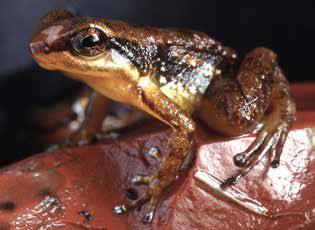
Anomaloglossus wothuja is endemic to Venezuela and is known only from its type locality at the base of Cerro Sipapo in Amazonas state. It has dark brown dorsal coloration, black flanks, a white oblique lateral stripe and a yellowish throat, chest and belly.
Written 27 November 2026 from the sources listed below. Each statement was checked against the passage it cites; statements that could not be supported were removed.
Similar species
Anomaloglossus verbeeksnyderorum is not genetically distinct from A. wothuja, although the two taxa exhibit subtle morphological differences.[1]
Appearance
The snout slopes and is pointed in profile, but nearly truncate in both dorsal and ventral views. The tympanum is distinct but partly hidden by the supratympanic fold.[2][3]
The fingers have small terminal discs and keel-like fringes. The toes have fringes and are partially webbed.[4][5]
The dorsal coloration is dark brown, with black flanks and a white oblique lateral stripe. A bright white spot occurs below the tympanic area, and the axilla is white.[6][7]
The throat, chest and belly are yellowish, while the lower arms and hind limbs are greyish. Some finger discs are white, the upper lip is dirty white, and the iris is bronze.[8][9]
Habitat
The species inhabits medium to tall evergreen forest at elevations of 150–200 m above sea level. Individuals have been found on large rocks along stream banks.[10][11]
Tadpoles have been collected from a small pool beside a stream.[12]
Reproduction and life cycle
A male was observed carrying two tadpoles on its back, both at Gosner stage 25. Tadpoles collected from a pool beside a stream were at Gosner stages 31–40.[13][14]
Conservation
The threats facing this species are unknown. It is not known to occur in any protected area.[15][16]
Classification of the Cerro Sipapo Rocket Frog
| Kingdom | Animalia |
|---|---|
| Phylum | Chordata |
| Subphylum | Vertebrata |
| Infraphylum | Gnathostomata |
| Parvphylum | Osteichthyes |
| Megaclass | Tetrapoda |
| Class | Amphibia (Amphibians) |
| Order | Anura (Frogs) |
| Superfamily | Dendrobatoidea |
| Family | Aromobatidae (Rocket Frogs) |
| Subfamily | Anomaloglossinae |
| Genus | Anomaloglossus |
| Species | Anomaloglossus wothuja (Barrio-Amorós, Fuentes-Ramos & Rivas-Fuenmayor, 2004) |
Common names
English
- Cerro Sipapo Rocket Frog
Synonyms
One other scientific name has been used for this species and is now treated as a synonym of Anomaloglossus wothuja.
- Colostethus wothuja Barrio-Amorós, Fuentes-Ramos & Rivas-Fuenmayor, 2004
Related species
-
 Beebe's Rocket FrogAnomaloglossus beebei
-
 Eastern Tepui Rocket FrogAnomaloglossus roraima
-
 Guiana Rocket FrogAnomaloglossus baeobatrachus
-
 Stephen's Rocket FrogAnomaloglossus stepheni
-
 Kaie Rock FrogAnomaloglossus kaiei
-
 Cueva Del Fantasma Rocket FrogAnomaloglossus breweri
-
 La Escalera Rocket FrogAnomaloglossus parkerae
-
 Degranville's Rocket FrogAnomaloglossus degranvillei
Compare
Questions and answers
What is the scientific name of the Cerro Sipapo Rocket Frog?
The scientific name of the Cerro Sipapo Rocket Frog is Anomaloglossus wothuja. Written with its author, the full name is Anomaloglossus wothuja (Barrio-Amorós, Fuentes-Ramos & Rivas-Fuenmayor, 2004).
Which family does the Cerro Sipapo Rocket Frog belong to?
Anomaloglossus wothuja belongs to the family Aromobatidae, in the order Anura and the class Amphibia.
What is the conservation status of the Cerro Sipapo Rocket Frog?
The IUCN Red List category recorded for Anomaloglossus wothuja is Least Concern (LC).
Where does the striped rocket frog live?
The Cerro Sipapo Rocket Frog is endemic to Venezuela and is known only from its type locality at the base of Cerro Sipapo in Amazonas state. A documented locality is the base of Cerro Sipapo at Tobogán del Cuao in Amazonas state, Venezuela, at an elevation of 150 m.[17][18]
Sources
Passages the profile rests on
- Anomaloglossus verbeeksnyderorum is not genetically distinct from A. wothuja, although the two taxa exhibit subtle morphological differences. Source passage: “Anomaloglossus verbeeksnyderorum Barrio-Amorós, Santos, and Jovanovic, 2010 is not genetically distinct from Anomaloglossus wothuja, but these species show subtle morphological differences.” — English Wikipedia
- The species has a sloping snout that is pointed in profile and nearly truncate in both dorsal and ventral views. Source passage: “The snout sloping, pointed in profile, and nearly truncate in both dorsal and ventral profile.” — English Wikipedia
- The tympanum is distinct but partly hidden by the supratympanic fold. Source passage: “The tympanum is distinct but partly concealed by the supratympanic fold.” — English Wikipedia
- The fingers have small terminal discs and keel-like fringes. Source passage: “The fingers bear small terminal discs and keel-like fringes.” — English Wikipedia
- The toes have fringes and are partially webbed. Source passage: “The toes have fringes and are partially webbed.” — English Wikipedia
- The dorsal coloration is dark brown, with black flanks and a white oblique lateral stripe. Source passage: “Dorsal coloration is dark brown, with black flanks and a white, oblique lateral stripe.” — English Wikipedia
- A bright white spot occurs below the tympanic area, and the axilla is white. Source passage: “There is a bright white spot below tympanic area. The axilla is white.” — English Wikipedia
- The throat, chest and belly are yellowish, while the lower arms and hind limbs are greyish. Source passage: “Throat, chest and belly yellowish, lower arms, and hind limbs are greyish.” — English Wikipedia
- Some finger discs are white, the upper lip is dirty white, and the iris is bronze. Source passage: “Some finger discs are white. The upper lip is dirty white. The iris is bronze.” — English Wikipedia
- The species inhabits medium to tall evergreen forest at elevations of 150–200 m above sea level. Source passage: “Anomaloglossus wothuja is known from medium to tall evergreen forest at elevations of 150–200 m (490–660 ft) above sea level.” — English Wikipedia
- Individuals have been found on large rocks along stream banks. Source passage: “Individuals were found on large rocks on the bank of a stream.” — English Wikipedia
- Tadpoles have been collected from a small pool beside a stream. Source passage: “Tadpoles collected from a small pool beside a stream were of Gosner stages 31–40.” — English Wikipedia
- A male was observed carrying two tadpoles on its back, both at Gosner stage 25. Source passage: “The male was found carrying two tadpoles in Gosner stage 25 on its back.” — English Wikipedia
- Tadpoles collected from a pool beside a stream were at Gosner stages 31–40. Source passage: “Tadpoles collected from a small pool beside a stream were of Gosner stages 31–40.” — English Wikipedia
- The threats facing this species are unknown. Source passage: “Threats to this species are unknown.” — English Wikipedia
- The species is not known to occur in any protected area. Source passage: “It is not known to occur in any protected areas.” — English Wikipedia
- The species is endemic to Venezuela and is known only from its type locality at the base of Cerro Sipapo in Amazonas state. Source passage: “It is endemic to Venezuela and is only known from its type locality, the base of Cerro Sipapo, in the Amazonas state.” — English Wikipedia
- A documented locality is the base of Cerro Sipapo at Tobogán del Cuao in Amazonas state, Venezuela, at an elevation of 150 m. Source passage: “Anomaloglossus wothuja—VENEZUELA: Estado Amazonas, base of Cerro Sipapo, Tobogán del Cuao (5°5'9” N, 67°27'7” W), elev. 150 m” — academia.edu
Data
- Catalogue of Life, 2026-10-16 XR cc by
- Wikidata CC0
- Wikimedia Commons per image; credit shown with each image
- Within the Catalogue of Life, this name comes from The Integrated Taxonomic Information System cc0
References
- Barrio-Amoros CL, Fuentes O, Rivas G. 2004. Two new species of Colostethus (Anura, Dendrobatidae) from Venezuelan Guayana. Salamandra 40: 183 - 200. where the name was published
This species in other databases
Page built on 29 November 2026. See how the catalog is made and all sources and licences.
Cite this page
ScientificNames.org. (2026). Anomaloglossus wothuja (Cerro Sipapo Rocket Frog). Retrieved November 29, 2026, from https://scientificnames.org/species/anomaloglossus-wothuja
“Anomaloglossus wothuja (Cerro Sipapo Rocket Frog).” ScientificNames.org, 2026, scientificnames.org/species/anomaloglossus-wothuja. Accessed 29 Nov. 2026.
ScientificNames.org. “Anomaloglossus wothuja (Cerro Sipapo Rocket Frog).” Accessed November 29, 2026. https://scientificnames.org/species/anomaloglossus-wothuja.
@misc{scientificnames_anomaloglossus_wothuja_cerro_sipapo_rocket_frog,
  author = {{ScientificNames.org}},
  title = {Anomaloglossus wothuja (Cerro Sipapo Rocket Frog)},
  year = {2026},
  url = {https://scientificnames.org/species/anomaloglossus-wothuja},
  note = {Accessed 2026-11-29}
}