Species · Reptiles
Leonard's Pipe Snake Anomochilus leonardi
The scientific name of the Leonard's Pipe Snake is Anomochilus leonardi. It is a species of reptile in the family Anomochilidae (dwarf pipe snakes), order Squamata. The name dates from 1940.
- Scientific name
- Anomochilus leonardi Smith, 1940
- Common name
- Leonard's Pipe Snake
- Genus
- Anomochilus
- Family
- Anomochilidae (Dwarf Pipe Snakes)
- Order
- Squamata
- Class
- Reptilia
- Red List category
- LC Least Concern
- Recorded in
- 1 country
- Name status
- accepted in the Catalogue of Life
Overview
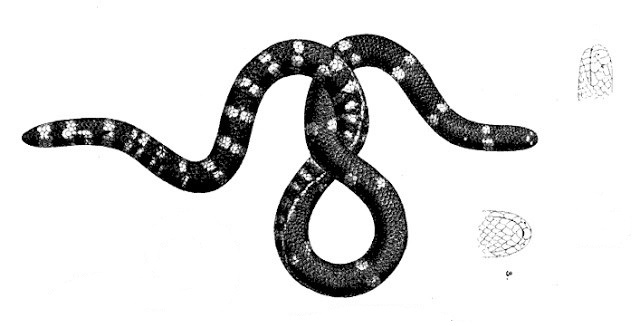
Anomochilus leonardi has a glossy black to purplish-brown upper body with two rows of elliptical yellow spots along the sides of its vertebral scales.
Written 26 November 2026 from the sources listed below. Each statement was checked against the passage it cites; statements that could not be supported were removed.
Appearance
Its back has two rows of elliptical yellow spots along the sides of the vertebral scales. It also has a yellow bar across its snout and a large red patch on its subcaudal scales.[1][2]
Its dorsal scales are smooth and slightly larger than those on its underside. It has either 17 or 19 rows of scales around the middle of its body, excluding the ventral scales, between 214 and 252 midventral scales, and between six and seven subcaudal scales.[3][4][5][6]
Its maximum recorded snout-to-vent length is 390 mm.[7]
Habitat
Leonard's Pipe Snake inhabits primary and mature secondary dipterocarp forests. It occurs in forested plains and hills, mostly in riparian areas near streams and rivers.[8][9][10]
It generally occurs at elevations around 250 metres, with some specimens recorded at elevations up to 500 metres.[11]
Diet
Its suspected diet includes earthworms and may also include small vertebrates such as snakes and legless lizards.[12][13]
Reproduction and life cycle
The reproductive habits of Leonard's Pipe Snake have not been studied. Other species in the genus Anomochilus are known to lay eggs.[14][15]
Conservation
Leonard's Pipe Snake is classified as Least Concern by the International Union for Conservation of Nature. Its presence in protected areas is one reason for this classification.[16][17]
Recorded protected areas include Ulu Gombak Forest Reserve and Taman Negara National Park.[18]
Similar species
Leonard's Pipe Snake differs from Anomochilus weberi by lacking pale lateral stripes and having an unpaired parietofrontal scale.[19]
It differs from Anomochilus monticola by having pale patches bordering its vertebral scales. It also has fewer midventral scales than Anomochilus monticola, which has between 258 and 261.[20][21]
Classification of the Leonard's Pipe Snake
| Kingdom | Animalia |
|---|---|
| Phylum | Chordata |
| Subphylum | Vertebrata |
| Infraphylum | Gnathostomata |
| Parvphylum | Osteichthyes |
| Megaclass | Tetrapoda |
| Class | Reptilia (Reptile) |
| Order | Squamata (Snakes) |
| Suborder | Serpentes (Snakes) |
| Infraorder | Alethinophidia |
| Family | Anomochilidae (Dwarf Pipe Snakes) |
| Genus | Anomochilus (Dwarf Pipesnakes) |
| Species | Anomochilus leonardi Smith, 1940 |
Where the Leonard's Pipe Snake is found
Checklists and occurrence records place Anomochilus leonardi in 1 country. GBIF holds 4 georeferenced records of it.
Countries
Range as the checklists state it
W Malaysia, Borneo (Sabah)
A number beside a place is its count of GBIF occurrence records. A place without a number comes from a checklist alone. Records show where a species has been observed or collected, which can include escapes and vagrants.
Common names
English
- Leonard's Pipe Snake
- Leonard's Burrowing Snake
- Malayan Giant Blind Snake
Names in 3 other languages
- Chinese
- 李奧拿氏倭管蛇
- German
- Leonards Wuhlschlange, Leonards Wühlschlange
- Hungarian
- Leonard-hengereskígyó
Related species

Compare
Questions and answers
What is the scientific name of the Leonard's Pipe Snake?
The scientific name of the Leonard's Pipe Snake is Anomochilus leonardi. Written with its author, the full name is Anomochilus leonardi Smith, 1940.
Which family does the Leonard's Pipe Snake belong to?
Anomochilus leonardi belongs to the family Anomochilidae, in the order Squamata and the class Reptilia.
Where is the Leonard's Pipe Snake found?
Checklists and occurrence records place Anomochilus leonardi in 1 country: Malaysia.
What is the conservation status of the Leonard's Pipe Snake?
The IUCN Red List category recorded for Anomochilus leonardi is Least Concern (LC).
What other names does the Leonard's Pipe Snake have?
Anomochilus leonardi is also known in English as Leonard's Burrowing Snake and Malayan Giant Blind Snake.
Sources
Passages the profile rests on
- Its back has two rows of elliptical yellow spots along the sides of the vertebral scales. Source passage: “The back has two rows of elliptical yellow spots along the sides of vertebral scales” — English Wikipedia
- It has a yellow bar across its snout and a large red patch on its subcaudal scales. Source passage: “there is a yellow bar across the snout and a large red patch on the subcaudal scales.” — English Wikipedia
- Its dorsal scales are smooth and slightly larger than those on its underside. Source passage: “The dorsum is smooth, with slightly larger scales than the underside.” — English Wikipedia
- It has either 17 or 19 rows of scales around the middle of its body, excluding the ventral scales. Source passage: “A. leonardi has 17 or 19 rows of scales (excluding ventral scales) in the middle of the body.” — English Wikipedia
- It has between 214 and 252 midventral scales. Source passage: “It has 214–252 midventral scales” — English Wikipedia
- It has between six and seven subcaudal scales. Source passage: “and 6–7 subcaudal scales” — English Wikipedia
- Its maximum recorded snout-to-vent length is 390 mm. Source passage: “It has a snout–vent length of up to 390 mm (15 in).” — English Wikipedia
- It inhabits primary and mature secondary dipterocarp forests. Source passage: “It inhabits primary and mature secondary dipterocarp forests” — English Wikipedia
- It occurs in forested plains and hills. Source passage: “It inhabits primary and mature secondary dipterocarp forests in plains and hills” — English Wikipedia
- It is mostly recorded in riparian areas near streams and rivers. Source passage: “It is mostly known from riparian areas near streams and rivers” — English Wikipedia
- It generally occurs at elevations around 250 metres, with some specimens recorded at elevations up to 500 metres. Source passage: “usually at altitudes of around 250 m (820 ft), although some specimens have been collected from as high as 500 m (1,600 ft).” — English Wikipedia
- Its suspected diet includes earthworms. Source passage: “the snake feeds on elongate invertebrates like earthworms” — English Wikipedia
- Its suspected diet may include small vertebrates such as snakes and legless lizards. Source passage: “and perhaps on small, slim vertebrates like snakes and legless lizards.” — English Wikipedia
- The reproductive habits of this species have not been studied. Source passage: “Reproduction in the species has not been studied” — English Wikipedia
- Other species in the genus Anomochilus are known to lay eggs. Source passage: “other Anomochilus are known to lay eggs” — English Wikipedia
- The species is classified as Least Concern by the International Union for Conservation of Nature. Source passage: “The species is currently classified as being of least concern by the International Union for Conservation of Nature” — English Wikipedia
- Its presence in protected areas is one reason for its Least Concern classification. Source passage: “as it is known to inhabit nature reserves and its range is likely larger than currently known.” — English Wikipedia
- Recorded protected areas include Ulu Gombak Forest Reserve and Taman Negara National Park. Source passage: “It is known from the protected areas of Ulu Gombak Forest Reserve and Taman Negara National Park.” — English Wikipedia
- The species differs from Anomochilus weberi by lacking pale lateral stripes and having an unpaired parietofrontal scale. Source passage: “It differs from A. weberi in lacking pale stripes along its sides and having an unpaired parietofrontal scale on the forehead.” — English Wikipedia
- The species differs from Anomochilus monticola by having pale patches bordering its vertebral scales. Source passage: “It can be distinguished from A. monticola by the presence of pale patches bordering the vertebral scales” — English Wikipedia
- Anomochilus leonardi has fewer midventral scales than Anomochilus monticola, which has between 258 and 261. Source passage: “monticola has 258–261, compared to 214–252 for leonardi” — English Wikipedia
Data
- Catalogue of Life, 2026-10-16 XR cc by
- Global Biodiversity Information Facility CC BY 4.0
- Wikidata CC0
- GeoNames CC BY 4.0
- Within the Catalogue of Life, this name comes from The Reptile Database cc by
References
- Smith, M. A. (1940). A new snake of the genus Anomochilus from the Malay Peninsula. Ann. Mag. Nat. Hist. (6) 35: 447-449.
- Cundall, D., Wallach, V., & Rossman, D. A. (1993). The systematic relationships of the snake genus Anomochilus. Zool. J. Linnean Soc. 109: 275-299.
- Stuebing R B, & Goh R. (1993). A new record of Leonard’s pipe snake, Anomochilus leonardi Smith (Serpentes: Uropeltidae: Cylindrophinae) from Sabah, northwestern Borneo. Raffles Bull. Zool. 41 (2): 311-314.
- Manthey, U., & Grossmann, W. (1997). Amphibien & Reptilien Südostasiens. Natur Und Tier Verlag (Münster), 512 Pp. (ISBN 3-931587-12-6).
- McDiarmid, R.W.; Campbell, J.A. & Touré,T.A. (1999). Snake species of the world. Vol. 1. [type catalogue]. Herpetologists’ League, 511 Pp.
- Yaakob, N. S. (2003). A record of Anomochilus leonardi Smith, 1940 (Anomochilidae) from Peninsular Malaysia. Hamadryad 27 (2):285-286.
- Gower, D. J., Vidal, N., Spinks, J. N., & and McCarthy, C. J. (2005). The phylogenetic position of Anomochilidae (Reptilia: Serpentes): first evidence from DNA sequences. Journal of Zoological Systematics and Evolutionary Research 43(4):315-320.
- Das, Indraneil; Maklarin Lakim, Kelvin K.P. Lim, and Tan Heok Hui. (2008). New Species of Anomochilus from Borneo (Squamata: Anomochilidae). Journal of Herpetology 42 (3): 584-591.
- Beolens, B., & Michael Watkins, a. M. G. (2011). The Eponym Dictionary of Reptiles. Johns Hopkins University Press, Baltimore, USA.
- Seung Hoon, & Cha. (2012). Snake, the world most beautifull curve [in Korean]. Hownext, 304 Pp. [ISBN 978-89-965656-7-3].
- Wallach, Van; Kenneth L. Williams, Jeff Boundy. (2014). Snakes of the World: A Catalogue of Living and Extinct Species. [type catalogue]. Taylor and Francis, CRC Press, 1237 Pp.
- Stuebing, R. B., Inger, R. F., & Lardner, B. (2014). A field guide to the snakes of Borneo, second edition. Natural History Publications (Borneo).
This species in other databases
Page built on 28 November 2026. See how the catalog is made and all sources and licences.
Cite this page
ScientificNames.org. (2026). Anomochilus leonardi (Leonard's Pipe Snake). Retrieved November 28, 2026, from https://scientificnames.org/species/anomochilus-leonardi
“Anomochilus leonardi (Leonard's Pipe Snake).” ScientificNames.org, 2026, scientificnames.org/species/anomochilus-leonardi. Accessed 28 Nov. 2026.
ScientificNames.org. “Anomochilus leonardi (Leonard's Pipe Snake).” Accessed November 28, 2026. https://scientificnames.org/species/anomochilus-leonardi.
@misc{scientificnames_anomochilus_leonardi_leonards_pipe_snake,
  author = {{ScientificNames.org}},
  title = {Anomochilus leonardi (Leonard's Pipe Snake)},
  year = {2026},
  url = {https://scientificnames.org/species/anomochilus-leonardi},
  note = {Accessed 2026-11-28}
}