Species · Reptiles
Weber's Cylinder Snake Anomochilus weberi
The scientific name of the Weber's Cylinder Snake is Anomochilus weberi. It is a species of reptile in the family Anomochilidae (dwarf pipe snakes), order Squamata. The name dates from 1890.
- Scientific name
- Anomochilus weberi (Lidth de Jeude, 1890)
- Common name
- Weber's Cylinder Snake
- Genus
- Anomochilus
- Family
- Anomochilidae (Dwarf Pipe Snakes)
- Order
- Squamata
- Class
- Reptilia
- Red List category
- DD Data Deficient
- Recorded in
- 1 country
- Name status
- accepted in the Catalogue of Life
Overview
Anomochilus weberi occurs on the Greater Sunda Islands of Sumatra and Borneo. It is distinguished from other members of its genus by its small size, pale lateral stripes and dorsal blotches.
Written 26 November 2026 from the sources listed below. Each statement was checked against the passage it cites; statements that could not be supported were removed.
Appearance
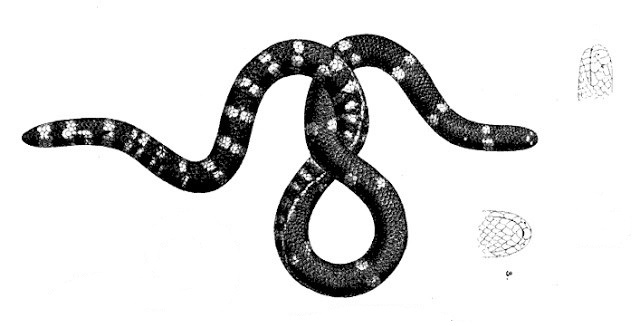
Weber's Cylinder Snake has a stout, cylindrical body, a small head and a short, conical tail. Its coloration is predominantly black, with pale lateral stripes and pale blotches bordering its vertebral scales.[1][2]
The underside is completely black. The prefrontal and anal scales are whitish, and a whitish band forms a half-ring around the underside of the tail.[3][4][5]
Preservation in alcohol changes its coloration to mainly brown. It has 19 rows of scales around the middle of its body, excluding ventral scales, 242–248 midventral scales and 6–8 subcaudal scales.[6][7][8][9]
The species completely lacks the left lung.[10]
Habitat
The species is fossorial and adapted to living underground.[11]
Diet
Weber's Cylinder Snake most likely feeds on earthworms and is thought to consume elongate invertebrates such as earthworms. It may also feed on small snakes and legless lizards.[12][13][14][15]
Behaviour
Weber's Cylinder Snake is nocturnal and lives underground.[16][17]
Reproduction and life cycle
Weber's Cylinder Snake lays eggs in clutches of four. Egg laying is unusual within the superfamily Uropeltoidea, whose other members give birth to live young.[18][19]
Conservation
The IUCN Red List classifies Weber's Cylinder Snake as Data Deficient. This classification reflects insufficient information about its range, population size and threats.[20][21]
Logging and urbanisation may threaten the species through habitat loss.[22][23]
Similar species
Weber's Cylinder Snake can be distinguished from other members of its genus by its small size, pale lateral stripes and dorsal blotches. It differs from Anomochilus monticola and Anomochilus leonardi by having pale lateral stripes and a paired parietofrontal scale.[24][25]
Classification of the Weber's Cylinder Snake
| Kingdom | Animalia |
|---|---|
| Phylum | Chordata |
| Subphylum | Vertebrata |
| Infraphylum | Gnathostomata |
| Parvphylum | Osteichthyes |
| Megaclass | Tetrapoda |
| Class | Reptilia (Reptile) |
| Order | Squamata (Snakes) |
| Suborder | Serpentes (Snakes) |
| Infraorder | Alethinophidia |
| Family | Anomochilidae (Dwarf Pipe Snakes) |
| Genus | Anomochilus (Dwarf Pipesnakes) |
| Species | Anomochilus weberi (Lidth de Jeude, 1890) |
Where the Weber's Cylinder Snake is found
Checklists and occurrence records place Anomochilus weberi in 1 country across Asia. GBIF holds 3 georeferenced records of it.
Countries
Range as the checklists state it
Indonesia (Sumatra, Borneo)
A number beside a place is its count of GBIF occurrence records. A place without a number comes from a checklist alone. Records show where a species has been observed or collected, which can include escapes and vagrants.
Common names
English
- Weber's Cylinder Snake
- Sumatran Giant Blind Snake
- Webers Cylinder Snake
Synonyms
One other scientific name has been used for this species and is now treated as a synonym of Anomochilus weberi.
- Anomalochilus weberi Lidth de Jeude, 1890
Related species

Compare
Questions and answers
What is the scientific name of the Weber's Cylinder Snake?
The scientific name of the Weber's Cylinder Snake is Anomochilus weberi. Written with its author, the full name is Anomochilus weberi (Lidth de Jeude, 1890).
Which family does the Weber's Cylinder Snake belong to?
Anomochilus weberi belongs to the family Anomochilidae, in the order Squamata and the class Reptilia.
Where is the Weber's Cylinder Snake found?
Checklists and occurrence records place Anomochilus weberi in 1 country: Indonesia.
What is the conservation status of the Weber's Cylinder Snake?
The IUCN Red List category recorded for Anomochilus weberi is Data Deficient (DD).
What other names does the Weber's Cylinder Snake have?
Anomochilus weberi is also known in English as Sumatran Giant Blind Snake and Webers Cylinder Snake.
Sources
Passages the profile rests on
- The species has a stout, cylindrical body, a small head, and a short, conical tail. Source passage: “the species is a stout, cylindrical snake with a small head and short, conical tail.” — English Wikipedia
- The snake is predominantly black, with pale lateral stripes and pale blotches bordering its vertebral scales. Source passage: “It is mostly black in color, with pale stripes along its sides and pale blotches bordering the vertebral scales” — English Wikipedia
- The species has a completely black underside. Source passage: “It has a completely black underside” — English Wikipedia
- The prefrontal and anal scales are whitish. Source passage: “The prefrontal scales and anal scales are whitish” — English Wikipedia
- The underside of the tail has a whitish band forming a half-ring around it. Source passage: “the underside of the tail has a whitish band that forms a half-ring around the tail.” — English Wikipedia
- Preservation in alcohol changes the species' coloration to mainly brown. Source passage: “When preserved in alcohol, the species' color changes to mainly brown.” — English Wikipedia
- The species has 19 rows of scales around the middle of its body, excluding ventral scales. Source passage: “A. weberi has 19 rows of scales (excluding ventral scales) in the middle of the body.” — English Wikipedia
- The species has 242–248 midventral scales. Source passage: “It has 242–248 midventral scales” — English Wikipedia
- The species has 6–8 subcaudal scales. Source passage: “and 6–8 subcaudal scales” — English Wikipedia
- The species completely lacks the left lung. Source passage: “The species also completely lacks the left lung.” — English Wikipedia
- The species is fossorial and adapted to living underground. Source passage: “The species is nocturnal and fossorial (adapted to living underground).” — English Wikipedia
- The species most likely feeds on earthworms. Source passage: “It most likely feeds on earthworms, snakes, and legless lizards.” — English Wikipedia
- The species may feed on small snakes. Source passage: “perhaps on small, slim vertebrates like other snakes and legless lizards.” — English Wikipedia
- The species may feed on legless lizards. Source passage: “perhaps on small, slim vertebrates like other snakes and legless lizards.” — English Wikipedia
- The species is thought to consume elongate invertebrates such as earthworms. Source passage: “the snake feeds on elongate invertebrates like earthworms” — English Wikipedia
- The species is nocturnal. Source passage: “The species is nocturnal and fossorial.” — English Wikipedia
- The species lives underground. Source passage: “fossorial (adapted to living underground).” — English Wikipedia
- The species lays eggs in clutches of four. Source passage: “The species lays eggs in clutches of four” — English Wikipedia
- Egg laying in this species is unusual within the superfamily Uropeltoidea, whose other members give birth to live young. Source passage: “this is unique within the superfamily Uropeltoidea, the rest of which give birth to live young.” — English Wikipedia
- The IUCN Red List classifies the species as Data Deficient. Source passage: “The species is currently classified as being data deficient by the International Union for Conservation of Nature” — English Wikipedia
- The species' Data Deficient classification reflects insufficient information about its range, population size, and threats. Source passage: “due to a lack of information about its range, population size, and threats affecting it.” — English Wikipedia
- Logging may threaten the species through habitat loss. Source passage: “It may be threatened by habitat loss caused by logging and urbanisation.” — English Wikipedia
- Urbanisation may threaten the species through habitat loss. Source passage: “It may be threatened by habitat loss caused by logging and urbanisation.” — English Wikipedia
- The species can be distinguished from other members of its genus by its small size and pale lateral stripes and dorsal blotches. Source passage: “It can be told apart from the other species in its genus by its small size, the presence of a pale stripe along its sides, and the presence of pale blotches along its back.” — English Wikipedia
- The species differs from Anomochilus monticola and Anomochilus leonardi by having pale lateral stripes and a paired parietofrontal scale. Source passage: “It differs from both A. monticola and A. leonardi by the presence of pale stripes along its sides and a paired parietofrontal scale on the forehead.” — English Wikipedia
Data
- Catalogue of Life, 2026-10-16 XR cc by
- Global Biodiversity Information Facility CC BY 4.0
- Wikidata CC0
- GeoNames CC BY 4.0
- Wikimedia Commons per image; credit shown with each image
- Within the Catalogue of Life, this name comes from The Reptile Database cc by
References
- Lidth DE JEUDE, & VAN, T. W. (1890). Reptilia from the Malay Archipelago. Il. Ophidia. ln: M. WEBER: Zoologische Ergebnisse einer Reise in Niederländisch Ost-Indien. Leiden (E. J. Brill), 1 (2): 178-192.
- Boulenger, G. A. (1893). Catalogue of the snakes in the British Museum (Nat. Hist.) I. London (Taylor & Francis), 448 Pp.
- Berg, C. (1901). Herpetological notes. Communicacionis Del Museo Nacional de Buenos Aires 1:289–291.
- de Rooij, & DE, N. (1917). The Reptiles of the Indo-Australian Archipelago. Il. Ophidia. Leiden (E. J. Brill), Xiv + 334 S.
- Lidth DE JEUDE, & VAN, T. W. (1922). Snakes from Sumatra. Zoologische Mededelingen 6: 239-253.
- BRONGERSMA, L. D., AND W. HELLE. (1951). Notes on Indo-Australian snakes. I. Proceedings of the Section on Science, Koninlijke Akademie van Wetenschappen, Amsterdam 54C:1–8.
- McDowell, S. B. (1975). A catalogue of the snakes of New Guinea and the Solomons, with special reference to those in the Bernice P. Bishop Museum. Part lI. Aniloidea and Pythoninae. Journal of Herpetology 9 (1): 1-79.
- Tweedie, M. W. F. (1983). The snakes of Malaya. Third edition. Singapore National Printers (Pte) Ltd., Singapore. 167 Pp.
- Williams, K. L., & Wallach, V. (1989). Snakes of the World. 1. Synopsis of snake generic names. Krieger, Malabar, Florida, 234 Pp.
- Cundall, D., & Rossman, D. A. (1993). Cephalic anatomy of the rare Indonesian snake Anomochilus weberi. Zoological Journal of the Linnean Society 109 (3): 235-273.
- Cundall, D., Wallach, V., & Rossman, D. A. (1993). The systematic relationships of the snake genus Anomochilus. Zool. J. Linnean Soc. 109: 275-299.
- Manthey, U., & Grossmann, W. (1997). Amphibien & Reptilien Südostasiens. Natur Und Tier Verlag (Münster), 512 Pp. (ISBN 3-931587-12-6).
- McDiarmid, R.W.; Campbell, J.A. & Touré,T.A. (1999). Snake species of the world. Vol. 1. [type catalogue]. Herpetologists’ League, 511 Pp.
- Gower, D. J., Vidal, N., Spinks, J. N., & and McCarthy, C. J. (2005). The phylogenetic position of Anomochilidae (Reptilia: Serpentes): first evidence from DNA sequences. Journal of Zoological Systematics and Evolutionary Research 43(4):315-320.
- Das, I., & Yaakob, N. (2007). Status of knowledge of the Malaysian herpetofauna. In Status of biological diversity in Malaysia & threat assessment of plant species in Malaysia. In: L. S. L. Chua, L. G. Kirton & L. G. Saw (Eds.), Status of Biological Diversity in Malaysia & Threat Assessment of Plant Species in Malaysia. Forest Research Institute Malaysia, Kepong, Pp. 31-81.
- Das, Indraneil; Maklarin Lakim, Kelvin K.P. Lim, and Tan Heok Hui. (2008). New Species of Anomochilus from Borneo (Squamata: Anomochilidae). Journal of Herpetology 42 (3): 584-591.
- TEYNIÉ, ALEXANDRE; PATRICK DAVID, & ANNEMARIE OHLER. (2010). Note on a collection of Amphibians and Reptiles from Western Sumatra (Indonesia), with the description of a new species of the genus Bufo. Zootaxa 2416: 1–43.
- Beolens, B., & Michael Watkins, a. M. G. (2011). The Eponym Dictionary of Reptiles. Johns Hopkins University Press, Baltimore, USA.
- Wallach, Van; Kenneth L. Williams, Jeff Boundy. (2014). Snakes of the World: A Catalogue of Living and Extinct Species. [type catalogue]. Taylor and Francis, CRC Press, 1237 Pp.
- Stuebing, R. B., Inger, R. F., & Lardner, B. (2014). A field guide to the snakes of Borneo, second edition. Natural History Publications (Borneo).
This species in other databases
Page built on 27 November 2026. See how the catalog is made and all sources and licences.
Cite this page
ScientificNames.org. (2026). Anomochilus weberi (Weber's Cylinder Snake). Retrieved November 27, 2026, from https://scientificnames.org/species/anomochilus-weberi
“Anomochilus weberi (Weber's Cylinder Snake).” ScientificNames.org, 2026, scientificnames.org/species/anomochilus-weberi. Accessed 27 Nov. 2026.
ScientificNames.org. “Anomochilus weberi (Weber's Cylinder Snake).” Accessed November 27, 2026. https://scientificnames.org/species/anomochilus-weberi.
@misc{scientificnames_anomochilus_weberi_webers_cylinder_snake,
  author = {{ScientificNames.org}},
  title = {Anomochilus weberi (Weber's Cylinder Snake)},
  year = {2026},
  url = {https://scientificnames.org/species/anomochilus-weberi},
  note = {Accessed 2026-11-27}
}