Species · Mammals
Gray-handed Night Monkey Aotus griseimembra
The scientific name of the Gray-handed Night Monkey is Aotus griseimembra. It is a species of mammal in the family Aotidae (owl monkeys), order Primates. The name dates from 1912.

Overview
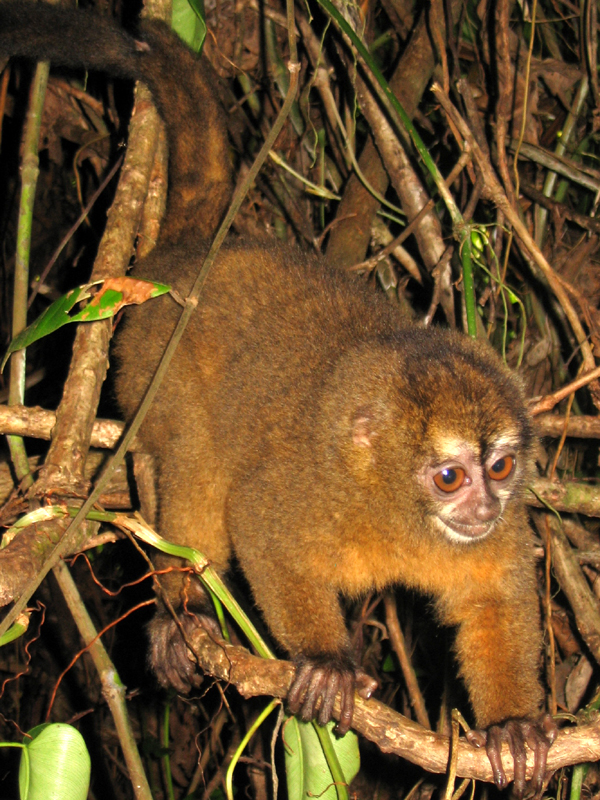
Aotus griseimembra occurs in parts of Colombia and Venezuela. It has light coffee-colored hair with darker tips on the backs of its hands and feet.
Written 26 November 2026 from the sources listed below. Each statement was checked against the passage it cites; statements that could not be supported were removed.
Appearance
The species has short, tightly textured fur. Its back fur ranges from grayish brown to reddish brown, and its belly is yellowish.[1][2][3]
The backs of its hands and feet have light coffee-colored hair with darker tips. This coloration distinguishes it from other subspecies of A. lemurinus.[4][5]
Habitat
The species inhabits secondary forests and occurs in coffee plantations. One study indicated that it prefers highly diverse forests.[6][7][8]
Behaviour
The Gray-handed Night Monkey is arboreal and nocturnal. It is among the only nocturnal monkeys, together with other members of the genus Aotus.[9][10][11]
Laboratory experiments found reduced activity under lighting conditions resembling a full moon.[12]
The species lives in groups containing between two and six individuals, most commonly two to four. Groups consist of an adult pair and one infant, sometimes accompanied by juveniles or subadults.[13][14][15]
Groups are territorial, and the home ranges of neighboring groups overlap only slightly.[16][17]
Adult males weigh approximately 1,009 grams, while adult females weigh approximately 923 grams.[18][19]
Reproduction and life cycle
The species is generally monogamous. Monogamous pairs generally produce one infant annually, although twins occasionally occur.[20][21][22]
The gestation period lasts approximately 133 days. The average interval between births for a female is 271 days.[23][24]
The father begins carrying the infant when it is one or two days old and transfers it to the mother for nursing.[25][26]
Conservation
The Gray-handed Night Monkey is classified as vulnerable by the IUCN and is considered particularly threatened in Colombia. Habitat loss is one of the threats affecting the species.[27][28][29]
Uses
Many individuals were captured during the 1960s and 1970s for malaria research.[30]
Similar species
The Gray-handed Night Monkey was formerly classified as a subspecies of the gray-bellied night monkey. Some authors classify it as a subspecies of Aotus lemurinus, whereas others recognize it as a separate species.[31][32][33]
Classification of the Gray-handed Night Monkey
| Kingdom | Animalia |
|---|---|
| Phylum | Chordata |
| Subphylum | Vertebrata |
| Infraphylum | Gnathostomata |
| Parvphylum | Osteichthyes |
| Megaclass | Tetrapoda |
| Class | Mammalia (Mammal) |
| Subclass | Theria |
| Infraclass | Eutheria |
| Order | Primates (Primate) |
| Suborder | Haplorrhini |
| Infraorder | Simiiformes |
| Family | Aotidae (Owl Monkeys) |
| Genus | Aotus (Night Monkeys) |
| Species | Aotus griseimembra Elliot, 1912 |
Where the Gray-handed Night Monkey is found
Checklists and occurrence records place Aotus griseimembra in 1 country across South America. GBIF holds 653 georeferenced records of it.
Countries
Regions and cities with the most records
- Santander Department, Colombia 242
- Caldas Department, Colombia 75
- La Dorada, Colombia 60
- Puerto Salgar, Colombia 60
- Sucre Department, Colombia 52
- Tolú Viejo, Colombia 48
- Magdalena Department, Colombia 42
- Antioquia, Colombia 41
- Cesar Department, Colombia 39
- Santiago de Tolú, Colombia 39
- Honda, Colombia 38
- Puerto Wilches, Colombia 35
- Barrancabermeja, Colombia 28
- La Jagua de Ibirico, Colombia 21
- Santa Marta, Colombia 20
- Becerril, Colombia 17
- Ciénaga, Colombia 17
- Córdoba, Colombia 15
- Boyacá, Colombia 11
- Puebloviejo, Colombia 11
- Sincelejo, Colombia 11
- Yondó, Colombia 10
- Sabana de Torres, Colombia 9
- Girón, Colombia 8
- Planeta Rica, Colombia 8
- Curumaní, Colombia 7
- Puerto Boyacá, Colombia 7
- Puerto Triunfo, Colombia 7
- Tolima Department, Colombia 7
- Cimitarra, Colombia 6
- Cundinamarca, Colombia 6
- Manizales, Colombia 6
- Nechí, Colombia 6
- Neira, Colombia 6
- Villamaría, Colombia 6
- Bolívar, Colombia 5
1 more country has a few records outside this range
These countries hold a few records of Aotus griseimembra but lie outside the range the checklists give for it. Such records are often zoo or garden specimens, museum material or vagrants, so the species is not counted as occurring there.
Range as the checklists state it
South America
A number beside a place is its count of GBIF occurrence records. A place without a number comes from a checklist alone. Records show where a species has been observed or collected, which can include escapes and vagrants.
Common names
English
- Gray-handed Night Monkey
- Gray-legged Night Monkey
- Grey-handed Night Monkey
- Grey-legged Night Monkey
Names in 9 other languages
- Arabic
- قرد الليل ذو اليد الرمادية
- Czech
- mirikina severokolumbijská
- Dutch
- Grijshandnachtaapje
- French
- Douroucouli à bras gris
- German
- Grauhand-Nachtaffe, Grauhandnachtaffe
- Greek
- Γκριζοπόδαρος Νυχτοπίθηκος
- Japanese
- ハイアシヨザル
- Polish
- ponocnica szaroręka
- Spanish
- Mico De Noche Caribe, Mico De Noche Caribeño, Mono Cocuí
Synonyms
2 other scientific names have been used for this species and are now treated as synonyms of Aotus griseimembra.
- Aotus bipunstatus Bole, 1937
- Aotus lemurinus griseimembra Elliot, 1912
Related species
-
 Panamanian Night MonkeyAotus zonalis
-
 Azara's Night MonkeyAotus azarae
-
 Gray-bellied Night MonkeyAotus lemurinus
-
 Three-striped Night MonkeyAotus trivirgatus
-
 Peruvian Night MonkeyAotus miconax
-
 Spix's Night MonkeyAotus vociferans
-
 Black-headed Night MonkeyAotus nigriceps
-
 Brumback's Night MonkeyAotus brumbacki
Compare
Questions and answers
What is the scientific name of the Gray-handed Night Monkey?
The scientific name of the Gray-handed Night Monkey is Aotus griseimembra. Written with its author, the full name is Aotus griseimembra Elliot, 1912.
Which family does the Gray-handed Night Monkey belong to?
Aotus griseimembra belongs to the family Aotidae, in the order Primates and the class Mammalia.
Where is the Gray-handed Night Monkey found?
Checklists and occurrence records place Aotus griseimembra in 1 country: Colombia.
What is the conservation status of the Gray-handed Night Monkey?
The IUCN Red List category recorded for Aotus griseimembra is Vulnerable (VU).
What other names does the Gray-handed Night Monkey have?
Aotus griseimembra is also known in English as Gray-legged Night Monkey, Grey-handed Night Monkey and Grey-legged Night Monkey.
What is the only nocturnal monkey?
The Gray-handed Night Monkey is among the only nocturnal monkeys, together with other members of the genus Aotus.[10][11]
What is a nocturnal primate called?
The Gray-handed Night Monkey is a nocturnal primate.[10]
Sources
Passages the profile rests on
- The species has short, tightly textured fur. Source passage: “It has short, tight fur.” — English Wikipedia
- Its back fur ranges from grayish brown to reddish brown. Source passage: “The fur on the back ranges from grayish brown to reddish brown.” — English Wikipedia
- Its belly is yellowish in color. Source passage: “The belly is yellowish.” — English Wikipedia
- The backs of its hands and feet have light coffee-colored hair with darker tips. Source passage: “The hair on the back of the hands and feet is the color of light coffee with darker hair tips” — English Wikipedia
- The coloration of the hair on its hands and feet distinguishes it from other subspecies of A. lemurinus. Source passage: “a key distinguishing feature from other A. lemurinus subspecies.” — English Wikipedia
- The species inhabits secondary forests. Source passage: “including secondary forest” — English Wikipedia
- The species occurs in coffee plantations. Source passage: “and coffee plantations” — English Wikipedia
- One study indicated that the species prefers highly diverse forests. Source passage: “one study indicated a preference for highly diverse forest.” — English Wikipedia
- The gray-handed night monkey is arboreal. Source passage: “The gray-handed night monkey is arboreal and nocturnal.” — English Wikipedia
- The species is nocturnal. Source passage: “The gray-handed night monkey is arboreal and nocturnal.” — English Wikipedia
- The species is among the only nocturnal monkeys, together with other members of the genus Aotus. Source passage: “It and the other members of the genus Aotus are the only nocturnal monkeys.” — English Wikipedia
- Laboratory experiments found reduced activity under lighting conditions resembling a full moon. Source passage: “Laboratory experiments indicated lower levels of activity even in lighting conditions consistent with a full moon.” — English Wikipedia
- The species lives in groups containing between two and six individuals. Source passage: “It lives in small groups of between two and six monkeys” — English Wikipedia
- Its groups most commonly contain two to four individuals. Source passage: “most typically two to four” — English Wikipedia
- Its social groups consist of an adult pair and one infant, sometimes accompanied by juveniles or subadults. Source passage: “consisting of an adult pair and one infant and several juveniles and/or subadults.” — English Wikipedia
- Groups of this species are territorial. Source passage: “Groups are territorial” — English Wikipedia
- The home ranges of neighboring groups overlap only slightly. Source passage: “groups occupy ranges that overlap only slightly.” — English Wikipedia
- Adult males weigh approximately 1,009 grams. Source passage: “males weighing approximately 1,009 grams” — English Wikipedia
- Adult females weigh approximately 923 grams. Source passage: “females weighing about 923 grams” — English Wikipedia
- The species is generally monogamous. Source passage: “the gray-handed night monkey is one of the few monogamous monkeys.” — English Wikipedia
- Monogamous pairs generally produce one infant annually. Source passage: “The monogamous pair generally gives birth to a single infant each year” — English Wikipedia
- Twins occasionally occur in this species. Source passage: “although twins occasionally occur.” — English Wikipedia
- The gestation period lasts approximately 133 days. Source passage: “The gestation period is about 133 days.” — English Wikipedia
- The average interval between births for a female is 271 days. Source passage: “Average interbirth interval for the mother is 271 days.” — English Wikipedia
- The father begins carrying the infant when it is one or two days old. Source passage: “The father carries the infant from the time it is one or two days old” — English Wikipedia
- The father transfers the infant to the mother for nursing. Source passage: “passing it to the mother for nursing.” — English Wikipedia
- The gray-handed night monkey is classified as vulnerable by the IUCN. Source passage: “The gray-handed night monkey is listed as "vulnerable" by the International Union for Conservation of Nature (IUCN).” — English Wikipedia
- The species is considered particularly threatened in Colombia. Source passage: “It is believed to be particularly threatened in Colombia.” — English Wikipedia
- Habitat loss is one of the threats affecting the species. Source passage: “This is in part due to habitat loss” — English Wikipedia
- Many individuals were captured during the 1960s and 1970s for malaria research. Source passage: “many were captured in the 1960s and 1970s for malaria research.” — English Wikipedia
- The gray-handed night monkey was formerly classified as a subspecies of the gray-bellied night monkey. Source passage: “formerly considered a subspecies of Gray-bellied night monkey” — English Wikipedia
- The taxonomic classification of the gray-handed night monkey remains uncertain. Source passage: “The exact classification of the gray-handed night monkey is uncertain.” — English Wikipedia
- Some authors classify the species as a subspecies of Aotus lemurinus, whereas others recognize it as a separate species. Source passage: “While some authors consider it a subspecies of the gray-bellied night monkey, A. lemurinus, other authors consider it a separate species, A. griseimembra.” — English Wikipedia
Data
- Catalogue of Life, 2026-10-16 XR cc by
- Global Biodiversity Information Facility CC BY 4.0
- Wikidata CC0
- GeoNames CC BY 4.0
- Wikimedia Commons per image; credit shown with each image
- Within the Catalogue of Life, this name comes from The Integrated Taxonomic Information System cc0
References
- New species of Monkeys of the genera Seniocebus, Alouatta, and Aotus. (1912). New York Bulletin of the American Museum of Natural History, 31, 31–33. https://bionames.org/references/c0ca799956d356c0b70a154ba817b753 Link where the name was published
- Mittermeier, Rusell A., Anthony B. Rylands, and Don E. Wilson, eds. (2013). Handbook of the Mammals of the World. Volume 3. Primates.
This species in other databases
Page built on 27 November 2026. See how the catalog is made and all sources and licences.
Cite this page
ScientificNames.org. (2026). Aotus griseimembra (Gray-handed Night Monkey). Retrieved November 27, 2026, from https://scientificnames.org/species/aotus-griseimembra
“Aotus griseimembra (Gray-handed Night Monkey).” ScientificNames.org, 2026, scientificnames.org/species/aotus-griseimembra. Accessed 27 Nov. 2026.
ScientificNames.org. “Aotus griseimembra (Gray-handed Night Monkey).” Accessed November 27, 2026. https://scientificnames.org/species/aotus-griseimembra.
@misc{scientificnames_aotus_griseimembra_gray_handed_night_monkey,
  author = {{ScientificNames.org}},
  title = {Aotus griseimembra (Gray-handed Night Monkey)},
  year = {2026},
  url = {https://scientificnames.org/species/aotus-griseimembra},
  note = {Accessed 2026-11-27}
}