Species · Spiders and other arachnids
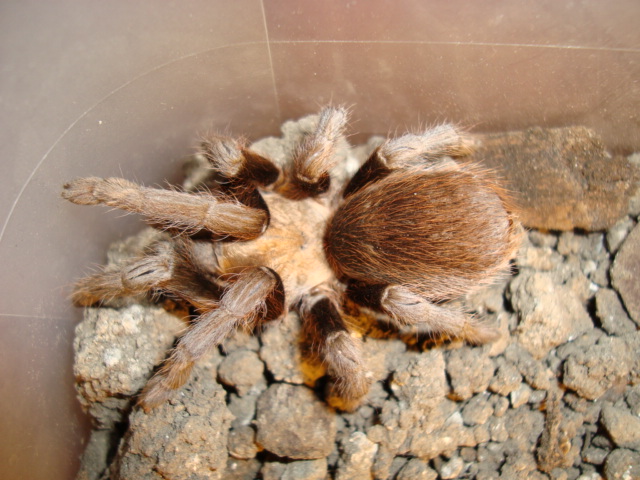
Desert Tarantula Aphonopelma iodius
The scientific name of the Desert Tarantula is Aphonopelma iodius. It is a species of arachnid in the family Theraphosidae (tarantulas), order Araneae. The name dates from 1939.
- Scientific name
- Aphonopelma iodius (Chamberlin & Ivie, 1939)
- Common name
- Desert Tarantula
- Genus
- Aphonopelma
- Family
- Theraphosidae (Tarantulas)
- Order
- Araneae
- Class
- Arachnida
- Recorded in
- 1 country
- Name status
- accepted in the Catalogue of Life

Overview
Aphonopelma iodius occurs in California, Nevada, Arizona, and Utah in the United States and is common in the Mojave Desert west of the Colorado River. It inhabits webbed burrows and individuals often seal their entrances with silken or silk-and-dirt plugs.
Written 26 November 2026 from the sources listed below. Each statement was checked against the passage it cites; statements that could not be supported were removed.
Habitat
The Desert Tarantula inhabits webbed burrows beneath the surface of desert areas in California, Nevada, and Utah.[1]
Individuals often block their burrow entrances with silken or silk-and-dirt plugs for protection against heat and predators.[2]
Reproduction and life cycle
Male Desert Tarantulas reach sexual maturity at approximately seven years of age. Mature males prepare for mating during autumn and transfer their sperm into sacs located in their pedipalps before searching for females.[3][4][5]
During mating, females receive sperm in their spermatheca. Females lay eggs during the following spring or summer after mating.[6][7]
Uses
The Desert Tarantula is traded as a pet under several common names. It is less readily available in the tarantula trade than many more colorful tarantula species and can be purchased at a slight premium.[8][9][10]
Similar species
Aphonopelma angusi, Aphonopelma melanium, and Aphonopelma nevadanum were synonymized with Aphonopelma iodius. Aphonopelma smithii was also reduced to a synonym following morphological and molecular analyses.[11][12]
The World Spider Catalog accepted the synonymy of Aphonopelma smithii with Aphonopelma iodius as of January 2021.[13]
Classification of the Desert Tarantula
| Kingdom | Animalia |
|---|---|
| Phylum | Arthropoda |
| Subphylum | Chelicerata |
| Class | Arachnida (Arachnid) |
| Order | Araneae (Spider) |
| Family | Theraphosidae (Tarantulas) |
| Genus | Aphonopelma |
| Species | Aphonopelma iodius (Chamberlin & Ivie, 1939) |
Where the Desert Tarantula is found
Checklists and occurrence records place Aphonopelma iodius in 1 country across North America. GBIF holds 3,351 georeferenced records of it.
Countries
Regions and cities with the most records
- California, United States 2,263
- Utah, United States 639
- Concord, United States 553
- Pleasant Hill, United States 552
- Walnut Creek, United States 551
- Danville, United States 549
- San Ramon, United States 546
- Bay Point, United States 537
- Lafayette, United States 530
- Pittsburg, United States 527
- Moraga, United States 517
- Antioch, United States 468
- Nevada, United States 389
- San Jose, United States 243
- Palo Alto, United States 210
- Santa Clara, United States 210
- Los Altos, United States 208
- East Palo Alto, United States 206
- Menlo Park, United States 205
- Campbell, United States 204
- Mountain View, United States 203
- Cupertino, United States 202
- Sunnyvale, United States 199
- Dublin, United States 192
- Redwood City, United States 186
- Newark, United States 176
- Martinez, United States 172
- Milpitas, United States 164
- Morgan Hill, United States 162
- Saratoga, United States 158
- Los Gatos, United States 155
- Orinda, United States 143
- Pleasanton, United States 137
- San Carlos, United States 137
- Murray, United States 134
- Holladay, United States 131
Range as the checklists state it
USA
A number beside a place is its count of GBIF occurrence records. A place without a number comes from a checklist alone. Records show where a species has been observed or collected, which can include escapes and vagrants.
Common names
English
- Desert Tarantula
- Bay Area Blonde
- Fresno County Brown
- Salt Lake County Brown
Names in 1 other language
- Czech
- sklípkan Russellův, sklípkan hnědavý, sklípkan utažský
Synonyms
10 other scientific names have been used for this species and are now treated as synonyms of Aphonopelma iodius.
- Aphonopelma angusi Chamberlin, 1940
- Aphonopelma brunnius Chamberlin, 1940
- Aphonopelma chamberlini Smith, 1995
- Aphonopelma iviei Smith, 1995
- Aphonopelma lithodomum Chamberlin, 1940
- Aphonopelma melanius (Chamberlin & lvie, 1939)
- Aphonopelma nevadanum Chamberlin, 1940
- Aphonopelma smithi Smith, 1995
- Aphonopelma zionis Chamberlin, 1940
- Delopelma iodius Chamberlin & Ivie, 1939
Related species
-
 Texas Brown TarantulaAphonopelma hentzi
-
 Arizona Blonde TarantulaAphonopelma chalcodes
-
 Costa Rican Striped-knee TarantulaAphonopelma seemanni
-
 California Ebony TarantulaAphonopelma eutylenum
-
 Johnny Cash TarantulaAphonopelma johnnycashi
-
 Texas Tan TarantulaAphonopelma anax
-
 Grand Canyon Black TarantulaAphonopelma marxi
-
 Mojave Dwarf TarantulaAphonopelma mojave
Compare
Questions and answers
What is the scientific name of the Desert Tarantula?
The scientific name of the Desert Tarantula is Aphonopelma iodius. Written with its author, the full name is Aphonopelma iodius (Chamberlin & Ivie, 1939).
Which family does the Desert Tarantula belong to?
Aphonopelma iodius belongs to the family Theraphosidae, in the order Araneae and the class Arachnida.
Where is the Desert Tarantula found?
Checklists and occurrence records place Aphonopelma iodius in 1 country: United States.
What other names does the Desert Tarantula have?
Aphonopelma iodius is also known in English as Bay Area Blonde, Fresno County Brown and Salt Lake County Brown.
How long do desert tarantulas live?
Females can live for more than thirty years in captivity. Males die at the end of the mating season in mid-autumn.[14][15]
What kind of habitat do tarantulas live in?
The Desert Tarantula inhabits webbed burrows beneath the surface of desert areas in California, Nevada, and Utah.[1]
Sources
Passages the profile rests on
- The species inhabits webbed burrows beneath the surface of desert areas in California, Nevada, and Utah. Source passage: “A. iodius lives in webbed burrows under the surface of desert areas of California, Nevada, and Utah.” — English Wikipedia
- Individuals often block their burrow entrances with silken or silk-and-dirt plugs for protection against heat and predators. Source passage: “They often obstruct the entrance to their burrows with a silken or silk and dirt plug to protect against heat and predators.” — English Wikipedia
- Male Aphonopelma iodius reach sexual maturity at approximately seven years of age. Source passage: “Male A. iodius reach sexual maturity at around seven years of age.” — English Wikipedia
- Mature males prepare for mating during autumn. Source passage: “In autumn, mature males prepare to mate.” — English Wikipedia
- Males transfer their sperm into sacs located in their pedipalps before searching for females. Source passage: “They transfer their sperm to sacs located in their pedipalps, then leave their burrows in search of a female.” — English Wikipedia
- Females receive sperm in their spermatheca during mating. Source passage: “The female then emerges and the two mate, with the female receiving the sperm in her spermatheca.” — English Wikipedia
- Females lay eggs during the following spring or summer after mating. Source passage: “Females lay eggs the following spring or summer.” — English Wikipedia
- Aphonopelma iodius is traded as a pet under several common names. Source passage: “In the pet trade A. iodius is known by many names, such as the Great Basin blonde, Fresno County blonde, desert tarantula, Salt Lake City brown, northern blonde.” — English Wikipedia
- The species is less readily available in the tarantula trade than many more colorful tarantula species. Source passage: “The species is harder to find in the tarantula trade than many of the more colorful species” — English Wikipedia
- Aphonopelma iodius can be purchased at a slight premium in the pet trade. Source passage: “but can still be purchased at a slight premium.” — English Wikipedia
- Aphonopelma angusi, Aphonopelma melanium, and Aphonopelma nevadanum were synonymized with Aphonopelma iodius. Source passage: “The formerly recognized A. melanium, A. angusi, and A. nevadanum were found to be in synonymy with, and were folded into, A. iodius.” — English Wikipedia
- Aphonopelma smithii was reduced to a synonym of Aphonopelma iodius following morphological and molecular analyses. Source passage: “A 2016 study of Aphonopelma species found in the United States concluded that morphological and molecular analyses failed to distinguish A. smithi (among other species) from A. iodius, and so reduced it to a synonym.” — English Wikipedia
- The World Spider Catalog accepted the synonymy of Aphonopelma smithii with Aphonopelma iodius as of January 2021. Source passage: “The synonymy was accepted by the World Spider Catalog, as of January 2021.” — English Wikipedia
- Males die at the end of the mating season in mid-autumn. Source passage: “Males die at the end of the mating season in mid-autumn.” — English Wikipedia
- Females can live for more than thirty years in captivity. Source passage: “Females can live for over thirty years in captivity.” — English Wikipedia
Data
- Catalogue of Life, 2026-10-16 XR cc by
- Global Biodiversity Information Facility CC BY 4.0
- Wikidata CC0
- GeoNames CC BY 4.0
- Wikimedia Commons per image; credit shown with each image
- iNaturalist per image; credit shown with each image
- Within the Catalogue of Life, this name comes from The World Spider Catalog cc by
References
- Chamberlin, R. V. & Ivie, W. (1939b). New tarantulas from the southwestern states. Bulletin of the University of Utah 29(11): 1-17. where the name was published
This species in other databases
Page built on 27 November 2026. See how the catalog is made and all sources and licences.
Cite this page
ScientificNames.org. (2026). Aphonopelma iodius (Desert Tarantula). Retrieved November 27, 2026, from https://scientificnames.org/species/aphonopelma-iodius
“Aphonopelma iodius (Desert Tarantula).” ScientificNames.org, 2026, scientificnames.org/species/aphonopelma-iodius. Accessed 27 Nov. 2026.
ScientificNames.org. “Aphonopelma iodius (Desert Tarantula).” Accessed November 27, 2026. https://scientificnames.org/species/aphonopelma-iodius.
@misc{scientificnames_aphonopelma_iodius_desert_tarantula,
  author = {{ScientificNames.org}},
  title = {Aphonopelma iodius (Desert Tarantula)},
  year = {2026},
  url = {https://scientificnames.org/species/aphonopelma-iodius},
  note = {Accessed 2026-11-27}
}