Species · Spiders and other arachnids
Costa Rican Striped-knee Tarantula Aphonopelma seemanni
The scientific name of the Costa Rican Striped-knee Tarantula is Aphonopelma seemanni. It is a species of arachnid in the family Theraphosidae (tarantulas), order Araneae. The name dates from 1897.
- Scientific name
- Aphonopelma seemanni (F. O. Pickard-Cambridge, 1897)
- Common name
- Costa Rican Striped-knee Tarantula
- Genus
- Aphonopelma
- Family
- Theraphosidae (Tarantulas)
- Order
- Araneae
- Class
- Arachnida
- Recorded in
- 5 countries
- Name status
- accepted in the Catalogue of Life

Overview
The species inhabits most of western Costa Rica and also occurs in Honduras, with a possible occurrence in Guatemala. It is usually black with white stripes near the leg joints, although a brown color form also exists.
Written 26 November 2026 from the sources listed below. Each statement was checked against the passage it cites; statements that could not be supported were removed.
Appearance
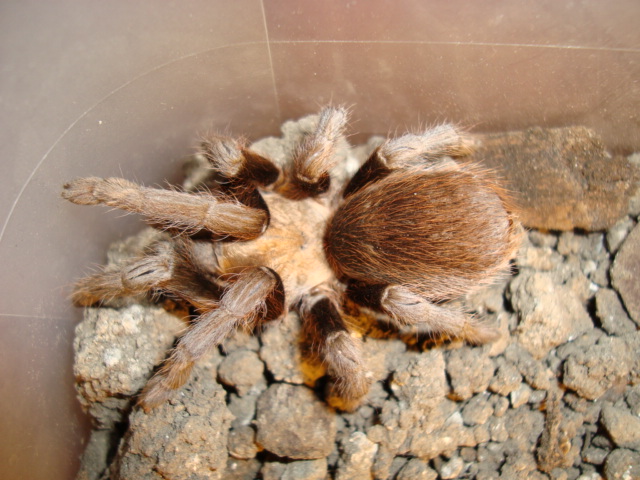
The Costa Rican Striped-knee Tarantula is usually black with white stripes near the leg joints. A brown color form also exists.[1][2]
The species can reach approximately 10–13 cm in total leg span.[3]
Habitat
The species inhabits open, semiarid scrublands and constructs deep burrows. Individuals are often found in large aggregations.[4][5][6]
Its deep burrows maintain temperatures below the highest daytime temperatures and buffer individuals against the lowest nighttime temperatures.[7][8]
Diet
Wild individuals eat various insects, including grasshoppers and cockroaches. Captive individuals are fed crickets.[9][10]
Behaviour
The species possesses urticating hairs that it can throw. These hairs can irritate human skin, although individuals rarely throw them.[11][12][13]
The species is very skittish.[14]
Classification of the Costa Rican Striped-knee Tarantula
| Kingdom | Animalia |
|---|---|
| Phylum | Arthropoda |
| Subphylum | Chelicerata |
| Class | Arachnida (Arachnid) |
| Order | Araneae (Spider) |
| Family | Theraphosidae (Tarantulas) |
| Genus | Aphonopelma |
| Species | Aphonopelma seemanni (F. O. Pickard-Cambridge, 1897) |
Where the Costa Rican Striped-knee Tarantula is found
Checklists and occurrence records place Aphonopelma seemanni in 5 countries across North America. GBIF holds 377 georeferenced records of it.
Countries
Regions and cities with the most records
- Francisco Morazán Department, Honduras 149
- Morocelí, Honduras 146
- Guanacaste Province, Costa Rica 113
- Puntarenas Province, Costa Rica 21
- Esparza, Costa Rica 9
- Managua Department, Nicaragua 9
- Alajuela Province, Costa Rica 8
- Chacarita, Costa Rica 7
- San Rafael Abajo, Costa Rica 7
- Cojutepeque, El Salvador 6
- Liberia, Costa Rica 6
- Nicoya, Costa Rica 6
- Puntarenas, Costa Rica 6
- San Martín, El Salvador 6
- Santa Tecla, El Salvador 6
- Antiguo Cuscatlán, El Salvador 5
- Cabanas, El Salvador 5
- Chalatenango, El Salvador 5
- Delgado, El Salvador 5
- Managua, Nicaragua 5
- Mejicanos, El Salvador 5
- San Marcos, El Salvador 5
- San Rafael del Sur, Nicaragua 5
- San Salvador, El Salvador 5
- San Salvador Department, El Salvador 5
- Soyapango, El Salvador 5
- Cañas, Costa Rica 4
- Granada Department, Nicaragua 4
- León, Nicaragua 4
- Masatepe, Nicaragua 4
- Nandaime, Nicaragua 4
- Rivas Department, Nicaragua 4
- Tipitapa, Nicaragua 4
- Usulutan, El Salvador 4
- Chichigalpa, Nicaragua 3
- Chinandega, Nicaragua 3
Range as the checklists state it
El Salvador, Honduras, Nicaragua, Costa Rica
El Salvador, Nicaragua
A number beside a place is its count of GBIF occurrence records. A place without a number comes from a checklist alone. Records show where a species has been observed or collected, which can include escapes and vagrants.
Common names
English
- Costa Rican Striped-knee Tarantula
- Costa Rican Stripe Knee
- Costa Rican Zebra Tarantula
- Striped-knee Tarantula
Names in 5 other languages
- Czech
- sklípkan hrabavý, sklípkan skrytý
- Dutch
- Zebravogelspin
- German
- Gestreifte Guatemala-Vogelspinne
- Italian
- Tarantola zebrata costaricana
- Spanish
- Tarántula cebra americana, Tarántula de rodillas rayadas
Synonyms
One other scientific name has been used for this species and is now treated as a synonym of Aphonopelma seemanni.
- Aphonopelma latens (Chamberlin, 1917)
Related species
-
 Texas Brown TarantulaAphonopelma hentzi
-
 Arizona Blonde TarantulaAphonopelma chalcodes
-
 Desert TarantulaAphonopelma iodius
-
 California Ebony TarantulaAphonopelma eutylenum
-
 Johnny Cash TarantulaAphonopelma johnnycashi
-
 Texas Tan TarantulaAphonopelma anax
-
 Grand Canyon Black TarantulaAphonopelma marxi
-
 Mojave Dwarf TarantulaAphonopelma mojave
Compare
Questions and answers
What is the scientific name of the Costa Rican Striped-knee Tarantula?
The scientific name of the Costa Rican Striped-knee Tarantula is Aphonopelma seemanni. Written with its author, the full name is Aphonopelma seemanni (F. O. Pickard-Cambridge, 1897).
Which family does the Costa Rican Striped-knee Tarantula belong to?
Aphonopelma seemanni belongs to the family Theraphosidae, in the order Araneae and the class Arachnida.
Where is the Costa Rican Striped-knee Tarantula found?
Checklists and occurrence records place Aphonopelma seemanni in 5 countries: Honduras, Costa Rica, El Salvador, Nicaragua and Guatemala.
What other names does the Costa Rican Striped-knee Tarantula have?
Aphonopelma seemanni is also known in English as Costa Rican Stripe Knee, Costa Rican Zebra Tarantula and Striped-knee Tarantula.
What do striped knee tarantulas eat?
Wild individuals eat various insects, including grasshoppers and cockroaches. Captive individuals are fed crickets.[9][10]
How big can an Aphonopelma seemanni tarantula get?
The species can reach approximately 10–13 cm in total leg span.[3]
Sources
Passages the profile rests on
- The species is usually black with white stripes near the leg joints. Source passage: “It is usually black with white stripes near the leg joints” — English Wikipedia
- A brown color form also exists in this species. Source passage: “but a brown color form also exists for the spider.” — English Wikipedia
- The species can reach approximately 10–13 cm in total leg span. Source passage: “Zebra tarantulas can grow to about 10–13 cm including leg span.” — English Wikipedia
- The species inhabits open, semiarid scrublands. Source passage: “They live in open, semiarid scrublands” — English Wikipedia
- The species constructs deep burrows. Source passage: “Zebra tarantulas are deep-burrowing spiders.” — English Wikipedia
- Individuals of this species are often found in large aggregations. Source passage: “and are often found in large aggregations.” — English Wikipedia
- The species' deep burrows maintain temperatures below the highest daytime temperatures. Source passage: “Their deep burrows keep the temperature below the highest daytime temperatures” — English Wikipedia
- The burrows buffer individuals against the lowest nighttime temperatures. Source passage: “as temperatures drop at night, the burrows buffer away from the lowest temperatures.” — English Wikipedia
- Wild individuals eat various insects, including grasshoppers and cockroaches. Source passage: “In the wild, they eat a wide variety of insects such as grasshoppers and cockroaches.” — English Wikipedia
- Captive individuals are fed crickets. Source passage: “In captivity, they eat crickets.” — English Wikipedia
- The species possesses urticating hairs that it can throw. Source passage: “Zebra tarantulas have urticating hairs, which can be thrown” — English Wikipedia
- The species' urticating hairs can irritate human skin. Source passage: “and are irritating to human skin.” — English Wikipedia
- Individuals rarely throw their urticating hairs. Source passage: “However, it is rare for them to do so.” — English Wikipedia
- The species is very skittish. Source passage: “They are very skittish in nature” — English Wikipedia
- Females can live for up to 20 years. Source passage: “Females can live up to 20 years.” — English Wikipedia
- Males can live for up to five years. Source passage: “Males, however, tend to live a much shorter life – up to five years” — English Wikipedia
Data
- Catalogue of Life, 2026-10-16 XR cc by
- Global Biodiversity Information Facility CC BY 4.0
- Wikidata CC0
- GeoNames CC BY 4.0
- Wikimedia Commons per image; credit shown with each image
- Within the Catalogue of Life, this name comes from The World Spider Catalog cc by
References
- Pickard-Cambridge, F. O. (1897a). Arachnida. Araneidea and Opiliones. Vol. II. In: Biologia Centrali-Americana. Taylor and Francis, London, pp. 1-40, pl. 1-3. doi: <a href="https://doi.org/10.5962/bhl.title.730" target="_blank">10.5962/bhl.title.730 Link where the name was published
This species in other databases
Page built on 26 November 2026. See how the catalog is made and all sources and licences.
Cite this page
ScientificNames.org. (2026). Aphonopelma seemanni (Costa Rican Striped-knee Tarantula). Retrieved November 26, 2026, from https://scientificnames.org/species/aphonopelma-seemanni
“Aphonopelma seemanni (Costa Rican Striped-knee Tarantula).” ScientificNames.org, 2026, scientificnames.org/species/aphonopelma-seemanni. Accessed 26 Nov. 2026.
ScientificNames.org. “Aphonopelma seemanni (Costa Rican Striped-knee Tarantula).” Accessed November 26, 2026. https://scientificnames.org/species/aphonopelma-seemanni.
@misc{scientificnames_aphonopelma_seemanni_costa_rican_striped_knee_tarantula,
  author = {{ScientificNames.org}},
  title = {Aphonopelma seemanni (Costa Rican Striped-knee Tarantula)},
  year = {2026},
  url = {https://scientificnames.org/species/aphonopelma-seemanni},
  note = {Accessed 2026-11-26}
}