Species · Insects
Indian Albatross Appias wardii
The scientific name of the Indian Albatross is Appias wardii. It is a species of insect in the family Pieridae (whites), order Lepidoptera. The name dates from 1884.
- Scientific name
- Appias wardii (Moore, 1884)
- Common name
- Indian Albatross
- Genus
- Appias
- Family
- Pieridae (Whites)
- Order
- Lepidoptera
- Class
- Insecta
- Recorded in
- 1 country
- Name status
- accepted in the Catalogue of Life

Overview
Appias wardii, known as the Indian Albatross, is a butterfly in the family Pieridae. The species occurs in the Western Ghats of India and the hills of southern India. Its wingspan ranges from 65 to 76 mm.
Written 27 November 2026 from the sources listed below. Each statement was checked against the passage it cites; statements that could not be supported were removed.
Appearance
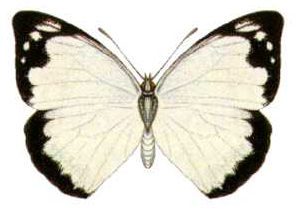
The male wet-season form has a white upperside with a black apical area covering approximately one-third of the forewing. The forewing has four or five white spots in a curved preapical series, while the hindwing has black spots near the margin at the tips of veins 3 to 7.[1][2][3]
The male wet-season forewing underside is white with a butter-yellow apex and a curved irregular black band. The hindwing underside is uniformly butter yellow.[4][5]
The female wet-season form has a black forewing apical area covering the outer apical half and two white spots over the black area. Its hindwing has a broad, continuous black terminal band.[6][7][8]
The female wet-season forewing underside has a broad curved black band extending from the costa to the tornus and a pearly bluish-white apex. The hindwing underside is uniformly pearly bluish white.[9][10][11]
The male dry-season form has a reduced black basal forewing area and a less extensive black apical area than the wet-season form. Its hindwing is entirely white, sometimes with a faint yellowish tint.[12][13]
The male dry-season forewing underside usually lacks the curved black band. The female dry-season form has much smaller black areas on both pairs of wings and a much narrower curved black band on the forewing underside than the wet-season form.[14][15][16]
Classification of the Indian Albatross
| Kingdom | Animalia |
|---|---|
| Phylum | Arthropoda |
| Subphylum | Hexapoda |
| Class | Insecta (Insect) |
| Order | Lepidoptera |
| Superfamily | Papilionoidea |
| Family | Pieridae (Whites) |
| Genus | Appias (Albatrosses and Puffins) |
| Species | Appias wardii (Moore, 1884) |
Where the Indian Albatross is found
Checklists and occurrence records place Appias wardii in 1 country. GBIF holds 25 georeferenced records of it.
Countries
Regions and cities with the most records
Range as the checklists state it
IND
A number beside a place is its count of GBIF occurrence records. A place without a number comes from a checklist alone. Records show where a species has been observed or collected, which can include escapes and vagrants.
Common names
English
- Indian Albatross
- Sahyadri Albatross
Related species
-
 Common AlbatrossAppias albina
-
 Chocolate AlbatrossAppias lyncida
-
 Eastern Striped AlbatrossAppias olferna
-
 Striped AlbatrossAppias libythea
-
 Orange AlbatrossAppias nero
-
 Common AlbatrossAppias paulina
-
 Plain PuffinAppias indra
-
 Flame AlbatrossAppias zarinda
Compare
Questions and answers
What is the scientific name of the Indian Albatross?
The scientific name of the Indian Albatross is Appias wardii. Written with its author, the full name is Appias wardii (Moore, 1884).
Which family does the Indian Albatross belong to?
Appias wardii belongs to the family Pieridae, in the order Lepidoptera and the class Insecta.
Where is the Indian Albatross found?
Checklists and occurrence records place Appias wardii in 1 country: India.
What other names does the Indian Albatross have?
Appias wardii is also known in English as Sahyadri Albatross.
Sources
Passages the profile rests on
- The male wet-season form has a white upperside with a black apical area covering approximately one-third of the forewing. Source passage: “Forewing has the base densely and broadly irrorated with black scales which gradually merge along the costa into the black apical area that occupies about one-third of the wing” — English Wikipedia
- The male wet-season forewing has four or five white spots arranged in a curved preapical series over the black area. Source passage: “a curved preapical series of four or five white spots superposed on the black area.” — English Wikipedia
- The male wet-season hindwing has black spots near the wing margin at the tips of veins 3 to 7. Source passage: “Hindwing: slightly irrorated (sprinkled) with black scales at base which leave a terminal series of large, somewhat diamond-shaped, black spots at the apices of veins 3 to 7.” — English Wikipedia
- The male wet-season forewing underside is white with a butter-yellow apex and a curved irregular black band. Source passage: “Underside, forewing: white, apex butter yellow, a somewhat narrow zigzag curved irregular black band from middle of costa to tornus.” — English Wikipedia
- The male wet-season hindwing underside is uniformly butter yellow. Source passage: “Hindwing: uniform butter yellow.” — English Wikipedia
- The female wet-season form has a larger black forewing apical area than the male, covering the outer apical half. Source passage: “differs in the much greater extent of the black area which occupies the outer apical half of the forewing” — English Wikipedia
- The female wet-season hindwing has a broad, continuous black terminal band. Source passage: “on the hindwing forms a broad continuous terminal band;” — English Wikipedia
- The female wet-season forewing has two white spots over the black apical area. Source passage: “the superposed spots on black area of forewing reduced to two” — English Wikipedia
- The female wet-season forewing underside has a broad curved black band extending from the costa to the tornus. Source passage: “a very broad curved black band crosses the wing from costa to tornus” — English Wikipedia
- The female wet-season forewing underside has a pearly bluish-white apex. Source passage: “apex pearly bluish white.” — English Wikipedia
- The female wet-season hindwing underside is uniformly pearly bluish white. Source passage: “The hindwing is uniform, pearly bluish white.” — English Wikipedia
- The male dry-season form has a reduced black basal forewing area and a less extensive black apical area compared with the wet-season form. Source passage: “the irroration of black scales at base and the black on apical area much restricted” — English Wikipedia
- The male dry-season hindwing is entirely white, sometimes with a faint yellowish tint. Source passage: “Hindwing: entirely white, in some specimens with a faint yellowish tinge.” — English Wikipedia
- The male dry-season forewing underside usually lacks the curved black band. Source passage: “but in most it is entirely absent.” — English Wikipedia
- The female dry-season form has much smaller black areas on both pairs of wings than the wet-season form. Source passage: “the black area on both forewings and hindwings much restricted just as it is in the male.” — English Wikipedia
- The female dry-season forewing underside has a much narrower curved black band than the wet-season form. Source passage: “on the forewing the curved black band is very much narrower” — English Wikipedia
Data
- Catalogue of Life, 2026-10-16 XR cc by
- Global Biodiversity Information Facility CC BY 4.0
- Wikidata CC0
- GeoNames CC BY 4.0
- Wikimedia Commons per image; credit shown with each image
- Within the Catalogue of Life, this name comes from Global Butterfly Information System cc by
This species in other databases
Page built on 27 November 2026. See how the catalog is made and all sources and licences.
Cite this page
ScientificNames.org. (2026). Appias wardii (Indian Albatross). Retrieved November 27, 2026, from https://scientificnames.org/species/appias-wardii
“Appias wardii (Indian Albatross).” ScientificNames.org, 2026, scientificnames.org/species/appias-wardii. Accessed 27 Nov. 2026.
ScientificNames.org. “Appias wardii (Indian Albatross).” Accessed November 27, 2026. https://scientificnames.org/species/appias-wardii.
@misc{scientificnames_appias_wardii_indian_albatross,
  author = {{ScientificNames.org}},
  title = {Appias wardii (Indian Albatross)},
  year = {2026},
  url = {https://scientificnames.org/species/appias-wardii},
  note = {Accessed 2026-11-27}
}