Species · Fishes
Eastern Shovelnose Ray Aptychotrema rostrata
The scientific name of the Eastern Shovelnose Ray is Aptychotrema rostrata. It is a species of fish in the family Trygonorrhinidae (banjo rays), order Rhinopristiformes. The name dates from 1794.
- Scientific name
- Aptychotrema rostrata (Shaw, 1794)
- Common name
- Eastern Shovelnose Ray
- Genus
- Aptychotrema
- Family
- Trygonorrhinidae (Banjo Rays)
- Order
- Rhinopristiformes
- Class
- Elasmobranchii
- Red List category
- LC Least Concern
- Environment
- brackish, marine
- Recorded in
- 1 country
- Name status
- accepted in the Catalogue of Life

Overview
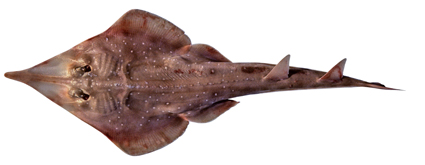
Aptychotrema rostrata is endemic to Australia's east coast, with a documented range from southern Queensland to southern New South Wales. It has a flat, wedge-shaped disc, an elongated triangular snout, a blackish snout tip and bold orange patches in front of its eyes.
Written 26 November 2026 from the sources listed below. Each statement was checked against the passage it cites; statements that could not be supported were removed.
Appearance
Its snout has a blackish tip, and bold orange patches occur in front of its eyes. Its eyes are positioned on the dorsal surface of its body.[1][2]
It has two dorsal fins of approximately equal size above a broad tail.[3]
The species reaches a maximum recorded total length of 120 cm, while mature adults commonly measure approximately 85 cm. Its maximum recorded body weight is 4 kg, and females generally attain greater body mass and total length than males.[4][5][6][7]
Habitat
The Eastern Shovelnose Ray inhabits subtropical and temperate waters. It commonly lives in shallow waters over mudflats and sandflats, and occurs in estuaries and on rocky reefs.[8][9][10]
The species is commonly seen in estuaries and on sandy substrates off beaches. Specimens have been recorded at depths of up to 220 m.[11][12]
Diet
The Eastern Shovelnose Ray predominantly eats fish, molluscs and benthic invertebrates. Recorded prey includes carid shrimps, penaeid prawns, stomatopods and crabs, while amphipods, isopods and squid are uncommon prey items.[13][14][15]
Juveniles consume carid shrimps more frequently than mature individuals, which generally consume larger prey. The species uses suction and crushing to capture and process prey.[16][17][18]
Behaviour
The species is thought to forage mainly in shallow waters rather than at great depths. Females move into shallower waters during summer to give birth.[19][20]
Reproduction and life cycle
The Eastern Shovelnose Ray has an annual and seasonal reproductive cycle. Mating generally occurs during winter, particularly July and August, and ovulation generally occurs in November.[21][22][23]
Females generally give birth in March following an average gestation period of four months. The usual gestation period ranges from three to five months.[24][25]
Females produce between four and twenty pups per litter, with larger females generally producing more pups. Newborn individuals measure approximately 13–15 cm in total length.[26][27][28]
The species is thought to reproduce through yolk-sac viviparity.[29]
Conservation
The International Union for Conservation of Nature lists the Eastern Shovelnose Ray as Least Concern. The 2020 Australian fish stock report classifies the Eastern Australia biological stock as undefined.[30][31]
Prawn trawling is assessed as posing a high ecological risk to the species within the Great Barrier Reef Marine Park. Longer trawl tow durations reduce the likelihood of survival for discarded individuals, while larger individuals are more likely to survive.[32][33][34]
Post-release survival of trawl-caught individuals is reported to be high. Females may abort their pups following stress associated with capture.[35][36]
Uses
The Eastern Shovelnose Ray is commercially caught in New South Wales and Queensland. It is also caught recreationally by anglers and by Indigenous Australians.[37][38][39]
The species is sold and consumed as seafood. Its flesh can be prepared by steaming, grilling, deep-frying or incorporating it into soups, casseroles and curries.[40][41]
The Sydney Fish Market recommends skinning and filleting the tail meat for consumption.[42]
Similar species
Its closest relatives include the eastern fiddler ray, giant shovelnose ray, southern fiddler ray and western shovelnose ray.[43]
Classification of the Eastern Shovelnose Ray
| Kingdom | Animalia |
|---|---|
| Phylum | Chordata |
| Subphylum | Vertebrata |
| Infraphylum | Gnathostomata |
| Parvphylum | Chondrichthyes |
| Class | Elasmobranchii |
| Subclass | Neoselachii |
| Infraclass | Batoidea |
| Order | Rhinopristiformes |
| Family | Trygonorrhinidae (Banjo Rays) |
| Genus | Aptychotrema |
| Species | Aptychotrema rostrata (Shaw, 1794) |
Where the Eastern Shovelnose Ray is found
Checklists and occurrence records place Aptychotrema rostrata in 1 country. GBIF holds 1,794 georeferenced records of it.
Countries
Regions and cities with the most records
- Newcastle, Australia 285
- Central Coast, Australia 126
- New South Wales, Australia 118
- Sydney, Australia 58
- Queensland, Australia 26
- Coffs Harbour, Australia 15
- Gold Coast, Australia 13
- Capalaba, Australia 11
- Sunshine Coast, Australia 11
- Caloundra, Australia 10
- Port Macquarie, Australia 8
- Batemans Bay, Australia 7
- Narangba, Australia 7
- Cessnock, Australia 3
- South Australia, Australia 3
- Victoria, Australia 3
A number beside a place is its count of GBIF occurrence records. A place without a number comes from a checklist alone. Records show where a species has been observed or collected, which can include escapes and vagrants.
Common names
English
- Eastern Shovelnose Ray
- Australian Shovelnose Ray
- Banjo Fish
- Bank's Shovelnosed Ray
- Bank's Shovelnosed-ray
- Banks Shovelnose Ray
- Banks Shovelnosed Ray
- Bouganville's Shovelnose Ray
- Common Shovelnosed Ray
- Eragoni
- Guitarfish
- Long-snout Shovelnose Ray
- Shovel-nosed Ray
- Shovelnose Ray
- Shovelnose Shark
- Southern Shovelnose Ray
Names in 9 other languages
- Czech
- pilohřbet nosatý
- Dutch
- Oostelijke gitaarrog
- Finnish
- nokkabanjorausku
- German
- Ostaustralischer Geigenrochen
- Italian
- Pesce chitarra di Bank, Pesce violino di Bank
- Japanese
- ウスクロモンサカタザメ
- Portuguese
- Raia-viola-australiana
- Spanish
- Raya banjo del este
- xdk
- ginara
Synonyms
6 other scientific names have been used for this species and are now treated as synonyms of Aptychotrema rostrata.
- Aptychotrema banksii (Müller & Henle, 1841)
- Aptychotrema bougainvillii (Müller & Henle, 1841)
- Raja rostrata Shaw, 1794
- Rhinobatus banksii Müller & Henle, 1841
- Rhinobatus bougainvillii Müller & Henle, 1841
- Rhinobatus tuberculatus MacLeay, 1882
Related species
-
 Southern Shovelnose RayAptychotrema vincentiana
-
 Spotted Shovelnose RayAptychotrema timorensis
-
 Eastern Fiddler RayTrygonorrhina fasciata
-
 Banded GuitarfishZapteryx exasperata
-
 Southern Fiddler RayTrygonorrhina dumerilii
-
 Southern Banded GuitarfishZapteryx xyster
-
 Shortnose GuitarfishZapteryx brevirostris
Compare
Questions and answers
What is the scientific name of the Eastern Shovelnose Ray?
The scientific name of the Eastern Shovelnose Ray is Aptychotrema rostrata. Written with its author, the full name is Aptychotrema rostrata (Shaw, 1794).
Which family does the Eastern Shovelnose Ray belong to?
Aptychotrema rostrata belongs to the family Trygonorrhinidae, in the order Rhinopristiformes and the class Elasmobranchii.
Where is the Eastern Shovelnose Ray found?
Checklists and occurrence records place Aptychotrema rostrata in 1 country: Australia.
What is the conservation status of the Eastern Shovelnose Ray?
The IUCN Red List category recorded for Aptychotrema rostrata is Least Concern (LC).
What other names does the Eastern Shovelnose Ray have?
Aptychotrema rostrata is also known in English as Australian Shovelnose Ray, Banjo Fish, Bank's Shovelnosed Ray, Bank's Shovelnosed-ray, Banks Shovelnose Ray and Banks Shovelnosed Ray.
Is shovelnose ray good for eating?
The Eastern Shovelnose Ray is sold and consumed as seafood. Its flesh can be steamed, grilled, deep-fried or used in soups, casseroles and curries.[40][41]
Are shovel nose sharks good eating?
The Eastern Shovelnose Ray is sold and consumed as seafood. Its flesh can be steamed, grilled, deep-fried or used in soups, casseroles and curries.[40][41]
Do people eat guitar fish?
The Eastern Shovelnose Ray, also known by the English name Guitarfish, is sold and consumed as seafood.[40]
Sources
Passages the profile rests on
- Its snout has a blackish tip and bold orange patches occur in front of its eyes. Source passage: “a blackish tip on the snout, bold orange patches visible in front of the eyes” — English Wikipedia
- Its eyes are positioned on the dorsal surface of its body. Source passage: “Its eyes are positioned on the dorsal surface.” — English Wikipedia
- It has two dorsal fins of approximately equal size above a broad tail. Source passage: “The body features two dorsal fins of roughly equal size on top of a broad tail.” — English Wikipedia
- The species reaches a maximum recorded total length of 120 cm. Source passage: “Maximum total length has been recorded to reach 120 cm (47 in)” — English Wikipedia
- Mature adults commonly measure approximately 85 cm in length. Source passage: “common lengths for mature adults are around 85 cm (33 in).” — English Wikipedia
- The maximum recorded body weight is 4 kg. Source passage: “The maximum weight of the species has been recorded at 4 kg (8.8 lb)” — English Wikipedia
- Females generally attain greater body mass and total length than males. Source passage: “with females generally larger in both mass and total length.” — English Wikipedia
- The species inhabits subtropical and temperate waters. Source passage: “The species inhabits subtropical and temperate waters” — English Wikipedia
- It commonly lives in shallow waters over mudflats and sandflats. Source passage: “generally living in shallow waters over mudflats and sandflats” — English Wikipedia
- It occurs in estuaries and on rocky reefs. Source passage: “as well as in estuaries and on rocky reefs.” — English Wikipedia
- Specimens have been recorded at depths of up to 220 m. Source passage: “recent reports have recorded specimens collected from depths of up to 220 m (720 ft).” — English Wikipedia
- The species is commonly seen in estuaries and on sandy substrates off beaches. Source passage: “It is usually seen in estuaries and on sandy substrates off beaches” — australian.museum
- Its diet predominantly includes fish, molluscs and benthic invertebrates. Source passage: “The diet of the eastern shovelnose ray consists predominantly of fish, molluscs and benthic invertebrates.” — English Wikipedia
- Its recorded prey includes carid shrimps, penaeid prawns, stomatopods and crabs. Source passage: “the eastern shovelnose ray's diet includes carid shrimps, penaeid prawns, stomatopods and crabs.” — English Wikipedia
- Amphipods, isopods and squid are uncommon prey items. Source passage: “Uncommon prey groups include amphipods, isopods and squid.” — English Wikipedia
- Juveniles consume carid shrimps more frequently than mature individuals. Source passage: “carids are significantly more common in the diet of juveniles.” — English Wikipedia
- Mature individuals generally consume larger prey than juveniles. Source passage: “prey ingested by mature specimens was generally larger than that of juveniles” — English Wikipedia
- The species uses suction and crushing to capture and process prey. Source passage: “Shovelnose rays are suction-crushing feeders” — English Wikipedia
- The species is thought to forage mainly in shallow waters rather than at great depths. Source passage: “it is speculated that the eastern shovelnose ray does not feed at great depths but more likely forages in shallow waters.” — English Wikipedia
- Females move into shallower waters during summer to give birth. Source passage: “Females relocate to shallower waters in summer to give birth.” — English Wikipedia
- The species has an annual and seasonal reproductive cycle. Source passage: “The eastern shovelnose ray has an annual and seasonal reproductive cycle.” — English Wikipedia
- Mating generally occurs during winter, particularly July and August. Source passage: “Generally, the species mates in winter (July/August)” — English Wikipedia
- Ovulation generally occurs in November. Source passage: “ovulates in November” — English Wikipedia
- Females generally give birth in March following an average gestation period of four months. Source passage: “gives birth in March after an average four-month gestation period” — English Wikipedia
- The usual gestation period ranges from three to five months. Source passage: “Normal gestation period for the species is three to five months” — English Wikipedia
- Females produce between four and twenty pups per litter. Source passage: “the litter size of the eastern shovelnose ray ranges from 4 to 20 pups.” — English Wikipedia
- Larger females generally produce more pups. Source passage: “Litter size was significantly correlated with maternal total length as larger females produce more pups.” — English Wikipedia
- Newborn individuals measure approximately 13–15 cm in total length. Source passage: “Size at birth is around 13 to 15 cm (5.1 to 5.9 in) total length.” — English Wikipedia
- The species is thought to reproduce through yolk-sac viviparity. Source passage: “The eastern shovelnose ray is thought to be yolk sac viviparous” — English Wikipedia
- The International Union for Conservation of Nature lists the species as Least Concern. Source passage: “The eastern shovelnose ray is currently listed as a species of least concern by the International Union for Conservation of Nature.” — English Wikipedia
- The 2020 Australian fish stock report classifies the Eastern Australia biological stock as undefined. Source passage: “the Eastern Australia biological stock is classified as an undefined stock.” — fish.gov.au
- Prawn trawling is assessed as posing a high ecological risk to the species within the Great Barrier Reef Marine Park. Source passage: “categorised prawn trawling as posing a high ecological risk to the species.” — English Wikipedia
- Longer trawl tow durations reduce the likelihood of survival for discarded individuals. Source passage: “Increased tow duration leads to lower chances of survival for the species.” — English Wikipedia
- Larger individuals are more likely to survive after being discarded from trawling operations. Source passage: “total size was the best predictor of survival with larger animals more likely to survive.” — English Wikipedia
- Post-release survival of trawl-caught individuals is reported to be high. Source passage: “Research on the fate of trawl-caught Eastern Shovelnose Rays suggests that post-release survivorship is high for this species” — fish.gov.au
- Females may abort their pups following stress associated with capture. Source passage: “although females often abort pups following capture stress” — fish.gov.au
- The species is commercially caught in New South Wales and Queensland. Source passage: “Commercial trawling in New South Wales and Queensland report high catch rates of the eastern shovelnose ray” — English Wikipedia
- The species is caught recreationally by anglers. Source passage: “the eastern shovelnose ray is also fished for sport by anglers.” — English Wikipedia
- Indigenous Australians also catch the species. Source passage: “Significant numbers are also caught by Indigenous Australians.” — English Wikipedia
- The species is sold and consumed as seafood. Source passage: “The eastern shovelnose ray can be sold and eaten as seafood.” — English Wikipedia
- Its flesh can be prepared by steaming, grilling, deep-frying or incorporating it into soups, casseroles and curries. Source passage: “The flesh is versatile and can be steamed, grilled, deep-fried, and used in soups, casseroles and curries.” — English Wikipedia
- The Sydney Fish Market recommends skinning and filleting the tail meat for consumption. Source passage: “The Sydney Fish Market recommends that tail meat is skinned and filleted for consumption.” — English Wikipedia
- Its closest relatives include the eastern fiddler ray, giant shovelnose ray, southern fiddler ray and western shovelnose ray. Source passage: “The eastern shovelnose ray is most closely related to the eastern fiddler ray, giant shovelnose ray, southern fiddler ray, and western shovelnose ray.” — English Wikipedia
Data
- Catalogue of Life, 2026-10-16 XR cc by
- Global Biodiversity Information Facility CC BY 4.0
- Wikidata CC0
- GeoNames CC BY 4.0
- Wikimedia Commons per image; credit shown with each image
- Within the Catalogue of Life, this name comes from World Register of Marine Species cc by
References
- Shaw and Nodder, 1794 where the name was published
This species in other databases
- Catalogue of Life FZBB
- Wikidata Q3768419
- iNaturalist 94476
- WoRMS urn:lsid:marinespecies.org:taxname:279673
- ITIS 564447
Page built on 28 November 2026. See how the catalog is made and all sources and licences.
Cite this page
ScientificNames.org. (2026). Aptychotrema rostrata (Eastern Shovelnose Ray). Retrieved November 28, 2026, from https://scientificnames.org/species/aptychotrema-rostrata
“Aptychotrema rostrata (Eastern Shovelnose Ray).” ScientificNames.org, 2026, scientificnames.org/species/aptychotrema-rostrata. Accessed 28 Nov. 2026.
ScientificNames.org. “Aptychotrema rostrata (Eastern Shovelnose Ray).” Accessed November 28, 2026. https://scientificnames.org/species/aptychotrema-rostrata.
@misc{scientificnames_aptychotrema_rostrata_eastern_shovelnose_ray,
  author = {{ScientificNames.org}},
  title = {Aptychotrema rostrata (Eastern Shovelnose Ray)},
  year = {2026},
  url = {https://scientificnames.org/species/aptychotrema-rostrata},
  note = {Accessed 2026-11-28}
}