Species · Fishes
Banded Guitarfish Zapteryx exasperata
The scientific name of the Banded Guitarfish is Zapteryx exasperata. It is a species of fish in the family Trygonorrhinidae (banjo rays), order Rhinopristiformes. The name dates from 1880.
- Scientific name
- Zapteryx exasperata (Jordan & Gilbert, 1880)
- Common name
- Banded Guitarfish
- Genus
- Zapteryx
- Family
- Trygonorrhinidae (Banjo Rays)
- Order
- Rhinopristiformes
- Class
- Elasmobranchii
- Red List category
- VU Vulnerable
- Environment
- marine
- Recorded in
- 3 countries
- Name status
- accepted in the Catalogue of Life

Overview
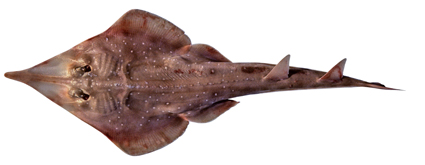
The Banded Guitarfish is a guitar-shaped fish with a diamond-shaped body. It occurs in the eastern Pacific from California, United States, to Mazatlan, Mexico, including the Gulf of California. It has dark bands across its back and rough dorsal skin covered with prickles and a central row of larger spikes.
Written 26 November 2026 from the sources listed below. Each statement was checked against the passage it cites; statements that could not be supported were removed.
Appearance
The Banded Guitarfish has a slender, diamond-shaped body, with its head and adjoining pectoral fins forming a broad triangular structure. Its disc is approximately as long as it is wide, and its head is relatively broad with a short, blunt snout.[1][2][3][4]
It has two ridges extending forward from the inner edges of its eyes and a large spiracle behind each eye. Its dorsal skin is rough and covered with small prickles or spikes, including a row of thorny projections along the midline from behind the eyes to the first dorsal fin.[5][6][7][8]
It has two large, triangular dorsal fins of equal size. Its tail is thick, with an asymmetrical caudal fin that lacks a distinct lower lobe and is equal to or shorter than its disc.[9][10][11]
Habitat
The Banded Guitarfish occurs from shallow water to depths of 200 m. It inhabits soft benthic substrates and sometimes occurs next to rocky reefs.[12][13]
Its principal documented range extends through the eastern Pacific from California, United States, to Mazatlan, Mexico, including the Gulf of California. It is also recorded from Southern California to the Gulf of California.[14][15]
Diet
The Banded Guitarfish is a specialist feeder whose main prey includes invertebrates, crustaceans, and teleost fishes. Documented prey include mobile benthic gastropods, bivalves, bony fishes, and mobile benthic crustaceans.[16][17]
Crabs are the principal crustaceans consumed by the species. Juveniles and adults consume crustaceans and demersal fishes, particularly Daisy midshipman, while adults have also been recorded consuming pelagic fishes.[18][19][20]
Behaviour
The Banded Guitarfish is primarily a bottom feeder but can also forage on pelagic fishes. It is a top predator in coastal rocky-reef benthic communities.[21][22]
It is generally skittish when approached and is described as harmless to humans.[23]
Reproduction and life cycle
The reproductive cycle lasts approximately one year, and gestation is estimated to last three to four months. Embryos develop through lecithotrophic yolk-sac viviparity, and the species gives birth to live young without a pelagic larval phase.[24][25][26][27]
Birth generally occurs in shallow sandy bays in late July or early August. Litter size ranges from four to eleven offspring, averaging seven, and newborn individuals have an average total length of 18 cm.[28][29][30]
Males are considered sexually mature at approximately 68 cm total length or seven years of age. Females are considered sexually mature at approximately 77 cm total length or nine years of age.[31][32]
In Baja California Sur, females occupy shallow birth areas while males remain elsewhere, and the sexes reunite in spring to reproduce. Embryonic diapause occurs in the Gulf of California population.[33][34]
Conservation
The species is classified as data deficient in the IUCN assessment described in the document. Its population doubling time is classified as very low, with a minimum exceeding 14 years.[35][36]
Its reproductive output is low because females produce relatively few offspring per cycle and maturation is slow. No conservation actions are reported as currently being in place.[37][38]
Uses
The Banded Guitarfish is caught in commercial and artisanal gillnet fisheries in Mexican waters, particularly the Gulf of California. Gillnet catches commonly occur during the spring reproductive period at depths of 9–22 m.[39][40]
Classification of the Banded Guitarfish
| Kingdom | Animalia |
|---|---|
| Phylum | Chordata |
| Subphylum | Vertebrata |
| Infraphylum | Gnathostomata |
| Parvphylum | Chondrichthyes |
| Class | Elasmobranchii |
| Subclass | Neoselachii |
| Infraclass | Batoidea |
| Order | Rhinopristiformes |
| Family | Trygonorrhinidae (Banjo Rays) |
| Genus | Zapteryx |
| Species | Zapteryx exasperata (Jordan & Gilbert, 1880) |
Where the Banded Guitarfish is found
Checklists and occurrence records place Zapteryx exasperata in 3 countries. GBIF holds 37,674 georeferenced records of it.
Countries
Regions and cities with the most records
- California, United States 3,521
- Goleta, United States 2,245
- Isla Vista, United States 2,245
- Santa Barbara, United States 1,694
- Lompoc, United States 1,213
- Agoura Hills, United States 627
- Thousand Oaks, United States 627
- Agoura, United States 375
- Orcutt, United States 180
- San Diego, United States 154
- Coronado, United States 92
- Santa Maria, United States 74
- National City, United States 24
- Chula Vista, United States 20
- Baja California Sur, Mexico 19
- Cabo San Lucas, Mexico 19
- Colonia del Sol, Mexico 19
- Sonora, Mexico 19
- Imperial Beach, United States 17
- Lemon Grove, United States 17
- La Mesa, United States 14
- Encinitas, United States 13
- Spring Valley, United States 9
- La Presa, United States 8
- Heroica Guaymas, Mexico 7
- Casa de Oro-Mount Helix, United States 6
- Empalme, Mexico 6
- La Paz, Mexico 4
- Lázaro Cárdenas, Mexico 4
- Compton, United States 3
- Dana Point, United States 3
- East Rancho Dominguez, United States 3
- Florence-Graham, United States 3
- Hermosa Beach, United States 3
- Ladera Ranch, United States 3
- Laguna Niguel, United States 3
1 more country has a few records outside this range
These countries hold a few records of Zapteryx exasperata but lie outside the range the checklists give for it. Such records are often zoo or garden specimens, museum material or vagrants, so the species is not counted as occurring there.
A number beside a place is its count of GBIF occurrence records. A place without a number comes from a checklist alone. Records show where a species has been observed or collected, which can include escapes and vagrants.
Common names
English
- Banded Guitarfish
- Mottled Guitarfish
- Prickly Skate
- Striped Guitarfish
Names in 7 other languages
- Czech
- pilohřbet kalifornský
- Dutch
- Bandgitaarrog
- Finnish
- vyökitararausku
- German
- Gebänderter Geigenrochen
- Italian
- Pesce chitarra a bande, Pesce violino a bande
- Portuguese
- Raia-viola-castanha
- Spanish
- Guitarra Pinta, guitarra rayada
Synonyms
2 other scientific names have been used for this species and are now treated as synonyms of Zapteryx exasperata.
- Platyrhina exasperata Jordan & Gilbert, 1880
- Trigonorhina alveata Garman, 1880
Related species
-
 Southern Banded GuitarfishZapteryx xyster
-
 Shortnose GuitarfishZapteryx brevirostris
-
 Eastern Fiddler RayTrygonorrhina fasciata
-
 Eastern Shovelnose RayAptychotrema rostrata
-
 Southern Fiddler RayTrygonorrhina dumerilii
-
 Southern Shovelnose RayAptychotrema vincentiana
-
 Spotted Shovelnose RayAptychotrema timorensis
Compare
Questions and answers
What is the scientific name of the Banded Guitarfish?
The scientific name of the Banded Guitarfish is Zapteryx exasperata. Written with its author, the full name is Zapteryx exasperata (Jordan & Gilbert, 1880).
Which family does the Banded Guitarfish belong to?
Zapteryx exasperata belongs to the family Trygonorrhinidae, in the order Rhinopristiformes and the class Elasmobranchii.
Where is the Banded Guitarfish found?
Checklists and occurrence records place Zapteryx exasperata in 3 countries: United States, Mexico and Panama.
What is the conservation status of the Banded Guitarfish?
The IUCN Red List category recorded for Zapteryx exasperata is Vulnerable (VU).
What other names does the Banded Guitarfish have?
Zapteryx exasperata is also known in English as Mottled Guitarfish, Prickly Skate and Striped Guitarfish.
What do guitarfish eat?
The Banded Guitarfish eats invertebrates, crustaceans, and teleost fishes. Crabs are its principal crustacean prey, and its diet also includes demersal fishes, particularly Daisy midshipman, as well as pelagic fishes.[16][18][19][20]
Are guitarfish aggressive?
The Banded Guitarfish is generally skittish when approached and is described as harmless to humans.[23]
Sources
Passages the profile rests on
- The species has a diamond-shaped body resembling a guitar. Source passage: “Banded guitarfish have diamond-shaped bodies that, as their name suggests, resemble guitars.” — English Wikipedia
- Its disc is approximately as long as it is wide, and it lacks the yellow eyespots found in Zapteryx xyster. Source passage: “Z. exasperata has a disc that is equally long as wide and lacks yellow eyespots found on Z. xyster.” — English Wikipedia
- Its body is slender, with the head and adjoining pectoral fins forming a broad triangular structure. Source passage: “Body slender; head and adjoining pectoral fins forming a distinctly broad triangular structure;” — biogeodb.stri.si.edu
- Its head is relatively broad, and its snout is short and relatively blunt. Source passage: “head relatively broad, snout short, relatively blunt,” — biogeodb.stri.si.edu
- Its dorsal skin is rough and covered with small prickles or spikes, including a central row of larger spikes extending to the first dorsal fin. Source passage: “Banded guitarfish have a rough textured skin caused by prickles or tiny spikes throughout the dorsal surface with a line of large spikes in the middle running to the first dorsal fin.” — English Wikipedia
- It has two ridges extending forward from the inner edges of its eyes. Source passage: “with two ridges running forwards from inner edges of eyes;” — biogeodb.stri.si.edu
- It has a large spiracle behind each eye. Source passage: “a large spiracle behind each eye;” — biogeodb.stri.si.edu
- A row of thorny projections runs along its dorsal midline from behind the eyes to the first dorsal fin. Source passage: “a row of thorny projections along dorsal midline from behind eyes to origin of first dorsal fin;” — biogeodb.stri.si.edu
- Its tail is thick and terminates in a rounded caudal fin, with a length equal to or shorter than its disc. Source passage: “The tail is thick from the base of the disc to its rounded caudal fin and is equal or shorter in length to its disc.” — English Wikipedia
- It has two large, triangular dorsal fins of equal size. Source passage: “two large, triangular, equal-sized dorsal fins;” — biogeodb.stri.si.edu
- Its tail fin is asymmetrical and lacks a distinct lower lobe. Source passage: “tail fin asymetrical without distinct lower lobe.” — biogeodb.stri.si.edu
- The species occurs from shallow water to depths of 200 m. Source passage: “They are found from shallow water to a depth of 200 m (660 ft)” — English Wikipedia
- It inhabits soft benthic substrates and sometimes occurs next to rocky reefs. Source passage: “Habitat: benthic on soft bottoms, sometimes adjacent to rocky reefs;” — biogeodb.stri.si.edu
- Its principal documented range extends through the eastern Pacific from California, United States, to Mazatlan, Mexico, including the Gulf of California. Source passage: “in the East Pacific from California, United States, to Mazatlan, Mexico, including the Gulf of California.” — English Wikipedia
- The species is recorded from Southern California to the Gulf of California. Source passage: “Southern California to the Gulf of California.” — biogeodb.stri.si.edu
- It is a specialist feeder whose main prey includes invertebrates, crustaceans, and teleost fishes. Source passage: “Banded guitarfish are specialist feeders whose main prey consists of invertebrates, crustaceans (mainly crabs), and teleost's.” — English Wikipedia
- Its documented prey categories include mobile benthic gastropods, bivalves, bony fishes, and mobile benthic crustaceans. Source passage: “Mobile benthic gastropods/bivalves Data Bony fishes Mobile benthic crustacea (shrimps/crabs)” — biogeodb.stri.si.edu
- Crabs are the principal crustaceans consumed by this species. Source passage: “crustaceans (mainly crabs)” — English Wikipedia
- Adults have been recorded consuming pelagic fishes. Source passage: “adults have been found to eat pelagic fish” — English Wikipedia
- Juveniles and adults consume crustaceans and demersal fishes, particularly Daisy midshipman. Source passage: “Both Juveniles and adults consume crustaceans (mainly consumed by juveniles) and demersal fish, mostly Daisy midshipman.” — English Wikipedia
- It is primarily a bottom feeder but can also forage on pelagic fishes. Source passage: “They are mostly bottom feeders, but adults have been found to eat pelagic fish” — English Wikipedia
- It is a top predator in coastal rocky-reef benthic communities. Source passage: “being a top predator in benthic communities on coastal rocky reefs.” — English Wikipedia
- It is generally skittish when approached and is described as harmless to humans. Source passage: “Banded guitarfish are harmless to humans and tend to be skittish when approached.” — English Wikipedia
- The reproductive cycle lasts approximately one year. Source passage: “The reproductive cycle of banded guitarfish is a year long.” — English Wikipedia
- Gestation is estimated to last three to four months. Source passage: “Gestation is thought to be 3–4 months” — English Wikipedia
- Embryos develop through lecithotrophic yolk-sac viviparity. Source passage: “Their embryo development is categorized as lecithotrophy yolk sac viviparity” — English Wikipedia
- The species gives birth to live young and has no pelagic larval phase. Source passage: “Live birth No pelagic phase No data No pelagic larva” — biogeodb.stri.si.edu
- Birth generally occurs in shallow sandy bays in late July or early August. Source passage: “followed by birth in shallow, sandy bays in late July or early August” — English Wikipedia
- Litter size ranges from four to eleven offspring, averaging seven. Source passage: “Litter sizes are dependent on the size of the female and range from 4-11 offspring with an average of 7 offspring.” — English Wikipedia
- Newborn individuals have an average total length of 18 cm. Source passage: “The average birth size of the neonates is 18 cm TL.” — English Wikipedia
- Males are considered sexually mature at approximately 68 cm total length or seven years of age. Source passage: “Males are considered sexually mature once they are 68 cm TL or around 7 years of age;” — English Wikipedia
- Females are considered sexually mature at approximately 77 cm total length or nine years of age. Source passage: “females are around 77 cm TL or about 9 years of age when thought to be mature.” — English Wikipedia
- In Baja California Sur, females occupy shallow birth areas while males remain elsewhere, and the sexes reunite in spring to reproduce. Source passage: “There is a known sexual segregation in Baja California Sur, Mexico, where females are found in shallow areas for birth but males are not. They only meet again in the spring months to reproduce” — English Wikipedia
- Embryonic diapause occurs in the Gulf of California population. Source passage: “In the Gulf of California, banded guitarfish also undergo embryonic diapause” — English Wikipedia
- The species is classified as data deficient in the IUCN assessment described in the document. Source passage: “Banded guitarfish are a data deficient species according to the IUCN.” — English Wikipedia
- Its population doubling time is classified as very low, with a minimum exceeding 14 years. Source passage: “Very Low, minimum population doubling time more than 14 years (Fec = 4).” — fishbase.se
- The species' reproductive output is low because females produce relatively few offspring per cycle and maturation is slow. Source passage: “Banded guitarfish have a low population growth because they produce small amounts of offspring per cycle that mature slow.” — English Wikipedia
- No conservation actions are reported as currently being in place. Source passage: “but no conservation actions are currently in place.” — English Wikipedia
- The species is caught in commercial and artisanal gillnet fisheries in Mexican waters, particularly the Gulf of California. Source passage: “Z. exasperata are mainly caught in commercial and artisanal gillnet fisheries in Mexican waters especially the Gulf of California, Mexico.” — English Wikipedia
- Gillnet catches commonly occur during the spring reproductive period at depths of 9–22 m. Source passage: “The reproduction period in spring is the most common time they are caught within depths ranging from 9–22 m deep.” — English Wikipedia
Data
- Catalogue of Life, 2026-10-16 XR cc by
- Global Biodiversity Information Facility CC BY 4.0
- Wikidata CC0
- GeoNames CC BY 4.0
- Wikimedia Commons per image; credit shown with each image
- Within the Catalogue of Life, this name comes from World Register of Marine Species cc by
This species in other databases
- Catalogue of Life 5CX6S
- Wikidata Q3320351
- iNaturalist 85115
- WoRMS urn:lsid:marinespecies.org:taxname:283213
- ITIS 160826
Page built on 27 November 2026. See how the catalog is made and all sources and licences.
Cite this page
ScientificNames.org. (2026). Zapteryx exasperata (Banded Guitarfish). Retrieved November 27, 2026, from https://scientificnames.org/species/zapteryx-exasperata
“Zapteryx exasperata (Banded Guitarfish).” ScientificNames.org, 2026, scientificnames.org/species/zapteryx-exasperata. Accessed 27 Nov. 2026.
ScientificNames.org. “Zapteryx exasperata (Banded Guitarfish).” Accessed November 27, 2026. https://scientificnames.org/species/zapteryx-exasperata.
@misc{scientificnames_zapteryx_exasperata_banded_guitarfish,
  author = {{ScientificNames.org}},
  title = {Zapteryx exasperata (Banded Guitarfish)},
  year = {2026},
  url = {https://scientificnames.org/species/zapteryx-exasperata},
  note = {Accessed 2026-11-27}
}