Species · Flowering plants
Waldo Rockcress Arabis aculeolata
The scientific name of the Waldo Rockcress is Arabis aculeolata. It is a species of flowering plant in the family Brassicaceae (crucifer), order Capparales.
- Scientific name
- Arabis aculeolata Greene
- Common name
- Waldo Rockcress
- Genus
- Arabis
- Family
- Brassicaceae (Crucifer)
- Order
- Capparales
- Class
- Magnoliopsida
- Recorded in
- 1 country
- Name status
- accepted in the Catalogue of Life

Overview
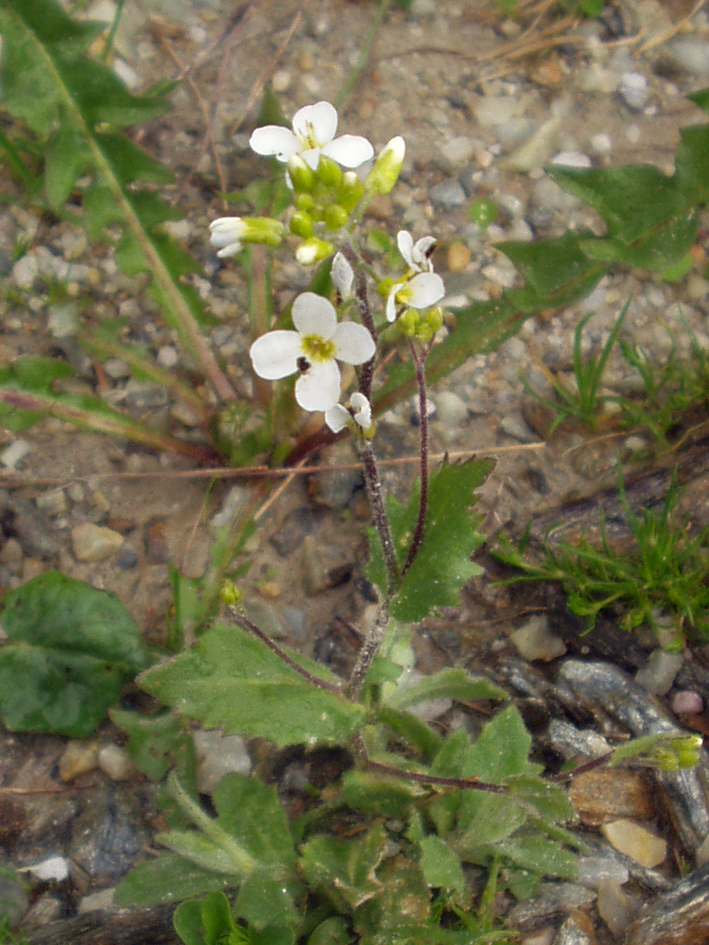
Waldo Rockcress (Arabis aculeolata Greene) is a perennial flowering herb in the family Brassicaceae, order Capparales, and class Magnoliopsida. It is native to a limited mountainous range in southern Oregon and is recorded in Del Norte and Siskiyou counties in California and Curry, Josephine, Jackson, and Douglas counties in Oregon. It has dark, hairy upright stems, pink or purple flowers, and long, thin upright fruits.
Written 27 November 2026 from the sources listed below. Each statement was checked against the passage it cites; statements that could not be supported were removed.
Appearance
Waldo Rockcress is a perennial herb that grows from a tough caudex covered with large hairs and the bases of leaves shed in previous seasons. Its upright stems are dark, often reddish or purplish, and covered with stiff white hairs.[1][2]
Its basal leaves are oval and green, with sparse coarse white hairs and smooth or wavy margins. Leaves higher on the stem are smaller than the basal leaves.[3][4]
Its flowers have dark purple sepals and lighter purple petals, and its flowering color is pink or purple. Its inflorescence is arranged as a raceme.[5][6][7]
Its fruit is a long, thin, upright silique. Its upright stems reach heights of 20–35 centimetres, basal leaves can reach 4 centimetres in length, and siliques can reach 6.5 centimetres in length.[8][9][10][11]
Habitat
Waldo Rockcress grows on rocky hillsides and in serpentine soil habitats. It occurs at elevations of 200–1,800 metres.[12][13][14]
Its recorded forest communities include yellow pine forest, red fir forest, lodgepole pine forest, and mixed evergreen forest. Its recorded habitats also include broadleafed upland forest and lower and upper montane coniferous forests.[15][16]
Reproduction and life cycle
Waldo Rockcress flowers from April through June.[17]
Similar species
Some plants recorded in the 1940s appeared intermediate between Arabis aculeolata and Arabis modesta, although this relationship was not confirmed.[18]
Conservation
Its global conservation rank is G4, indicating that it is apparently secure. Its global conservation status was last reviewed in 1989.[19][20]
Its conservation rank in Oregon is S3, indicating vulnerability, while its rank in California is S2, indicating imperiled status. The California species list assigns it a conservation rank of 2.2.[21][22][23]
The 2001 Oregon rare, threatened, and endangered species reference lists Waldo rockcress with a global rank of G4.[24]
Classification of the Waldo Rockcress
| Kingdom | Plantae |
|---|---|
| Subkingdom | Pteridobiotina |
| Phylum | Tracheophyta |
| Class | Magnoliopsida |
| Order | Capparales |
| Family | Brassicaceae (Crucifer) |
| Subfamily | Brassicoideae |
| Tribe | Arabideae |
| Genus | Arabis (Rockcress) |
| Species | Arabis aculeolata Greene |
Where the Waldo Rockcress is found
Checklists and occurrence records place Arabis aculeolata in 1 country across North America. GBIF holds 530 georeferenced records of it.
Countries
Regions and cities with the most records
Range as the checklists state it
USA (Oregon: Curry Co., Douglas Co., Josephine Co.)
A number beside a place is its count of GBIF occurrence records. A place without a number comes from a checklist alone. Records show where a species has been observed or collected, which can include escapes and vagrants.
Common names
English
- Waldo Rockcress
Related species
-
 Alpine Rock-CressArabis alpina
-
 Garden ArabisArabis caucasica
-
 Hairy RockcressArabis hirsuta
-
 Running RockcressArabis procurrens
-
 Rose RockcressArabis blepharophylla
-
 Bristol Rock-CressArabis scabra
-
 Troodos RockcressArabis kennedyae
-
 Annual RockcressArabis auriculata
Compare
Questions and answers
What is the scientific name of the Waldo Rockcress?
The scientific name of the Waldo Rockcress is Arabis aculeolata. Written with its author, the full name is Arabis aculeolata Greene.
Which family does the Waldo Rockcress belong to?
Arabis aculeolata belongs to the family Brassicaceae, in the order Capparales and the class Magnoliopsida.
Where is the Waldo Rockcress found?
Checklists and occurrence records place Arabis aculeolata in 1 country: United States.
Where is Waldo Rockcress found?
It is native to a limited mountainous range in southern Oregon. In California, it is recorded in Del Norte and Siskiyou counties; in Oregon, it is recorded in Curry, Josephine, Jackson, and Douglas counties.[25][26][27]
What type of soil does Waldo Rockcress grow in?
It grows in serpentine soils and on rocky hillsides.[12][13]
When does Waldo Rockcress flower?
Its flowering period extends from April through June.[17]
How tall does Waldo Rockcress grow?
Its upright stems reach heights of 20–35 centimetres.[9]
Sources
Passages the profile rests on
- Arabis aculeolata is a perennial herb that grows from a tough caudex covered with large hairs and the bases of leaves shed in previous seasons. Source passage: “This is a perennial herb growing from a tough caudex covered in large hairs and the bases of leaves shed in previous seasons.” — English Wikipedia
- Its upright stems are dark, often reddish or purplish, and covered with stiff white hairs. Source passage: “The stems are dark in color, often reddish or purplish, and are coated in stiff white hairs.” — English Wikipedia
- Its basal leaves are oval, green, sparsely covered with coarse white hairs, and have smooth or wavy margins. Source passage: “They are oval-shaped, green in color and sparsely covered in coarse white hairs, up to 4 centimetres (1.6 in) long, and with smooth or wavy edges.” — English Wikipedia
- Leaves higher on the stem are smaller than the basal leaves. Source passage: “Leaves located higher up the stem are smaller.” — English Wikipedia
- Its flowers have dark purple sepals and lighter purple petals. Source passage: “The flowers have dark purple sepals and lighter purple petals.” — English Wikipedia
- Its flowering color is pink or purple. Source passage: “The bloom color is pink or purple.” — English Wikipedia
- Its inflorescence is arranged as a raceme. Source passage: “The inflorescence is raceme.” — English Wikipedia
- Its fruit is a long, thin, upright silique. Source passage: “The fruit is a long, thin, upright silique up to 6.5 centimetres (2.6 in) long.” — English Wikipedia
- Its upright stems reach heights of 20–35 centimetres. Source passage: “It produces one or more upright stems to heights between 20 and 35 centimetres (7.9 and 13.8 in).” — English Wikipedia
- Its basal leaves can reach 4 centimetres in length. Source passage: “They are oval-shaped, green in color and sparsely covered in coarse white hairs, up to 4 centimetres (1.6 in) long, and with smooth or wavy edges.” — English Wikipedia
- Its siliques can reach 6.5 centimetres in length. Source passage: “The fruit is a long, thin, upright silique up to 6.5 centimetres (2.6 in) long.” — English Wikipedia
- Arabis aculeolata occurs in serpentine soil habitats. Source passage: “It is native to a small range in the mountains of southern Oregon, where it is an uncommon member of the serpentine soils flora.” — English Wikipedia
- It grows on rocky hillsides and serpentine soils. Source passage: “It is found in rocky hillsides and serpentine soils.” — English Wikipedia
- It occurs at elevations of 200–1,800 metres. Source passage: “It is also found at elevations of 200–1,800 m (660–5,910 ft).” — English Wikipedia
- Its recorded forest communities include yellow pine forest, red fir forest, lodgepole pine forest, and mixed evergreen forest. Source passage: “Its communities include, yellow pine forest, red fir forest, lodgepole pine forest, and mixed evergreen forest.” — English Wikipedia
- Its recorded habitats include broadleafed upland forest and lower and upper montane coniferous forests. Source passage: “Broadleafed upland forest, lower montane coniferous forest, upper montane coniferous forest.” — nrm.dfg.ca.gov
- Its flowering period extends from April through June. Source passage: “The bloom period is between the months of April, May and June.” — English Wikipedia
- Some plants recorded in the 1940s appeared intermediate between Arabis aculeolata and Arabis modesta, although this relationship was not confirmed. Source passage: “Some plants in the 1940s seem intermediate between Arabis aculeolata and Arabis modesta. However, this has not been confirmed.” — English Wikipedia
- Its global conservation rank is G4, indicating that it is apparently secure. Source passage: “It has a global rank of G4, which means apparently secure.” — English Wikipedia
- Its global conservation status was last reviewed in 1989. Source passage: “The global status was last reviewed in 1989.” — English Wikipedia
- Its conservation rank in Oregon is S3, indicating vulnerability. Source passage: “It has a S3 rank in Oregon, meaning vulnerable” — English Wikipedia
- Its conservation rank in California is S2, indicating imperiled status. Source passage: “and a S2 rank in California, meaning imperiled.” — English Wikipedia
- The California species list assigns it a conservation rank of 2.2. Source passage: “Arabis aculeolata. Waldo rock-cress. None. None. 2.2.” — nrm.dfg.ca.gov
- The 2001 Oregon rare, threatened, and endangered species reference lists Waldo rockcress with a global rank of G4. Source passage: “Arabis aculeolata Greene. KM, WC; CA. G4.” — pdxscholar.library.pdx.edu
- Arabis aculeolata is native to a limited mountainous range in southern Oregon. Source passage: “It is native to a small range in the mountains of southern Oregon” — English Wikipedia
- In California, it is recorded in Del Norte and Siskiyou counties. Source passage: “It is typically found in the counties of Del Norte and Siskiyou in California.” — English Wikipedia
- In Oregon, it is recorded in Curry, Josephine, Jackson, and Douglas counties. Source passage: “It is also found in the counties of Curry, Josephine, Jackson, and Douglas in Oregon.” — English Wikipedia
Data
- Catalogue of Life, 2026-10-16 XR cc by
- Global Biodiversity Information Facility CC BY 4.0
- Wikidata CC0
- GeoNames CC BY 4.0
- Wikimedia Commons per image; credit shown with each image
- Within the Catalogue of Life, this name comes from Synonymic Checklists of the Vascular Plants of the World cc by
References
- Greene. (1910). Leafl. Bot. Observ. Crit. 2: 69 (1910). where the name was published
This species in other databases
Page built on 28 November 2026. See how the catalog is made and all sources and licences.
Cite this page
ScientificNames.org. (2026). Arabis aculeolata (Waldo Rockcress). Retrieved November 28, 2026, from https://scientificnames.org/species/arabis-aculeolata
“Arabis aculeolata (Waldo Rockcress).” ScientificNames.org, 2026, scientificnames.org/species/arabis-aculeolata. Accessed 28 Nov. 2026.
ScientificNames.org. “Arabis aculeolata (Waldo Rockcress).” Accessed November 28, 2026. https://scientificnames.org/species/arabis-aculeolata.
@misc{scientificnames_arabis_aculeolata_waldo_rockcress,
  author = {{ScientificNames.org}},
  title = {Arabis aculeolata (Waldo Rockcress)},
  year = {2026},
  url = {https://scientificnames.org/species/arabis-aculeolata},
  note = {Accessed 2026-11-28}
}