Species · Flowering plants
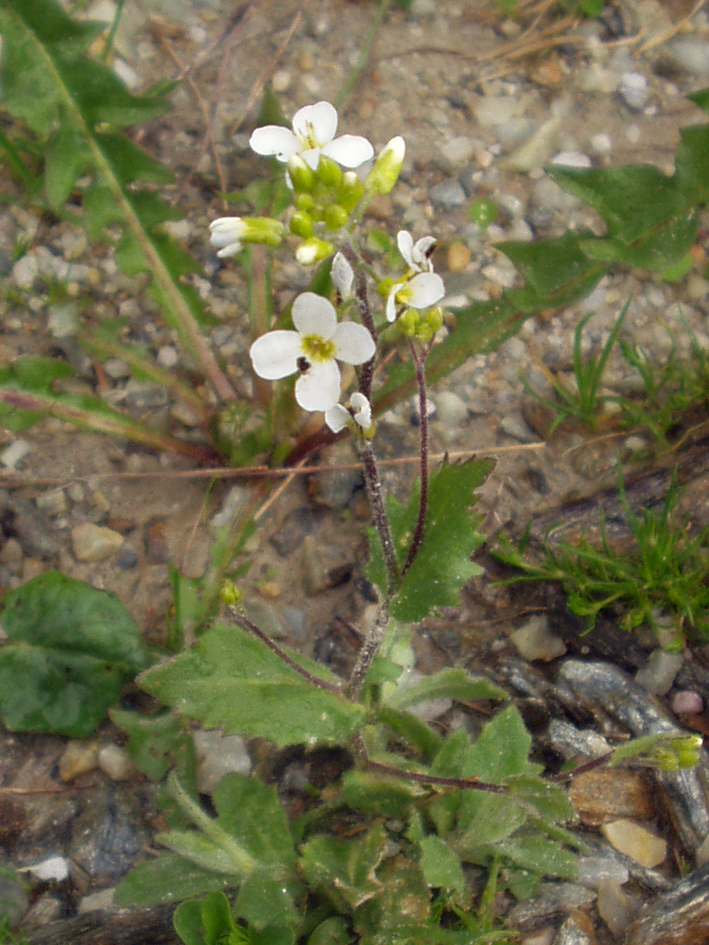
Bristol Rock-Cress Arabis scabra
The scientific name of the Bristol Rock-Cress is Arabis scabra. It is a species of flowering plant in the family Brassicaceae (crucifer), order Capparales.
- Scientific name
- Arabis scabra All.
- Common name
- Bristol Rock-Cress
- Genus
- Arabis
- Family
- Brassicaceae (Crucifer)
- Order
- Capparales
- Class
- Magnoliopsida
- Recorded in
- 10 countries
- Name status
- accepted in the Catalogue of Life

Overview
Bristol Rock-Cress is a perennial flowering plant and a short-lived perennial herb. It grows in shallow, lime-rich soils on warm limestone slopes, including scree, rocky ledges and open woodland edges. The Avon Gorge population retains a high proportion of the species' overall genetic variation.
Written 27 November 2026 from the sources listed below. Each statement was checked against the passage it cites; statements that could not be supported were removed.
Appearance
Bristol Rock-Cress is a perennial flowering plant. It is described as a short-lived perennial herb.[1][2]
Habitat
Suitable habitats include scree, rocky ledges and open woodland edges. Its native distribution includes France, Spain and Switzerland, with an isolated population in the Avon Gorge in England.[3][4]
The species occurs in the Pyrenees, northern and north-eastern Iberia, south-eastern France and the south-western Alps. Its only native English population occurs in the Avon Gorge near Bristol.[5][6]
Conservation
The Iberian Peninsula is the primary centre of genetic diversity for Bristol Rock-Cress. Its two major gene pools diverged during the last glacial period and contain most of the species' rare alleles.[7][8][9]
The Avon Gorge population retains a high proportion of the species' overall genetic variation. British Isles populations also exhibit high genetic diversity.[10][11]
Introduced populations outside the native English range, including one at Combwich, have generally failed to persist.[12]
Behaviour
Bristol Rock-Cress expanded northwards from Iberian refugia after the Last Glacial Maximum. Its range expanded through corridors in open landscapes.[13][14]
The British Isles were colonized after the Last Glacial Maximum. The Avon Gorge population was probably established through seed dispersal approximately 16,000 years ago.[15][16]
Classification of the Bristol Rock-Cress
| Kingdom | Plantae |
|---|---|
| Subkingdom | Pteridobiotina |
| Phylum | Tracheophyta |
| Class | Magnoliopsida |
| Order | Capparales |
| Family | Brassicaceae (Crucifer) |
| Subfamily | Brassicoideae |
| Tribe | Arabideae |
| Genus | Arabis (Rockcress) |
| Species | Arabis scabra All. |
Where the Bristol Rock-Cress is found
Checklists and occurrence records place Arabis scabra in 10 countries across Europe. GBIF holds 4,511 georeferenced records of it.
Countries
- Andorra 3
- Austria 9
- Czechia 3
- Finland 3
- France 2,100
- Germany 25
- Italy 4
- Spain 1,728
- Switzerland 70
- United Kingdom 566
Regions and cities with the most records
- Auvergne-Rhône-Alpes, France 1,308
- Occitanie, France 509
- England, United Kingdom 491
- Clevedon, United Kingdom 419
- Nailsea, United Kingdom 419
- Bristol, United Kingdom 418
- Portishead, United Kingdom 418
- Keynsham, United Kingdom 416
- Vernier, Switzerland 415
- Kingswood, United Kingdom 414
- Onex, Switzerland 413
- Mangotsfield, United Kingdom 408
- Yate, United Kingdom 408
- Meyrin, Switzerland 404
- Carouge, Switzerland 378
- Geneva, Switzerland 374
- Échirolles, France 323
- Fontaine, France 322
- Grenoble, France 314
- Saint-Égrève, France 311
- Saint-Martin-d'Hères, France 297
- Meylan, France 288
- Annemasse, France 280
- Catalonia, Spain 200
- Aragon, Spain 163
- Voiron, France 142
- Basque Country, Spain 141
- Valencia, Spain 105
- Barañáin, Spain 102
- Pamplona, Spain 98
- Burlata, Spain 94
- Burnham-on-Sea, United Kingdom 69
- Bridgwater, United Kingdom 68
- Taunton, United Kingdom 63
- Annecy-le-Vieux, France 61
- Tortosa, Spain 60
1 more country has a few records outside this range
These countries hold a few records of Arabis scabra but lie outside the range the checklists give for it. Such records are often zoo or garden specimens, museum material or vagrants, so the species is not counted as occurring there.
Range as the checklists state it
England (SW-England: Avon Gorge); N-Spain (mountains); Andorra; SE-France; SW-France
A number beside a place is its count of GBIF occurrence records. A place without a number comes from a checklist alone. Records show where a species has been observed or collected, which can include escapes and vagrants.
Common names
English
- Bristol Rock-Cress
Names in 2 other languages
- French
- Arabette scabre
- Welsh
- Berwr Bryste, Berwr-y-Cerrig Bryste
Synonyms
11 other scientific names have been used for this species and are now treated as synonyms of Arabis scabra.
- Arabis hirta Lam.
- Arabis scabra var. corbariensis (Timb.-Lagr.) P.Fourn.
- Arabis stricta subsp. biennis (Timb.-Lagr.) Rouy & Foucaud
- Arabis stricta subsp. corbariensis (Timb.-Lagr.) Rouy & Foucaud
- Turrita stricta (Huds.) Bubani
- Turritis raii Vill.
- Arabis hispida Aiton ambiguous synonym
- Arabis montana Bernh. ex DC. ambiguous synonym
- Arabis stricta Huds. ambiguous synonym
- Erysimum strictum (Huds.) Kuntze ambiguous synonym
- Turritis stricta (Huds.) Fourr. ambiguous synonym
Related species
-
 Alpine Rock-CressArabis alpina
-
 Garden ArabisArabis caucasica
-
 Hairy RockcressArabis hirsuta
-
 Running RockcressArabis procurrens
-
 Rose RockcressArabis blepharophylla
-
 Waldo RockcressArabis aculeolata
-
 Troodos RockcressArabis kennedyae
-
 Annual RockcressArabis auriculata
Compare
Questions and answers
What is the scientific name of the Bristol Rock-Cress?
The scientific name of the Bristol Rock-Cress is Arabis scabra. Written with its author, the full name is Arabis scabra All..
Which family does the Bristol Rock-Cress belong to?
Arabis scabra belongs to the family Brassicaceae, in the order Capparales and the class Magnoliopsida.
Where is the Bristol Rock-Cress found?
Checklists and occurrence records place Arabis scabra in 10 countries, including France, Spain, United Kingdom, Switzerland, Germany and Austria.
Sources
Passages the profile rests on
- Arabis scabra is a perennial flowering plant. Source passage: “Arabis scabra, the Bristol rockcress, is a perennial flowering plant” — English Wikipedia
- Arabis scabra is described as a short-lived perennial herb. Source passage: “The short-lived perennial herb Arabis scabra” — pmc.ncbi.nlm.nih.gov
- Suitable habitats include scree, rocky ledges and open woodland edges. Source passage: “on scree, rocky ledges and open woodland edges” — English Wikipedia
- The native distribution of Arabis scabra includes France, Spain and Switzerland, with an isolated population in the Avon Gorge in England. Source passage: “with a disjunct native range in France, Spain and Switzerland and a single outpost in the Avon Gorge, England.” — English Wikipedia
- The species occurs in the Pyrenees, northern and north-eastern Iberia, south-eastern France and the south-western Alps. Source passage: “the mountains of northern and north-eastern Iberia, south-eastern France and the south-western Alps.” — English Wikipedia
- The only native English population of Arabis scabra occurs in the Avon Gorge near Bristol. Source passage: “In England it is native only to the Avon Gorge near Bristol” — English Wikipedia
- The Iberian Peninsula is the primary centre of genetic diversity for the species. Source passage: “with the Iberian Peninsula as the primary centre of genetic diversity” — pmc.ncbi.nlm.nih.gov
- The Iberian Peninsula's two major gene pools diverged during the last glacial period. Source passage: “two major gene pools there diverged during the last glacial period” — English Wikipedia
- The Iberian Peninsula gene pools contain most of the species' rare alleles. Source passage: “harbour most of the species' rare alleles.” — English Wikipedia
- The Avon Gorge population retains a high proportion of the species' overall genetic variation. Source passage: “has nonetheless retained a high proportion of the species' overall genetic variation.” — English Wikipedia
- The British Isles populations of Arabis scabra exhibit high genetic diversity. Source passage: “The British Isles were colonized after the LGM and feature high genetic diversity.” — pmc.ncbi.nlm.nih.gov
- Introduced populations outside the native English range, including one at Combwich, have generally failed to persist. Source passage: “isolated introductions elsewhere (for example at Combwich) have generally failed to persist.” — English Wikipedia
- The species expanded northwards from Iberian refugia after the Last Glacial Maximum. Source passage: “From these refugia A. scabra expanded northwards after the Last Glacial Maximum” — English Wikipedia
- The species expanded its range after the Last Glacial Maximum through corridors in open landscapes. Source passage: “has expanded its distribution range after the LGM, following corridors within an open landscape” — pmc.ncbi.nlm.nih.gov
- The British Isles were colonized by Arabis scabra after the Last Glacial Maximum. Source passage: “The British Isles were colonized after the LGM” — pmc.ncbi.nlm.nih.gov
- The Avon Gorge population was probably established through seed dispersal approximately 16,000 years ago. Source passage: “The Avon Gorge population appears to have been founded around 16,000 years ago by seed‐mediated dispersal” — English Wikipedia
Data
- Catalogue of Life, 2026-10-16 XR cc by
- Global Biodiversity Information Facility CC BY 4.0
- Wikidata CC0
- GeoNames CC BY 4.0
- Wikimedia Commons per image; credit shown with each image
- Within the Catalogue of Life, this name comes from Synonymic Checklists of the Vascular Plants of the World cc by
References
- All. (1785). Fl. Pedem. 1: 268 (1785). where the name was published
This species in other databases
Page built on 28 November 2026. See how the catalog is made and all sources and licences.
Cite this page
ScientificNames.org. (2026). Arabis scabra (Bristol Rock-Cress). Retrieved November 28, 2026, from https://scientificnames.org/species/arabis-scabra
“Arabis scabra (Bristol Rock-Cress).” ScientificNames.org, 2026, scientificnames.org/species/arabis-scabra. Accessed 28 Nov. 2026.
ScientificNames.org. “Arabis scabra (Bristol Rock-Cress).” Accessed November 28, 2026. https://scientificnames.org/species/arabis-scabra.
@misc{scientificnames_arabis_scabra_bristol_rock_cress,
  author = {{ScientificNames.org}},
  title = {Arabis scabra (Bristol Rock-Cress)},
  year = {2026},
  url = {https://scientificnames.org/species/arabis-scabra},
  note = {Accessed 2026-11-28}
}