Species · Mammals
Asian Palm Civet Paradoxurus hermaphroditus
The scientific name of the Asian Palm Civet is Paradoxurus hermaphroditus. It is a species of mammal in the family Viverridae (oyans), order Carnivora. The name dates from 1777.
- Scientific name
- Paradoxurus hermaphroditus (Pallas, 1777)
- Common name
- Asian Palm Civet
- Genus
- Paradoxurus
- Family
- Viverridae (Oyans)
- Order
- Carnivora
- Class
- Mammalia
- Red List category
- LC Least Concern
- Environment
- terrestrial
- Recorded in
- 16 countries
- Name status
- accepted in the Catalogue of Life

Overview
The Asian palm civet (Paradoxurus hermaphroditus), also called common palm civet, toddy cat and musang, is a viverrid native to South and Southeast Asia. Since 2008, it is IUCN Red Listed as least concern as it accommodates to a broad range of habitats. It is widely distributed with large populations that in 2008 were thought unlikely to be declining. It is threatened by poaching for the illegal wildlife trade.
Classification of the Asian Palm Civet
| Kingdom | Animalia |
|---|---|
| Phylum | Chordata |
| Subphylum | Vertebrata |
| Infraphylum | Gnathostomata |
| Parvphylum | Osteichthyes |
| Megaclass | Tetrapoda |
| Class | Mammalia (Mammal) |
| Subclass | Theria |
| Infraclass | Eutheria |
| Order | Carnivora (Carnivores) |
| Suborder | Feliformia (Cat-like Carnivores) |
| Family | Viverridae (Oyans) |
| Subfamily | Paradoxurinae (Binturong) |
| Genus | Paradoxurus (Palm Civet) |
| Species | Paradoxurus hermaphroditus (Pallas, 1777) |
Where the Asian Palm Civet is found
Checklists and occurrence records place Paradoxurus hermaphroditus in 16 countries across Asia. GBIF holds 3,997 georeferenced records of it.
Countries
- Bangladesh 12
- Bhutan 3
- Cambodia 2,009
- China 44
- India 505
- Indonesia 534
- Laos 42
- Malaysia 283
- Myanmar 59
- Nepal 32
- Pakistan 14
- Philippines 97
- Singapore 10
- Sri Lanka 63
- Thailand 149
- Vietnam 141
Regions and cities with the most records
- Preah Vihear, Cambodia 1,859
- Johor, Malaysia 80
- Kerala, India 65
- Maharashtra, India 46
- Karnataka, India 40
- Perak, Malaysia 38
- Uttar Pradesh, India 34
- Tamil Nadu, India 33
- Madhya Pradesh, India 32
- Thanh Hóa Province, Vietnam 30
- Uttarakhand, India 29
- Kelantan, Malaysia 26
- Yunnan, China 26
- Simpang Empat, Malaysia 25
- Dehradun, India 24
- Kota Tinggi, Malaysia 24
- West Bengal, India 24
- Bandar Baharu, Malaysia 22
- Tanintharyi Region, Myanmar 22
- Assam, India 20
- Goa, India 20
- Kedah, Malaysia 19
- Mondolkiri, Cambodia 19
- Telangana, India 17
- Valparai, India 15
- Battambang, Cambodia 14
- Khammouane Province, Laos 14
- Koh Kong, Cambodia 14
- Rajasthan, India 14
- Bankra, India 13
- Saraburi, Thailand 13
- Bāli, India 12
- Dam Dam, India 12
- Howrah, India 12
- Kolkata, India 12
- Dambulla, Sri Lanka 11
4 more countries have a few records outside this range
These countries hold a few records of Paradoxurus hermaphroditus but lie outside the range the checklists give for it. Such records are often zoo or garden specimens, museum material or vagrants, so the species is not counted as occurring there.
Range as the checklists state it
Southern Asia
A number beside a place is its count of GBIF occurrence records. A place without a number comes from a checklist alone. Records show where a species has been observed or collected, which can include escapes and vagrants.
Common names
English
- Asian Palm Civet
- Common Palm Civet
- Mentawai Palm Civet
- Northern Palm Civet
- South Asian Palm Civet
- Toddy Cat
Names in 40 other languages
- Arabic
- زباد, زباد النخيل الآسيوي
- Bengali
- গন্ধগোকুল
- Bulgarian
- Азиатска палмова цивета
- Chinese
- 椰子狸, 椰子貓
- Croatian
- Azijska cibetka palmašica
- Czech
- Oviječ skvrnitý
- Danish
- Indisk palmeruller, luwak
- Dutch
- Loewak
- Esperanto
- Azia palm-civeto
- Finnish
- musanki
- French
- Civette hermaphrodite
- German
- Fleckenmusang, Palmenroller
- Gujarati
- તાડ બિલાડી
- Hebrew
- גחן-דקלים אסייתי
- Hindi
- ताड़ बिल्ली
- Hungarian
- Közönséges pálmasodró
- Indonesian
- Musang, Musang Luwak
- Italian
- Civetta delle palme comune, Zibetto delle palme comune
- Japanese
- パームシベット
- Kannada
- ತಾಳೆಬೆಕ್ಕು, ಬೆರು
- Khmer
- សំពោចក្រអូប
- Korean
- 아시아사향고양이
- Lithuanian
- Palminis musangas
- Malay
- Musang Pulut
- Malayalam
- മരപ്പട്ടി, മരപ്പട്ടി Marappatti
- Marathi
- ऊदमांजर
- Norwegian Bokmål
- Asiapalmemår, Asiatisk Palmesivett
- Polish
- Łaskun mentawajski, Łaskun muzang, Łaskun palmowy
- Portuguese
- civeta-das-palmeiras-asiática
- Russian
- Малайская пальмовая куниц, Обыкновенный мусан
- Sinhala
- උගුඩුවා, කලවැද්දා
- Spanish
- Civeta palmera asiática, civeta de las palmeras
- Swedish
- Indisk palmmård
- Tagalog
- Alamid
- Tamil
- புனுகுப்பூனை
- Thai
- อีเห็นข้างลาย, อีเห็นธรรมดา
- Vietnamese
- Cầy vòi đốm
- ory
- ଶାଳିଆପାତିନି
- sun
- Careuh bulan
- tet
- Laku
Synonyms
25 other scientific names have been used for this species and are now treated as synonyms of Paradoxurus hermaphroditus.
- Paradoxurus hermaphroditus balicus Sody, 1933
- Paradoxurus hermaphroditus bondar (Desmarest, 1820)
- Paradoxurus hermaphroditus canescens Lyon, 1907
- Paradoxurus hermaphroditus canus Miller, 1913
- Paradoxurus hermaphroditus cochinensis Schwarz, 1911
- Paradoxurus hermaphroditus dongfangensis Corbet & Hill, 1992
- Paradoxurus hermaphroditus enganus Lyon, 1916
- Paradoxurus hermaphroditus exitus Schwarz, 1911
- Paradoxurus hermaphroditus kangeanus Thomas, 1910
- Paradoxurus hermaphroditus laotum Gyldenstolpe, 1917
- Paradoxurus hermaphroditus milleri Kloss, 1908
- Paradoxurus hermaphroditus nictitans Taylor, 1891
- Paradoxurus hermaphroditus pallasii Gray, 1832
- Paradoxurus hermaphroditus pallens Miller, 1913
- Paradoxurus hermaphroditus parvus Miller, 1913
- Paradoxurus hermaphroditus pugnax Miller, 1913
- Paradoxurus hermaphroditus pulcher Miller, 1913
- Paradoxurus hermaphroditus sacer Miller, 1913
- Paradoxurus hermaphroditus scindiae Pocock, 1934
- Paradoxurus hermaphroditus senex Miller, 1913
- Paradoxurus hermaphroditus setosus Jacquinot & Pucheran, 1853
- Paradoxurus hermaphroditus simplex Miller, 1913
- Paradoxurus hermaphroditus sumbanus Schwarz, 1910
- Paradoxurus hermaphroditus vellerosus Pocock, 1934
- Viverra hermaphrodita Pallas, 1777
Subspecies and varieties
- Paradoxurus hermaphroditus hermaphroditus (Indian Palm Civet) subspecies
- Paradoxurus hermaphroditus minor (Siamese Palm Civet) subspecies
Related species
-
 Golden Palm CivetParadoxurus zeylonensis
-
 Brown Palm CivetParadoxurus jerdoni
- Philippine Palm CivetParadoxurus philippinensis
- Sumatran Palm CivetParadoxurus musangus
-
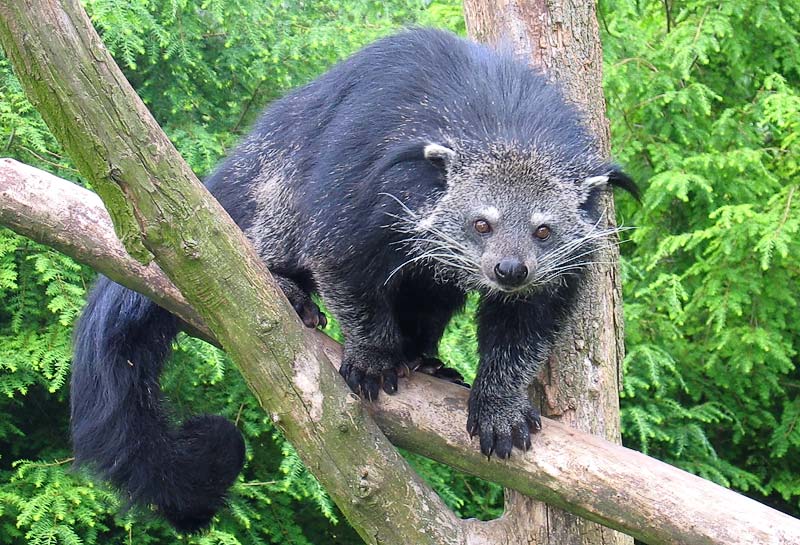 BinturongArctictis binturong
-
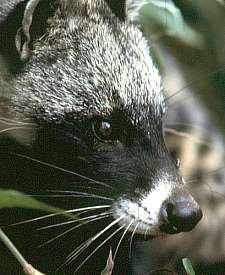 African CivetCivettictis civetta
-
 Common GenetGenetta genetta
-
 Masked Palm CivetPaguma larvata
Compare
Questions and answers
What is the scientific name of the Asian Palm Civet?
The scientific name of the Asian Palm Civet is Paradoxurus hermaphroditus. Written with its author, the full name is Paradoxurus hermaphroditus (Pallas, 1777).
Which family does the Asian Palm Civet belong to?
Paradoxurus hermaphroditus belongs to the family Viverridae, in the order Carnivora and the class Mammalia.
Where is the Asian Palm Civet found?
Checklists and occurrence records place Paradoxurus hermaphroditus in 16 countries, including Cambodia, Indonesia, India, Malaysia, Thailand and Vietnam.
What is the conservation status of the Asian Palm Civet?
The IUCN Red List category recorded for Paradoxurus hermaphroditus is Least Concern (LC).
What other names does the Asian Palm Civet have?
Paradoxurus hermaphroditus is also known in English as Common Palm Civet, Mentawai Palm Civet, Northern Palm Civet, South Asian Palm Civet and Toddy Cat.
Sources
Data
- Catalogue of Life, 2026-10-16 XR cc by
- Global Biodiversity Information Facility CC BY 4.0
- Wikidata CC0
- English Wikipedia CC BY-SA 4.0
- GeoNames CC BY 4.0
- Wikimedia Commons per image; credit shown with each image
- Within the Catalogue of Life, this name comes from The Integrated Taxonomic Information System cc0
References
- In Schreber, Die Säugethiere vol.3 25 p.426 [1777] where the name was published
- Wilson, Don E., and DeeAnn M. Reeder, eds. (1993). Mammal Species of the World: A Taxonomic and Geographic Reference, 2nd Ed., 3rd Printing.
- Wilson, Don E., and F. Russell Cole. (2000). Common Names of Mammals of the World.
- Wilson, Don E., and DeeAnn M. Reeder, eds. (2005). Mammal Species of the World: A Taxonomic and Geographic Reference, 3rd Ed., Vols. 1 & 2.
- Jennings, A. P., and G. Veron / Don E. Wilson and Russell A. Mittermeier, eds. (2009). Family Viverridae (Civets, Genets and Oyans). Handbook of the Mammals of the World. Vol. 1: Carnivores.
- Veron, Géraldine, Marie-Lilith Patou, Mária Tóth, Manori Goontilake, and Andrew P. Jennings. (2015). How many species of Paradoxurus civets are there? New insights from India and Sri Lanka. Journal of Zoological Systematics and Evolutionary Research, Vol. 53, No. 2.
This species in other databases
- Catalogue of Life 75P5H
- Wikidata Q18764
- iNaturalist 925714
- WoRMS urn:lsid:marinespecies.org:taxname:1550118
Page built on 24 November 2026. See how the catalog is made and all sources and licences.
Cite this page
ScientificNames.org. (2026). Paradoxurus hermaphroditus (Asian Palm Civet). Retrieved November 24, 2026, from https://scientificnames.org/species/paradoxurus-hermaphroditus
“Paradoxurus hermaphroditus (Asian Palm Civet).” ScientificNames.org, 2026, scientificnames.org/species/paradoxurus-hermaphroditus. Accessed 24 Nov. 2026.
ScientificNames.org. “Paradoxurus hermaphroditus (Asian Palm Civet).” Accessed November 24, 2026. https://scientificnames.org/species/paradoxurus-hermaphroditus.
@misc{scientificnames_paradoxurus_hermaphroditus_asian_palm_civet,
  author = {{ScientificNames.org}},
  title = {Paradoxurus hermaphroditus (Asian Palm Civet)},
  year = {2026},
  url = {https://scientificnames.org/species/paradoxurus-hermaphroditus},
  note = {Accessed 2026-11-24}
}