Species · Crustaceans
Ascidonia flavomaculata
Ascidonia flavomaculata has no English name on record in the checklists used here. It is a species of crustacean in the family Palaemonidae (palaemonids), order Decapoda. The name dates from 1864.
- Scientific name
- Ascidonia flavomaculata (Heller, 1864)
- Genus
- Ascidonia
- Family
- Palaemonidae (Palaemonids)
- Order
- Decapoda
- Class
- Malacostraca
- Environment
- marine
- Recorded in
- 5 countries
- Name status
- accepted in the Catalogue of Life
Overview
Ascidonia flavomaculata (Heller, 1864) is a crustacean in the family Palaemonidae, order Decapoda, and class Malacostraca. It inhabits shallow subtidal coastal marine environments, commonly living inside the branchial chambers of solitary ascidian hosts. It has a clear, translucent body marked with yellow spots and visible green internal organs.
Written 27 November 2026 from the sources listed below. Each statement was checked against the passage it cites; statements that could not be supported were removed.
Appearance
Ascidonia flavomaculata has a clear, translucent body with yellow spots and visible green internal organs. Individuals range from 2 to 20 mm in length.[1][2]
Habitat
The species inhabits shallow subtidal coastal marine environments and commonly occurs inside sea squirts, particularly Phallusia mammillata. Individuals live within the branchial chambers of ascidian hosts and are generally associated endosymbiotically with solitary ascidians.[3][4][5][6]
The species is recorded among ascidian hosts belonging to the order Phlebobranchia. It can also associate with sea sponges, sea anemones, gorgonians, corals, mollusks, and echinoderms.[7][8]
Behaviour
Individuals generally live alone inside the branchial chambers of ascidians. The species exhibits a symbiotic lifestyle within solitary ascidian hosts.[9][10]
Diet
Individuals occasionally leave their hosts to scavenge for debris and detritus.[11]
Reproduction and life cycle
The species is gonochoric, with separate male and female individuals. Females have larger abdomens and carapaces than males.[12][13]
Males leave their hosts to seek females for reproduction and remain with them for a period before returning to their own hosts.[14][15]
Females carry eggs in their swimmerets until the eggs hatch. Newly hatched larvae initially float planktonically and typically pass through zoeal and mysis stages before becoming juveniles.[16][17][18]
Juveniles seek out individual hosts after reaching juvenile form.[19]
Classification of Ascidonia flavomaculata
| Kingdom | Animalia |
|---|---|
| Phylum | Arthropoda |
| Subphylum | Crustacea |
| Class | Malacostraca |
| Order | Decapoda |
| Suborder | Pleocyemata |
| Infraorder | Caridea |
| Superfamily | Palaemonoidea |
| Family | Palaemonidae (Palaemonids) |
| Genus | Ascidonia |
| Species | Ascidonia flavomaculata (Heller, 1864) |
Where Ascidonia flavomaculata is found
Checklists and occurrence records place Ascidonia flavomaculata in 5 countries. GBIF holds 111 georeferenced records of it.
Countries
Regions and cities with the most records
- Lagos, Portugal 8
- Portimão, Portugal 8
- Porto de Mós, Portugal 8
- Palafrugell, Spain 5
- Bagnoli, Italy 4
- Barra, Italy 4
- Ercolano, Italy 4
- Fuorigrotta, Italy 4
- Naples, Italy 4
- Pianura, Italy 4
- Poggioreale, Italy 4
- Portici, Italy 4
- Posillipo, Italy 4
- Pozzuoli, Italy 4
- Quarto, Italy 4
- San Giorgio a Cremano, Italy 4
- San Giovanni a Teduccio, Italy 4
- Soccavo, Italy 4
- Torre del Greco, Italy 4
- Acerra, Italy 3
- Afragola, Italy 3
- Arpino, Italy 3
- Arzano, Italy 3
- Bacoli, Italy 3
- Brusciano, Italy 3
- Caivano, Italy 3
- Cardito, Italy 3
- Casalnuovo di Napoli, Italy 3
- Casavatore, Italy 3
- Casoria, Italy 3
- Catalonia, Spain 3
- Cercola, Italy 3
- Foligno, Italy 3
- Frattamaggiore, Italy 3
- Frattaminore, Italy 3
- Giugliano in Campania, Italy 3
Range as the checklists state it
Eastern Atlantic Ocean
A number beside a place is its count of GBIF occurrence records. A place without a number comes from a checklist alone. Records show where a species has been observed or collected, which can include escapes and vagrants.
Synonyms
6 other scientific names have been used for this species and are now treated as synonyms of Ascidonia flavomaculata.
- Alciope heterochelus Rafinesque, 1814
- Pontonia diazona Joliet, 1882
- Pontonia elegans Sarato, 1887
- Pontonia flavomaculata Heller, 1864
- Pontonia phallusiae Marion in de Folin & Périer, 1879
- Pontonia phallusiae Marion in Gourret, 1887
Related species
- Sea Squirt ShrimpAscidonia californiensis
- Ascidonia miserabilis
- Ascidonia pusilla
- Ascidonia quasipusilla
-
 Giant River PrawnMacrobrachium rosenbergii
-
 Harlequin ShrimpHymenocera picta
-
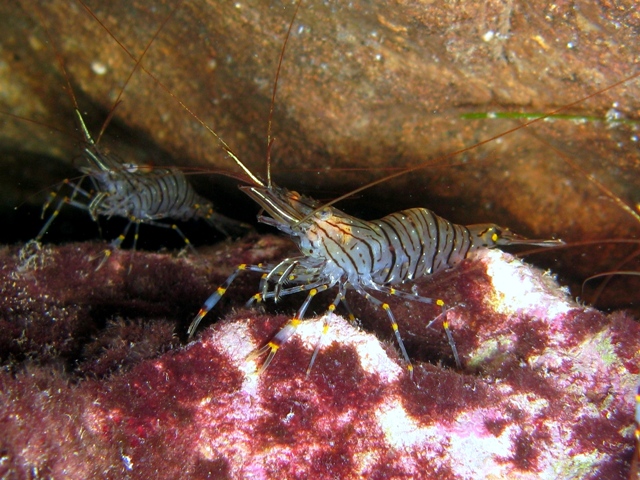 Common PrawnPalaemon serratus
-
 Bigclaw River ShrimpMacrobrachium carcinus
Compare
Questions and answers
Where is Ascidonia flavomaculata distributed?
The species is recorded in the northeastern Atlantic, the eastern Atlantic, and the Mediterranean region. It was also reported as a new record for the Portuguese marine invertebrate fauna.[20][21]
Which host does Ascidonia flavomaculata commonly inhabit?
It commonly inhabits sea squirts, particularly Phallusia mammillata, living inside their branchial chambers.[4][5]
How large is Ascidonia flavomaculata?
Individuals range from 2 to 20 mm in length.[2]
Sources
Passages the profile rests on
- Ascidonia flavomaculata has a clear, translucent body marked with yellow spots and visible green internal organs. Source passage: “Ascidonia flavomaculata is a benthic clear translucent shrimp with yellow spots and visible green internal organs” — English Wikipedia
- Individuals range from 2 to 20 mm in length. Source passage: “They can range from 2–20 mm (0.079–0.787 in) long.” — English Wikipedia
- The species inhabits shallow subtidal coastal marine environments. Source passage: “Ascidonia flavomaculata occurs in coastal marine environments, typically in shallow subtidal zones.” — English Wikipedia
- The species commonly inhabits sea squirts, particularly Phallusia mammillata. Source passage: “They can live in a wide range of other invertebrate organisms but are most commonly found in sea squirts, specifically Phallusia mammillata.” — English Wikipedia
- Individuals live inside the branchial chambers of ascidian hosts. Source passage: “As a symbiotic crustacean, A. flavomaculata is hosted by ascidians within the branchial chamber.” — English Wikipedia
- The species is generally associated endosymbiotically with solitary ascidians. Source passage: “generally associated endosymbiotically with solitary ascidians.” — English Wikipedia
- The species can associate with sea sponges, sea anemones, gorgonians, corals, mollusks, echinoderms, and ascidians. Source passage: “associates with a variety of other invertebrates like sea sponges, sea anemones, gorgonians, corals, mollusks, echinoderms, and ascidians.” — English Wikipedia
- Ascidonia flavomaculata is recorded among ascidian hosts belonging to the order Phlebobranchia. Source passage: “Ascidonia flavomaculata (Heller, 1864) can be found in ascidians from the order Phlebobranchia.” — pmc.ncbi.nlm.nih.gov
- Individuals generally live alone inside the branchial chambers of ascidians. Source passage: “A. flavomaculata prefer to live alone usually inside the branchial chambers of ascidians” — English Wikipedia
- The species exhibits a symbiotic lifestyle within solitary ascidian hosts. Source passage: “Ascidonia flavomaculata exhibits a symbiotic lifestyle within solitary ascidian hosts” — English Wikipedia
- Individuals occasionally leave their hosts to scavenge for debris and detritus. Source passage: “A. flavomaculata will occasionally leave their host to scavenge for debris and detritus.” — English Wikipedia
- The species is gonochoric, with separate male and female individuals. Source passage: “The species is gonochoric” — English Wikipedia
- Females have larger abdomens and carapaces than males. Source passage: “females having a larger abdomen and carapace than males” — English Wikipedia
- Males leave their hosts to seek females for reproduction. Source passage: “for reproduction male A. flavomaculata will leave their host to go find a female.” — English Wikipedia
- Males remain with females for a period before returning to their own hosts. Source passage: “the male will stay will the female for a period of time until leaving to go back to his host.” — English Wikipedia
- Females carry eggs in their swimmerets until the eggs hatch. Source passage: “Once the female has carried the eggs for long enough in her swimmerets, they will hatch” — English Wikipedia
- Newly hatched larvae initially float planktonically. Source passage: “they will hatch and float planktonically” — English Wikipedia
- Larvae typically pass through zoeal and mysis stages before becoming juveniles. Source passage: “larvae typically develop through zoeal and mysis stages before reaching juvenile form.” — English Wikipedia
- Juveniles seek out individual hosts after reaching juvenile form. Source passage: “After that, they find their own host to live in” — English Wikipedia
- The species is recorded in the northeastern Atlantic, the eastern Atlantic, and the Mediterranean region. Source passage: “They are recorded across the northeastern Atlantic as well as the broader eastern Atlantic and Mediterranean regions.” — English Wikipedia
- The species was reported as a new record for the Portuguese marine invertebrate fauna. Source passage: “Ascidonia flavomaculata (Heller, 1864), a new record for the Portuguese marine invertebrate fauna” — depts.washington.edu
Data
- Catalogue of Life, 2026-10-16 XR cc by
- Global Biodiversity Information Facility CC BY 4.0
- Wikidata CC0
- GeoNames CC BY 4.0
- Within the Catalogue of Life, this name comes from The Integrated Taxonomic Information System cc0
References
- De Grave, Sammy, and C. H. J. M. Fransen. (2011). Carideorum catalogus: the recent species of the Dendrobranchiate, Stenopodidean, Procarididean and Caridean Shrimps (Crustacea: Decapoda). Zoologische Mededelingen, Vol. 85, No. 9.
This species in other databases
- Catalogue of Life 9GNGP
- Wikidata Q13399285
- iNaturalist 1296684
- WoRMS urn:lsid:marinespecies.org:taxname:238020
Page built on 29 November 2026. See how the catalog is made and all sources and licences.
Cite this page
ScientificNames.org. (2026). Ascidonia flavomaculata. Retrieved November 29, 2026, from https://scientificnames.org/species/ascidonia-flavomaculata
“Ascidonia flavomaculata.” ScientificNames.org, 2026, scientificnames.org/species/ascidonia-flavomaculata. Accessed 29 Nov. 2026.
ScientificNames.org. “Ascidonia flavomaculata.” Accessed November 29, 2026. https://scientificnames.org/species/ascidonia-flavomaculata.
@misc{scientificnames_ascidonia_flavomaculata,
  author = {{ScientificNames.org}},
  title = {Ascidonia flavomaculata},
  year = {2026},
  url = {https://scientificnames.org/species/ascidonia-flavomaculata},
  note = {Accessed 2026-11-29}
}