Species · Fishes
Big-head Schizothoracin Aspiorhynchus laticeps
The scientific name of the Big-head Schizothoracin is Aspiorhynchus laticeps. It is a species of fish in the family Cyprinidae (carps), order Cypriniformes. The name dates from 1877.
- Scientific name
- Aspiorhynchus laticeps (Day, 1877)
- Common name
- Big-head Schizothoracin
- Genus
- Aspiorhynchus
- Family
- Cyprinidae (Carps)
- Order
- Cypriniformes
- Class
- Teleostei
- Environment
- freshwater
- Recorded in
- 1 country
- Name status
- accepted in the Catalogue of Life
Overview
Aspiorhynchus laticeps inhabits stagnant lakes and slow-flowing rivers in the Tarim River basin. It belongs to the subfamily Schizothoracinae and has a maximum recorded total length of 126 cm.
Written 26 November 2026 from the sources listed below. Each statement was checked against the passage it cites; statements that could not be supported were removed.
Appearance
The species belongs to the subfamily Schizothoracinae. Its maximum recorded total length is 126 cm.[1][2]
Habitat
The species inhabits lakes and rivers. It was found in stagnant lakes and slow-flowing rivers in the Tarim River basin.[3][4]
Behaviour
The species migrates into smaller streams containing scattered boulders to spawn.[5]
Reproduction and life cycle
The species spawns in smaller, boulder-strewn alluvial fan streams.[6]
Conservation
The only known extant population occurs in the Kezier Reservoir. This population is maintained through the introduction of captive-bred fish.[7][8]
Classification of the Big-head Schizothoracin
| Kingdom | Animalia |
|---|---|
| Phylum | Chordata |
| Subphylum | Vertebrata |
| Infraphylum | Gnathostomata |
| Parvphylum | Osteichthyes |
| Gigaclass | Actinopterygii |
| Superclass | Actinopteri |
| Class | Teleostei (Teleost) |
| Order | Cypriniformes |
| Family | Cyprinidae (Carps) |
| Genus | Aspiorhynchus (Big-head Schizothoracin) |
| Species | Aspiorhynchus laticeps (Day, 1877) |
Where the Big-head Schizothoracin is found
Checklists and occurrence records place Aspiorhynchus laticeps in 1 country. GBIF holds 4 georeferenced records of it.
Countries
A number beside a place is its count of GBIF occurrence records. A place without a number comes from a checklist alone. Records show where a species has been observed or collected, which can include escapes and vagrants.
Common names
English
- Big-head Schizothoracin
- Big-head Schizothorcin
- Datou Fish
- Xinjiang Datou Fish
Names in 3 other languages
- Chinese
- 扁吻鱼, 新疆大头鱼
- Czech
- parmoun kašgarský
- Russian
- Китайский жерех
Synonyms
4 other scientific names have been used for this species and are now treated as synonyms of Aspiorhynchus laticeps.
- Aspiorhynchus przewalskii Kessler, 1879
- Aspiorhynchus sartus Zugmayer, 1909
- Ptychobarbus laticeps Day, 1877
- Ptychobarbus longiceps Day, 1877
Related species
-
 GoldfishCarassius auratus
-
 Common CarpCyprinus carpio
- ZebrafishDanio rerio
-
 Grass CarpCtenopharyngodon idella
-
 Common RoachRutilus rutilus
-
 Silver CarpHypophthalmichthys molitrix
-
 Crucian CarpCarassius carassius
-
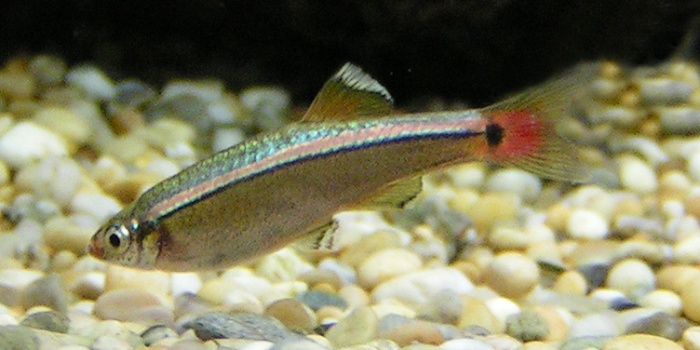 White Cloud Mountain MinnowTanichthys albonubes
Compare
Questions and answers
What is the scientific name of the Big-head Schizothoracin?
The scientific name of the Big-head Schizothoracin is Aspiorhynchus laticeps. Written with its author, the full name is Aspiorhynchus laticeps (Day, 1877).
Which family does the Big-head Schizothoracin belong to?
Aspiorhynchus laticeps belongs to the family Cyprinidae, in the order Cypriniformes and the class Teleostei.
Where is the Big-head Schizothoracin found?
Checklists and occurrence records place Aspiorhynchus laticeps in 1 country: China.
What other names does the Big-head Schizothoracin have?
Aspiorhynchus laticeps is also known in English as Big-head Schizothorcin, Datou Fish and Xinjiang Datou Fish.
Sources
Passages the profile rests on
- The species belongs to the subfamily Schizothoracinae. Source passage: “classified within the subfamily Schizothoracinae, the snow barbels.” — English Wikipedia
- The maximum recorded total length is 126 cm. Source passage: “Max length : 126 cm TL male/unsexed;” — fishbase.se
- The species inhabits lakes and rivers. Source passage: “Inhabits lakes and rivers with ...” — fishbase.se
- The species was found in stagnant lakes and slow-flowing rivers in the Tarim River basin. Source passage: “found only in stagnant lakes and slow flowing rivers in the basin of the Tarim He.” — English Wikipedia
- The species migrates into smaller streams containing scattered boulders to spawn. Source passage: “It migrates into smaller, boulder strewn alluvial fan streams to spawn.” — English Wikipedia
- The species spawns in smaller, boulder-strewn alluvial fan streams. Source passage: “It migrates into smaller, boulder strewn alluvial fan streams to spawn.” — English Wikipedia
- The only known extant population occurs in the Kezier Reservoir. Source passage: “The only known extant population is in the Kezier Reservoir” — English Wikipedia
- The Kezier Reservoir population is maintained through the introduction of captive-bred fish. Source passage: “a population maintained by the introduction of captive bred fish.” — English Wikipedia
Data
- Catalogue of Life, 2026-10-16 XR cc by
- Global Biodiversity Information Facility CC BY 4.0
- Wikidata CC0
- GeoNames CC BY 4.0
- Within the Catalogue of Life, this name comes from World Register of Marine Species cc by
This species in other databases
- Catalogue of Life HJHM
- Wikidata Q4904835
- iNaturalist 612538
- WoRMS urn:lsid:marinespecies.org:taxname:1017931
- ITIS 688418
Page built on 28 November 2026. See how the catalog is made and all sources and licences.
Cite this page
ScientificNames.org. (2026). Aspiorhynchus laticeps (Big-head Schizothoracin). Retrieved November 28, 2026, from https://scientificnames.org/species/aspiorhynchus-laticeps
“Aspiorhynchus laticeps (Big-head Schizothoracin).” ScientificNames.org, 2026, scientificnames.org/species/aspiorhynchus-laticeps. Accessed 28 Nov. 2026.
ScientificNames.org. “Aspiorhynchus laticeps (Big-head Schizothoracin).” Accessed November 28, 2026. https://scientificnames.org/species/aspiorhynchus-laticeps.
@misc{scientificnames_aspiorhynchus_laticeps_big_head_schizothoracin,
  author = {{ScientificNames.org}},
  title = {Aspiorhynchus laticeps (Big-head Schizothoracin)},
  year = {2026},
  url = {https://scientificnames.org/species/aspiorhynchus-laticeps},
  note = {Accessed 2026-11-28}
}