Species · Birds
Berlepsch's Canastero Asthenes berlepschi
The scientific name of the Berlepsch's Canastero is Asthenes berlepschi. It is a species of bird in the family Furnariidae (ovenbird), order Passeriformes. The name dates from 1917.
- Scientific name
- Asthenes berlepschi (Hellmayr, 1917)
- Common name
- Berlepsch's Canastero
- Genus
- Asthenes
- Family
- Furnariidae (Ovenbird)
- Order
- Passeriformes
- Class
- Aves
- Red List category
- NT Near Threatened
- Recorded in
- 2 countries
- Name status
- accepted in the Catalogue of Life

Overview
Berlepsch's Canastero is a monotypic bird in the ovenbird family Furnariidae. It is endemic to Bolivia and occurs only in the valley of the Consata River and its tributaries in north-central La Paz Department. It measures 15 to 16 cm in length and has a warm brown crown, rufous rump and flanks, and creamy whitish underparts.
Written 26 November 2026 from the sources listed below. Each statement was checked against the passage it cites; statements that could not be supported were removed.
Appearance
Berlepsch's Canastero measures 15 to 16 cm in length. Adults have an inconspicuous gray supercilium and blackish lores and ear coverts.[1][2]
The crown is warm brown, becoming paler and duller toward the back. The rump and uppertail coverts are rufous.[3][4]
The wings are mostly blackish, with dark rufous edges and tips on the coverts. The outermost tail feather pair is rufous, the next pair is partly rufous and partly blackish, and the remaining feathers are fully blackish.[5][6]
The throat, breast, and belly are creamy whitish, with faint rufous coloring in the throat center and faint dark scaling on the breast. The flanks and undertail coverts are rufous.[7][8]
The iris is brown, the maxilla is dark, the mandible is gray, and the legs and feet are blue-gray. Juveniles have a more pronounced dark scaly breast pattern than adults.[9][10]
Habitat
Berlepsch's Canastero primarily inhabits semi-arid montane scrublands. Its recorded elevational range is 2,300 to 3,700 m.[11][12]
It frequently occurs in vegetation around pastures, farms, and human habitations. It has also been observed in Polylepis woodlands and Eucalyptus stands.[13][14]
Diet
The species' diet has not been detailed but is thought to consist mostly of arthropods.[15]
Behaviour
Berlepsch's Canastero is a year-round resident throughout its geographical range. It forages alone or in pairs, apparently gleaning prey from the ground and low vegetation.[16][17]
Its song is a trill similar to that of the rusty-vented canastero.[18]
Reproduction and life cycle
Berlepsch's Canastero is thought to breed during the austral spring and summer. It builds its nest in a tree.[19][20]
Conservation
The IUCN first assessed Berlepsch's Canastero as Vulnerable in 1994 and has rated it Near Threatened since 2004. The IUCN Red List assessed the species in 2020 and listed it as Near Threatened.[21][22]
The species has a very small geographical range and an unknown population size that is believed to be decreasing. It appears to be common but has been recorded from only a few localities within its restricted range.[23][24]
Conversion of habitat to farming and ranching is the principal threat to the species. Despite surviving well in highly modified habitats, it remains at risk because of its tiny range, restricted elevational distribution, and limited available habitat.[25][26]
Similar species
Some authors have proposed treating Berlepsch's Canastero as a subspecies of the rusty-vented canastero because of similarities in plumage.[27]
Classification of the Berlepsch's Canastero
| Kingdom | Animalia |
|---|---|
| Phylum | Chordata |
| Subphylum | Vertebrata |
| Infraphylum | Gnathostomata |
| Parvphylum | Osteichthyes |
| Megaclass | Tetrapoda |
| Class | Aves (Bird) |
| Order | Passeriformes (Passerine) |
| Family | Furnariidae (Ovenbird) |
| Genus | Asthenes (Canastero) |
| Species | Asthenes berlepschi (Hellmayr, 1917) |
Where the Berlepsch's Canastero is found
Checklists and occurrence records place Asthenes berlepschi in 2 countries across South America. GBIF holds 231 georeferenced records of it.
Countries
Regions and cities with the most records
Range as the checklists state it
South America
A number beside a place is its count of GBIF occurrence records. A place without a number comes from a checklist alone. Records show where a species has been observed or collected, which can include escapes and vagrants.
Common names
English
- Berlepsch's Canastero
Names in 23 other languages
- Catalan
- cisteller de Berlepsch
- Chinese
- 波氏卡纳灶鸟, 玻利維亞卡納雀
- Croatian
- bolivijski kanastero
- Czech
- hrnčiřík pokřovní
- Danish
- Illampukurvebygger
- Dutch
- Berlepsch' Canastero
- Esperanto
- berlepŝa sinalakso
- Finnish
- metsäkanastero
- French
- Synallaxe de Berlepsch
- German
- Berlepsch-Schlüpfer, Cordillera Real-Canastero, Cordillera-Real-Canastero
- Italian
- Canestraio di Berlepsch
- Japanese
- ボリビアキタカマドドリ
- Lithuanian
- Berlepšo kanastera
- Norwegian
- consatakurvfugl
- Polish
- koszykarz samotny
- Portuguese
- cesteiro-do-illampu, lenheiro-de-la-paz
- Russian
- Горный канастеро, Канастеро Берлепша
- Serbian
- Berlepšov kanastero
- Slovak
- košikárik krovinový
- Spanish
- Canastero de Berlepsch
- Swedish
- consatakanastero
- Turkish
- Berlepsch Sepetöreni
- Ukrainian
- канастеро консатський
Synonyms
One other scientific name has been used for this species and is now treated as a synonym of Asthenes berlepschi.
- Siptornis berlepschi Hellmayr, 1917
Related species
-
 Hudson's CanasteroAsthenes hudsoni
-
 White-chinned ThistletailAsthenes fuliginosa
-
 Line-fronted CanasteroAsthenes urubambensis
-
 Sharp-billed CanasteroAsthenes pyrrholeuca
-
 Cordilleran CanasteroAsthenes modesta
-
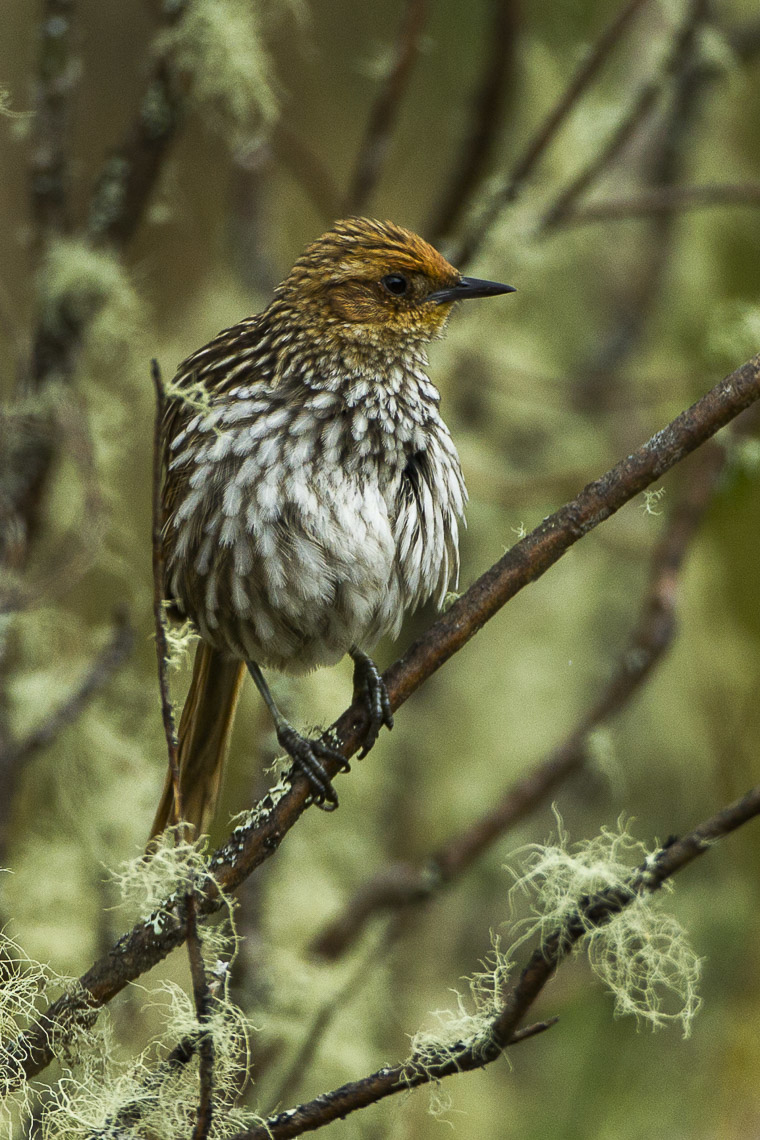 Many-striped CanasteroAsthenes flammulata
-
 Austral CanasteroAsthenes anthoides
-
 Streak-backed CanasteroAsthenes wyatti
Compare
Questions and answers
What is the scientific name of the Berlepsch's Canastero?
The scientific name of the Berlepsch's Canastero is Asthenes berlepschi. Written with its author, the full name is Asthenes berlepschi (Hellmayr, 1917).
Which family does the Berlepsch's Canastero belong to?
Asthenes berlepschi belongs to the family Furnariidae, in the order Passeriformes and the class Aves.
Where is the Berlepsch's Canastero found?
Checklists and occurrence records place Asthenes berlepschi in 2 countries: Bolivia and Peru.
What is the conservation status of the Berlepsch's Canastero?
The IUCN Red List category recorded for Asthenes berlepschi is Near Threatened (NT).
Where is Berlepsch's Canastero found?
It is endemic to Bolivia and occurs only in the valley of the Consata River and its tributaries in north-central La Paz Department.[28][29]
What is the elevational range of Berlepsch's Canastero?
Its recorded elevational range is 2,300 to 3,700 m.[12]
What does Berlepsch's Canastero eat?
Its diet is thought to consist mostly of arthropods.[15]
How does Berlepsch's Canastero forage?
It forages alone or in pairs, apparently gleaning prey from the ground and low vegetation.[17]
When does Berlepsch's Canastero breed?
It is thought to breed during the austral spring and summer.[19]
Where does Berlepsch's Canastero build its nest?
It builds its nest in a tree.[20]
What is the conservation status of Berlepsch's Canastero?
The IUCN Red List assessed it as Near Threatened in 2020.[22]
What is the principal threat to Berlepsch's Canastero?
Conversion of habitat to farming and ranching is its principal threat.[25]
What is the origin of the name Berlepsch's Canastero?
Its English common name and scientific specific epithet commemorate German ornithologist and collector Hans von Berlepsch.[30]
Sources
Passages the profile rests on
- Berlepsch's Canastero measures 15 to 16 cm in length. Source passage: “Berlepsch's canastero is 15 to 16 cm (5.9 to 6.3 in) long.” — English Wikipedia
- Adults have an inconspicuous gray supercilium and blackish lores and ear coverts. Source passage: “Adults have an inconspicuous gray supercilium and blackish lores and ear coverts.” — English Wikipedia
- The crown is warm brown and becomes paler and duller toward the back. Source passage: “Their crown is warm brown that becomes paler and duller on their back.” — English Wikipedia
- The rump and uppertail coverts are rufous. Source passage: “Their rump and uppertail coverts are rufous.” — English Wikipedia
- The wings are mostly blackish with dark rufous edges and tips on the coverts. Source passage: “Their wings are mostly blackish with dark rufous edges and tips on their coverts.” — English Wikipedia
- The outermost tail feather pair is rufous, the next pair is partly rufous and partly blackish, and the remaining feathers are fully blackish. Source passage: “Their tail's outermost pair of feathers are rufous, the next pair partly rufous and partly blackish, and the rest fully blackish.” — English Wikipedia
- The throat, breast, and belly are creamy whitish, with faint rufous coloring in the throat center and faint dark scaling on the breast. Source passage: “Their throat, breast, and belly are creamy whitish, with the faintest hint of rufous in the center of the throat and faint dark scaling on the breast.” — English Wikipedia
- The flanks and undertail coverts are rufous. Source passage: “Their flanks and undertail coverts are rufous.” — English Wikipedia
- The iris is brown, the maxilla is dark, the mandible is gray, and the legs and feet are blue-gray. Source passage: “Their iris is brown, their maxilla dark, their mandible gray, and their legs and feet blue-gray.” — English Wikipedia
- Juveniles have a more pronounced dark scaly breast pattern than adults. Source passage: “Juveniles have a more pronounced dark scaly pattern on the breast than adults.” — English Wikipedia
- The species primarily inhabits semi-arid montane scrublands. Source passage: “It primarily inhabits semi-arid montane scrublands” — English Wikipedia
- Its recorded elevational range is 2,300 to 3,700 m. Source passage: “In elevation it ranges between 2,300 and 3,700 m (7,500 and 12,100 ft).” — English Wikipedia
- The species frequently occurs in vegetation around pastures, farms, and human habitations. Source passage: “frequently occurs in vegetation around pastures, farm, and human habitations.” — English Wikipedia
- The species has also been observed in Polylepis woodlands and Eucalyptus stands. Source passage: “It has also been observed in Polylepis woodlands and Eucalyptus stands.” — English Wikipedia
- The species' diet has not been detailed but is thought to consist mostly of arthropods. Source passage: “Berlepsch's canastero's diet has not been detailed but is thought to be mostly arthropods.” — English Wikipedia
- Berlepsch's Canastero is a year-round resident throughout its geographical range. Source passage: “Berlepsch's canastero is a year-round resident throughout its range.” — English Wikipedia
- The species forages alone or in pairs, apparently gleaning prey from the ground and low vegetation. Source passage: “It forages singly or in pairs, apparently gleaning prey from the ground and low vegetation.” — English Wikipedia
- The species' song is a trill similar to that of the rusty-vented canastero. Source passage: “The song of Berlepsch's canastero is a trill that is similar to that of the rusty-vented canastero.” — English Wikipedia
- Berlepsch's Canastero is thought to breed during the austral spring and summer. Source passage: “Berlepsch's canastero is thought to breed in the austral spring and summer.” — English Wikipedia
- The species builds its nest in a tree. Source passage: “It builds a nest in a tree” — English Wikipedia
- The IUCN first assessed Berlepsch's Canastero as Vulnerable in 1994 and has rated it Near Threatened since 2004. Source passage: “The IUCN first assessed Berlepsch's canastero in 1994 as Vulnerable but since 2004 has rated it Near Threatened.” — English Wikipedia
- The IUCN Red List assessed Berlepsch's Canastero in 2020 and listed it as Near Threatened. Source passage: “Berlepsch's Canastero Asthenes berlepschi has most recently been assessed for The IUCN Red List of Threatened Species in 2020. listed as Near Threatened under ...” — iucnredlist.org
- The species has a very small geographical range and an unknown population size that is believed to be decreasing. Source passage: “It has a very small range and an unknown population size that is believed to be decreasing.” — English Wikipedia
- The species appears to be common but has been recorded from only a few localities within its restricted range. Source passage: “appears to be common, but recorded from only a few localities within [its] tiny range” — English Wikipedia
- Conversion of habitat to farming and ranching is the principal threat to the species. Source passage: “The principal threat is conversion of its habitat to farming and ranching.” — English Wikipedia
- Despite surviving well in highly modified habitats, the species remains at risk because of its tiny range, restricted elevational distribution, and limited available habitat. Source passage: “Despite surviving well in highly modified habitats, it must be considered at some risk owing to its tiny range in one small montane basin, its restricted elevational distribution, and the small amount of available habitat.” — English Wikipedia
- Some authors have proposed treating Berlepsch's Canastero as a subspecies of the rusty-vented canastero because of similarities in plumage. Source passage: “Several authors have suggested that Berlepsch's canastero should be treated as a subspecies of the rusty-vented canastero (A. dorbignyi) due to plumage similarities.” — English Wikipedia
- Berlepsch's Canastero is endemic to Bolivia and occurs only in the valley of the Consata River and its tributaries in north-central La Paz Department. Source passage: “It is found only in the valley of the Consata River and its tributaries in north-central La Paz Department.” — English Wikipedia
- Berlepsch's Canastero is endemic to Bolivia. Source passage: “It is endemic to Bolivia.” — inaturalist.org
- The species' English common name and scientific specific epithet commemorate German ornithologist and collector Hans von Berlepsch. Source passage: “The species' common name and specific epithet commemorate the German ornithologist and collector Hans von Berlepsch.” — English Wikipedia
Data
- Catalogue of Life, 2026-10-16 XR cc by
- Global Biodiversity Information Facility CC BY 4.0
- Wikidata CC0
- GeoNames CC BY 4.0
- Wikimedia Commons per image; credit shown with each image
- Within the Catalogue of Life, this name comes from The Integrated Taxonomic Information System cc0
References
- Gill, Frank, & and Minturn Wright. (2006). Birds of the World: Recommended English Names.
This species in other databases
Page built on 27 November 2026. See how the catalog is made and all sources and licences.
Cite this page
ScientificNames.org. (2026). Asthenes berlepschi (Berlepsch's Canastero). Retrieved November 27, 2026, from https://scientificnames.org/species/asthenes-berlepschi
“Asthenes berlepschi (Berlepsch's Canastero).” ScientificNames.org, 2026, scientificnames.org/species/asthenes-berlepschi. Accessed 27 Nov. 2026.
ScientificNames.org. “Asthenes berlepschi (Berlepsch's Canastero).” Accessed November 27, 2026. https://scientificnames.org/species/asthenes-berlepschi.
@misc{scientificnames_asthenes_berlepschi_berlepschs_canastero,
  author = {{ScientificNames.org}},
  title = {Asthenes berlepschi (Berlepsch's Canastero)},
  year = {2026},
  url = {https://scientificnames.org/species/asthenes-berlepschi},
  note = {Accessed 2026-11-27}
}