Species · Reptiles
Mayombe Bush Viper Atheris anisolepis
The scientific name of the Mayombe Bush Viper is Atheris anisolepis. It is a species of reptile in the family Viperidae (viper), order Squamata. The name dates from 1887.
- Scientific name
- Atheris anisolepis Mocquard, 1887
- Common name
- Mayombe Bush Viper
- Genus
- Atheris
- Family
- Viperidae (Viper)
- Order
- Squamata
- Class
- Reptilia
- Red List category
- LC Least Concern
- Recorded in
- 2 countries
- Name status
- accepted in the Catalogue of Life
Overview
Atheris anisolepis is a species in the genus Atheris. The species occurs in southern Gabon, southern Congo, and western Democratic Republic of Congo, and might also occur in northern Angola. It is distinguished from Atheris squamigera by a complete row of scales between the supralabial and ocular scales, although this characteristic is not always reliable.
Written 27 November 2026 from the sources listed below. Each statement was checked against the passage it cites; statements that could not be supported were removed.
Habitat
The species inhabits drier areas of shrubland and woodland-savanna. It occurs at elevations below 400 metres.[1][2]
Behaviour
The species is arboreal.[3]
Similar species
Atheris anisolepis closely resembles Atheris squamigera.[4]
Appearance
The species has enlarged scales that are smooth or weakly keeled. It is distinguished from Atheris squamigera by a complete row of scales between the supralabial and ocular scales, although these scale characteristics are not always reliable.[5][6][7]
Classification of the Mayombe Bush Viper
| Kingdom | Animalia |
|---|---|
| Phylum | Chordata |
| Subphylum | Vertebrata |
| Infraphylum | Gnathostomata |
| Parvphylum | Osteichthyes |
| Megaclass | Tetrapoda |
| Class | Reptilia (Reptile) |
| Order | Squamata (Snakes) |
| Suborder | Serpentes (Snakes) |
| Infraorder | Alethinophidia |
| Family | Viperidae (Viper) |
| Subfamily | Viperinae |
| Genus | Atheris (African Bush Vipers) |
| Species | Atheris anisolepis Mocquard, 1887 |
Where the Mayombe Bush Viper is found
Checklists and occurrence records place Atheris anisolepis in 2 countries across Africa. GBIF holds 36 georeferenced records of it.
Countries
Range as the checklists state it
S Gabon, S Republic of Congo (Brazzaville), W Democratic Republic of the Congo (Zaire)
A number beside a place is its count of GBIF occurrence records. A place without a number comes from a checklist alone. Records show where a species has been observed or collected, which can include escapes and vagrants.
Common names
English
- Mayombe Bush Viper
- Mayombe Bush-Viper
Synonyms
One other scientific name has been used for this species and is now treated as a synonym of Atheris anisolepis.
- Atheris laeviceps Boettger, 1887
Related species
-
 African Hairy Bush ViperAtheris hispida
-
 African Bush ViperAtheris squamigera
-
 Green Bush ViperAtheris chlorechis
-
 Great Lakes Bush ViperAtheris nitschei
- Katanga Mountain Bush ViperAtheris katangensis
-
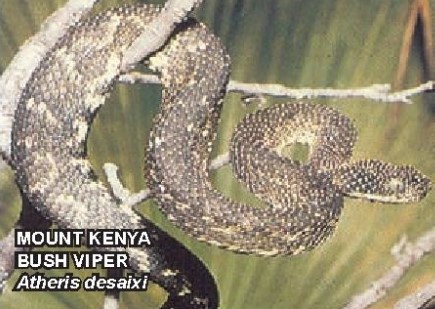 Ashe's Bush ViperAtheris desaixi
-
 Uzungwe Mountain Bush ViperAtheris barbouri
- Matilda's Horned ViperAtheris matildae
Compare
Questions and answers
What is the scientific name of the Mayombe Bush Viper?
The scientific name of the Mayombe Bush Viper is Atheris anisolepis. Written with its author, the full name is Atheris anisolepis Mocquard, 1887.
Which family does the Mayombe Bush Viper belong to?
Atheris anisolepis belongs to the family Viperidae, in the order Squamata and the class Reptilia.
Where is the Mayombe Bush Viper found?
Checklists and occurrence records place Atheris anisolepis in 2 countries: Democratic Republic of the Congo and Republic of the Congo.
What is the conservation status of the Mayombe Bush Viper?
The IUCN Red List category recorded for Atheris anisolepis is Least Concern (LC).
What other names does the Mayombe Bush Viper have?
Atheris anisolepis is also known in English as Mayombe Bush-Viper.
Sources
Passages the profile rests on
- The species inhabits drier areas of shrubland and woodland-savanna. Source passage: “drier areas of shrub and woodland-savanna” — English Wikipedia
- The species occurs at elevations below 400 metres. Source passage: “at elevations below 400 m (1,300 ft).” — English Wikipedia
- The species is arboreal. Source passage: “Atheris anisolepis is an arboreal snake” — English Wikipedia
- Atheris anisolepis closely resembles Atheris squamigera. Source passage: “The Atheris anisolepis is very similar to the Atheris squamigera” — English Wikipedia
- The species is distinguished from Atheris squamigera by a complete row of scales between the supralabial and ocular scales. Source passage: “the complete row of scales between the supralabial scales and the ocular scales” — English Wikipedia
- The species has enlarged scales that are smooth or weakly keeled. Source passage: “having enlarged, smooth, and/or weekly keeled scales.” — English Wikipedia
- The scale characteristics used to distinguish the species from Atheris squamigera are not always reliable. Source passage: “However, this differentiation does not always apply and may not always be accurate.” — English Wikipedia
- The species occurs in southern Gabon, southern Congo, and western Democratic Republic of Congo. Source passage: “Atheris anisolepis is found in southern Gabon, southern Congo, and western Democratic Republic of Congo.” — English Wikipedia
- The species might also occur in northern Angola, although its presence there was not listed by Marques and colleagues in 2018. Source passage: “It might be present in northern Angola, but was not listed as present by Marques and colleagues (2018).” — English Wikipedia
Data
- Catalogue of Life, 2026-10-16 XR cc by
- Global Biodiversity Information Facility CC BY 4.0
- Wikidata CC0
- GeoNames CC BY 4.0
- Within the Catalogue of Life, this name comes from The Reptile Database cc by
References
- Hallowell, E. (1854). Descriptions of new reptiles from Guinea. Proc. Acad. Nat. Sci. Philad. 1854: 193-194.
- Cope, E. D. (1860). Catalogue of the venomous serpents in the Museum of the Academy of Natural Sciences of Philadelphia, with notes on the families, genera and species. Proc. Acad. Nat. Sci. Philadelphia 1859: 332-347.
- Cope, E. D. (1862). Notes upon some reptiles of the Old World. Proc. Acad. Nat. Sci. Philadelphia 14: 337-344.
- Günther, A. (1863). On Atheris Burtonii, a new snake from West Africa. Ann. Mag. Nat. Hist. (3) 12: 239.
- Günther, A. (1863). On new species of snakes in the collection of the British Museum. Ann. Mag. Nat. Hist. (3) 11: 20-25.
- Rochebrune, & de, A. T. (1885). Vertebratonum novorum vel minus cognitorum orae Africae occidentalis in colarum. Bull. Soc. Philom. Paris 9: 86-99.
- Mocquard, F. (1887). Sur les ophidiens rapportés du Congo par la Mission de Brazza. Bull. Soc. Philomath. Paris (7) 11: 62-92.
- Boettger, & OSKAR. (1887). Diagnoses reptilium novorum ad ilI. viro Paul Hesse in finnibus fluminis Congo repetorum. Zool. Anz. 10 (267): 649-651.
- Fischer, J. G. (1888). Über zwei neue Schlangen und einen neuen Laubfrosch von Kamerun. Jahrb. Hamburg. Wiss. Anst. 5: 1-10.
- Günther, A. (1896). Report on a collection of reptiles and fishes made by Miss M. H. Kingsley during her travels on the Ogowe river and in Old Calabar. Ann. Mag. Nat. Hist. (6) 17: 261-267.
- Boulenger, G. A. (1897). A list of reptiles and batrachians from the Congo Free State, with the description of two new snakes. Ann. Mag. Nat. Hist. (6) 19: 276-281.
- Schmidt, K. P. (1923). Contributions to the herpetology of the Belgian Congo based on the collection of the American Museum Congo Expedition, 1909-1915. Part II. Snakes, with field notes by Herbert Lang and James P. Chapin. Bull. Amer. Mus. Nat. Hist. 49 (1): 1-146.
- Loveridge, & Arthur. (1929). East African reptiles and amphibians in the United States National Museum. Bull. US Natl. Mus. (151): 1-135.
- Loveridge, A. (1933). Reports on the scientific Results of an Expedition to the Southwestem Highlands of Tanganyika Territory. VII. Herpetology. Bull. Mus. Comp. Zool. Harvard 74: 197-415.
- Loveridge, A. (1936). African reptiles and amphibians in the Field Museum of Natural History. Zool. Ser. Field Mus. Nat. Hist., Chicago, 22 (1): 1-122.
- Laurent, R. F. (1956). Contribution à l’herpetologie de la région des Grandes Lacs de l’Afrique centrale. Ann. Mus. Roy. Congo Belge (Sci. Zool.), 48: 1-390.
- Perret, J. L. (1961). Études herpétologiques africaines III. 1. La faune ophidienne de la région camerounaise. Bull. Soc. Neuchâtel. Sci. Nat., 84: 133-138.
- Pitman, C. R. S. (1974). A guide to the snakes of Uganda. Codicote, Wheldon & Wesley, L., 290 Pp.
- Ota, H., & Hikida, T. (1987). On a small collection of lizards and snakes from Cameroon, West Africa. African Study Monographs 8 (2): 111-123.
- Chifundera, K. (1990). Snakes of Zaire and their bites. Afr. Stud. Monogr. (Kyoto) 10(3): 137-157.
- Trape, J.F. & R. ROUX-ESTÈVE. (1995). Les serpents du Congo: liste commentée et clé de détermination. Journal of African Zoology 109 (1): 31-50.
- Broadley, D. G. (1996). A review of the tribe Atherini (Serpentes: Viperidae), with the descriptions of two new genera. African Journal of Herpetology 45: 40-48.
- Broadley, D. G. (1998). A review of the genus Atheris Cope (Serpentes: Viperidae), with the description of a new species from Uganda. The Herpetological Journal 8: 117-135.
- Joger, U., & Courage, K. (1999). Are palearctic ‘rattlesnakes’ (Echis and Cerastes) monophyletic? Kaupia (Darmstadt) (8): 65-81.
- McDiarmid, R.W.; Campbell, J.A. & Touré,T.A. (1999). Snake species of the world. Vol. 1. [type catalogue]. Herpetologists’ League, 511 Pp.
This species in other databases
Page built on 29 November 2026. See how the catalog is made and all sources and licences.
Cite this page
ScientificNames.org. (2026). Atheris anisolepis (Mayombe Bush Viper). Retrieved November 29, 2026, from https://scientificnames.org/species/atheris-anisolepis
“Atheris anisolepis (Mayombe Bush Viper).” ScientificNames.org, 2026, scientificnames.org/species/atheris-anisolepis. Accessed 29 Nov. 2026.
ScientificNames.org. “Atheris anisolepis (Mayombe Bush Viper).” Accessed November 29, 2026. https://scientificnames.org/species/atheris-anisolepis.
@misc{scientificnames_atheris_anisolepis_mayombe_bush_viper,
  author = {{ScientificNames.org}},
  title = {Atheris anisolepis (Mayombe Bush Viper)},
  year = {2026},
  url = {https://scientificnames.org/species/atheris-anisolepis},
  note = {Accessed 2026-11-29}
}