Overview
Wikidata describes Atheris ceratophora as “species of reptile”.
Classification of the Horned Bush Viper
| Kingdom | Animalia |
|---|---|
| Phylum | Chordata |
| Subphylum | Vertebrata |
| Infraphylum | Gnathostomata |
| Parvphylum | Osteichthyes |
| Megaclass | Tetrapoda |
| Class | Reptilia (Reptile) |
| Order | Squamata (Snakes) |
| Suborder | Serpentes (Snakes) |
| Infraorder | Alethinophidia |
| Family | Viperidae (Viper) |
| Subfamily | Viperinae |
| Genus | Atheris (African Bush Vipers) |
| Species | Atheris ceratophora Werner, 1896 |
Where the Horned Bush Viper is found
Checklists and occurrence records place Atheris ceratophora in 1 country across Africa. GBIF holds 103 georeferenced records of it.
Countries
Regions and cities with the most records
- Tanga, Tanzania 34
- Iringa, Tanzania 28
- Maramba, Tanzania 13
- Lushoto, Tanzania 11
- Matui, Tanzania 11
- Mazinde, Tanzania 11
- Korogwe, Tanzania 7
- Muheza, Tanzania 7
- Morogoro, Tanzania 5
Range as the checklists state it
Tanzania (Usambara, Uluguru, Uzungwe Mountains), elevation 1400-3000 m.
A number beside a place is its count of GBIF occurrence records. A place without a number comes from a checklist alone. Records show where a species has been observed or collected, which can include escapes and vagrants.
Common names
English
- Horned Bush Viper
- Usambara Eyelash Viper
- Usambara Bush Viper
Names in 3 other languages
- Chinese
- 角樹蝰
- German
- Gehörnte Buschviper, Usambara-Buschviper
- Russian
- Рогатая древесная гадюка
Related species
-
 African Hairy Bush ViperAtheris hispida
-
 African Bush ViperAtheris squamigera
-
 Green Bush ViperAtheris chlorechis
-
 Great Lakes Bush ViperAtheris nitschei
- Katanga Mountain Bush ViperAtheris katangensis
-
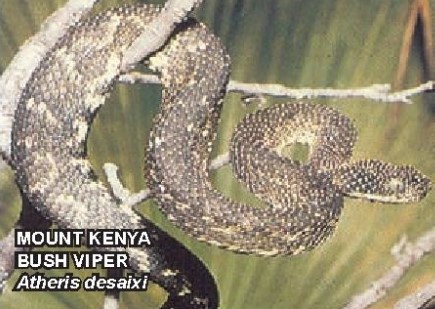 Ashe's Bush ViperAtheris desaixi
-
 Uzungwe Mountain Bush ViperAtheris barbouri
- Matilda's Horned ViperAtheris matildae
Compare
Questions and answers
What is the scientific name of the Horned Bush Viper?
The scientific name of the Horned Bush Viper is Atheris ceratophora. Written with its author, the full name is Atheris ceratophora Werner, 1896.
Which family does the Horned Bush Viper belong to?
Atheris ceratophora belongs to the family Viperidae, in the order Squamata and the class Reptilia.
Where is the Horned Bush Viper found?
Checklists and occurrence records place Atheris ceratophora in 1 country: Tanzania.
What other names does the Horned Bush Viper have?
Atheris ceratophora is also known in English as Usambara Eyelash Viper and Usambara Bush Viper.
Sources
Data
- Catalogue of Life, 2026-10-16 XR cc by
- Global Biodiversity Information Facility CC BY 4.0
- Wikidata CC0
- GeoNames CC BY 4.0
- Within the Catalogue of Life, this name comes from The Reptile Database cc by
References
- Werner, F. (1895). Über einige Reptilien aus Usambara (Deutsch-Ostafrika). Verhandlungen Der Kaiserlich-Königlichen Zoologisch-Botanischen Gesellschaft in Wien, 45: 190—194.
- Loveridge, A. (1933). Reports on the scientific Results of an Expedition to the Southwestem Highlands of Tanganyika Territory. VII. Herpetology. Bull. Mus. Comp. Zool. Harvard 74: 197-415.
- Rasmussen, J. B. (1981). The snakes from the rainforest of the Usambara Mountains, Tanzania: a checklist and key. Salamandra 17 (3-4): 173-188.
- Rasmussen, J.B. & K.M. HOWELL. (1982). The current status of the rare Usambara mountain forest-viper, Atheris ceratophorus Werner, 1895, including a probable new record of Atheris nitschei rungweensis Bogert, 1940, and a discussion of its validity (Reptilia, Serpentes, Viperidae). Amphibia-Reptilia 3: 269-277.
- Böhme, W. (1987). Seltene Reptilien aus dem Uzungwe-Gebirge, Süd-Tansania. Herpetofauna 9 (48): 27-34.
- Broadley, D. G., & HOWELL, K. M. (1991). A check list of the reptiles of Tanzania, with synoptic keys. Syntarsus 1: 1—70.
- Spawls, S., & Branch, B. (1995). The Dangerous Snakes of Africa. Blandford, London, 192 Pp.
- Emmrich D. (1997). Further remarks on the rare Usambara Forest viper, Atheris ceratophora, WERNER 1895. Mitt. Zool. Mus. Berlin 73: 131-151.
- Broadley, D. G. (1998). A review of the genus Atheris Cope (Serpentes: Viperidae), with the description of a new species from Uganda. The Herpetological Journal 8: 117-135.
- Joger, U., & Courage, K. (1999). Are palearctic ‘rattlesnakes’ (Echis and Cerastes) monophyletic? Kaupia (Darmstadt) (8): 65-81.
- McDiarmid, R.W.; Campbell, J.A. & Touré,T.A. (1999). Snake species of the world. Vol. 1. [type catalogue]. Herpetologists’ League, 511 Pp.
- Ernst, R., & Rödel, M. O. (2002). A new Atheris species (Serpentes: Viperidae), from Taï National Park, Ivory Coast. The Herpetological Journal 12: 55-61.
- Spawls, S.; Howell, K.; Drewes, R.C. & Ashe, J. (2002). A field guide to the reptiles of East Africa. Academic Press, 543 Pp. [Reviews in HR 34: 396 and Afr. J. Herp. 51; 147].
- Mallow, D. Ludwig, D. & Nilson, G. (2003). True Vipers: Natural History and Toxinology of Old World Vipers. Krieger, Malabar, Florida, 410 Pp. [Review in HR 35: 200, Reptilia 35: 74].
- Akeret, B. (2004). Grundlagen der Giftschlangenhaltung. Draco 5 (17): 37-53.
- Cimatti, E. (2006). Reptile Parks in Tanzania. Reptilia (GB) (48): 52-59.
- Dobiey, M., & Vogel, G. (2007). Venomous Snakes of Africa - Giftschlangen Afrikas. Edition Chimaira, Terralog 15, 150 Pp.
- Werning, H., & Wolf, C. (2007). Gebirge und Hochland - Reptilien und Amphibien in einem extremen Lebensraum. Draco 7 (27): 4-27.
- Hirschmann, W. (2008). Mehrjährige Haltung und erfolgreiche Vermehrung der Gehörnten Buschviper, Atheris ceratophora WERNER, 1896. Sauria 30 (3): 5-12.
- Menegon, M., & Nike Doggart, N. O. (2008). The Nguru mountains of Tanzania, an outstanding hotspot of herpetofaunal diversity. Acta Herpetologica 3 (2): 107-127.
- Cundall, D. (2009). Viper Fangs: Functional Limitations of Extreme Teeth. Physiological and Biochemical Zoology: Ecological and Evolutionary Approaches, 82(1), 63–79.
- Jachan, G. (2010). Pflege und Vermehrung der Usambara-Buschviper Atheris ceratophora. Reptilia (Münster) 15 (83): 58-68.
- Phelps, T. (2010). Old World Vipers. Edition Chimaira, Frankfurt, 558 Pp. [Critical Review in Sauria 33 (3): 19 and HR 43: 503].
- MENEGON, MICHELE; TIM R.B. DAVENPORT & KIM M. HOWELL. (2011). Description of a new and critically endangered species of Atheris (Serpentes: Viperidae) from the Southern Highlands of Tanzania, with an overview of the country’s tree viper fauna. Zootaxa 3120: 43–54. Link
- Spranger, & Tade Matthias. (2012). Haltung und Handel „exotischer” Tiere als Gegenstand des Polizei- und Ordnungsrechts. Draco 13 (51): 44-53.
This species in other databases
Page built on 28 November 2026. See how the catalog is made and all sources and licences.
Cite this page
ScientificNames.org. (2026). Atheris ceratophora (Horned Bush Viper). Retrieved November 28, 2026, from https://scientificnames.org/species/atheris-ceratophora
“Atheris ceratophora (Horned Bush Viper).” ScientificNames.org, 2026, scientificnames.org/species/atheris-ceratophora. Accessed 28 Nov. 2026.
ScientificNames.org. “Atheris ceratophora (Horned Bush Viper).” Accessed November 28, 2026. https://scientificnames.org/species/atheris-ceratophora.
@misc{scientificnames_atheris_ceratophora_horned_bush_viper,
  author = {{ScientificNames.org}},
  title = {Atheris ceratophora (Horned Bush Viper)},
  year = {2026},
  url = {https://scientificnames.org/species/atheris-ceratophora},
  note = {Accessed 2026-11-28}
}