Species · Spiders and other arachnids
Atomosphyrus wandae
Atomosphyrus wandae has no English name on record in the checklists used here. It is a species of arachnid in the family Salticidae (jumping spider), order Araneae. The name dates from 2020.
- Scientific name
- Atomosphyrus wandae Bustamante & Ruiz, 2020
- Genus
- Atomosphyrus
- Family
- Salticidae (Jumping Spider)
- Order
- Araneae
- Class
- Arachnida
- Recorded in
- 1 country
- Name status
- accepted in the Catalogue of Life
Overview
Atomosphyrus wandae lives on the ground in gallery forests, open fields, and both evergreen and deciduous shrubland. It is distinguished from other members of its genus by its longer embolus and the shape of its retrolateral tibial apophysis.
Written 28 November 2026 from the sources listed below. Each statement was checked against the passage it cites; statements that could not be supported were removed.
Appearance
The male has an orange carapace with dark stripes across its thorax. Its legs are orange with brown segments, its chelicerae are brown, and its clypeus is brown.[1][2][3][4]
The chelicerae have a three-pointed tooth at the front and a two-pointed tooth at the back.[3]
The male has an elongated palpal tibia with a projecting triangular retrolateral tibial apophysis. Its palpal bulb is flat and connected to a hairy cymbium.[5][6]
The embolus is simple, attached to the tegulum, and terminates in a coil.[7]
Habitat
The species lives on the ground in gallery forests and open fields. It also inhabits both evergreen and deciduous shrubland.[8][9][10][11]
Behaviour
The species lives on the ground.[11]
Reproduction and life cycle
Only the male of this species has been described.[12]
Similar species
Atomosphyrus wandae resembles Atomosphyrus breyeri but differs in its distinctive leg pattern.[13]
It can be distinguished from other members of its genus by its longer embolus and the shape of its retrolateral tibial apophysis.[14]
Classification of Atomosphyrus wandae
| Kingdom | Animalia |
|---|---|
| Phylum | Arthropoda |
| Subphylum | Chelicerata |
| Class | Arachnida (Arachnid) |
| Order | Araneae (Spider) |
| Family | Salticidae (Jumping Spider) |
| Genus | Atomosphyrus |
| Species | Atomosphyrus wandae Bustamante & Ruiz, 2020 |
Origin of the name. Etymology. The specific name honours prof. Wanda Wesolowska (University of Wroclaw). Wanda is one of the most influent salticidologists in Poland. She is particularly known for her study of the African jumping spider fauna.
Where Atomosphyrus wandae is found
Checklists and occurrence records place Atomosphyrus wandae in 1 country across South America. GBIF holds 4 georeferenced records of it.
Countries
Regions and cities with the most records
Range as the checklists state it
Brazil
A number beside a place is its count of GBIF occurrence records. A place without a number comes from a checklist alone. Records show where a species has been observed or collected, which can include escapes and vagrants.
Related species
-
 Atomosphyrus tristiculus
- Atomosphyrus breyeri
-
 Bold JumperPhidippus audax
-
 Regal Jumping SpiderPhidippus regius
-
 Johnson JumperPhidippus johnsoni
-
 Zebra SpiderSalticus scenicus
-
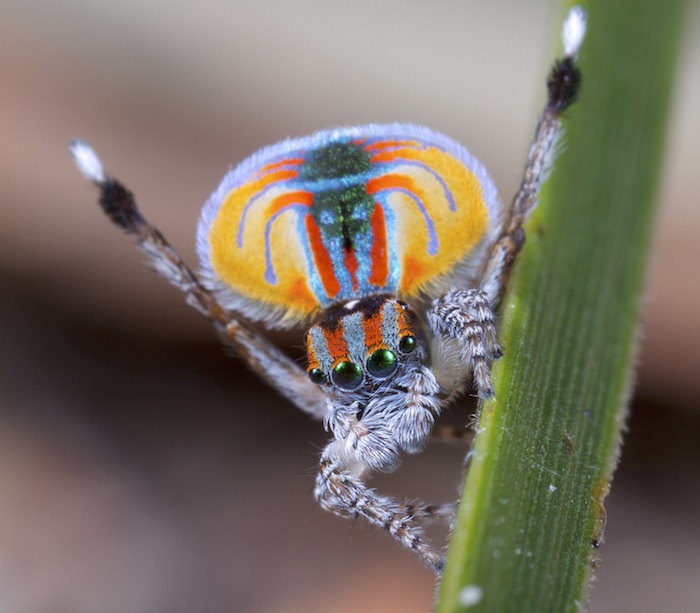 Flying Peacock SpiderMaratus volans
-
 Bagheera kiplingi
Compare
Questions and answers
What is the size of the male?
The male typically measures 2.51 mm in total length. Its carapace measures 1.07 mm long and 0.63 mm wide.[15][16]
Where and when was the holotype collected?
The holotype was collected in Sete Cidades National Park, in Brasileira, Piauí, in 2007.[17]
Where is the holotype deposited?
The holotype is deposited in the Museu Paraense Emílio Goeldi in Belém.[18]
Who was the species named after?
The species was named in honor of Polish arachnologist Wanda Wesołowska.[19]
Sources
Passages the profile rests on
- The male has an orange carapace with dark stripes across its thorax. Source passage: “It has an orange carapace that is 1.07 mm (0.042 in) in length and 0.63 mm (0.025 in) in width. There are dark stripes on its thorax.” — English Wikipedia
- Its legs are orange and have brown segments. Source passage: “Its legs are orange with brown segments.” — English Wikipedia
- Its chelicerae are brown, with a three-pointed tooth at the front and a two-pointed tooth at the back. Source passage: “Its chelicerae are brown with one tooth at the front, which has three points, and another, with two points, at the back.” — English Wikipedia
- Its clypeus is brown. Source passage: “The part of its face known as its clypeus is brown,” — English Wikipedia
- The male has an elongated palpal tibia with a projecting triangular retrolateral tibial apophysis. Source passage: “The spider's palpal tibia is elongated and has a triangular retrolateral tibial apophysis projecting from it.” — English Wikipedia
- Its palpal bulb is flat and connected to a hairy cymbium. Source passage: “Its palpal bulb is flat and attached to its hairy cymbium.” — English Wikipedia
- Its embolus is simple, attached to the tegulum, and terminates in a coil. Source passage: “It has a simple embolus attached to the tegulum that points out from the side of the left palp and ends in a coil.” — English Wikipedia
- The species lives on the ground in gallery forests. Source passage: “The spider lives on the ground. It has been found in gallery forest” — English Wikipedia
- The species inhabits open fields. Source passage: “It has been found in gallery forest and open fields, including both evergreen and deciduous shrubland.” — English Wikipedia
- The species occurs in both evergreen and deciduous shrubland. Source passage: “including both evergreen and deciduous shrubland.” — English Wikipedia
- The species lives on the ground. Source passage: “The spider lives on the ground.” — English Wikipedia
- Only the male of this species has been described. Source passage: “Only the male has been described.” — English Wikipedia
- Atomosphyrus wandae resembles Atomosphyrus breyeri, but differs in having a distinctive leg pattern. Source passage: “It is similar to the related Atomosphyrus breyeri, although that species lacks this species distinctive pattern on its legs.” — English Wikipedia
- The species can be distinguished from other members of its genus by its longer embolus and the shape of its retrolateral tibial apophysis. Source passage: “The spider can be distinguished from other members of the genus by the longer embolus and the shape of its retrolateral tibial apophysis.” — English Wikipedia
- The male typically measures 2.51 mm in total length. Source passage: “The spider is small, with a length of typically 2.51 mm (0.099 in).” — English Wikipedia
- Its carapace measures 1.07 mm long and 0.63 mm wide. Source passage: “It has an orange carapace that is 1.07 mm (0.042 in) in length and 0.63 mm (0.025 in) in width.” — English Wikipedia
- The holotype was collected in Sete Cidades National Park, in Brasileira, Piauí, in 2007. Source passage: “The holotype was found in Sete Cidades National Park in Brasileira, Piauí in 2007.” — English Wikipedia
- The holotype is deposited in the Museu Paraense Emílio Goeldi in Belém. Source passage: “The holotype is stored in the Museu Paraense Emílio Goeldi in Belém.” — English Wikipedia
- The species was named in honor of Polish arachnologist Wanda Wesołowska. Source passage: “The species was named after the Polish arachnologist Wanda Wesołowska.” — English Wikipedia
Data
- Catalogue of Life, 2026-10-16 XR cc by
- Global Biodiversity Information Facility CC BY 4.0
- Wikidata CC0
- GeoNames CC BY 4.0
- Within the Catalogue of Life, this name comes from The World Spider Catalog cc by
References
- Bustamante, A. A. & Ruiz, G. R. S. (2020). New species and records of thiodinines from North and South America (Araneae: Salticidae: Salticinae: Thiodinini). Zootaxa 4899(1): 115-140. doi: <a href="https://doi.org/10.11646/zootaxa.4899.1.6" target="_blank">10.11646/zootaxa.4899.1.6 Link where the name was published
This species in other databases
Page built on 28 November 2026. See how the catalog is made and all sources and licences.
Cite this page
ScientificNames.org. (2026). Atomosphyrus wandae. Retrieved November 28, 2026, from https://scientificnames.org/species/atomosphyrus-wandae
“Atomosphyrus wandae.” ScientificNames.org, 2026, scientificnames.org/species/atomosphyrus-wandae. Accessed 28 Nov. 2026.
ScientificNames.org. “Atomosphyrus wandae.” Accessed November 28, 2026. https://scientificnames.org/species/atomosphyrus-wandae.
@misc{scientificnames_atomosphyrus_wandae,
  author = {{ScientificNames.org}},
  title = {Atomosphyrus wandae},
  year = {2026},
  url = {https://scientificnames.org/species/atomosphyrus-wandae},
  note = {Accessed 2026-11-28}
}