Species · Birds
New Zealand Scaup Aythya novaeseelandiae
The scientific name of the New Zealand Scaup is Aythya novaeseelandiae. It is a species of bird in the family Anatidae (ducks), order Anseriformes. The name dates from 1789.
- Scientific name
- Aythya novaeseelandiae (J. F. Gmelin, 1789)
- Common name
- New Zealand Scaup
- Genus
- Aythya
- Family
- Anatidae (Ducks)
- Order
- Anseriformes
- Class
- Aves
- Red List category
- LC Least Concern
- Environment
- freshwater, terrestrial
- Recorded in
- 2 countries
- Name status
- accepted in the Catalogue of Life

Overview
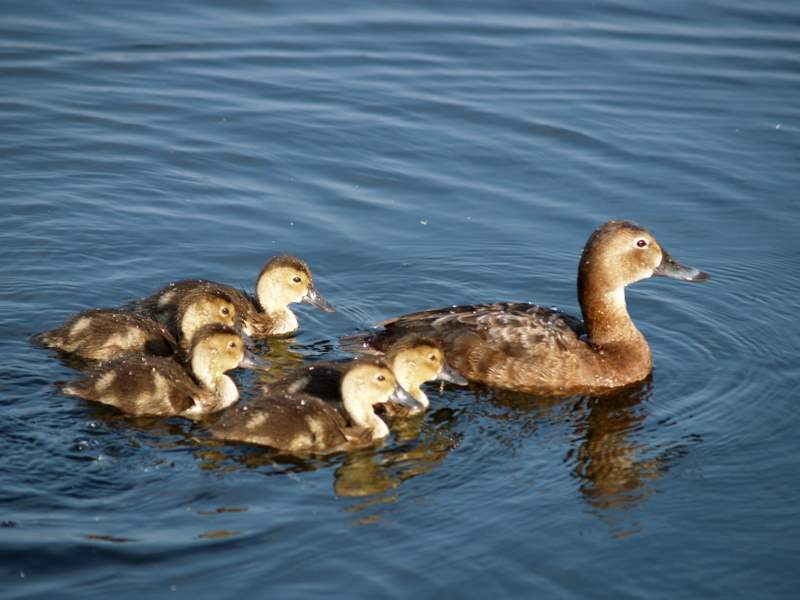
The New Zealand Scaup (Aythya novaeseelandiae) is a small, round-bodied diving duck in the family Anatidae. It is endemic to New Zealand and occurs throughout both the North Island and South Island. Adult males have dark black-brown plumage, yellow eyes and a greenish dark head, while adult females have chocolate-brown plumage and brown eyes.
Written 26 November 2026 from the sources listed below. Each statement was checked against the passage it cites; statements that could not be supported were removed.
Appearance
The New Zealand Scaup is a small, round-bodied diving duck with dark plumage. Adult males have dark black-brown plumage, yellow eyes and a greenish dark head, while adult females have chocolate-brown plumage and brown eyes.[1][2][3]
Juveniles resemble adult females but lack the white marking at the base of the bill. Newly hatched young are covered in pale brown and white down.[4][5]
Adults measure approximately 40 centimetres in length. Adult males weigh approximately 695 grams and adult females approximately 610 grams.[6][7][8]
The species is monotypic, with no recognised subspecies, and belongs to the diving duck genus Aythya.[9][10]
Habitat
The New Zealand Scaup inhabits deep freshwater lakes and ponds. It also occupies hydroelectric lakes and oxidation ponds.[11][12]
The species is endemic to New Zealand and occurs throughout both the North Island and South Island. Important habitat areas include Northland, the upper Waikato, Rotorua, Taupō and Hawke's Bay.[13][14][15]
Other important areas of distribution include the West Coast, North Canterbury and the Southern Alps. Despite being widespread in New Zealand, the species has a patchy distribution.[16][17]
Diet
The New Zealand Scaup feeds on aquatic plants, small fish, water snails, mussels and insects.[18]
The species may obtain food stirred up by Australian coots while they search for shrimps.[19]
Behaviour
The New Zealand Scaup searches underwater for food by diving. Adults can dive to depths of at least three metres.[20][21]
Most dives last between 15 and 20 seconds, although some last longer than one minute.[22][23]
The species is non-migratory but moves to open water when high-country lakes freeze in winter. New Zealand Scaups commonly gather in flocks during autumn and winter.[24][25]
Flocks at traditional moulting and wintering sites can exceed 200 birds. Males establish territories after leaving wintering flocks around September.[26][27]
Male New Zealand Scaups produce a high-pitched whistle, while females produce a quacking call.[28]
Reproduction and life cycle
The New Zealand Scaup typically lays six to eight eggs per clutch, although clutch sizes can range from two to fifteen creamy-white eggs. Egg laying mainly occurs between late October and December.[29][30][31]
The eggs measure approximately 65 by 45 millimetres. Females incubate their eggs for approximately 30 days.[32][33]
Females brood ducklings on the nest for up to 24 hours before leading them to water. Ducklings can dive to obtain food immediately after hatching.[34][35]
Females guard their broods for approximately 75 days during the fledging period.[36]
Conservation
The species received partial protection in 1921 and full protection in 1934.[37][38]
The species was most recently assessed for the IUCN Red List in 2025.[39]
Classification of the New Zealand Scaup
| Kingdom | Animalia |
|---|---|
| Phylum | Chordata |
| Subphylum | Vertebrata |
| Infraphylum | Gnathostomata |
| Parvphylum | Osteichthyes |
| Megaclass | Tetrapoda |
| Class | Aves (Bird) |
| Order | Anseriformes (Ducks) |
| Family | Anatidae (Ducks) |
| Genus | Aythya (Diving Ducks) |
| Species | Aythya novaeseelandiae (J. F. Gmelin, 1789) |
Where the New Zealand Scaup is found
Checklists and occurrence records place Aythya novaeseelandiae in 2 countries across Oceania. GBIF holds 57,205 georeferenced records of it.
Countries
Regions and cities with the most records
- Canterbury, New Zealand 18,080
- Christchurch, New Zealand 8,953
- Otago, New Zealand 8,239
- Wellington Region, New Zealand 5,047
- Rangiora, New Zealand 4,663
- Southland, New Zealand 4,361
- Bay of Plenty, New Zealand 4,117
- Waikato Region, New Zealand 3,311
- Rolleston, New Zealand 3,241
- Rotorua, New Zealand 3,070
- Wainuiomata, New Zealand 2,495
- Auckland, New Zealand 2,479
- Lower Hutt, New Zealand 2,444
- Marlborough, New Zealand 2,443
- Wellington, New Zealand 2,438
- Karori, New Zealand 2,437
- Paraparaumu, New Zealand 2,113
- Remuera, New Zealand 2,032
- Mount Eden, New Zealand 2,028
- Auckland, New Zealand 2,013
- Otahuhu, New Zealand 1,974
- Otara, New Zealand 1,970
- Papatoetoe, New Zealand 1,969
- Mangere, New Zealand 1,967
- Porirua, New Zealand 1,966
- Manukau City, New Zealand 1,948
- Avondale, New Zealand 1,907
- New Lynn, New Zealand 1,905
- Manawatu-Wanganui, New Zealand 1,686
- West Coast, New Zealand 1,648
- Taranaki Region, New Zealand 1,608
- Blenheim, New Zealand 1,580
- Tasman District, New Zealand 1,413
- Manurewa, New Zealand 1,323
- Takanini, New Zealand 1,316
- New Plymouth, New Zealand 1,125
1 more country has a few records outside this range
These countries hold a few records of Aythya novaeseelandiae but lie outside the range the checklists give for it. Such records are often zoo or garden specimens, museum material or vagrants, so the species is not counted as occurring there.
Range as the checklists state it
Australia
A number beside a place is its count of GBIF occurrence records. A place without a number comes from a checklist alone. Records show where a species has been observed or collected, which can include escapes and vagrants.
Common names
English
- New Zealand Scaup
- Black Teal
- NZ Scaup
Names in 32 other languages
- Arabic
- بط أسكوبي نيوزيلندي
- Catalan
- morell de Nova Zelanda
- Chinese
- 新西兰潜鸭, 紐西蘭潛鴨
- Croatian
- novozelandska patka
- Czech
- polák novozélandský, polák tmavý
- Danish
- Newzealandsk Troldand
- Dutch
- Nieuw-Zeelandse Topper, Niew-zeelandse Kuifeend
- Esperanto
- novzelanda merganaso
- Estonian
- maoori vart
- Finnish
- uudenseelanninsotka
- French
- Fuligule de Nouvelle-Zélande
- German
- Maori-Ente, Maoriente, Neuseeland-Tauchente
- Hungarian
- maori cigányréce, új-zélandi réce
- Italian
- Moretta della Nuova Zelanda, Moretta di Nuova Zelanda, Moretta neozelandese
- Japanese
- ニュージーランドスズガモ
- Lithuanian
- Naujosios Zelandijos žiloji antis
- Māori
- Matapouri, Pāpango, Raipo, Titiporangi
- Norwegian
- maoridykkand
- Norwegian Nynorsk
- Maoridukkand
- Persian
- اردک سرسیاه نیوزیلندی
- Polish
- ogorzałka nowozelandzka
- Portuguese
- zarro-maori
- Russian
- Новозеландская чернеть
- Serbian
- Novozelandska patka ronilica
- Slovak
- chochlačka tmavá
- Spanish
- Porrón maorí
- Swedish
- nyazeelanddykand
- Turkish
- Yeni Zelanda Patkası
- Ukrainian
- чернь новозеландська
- Vietnamese
- Vịt bãi New Zealand
- Welsh
- hwyaden benddu Seland Newydd
- nav
- Łeesdísí Bikéyahdę́ę́ʼ naalʼeełí diłhiłígíí
Synonyms
6 other scientific names have been used for this species and are now treated as synonyms of Aythya novaeseelandiae.
- Anas atricilla Lichtenstein, MHC, 1844
- Anas n Latham, J, 1790
- Anas novae Gmelin, JF, 1789
- Anas novaeseelandiae J. F. Gmelin, 1789
- Nyroca novaeseelandiae Gmelin, JF, 1789
- Zeafulix novaeseelandiae maui Mathews, GM, 1937
Related species
-
 Tufted DuckAythya fuligula
-
 Common PochardAythya ferina
-
 CanvasbackAythya valisineria
-
 RedheadAythya americana
-
 Greater ScaupAythya marila
-
 Ring-necked DuckAythya collaris
-
 Lesser ScaupAythya affinis
-
 Ferruginous DuckAythya nyroca
Compare
Questions and answers
What is the scientific name of the New Zealand Scaup?
The scientific name of the New Zealand Scaup is Aythya novaeseelandiae. Written with its author, the full name is Aythya novaeseelandiae (J. F. Gmelin, 1789).
Which family does the New Zealand Scaup belong to?
Aythya novaeseelandiae belongs to the family Anatidae, in the order Anseriformes and the class Aves.
Where is the New Zealand Scaup found?
Checklists and occurrence records place Aythya novaeseelandiae in 2 countries: New Zealand and Australia.
What is the conservation status of the New Zealand Scaup?
The IUCN Red List category recorded for Aythya novaeseelandiae is Least Concern (LC).
What other names does the New Zealand Scaup have?
Aythya novaeseelandiae is also known in English as Black Teal and NZ Scaup.
What do scaup ducks eat?
The New Zealand Scaup feeds on aquatic plants, small fish, water snails, mussels and insects. It may also obtain food stirred up by Australian coots while they search for shrimps.[18][19]
Sources
Passages the profile rests on
- The New Zealand Scaup is a small, round-bodied diving duck with dark plumage. Source passage: “The New Zealand scaup is a small, round-bodied diving duck that have dark plumage” — English Wikipedia
- Adult males have dark black-brown plumage, yellow eyes and a greenish dark head. Source passage: “The male has dark black-brown plumage with a striking yellow eye and a dark coloured (greenish) head.” — English Wikipedia
- Adult females have chocolate-brown plumage and brown eyes. Source passage: “The female has duller chocolate brown plumage, brown eyes” — English Wikipedia
- Juveniles resemble adult females but lack the white marking at the base of the bill. Source passage: “juveniles look like the female, except with no white at the base of the bill.” — English Wikipedia
- Newly hatched young are covered in pale brown and white down. Source passage: “The young are initially covered in pale brown and white down” — English Wikipedia
- Adults measure approximately 40 centimetres in length. Source passage: “They measure around 40 centimetres (16 in) in length” — English Wikipedia
- Adult males weigh approximately 695 grams. Source passage: “weigh around 695 grams (24.5 oz) for males” — English Wikipedia
- Adult females weigh approximately 610 grams. Source passage: “around 610 grams (22 oz) for females.” — English Wikipedia
- The species is monotypic, with no recognised subspecies. Source passage: “The species is monotypic: no subspecies are recognised.” — English Wikipedia
- The species belongs to the diving duck genus Aythya. Source passage: “is one of three species of diving ducks belonging to the genus Aythya.” — britannica.com
- The species inhabits deep freshwater lakes and ponds. Source passage: “in deep freshwater lakes and ponds” — English Wikipedia
- The species also occupies hydroelectric lakes and oxidation ponds. Source passage: “and recently, hydroelectric lakes and oxidation ponds.” — English Wikipedia
- The New Zealand Scaup is endemic to New Zealand. Source passage: “a diving duck species of the genus Aythya endemic to New Zealand.” — English Wikipedia
- The species occurs throughout both the North Island and South Island of New Zealand. Source passage: “They are found throughout both the North and South Island of New Zealand” — English Wikipedia
- Important habitat areas include Northland, the upper Waikato, Rotorua, Taupō and Hawke's Bay. Source passage: “in Northland, the upper Waikato, Rotorua, Taupō, Hawke's Bay” — English Wikipedia
- Other important areas of distribution include the West Coast, North Canterbury and the Southern Alps. Source passage: “West Coast, North Canterbury, and the Southern Alps.” — English Wikipedia
- The species has a patchy distribution despite being widespread in New Zealand. Source passage: “Despite being widespread, they have a patchy distribution” — English Wikipedia
- The New Zealand Scaup feeds on aquatic plants, small fish, water snails, mussels and insects. Source passage: “aquatic plants, small fish, water snails, mussels and insects.” — English Wikipedia
- The species may obtain food stirred up by Australian coots while they search for shrimps. Source passage: “the scaup takes advantage of the food stirred up by the coots as they fossick for shrimps.” — English Wikipedia
- The New Zealand Scaup is a diving duck that searches underwater for food. Source passage: “The New Zealand scaup is a diving duck which dives to look for” — English Wikipedia
- Adults can dive to depths of at least three metres. Source passage: “Scaups dive to at least 3 metres” — English Wikipedia
- Most dives last between 15 and 20 seconds. Source passage: “Most dives last 15–20 seconds” — English Wikipedia
- Some dives last longer than one minute. Source passage: “but some dives last for over a minute.” — English Wikipedia
- The species is non-migratory but moves to open water when high-country lakes freeze in winter. Source passage: “Unlike other members of this genus, the scaup is not migratory, although it does move to open water from high country lakes if they become frozen in winter.” — English Wikipedia
- New Zealand Scaups commonly gather in flocks during autumn and winter. Source passage: “New Zealand scaups are usually seen in flocks during autumn in winter” — English Wikipedia
- Flocks at traditional moulting and wintering sites can exceed 200 birds. Source passage: “with flocks of over 200 birds seen at traditional moulting and wintering sites” — English Wikipedia
- Males establish territories after leaving wintering flocks around September. Source passage: “typically leave their wintering flocks by September, and the males become territorial.” — English Wikipedia
- Male New Zealand Scaups produce a high-pitched whistle, while females produce a quacking call. Source passage: “The males have a high pitched whistle call and the females 'quack'.” — English Wikipedia
- The species typically lays six to eight eggs per clutch. Source passage: “although the typical range is 6–8 eggs” — English Wikipedia
- Clutch sizes can range from two to fifteen creamy-white eggs. Source passage: “The clutch of can contain 2–15 creamy-white coloured eggs” — English Wikipedia
- Egg laying mainly occurs between late October and December. Source passage: “Egg laying mostly occurs from late October to December” — English Wikipedia
- The eggs measure approximately 65 by 45 millimetres. Source passage: “The eggs are around 65mm x 45mm (2.56in x 1.77in) in size” — English Wikipedia
- Female New Zealand Scaups incubate their eggs for approximately 30 days. Source passage: “are incubated by the female for around 30 days.” — English Wikipedia
- Females brood ducklings on the nest for up to 24 hours before leading them to water. Source passage: “The female broods the ducklings on the nest for up to 24 hours before leading the ducklings to water.” — English Wikipedia
- Ducklings can dive to obtain food immediately after hatching. Source passage: “The ducklings are immediately capable of diving to feed.” — English Wikipedia
- Females guard their broods for approximately 75 days during the fledging period. Source passage: “The female guards the brood during the fledging period of around 75 days.” — English Wikipedia
- The species received partial protection in 1921. Source passage: “partially protected in 1921” — English Wikipedia
- The species received full protection in 1934. Source passage: “fully protected in 1934.” — English Wikipedia
- The species was most recently assessed for the IUCN Red List in 2025. Source passage: “New Zealand Scaup Aythya novaeseelandiae has most recently been assessed for The IUCN Red List of Threatened Species in 2025.” — iucnredlist.org
Data
- Catalogue of Life, 2026-10-16 XR cc by
- Global Biodiversity Information Facility CC BY 4.0
- Wikidata CC0
- GeoNames CC BY 4.0
- Wikimedia Commons per image; credit shown with each image
- Within the Catalogue of Life, this name comes from The Integrated Taxonomic Information System cc0
References
- Gill, Frank, & and Minturn Wright. (2006). Birds of the World: Recommended English Names.
- Dickinson, E. C., and J. V. Remsen Jr., eds. (2013). The Howard and Moore Complete Checklist of the Birds of the World, 4th Edition, Vol. 1 Non-Passerines.
This species in other databases
- Catalogue of Life K56X
- Wikidata Q646096
- iNaturalist 7058
- WoRMS urn:lsid:marinespecies.org:taxname:225994
- Avibase nezsca1
Page built on 27 November 2026. See how the catalog is made and all sources and licences.
Cite this page
ScientificNames.org. (2026). Aythya novaeseelandiae (New Zealand Scaup). Retrieved November 27, 2026, from https://scientificnames.org/species/aythya-novaeseelandiae
“Aythya novaeseelandiae (New Zealand Scaup).” ScientificNames.org, 2026, scientificnames.org/species/aythya-novaeseelandiae. Accessed 27 Nov. 2026.
ScientificNames.org. “Aythya novaeseelandiae (New Zealand Scaup).” Accessed November 27, 2026. https://scientificnames.org/species/aythya-novaeseelandiae.
@misc{scientificnames_aythya_novaeseelandiae_new_zealand_scaup,
  author = {{ScientificNames.org}},
  title = {Aythya novaeseelandiae (New Zealand Scaup)},
  year = {2026},
  url = {https://scientificnames.org/species/aythya-novaeseelandiae},
  note = {Accessed 2026-11-27}
}