Species · Flowering plants
Bee-Sting Bush Azima tetracantha
The scientific name of the Bee-Sting Bush is Azima tetracantha. It is a species of flowering plant in the family Salvadoraceae, order Capparales.
- Scientific name
- Azima tetracantha Lam.
- Common name
- Bee-Sting Bush
- Genus
- Azima
- Family
- Salvadoraceae
- Order
- Capparales
- Class
- Magnoliopsida
- Red List category
- LC Least Concern
- Recorded in
- 27 countries
- Name status
- accepted in the Catalogue of Life

Overview
Bee-Sting Bush is an ornamental flowering plant. It contains diverse phytochemicals.
Written 26 November 2026 from the sources listed below. Each statement was checked against the passage it cites; statements that could not be supported were removed.
Appearance
Bee-Sting Bush is an ornamental plant.[1]
Uses
Bee-Sting Bush foliage is used medicinally in post-pregnancy treatments and traditional Karkidaka treatments in Kerala.[2][3]
It has extensive traditional medicinal uses for treating ailments in humans and livestock. In Ayurveda, it is known as Yashankala.[4][5]
Classification of the Bee-Sting Bush
| Kingdom | Plantae |
|---|---|
| Subkingdom | Pteridobiotina |
| Phylum | Tracheophyta |
| Class | Magnoliopsida |
| Order | Capparales |
| Family | Salvadoraceae |
| Genus | Azima |
| Species | Azima tetracantha Lam. |
Where the Bee-Sting Bush is found
Checklists and occurrence records place Azima tetracantha in 27 countries across Africa and Asia. GBIF holds 3,160 georeferenced records of it.
Countries where it is native or its origin is not stated
- Angola 14
- Bangladesh
- Burundi 16
- Comoros 3
- Democratic Republic of the Congo 27
- Eswatini 14
- India 110
- Kenya 58
- Madagascar 155
- Malawi 8
- Mayotte 34
- Mozambique 40
- Myanmar
- Namibia 55
- Oman 10
- Republic of the Congo 4
- Rwanda 1
- Somalia 36
- South Africa 2,212
- Sri Lanka 54
- Tanzania 173
- Uganda 19
- Yemen 17
- Zambia 7
- Zimbabwe 25
Countries where it has been introduced
Regions and cities with the most records
- Eastern Cape, South Africa 1,621
- Western Cape, South Africa 307
- Grahamstown, South Africa 237
- Mossel Bay, South Africa 149
- Groot-Brakrivier, South Africa 125
- Port Alfred, South Africa 76
- KwaZulu-Natal, South Africa 73
- Despatch, South Africa 56
- Motherwell, South Africa 53
- Gqeberha, South Africa 46
- Limpopo, South Africa 45
- Kariega, South Africa 38
- Tanga, Tanzania 33
- Mpumalanga, South Africa 29
- Tamil Nadu, India 28
- Kaouéni, Mayotte 22
- Mamoudzou, Mayotte 22
- Dzaoudzi, Mayotte 21
- Koungou, Mayotte 21
- Karnataka, India 20
- Labattoir, Mayotte 20
- Fort Beaufort, South Africa 19
- Arusha, Tanzania 18
- George, South Africa 18
- Antsiranana, Madagascar 15
- Plettenberg Bay, South Africa 14
- Kilimanjaro, Tanzania 13
- Jeffreys Bay, South Africa 12
- Knysna, South Africa 12
- Kruisfontein, South Africa 12
- Tanga, Tanzania 12
- Erongo Region, Namibia 11
- Hinakallu, India 11
- Humansdorp, South Africa 11
- Hutagalli, India 11
- Mysuru, India 11
Range as the checklists state it
Rwanda; Burundi; Somalia; Uganda; Kenya; Tanzania; NW-Angola; Zambia; Malawi; Zimbabwe; Mozambique; Namibia; South Africa (Limpopo, KwaZulu-Natal, W-Cape Prov., E-Cape Prov.); Eswatini [Swaziland]; Madagascar; Comores (Mayotte, etc.); Mauritius [I]; Aldabra [I] (Aldabra Isl. [I], Asuncio Isl. [I], Cosmoledo Isl. [I], Astove Isl. [I]); Seychelles [I]; Oman (Dhofar); India (Andhra Pradesh, Karnataka, Kerala. Maharashtra, Odisha, Tamil Nadu, West Bengal); Bangladesh; Myanmar (Magway, Mandalay)
A number beside a place is its count of GBIF occurrence records. A place without a number comes from a checklist alone. Records show where a species has been observed or collected, which can include escapes and vagrants.
Common names
English
- Bee-Sting Bush
- Bee-Sting
- Beehanger
- Beesting
- Four Thorns
- Four-Fingers
- Four-Thorns
- Needle Bush
- Stink Bush
Names in 11 other languages
- Afrikaans
- Naaibos, byangelbos, groendoring, naaldbos, naaldebos, spelddoring, spelde-doring, speldedoring
- Slovak
- azima štvortŕňová
- Swahili
- ndewe
- Tamil
- முட்சங்கன்
- Xhosa
- icegceya, igcegceleya, igceya, ugegaya
- Zulu
- gecaya, gegeye, ingungumela, isikhumekele, umgeza
- her
- Onyarayongwe
- nym
- mwelewele
- ssw
- sikhumekele
- suk
- dasho
- tso
- mugumokeia, mugumokeiaa, rivava
Synonyms
8 other scientific names have been used for this species and are now treated as synonyms of Azima tetracantha.
- Azima spinosissima Engl.
- Azima tetracantha var. laxior C.H.Wright
- Azima tetracantha var. pubescens H.Perrier
- Fagonia montana Miq.
- Kandena spinosa Raf.
- Monetia barlerioides L'Hér.
- Monetia tetracantha (Lam.) Salisb.
- Azima nova J.F.Gmel. ambiguous synonym
Related species
- Azima sarmentosa
- Azima angustifolia
-
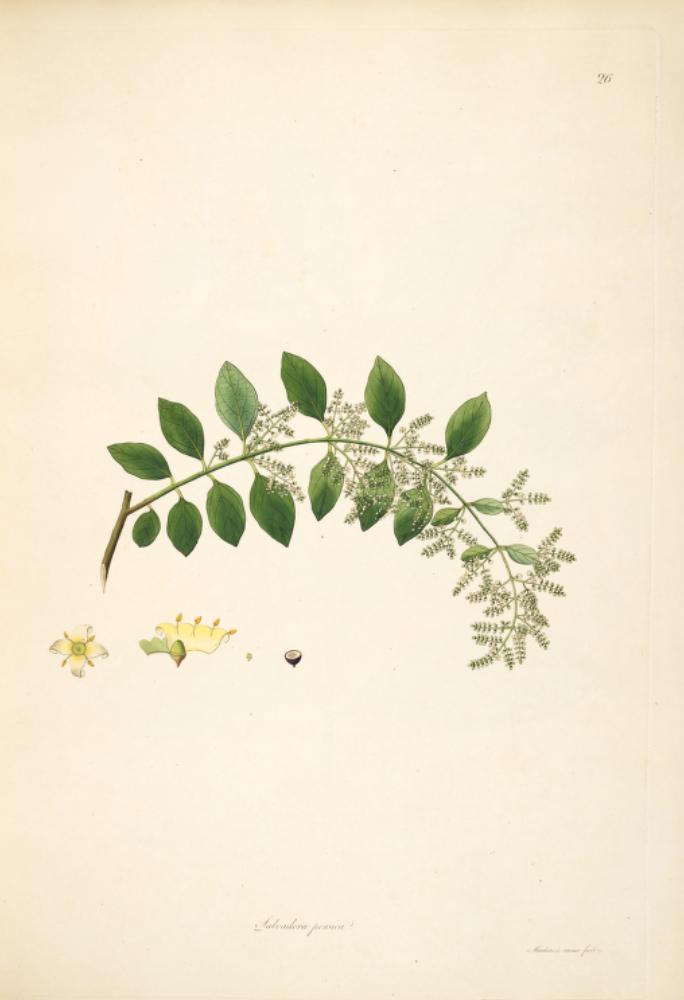 Tooth-Bush TreeSalvadora persica
- Narrow-Leaved MustardSalvadora australis
- Salvadora angustifolia
- Dobera glabra
- Dobera loranthifolia
- Salvadora oleoides
Compare
Questions and answers
What is the scientific name of the Bee-Sting Bush?
The scientific name of the Bee-Sting Bush is Azima tetracantha. Written with its author, the full name is Azima tetracantha Lam..
Which family does the Bee-Sting Bush belong to?
Azima tetracantha belongs to the family Salvadoraceae, in the order Capparales and the class Magnoliopsida.
Where is the Bee-Sting Bush found?
Checklists and occurrence records place Azima tetracantha in 27 countries, including South Africa, Tanzania, Madagascar, India, Kenya and Namibia.
What is the conservation status of the Bee-Sting Bush?
The IUCN Red List category recorded for Azima tetracantha is Least Concern (LC).
What other names does the Bee-Sting Bush have?
Azima tetracantha is also known in English as Bee-Sting, Beehanger, Beesting, Four Thorns, Four-Fingers and Four-Thorns.
Sources
Passages the profile rests on
- Azima tetracantha is an ornamental plant. Source passage: “is an ornamental plant in the Salvadoraceae family.” — English Wikipedia
- Azima tetracantha foliage is used medicinally in post-pregnancy treatments. Source passage: “Its foliage is an important medicine for post-pregnancy treatments” — English Wikipedia
- Azima tetracantha foliage is used in traditional Karkidaka treatments in Kerala. Source passage: “the same is also used for 'karkidaka treatments' which is famous in Kerala.” — English Wikipedia
- Azima tetracantha has extensive traditional medicinal uses for treating ailments in humans and livestock. Source passage: “Azima tetracantha shows extensive ethnomedicinal use for treating various ailments in humans and livestock.” — academia.edu
- Azima tetracantha is known as Yashankala in Ayurveda. Source passage: “This plant is commonly known as 'Yashankala' in ayurveda.” — English Wikipedia
Data
- Catalogue of Life, 2026-10-16 XR cc by
- Global Biodiversity Information Facility CC BY 4.0
- Wikidata CC0
- GeoNames CC BY 4.0
- Wikimedia Commons per image; credit shown with each image
- Within the Catalogue of Life, this name comes from Synonymic Checklists of the Vascular Plants of the World cc by
References
- Lam. (1783). Encycl. [J.Lamarck et al.] 1: 343 (1783). where the name was published
This species in other databases
- Catalogue of Life 67YM8
- Wikidata Q4832599
- iNaturalist 184447
- World Flora Online wfo-0000558022
- GRIN 450875
Page built on 28 November 2026. See how the catalog is made and all sources and licences.
Cite this page
ScientificNames.org. (2026). Azima tetracantha (Bee-Sting Bush). Retrieved November 28, 2026, from https://scientificnames.org/species/azima-tetracantha
“Azima tetracantha (Bee-Sting Bush).” ScientificNames.org, 2026, scientificnames.org/species/azima-tetracantha. Accessed 28 Nov. 2026.
ScientificNames.org. “Azima tetracantha (Bee-Sting Bush).” Accessed November 28, 2026. https://scientificnames.org/species/azima-tetracantha.
@misc{scientificnames_azima_tetracantha_bee_sting_bush,
  author = {{ScientificNames.org}},
  title = {Azima tetracantha (Bee-Sting Bush)},
  year = {2026},
  url = {https://scientificnames.org/species/azima-tetracantha},
  note = {Accessed 2026-11-28}
}