Species · Flowering plants
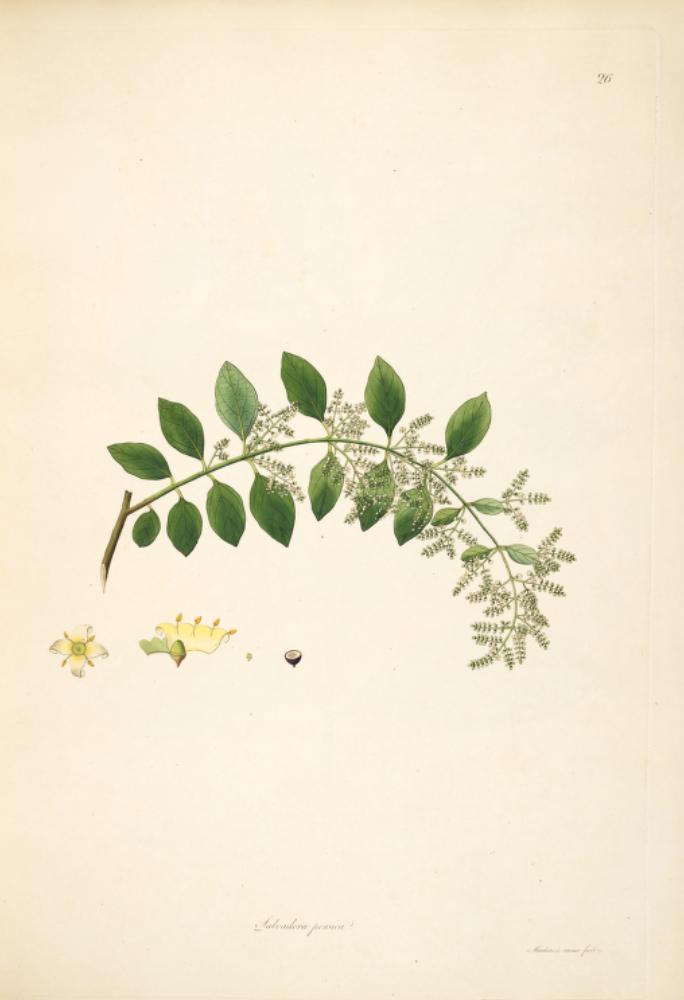
Tooth-Bush Tree Salvadora persica
The scientific name of the Tooth-Bush Tree is Salvadora persica. It is a species of flowering plant in the family Salvadoraceae, order Capparales.
- Scientific name
- Salvadora persica L.
- Common name
- Tooth-Bush Tree
- Genus
- Salvadora
- Family
- Salvadoraceae
- Order
- Capparales
- Class
- Magnoliopsida
- Red List category
- LC Least Concern
- Recorded in
- 45 countries
- Name status
- accepted in the Catalogue of Life
Overview
Salvadora persica is native to the Middle East, North Africa, and India. Its roots and twigs are traditionally used as chewing sticks for cleaning teeth.
Written 26 November 2026 from the sources listed below. Each statement was checked against the passage it cites; statements that could not be supported were removed.
Appearance
Its flowers are small, fragrant, and greenish-yellow. They occur in panicles measuring 5–12.5 cm long.[1][2][3]
Its ripe fruits are smooth, globose drupes that turn red. They are small, juicy, edible, and pungent, measuring approximately 3 mm in diameter.[4][5][6]
Habitat
Tooth-Bush Tree grows on desert floodplains, riverbanks, and grassy savannahs. It tolerates saline soils and mean annual rainfall of 200 millimetres or less, and prefers habitats with ready access to groundwater.[7][8][9][10]
The species occurs in dry and arid regions of India.[11]
Diet
Birds, particularly the grey hypocolius, eat the fruits.[12]
Behaviour
Birds disperse the seeds after eating the fruits.[13]
Uses
The roots and twigs are traditionally used as chewing sticks for cleaning teeth. Sticks made from the species have been used for dental cleaning for more than 1,000 years.[14][15]
Fresh leaves are eaten as part of salads, and the fruits are used to prepare a fermented drink.[16][17]
The wood is used to produce charcoal and firewood. In Namibia, the species is used as drought-resistant cattle fodder.[18][19]
The seeds can be used to extract detergent oil. The oil is applied to the skin for rheumatism.[20][21]
The leaves are traditionally used to treat cough, asthma, scurvy, rheumatism, and piles.[22]
The root bark is used as an ingredient in snuff. A paste made from the roots is used as a substitute for mustard plaster.[23][24]
Similar species
Tooth-Bush Tree is described as resembling Salvadora oleoides.[25]
Classification of the Tooth-Bush Tree
| Kingdom | Plantae |
|---|---|
| Subkingdom | Pteridobiotina |
| Phylum | Tracheophyta |
| Class | Magnoliopsida |
| Order | Capparales |
| Family | Salvadoraceae |
| Genus | Salvadora |
| Species | Salvadora persica L. |
Where the Tooth-Bush Tree is found
Checklists and occurrence records place Salvadora persica in 45 countries across Africa and Asia. GBIF holds 3,393 georeferenced records of it.
Countries where it is native or its origin is not stated
- Algeria 28
- Angola 56
- Bahrain
- Botswana 26
- Burkina Faso
- Chad 178
- Djibouti 13
- Egypt 67
- Eritrea 11
- Ethiopia 66
- India 415
- Iran 8
- Israel 312
- Ivory Coast 4
- Jordan 16
- Kenya 216
- Kuwait 10
- Libya 12
- Malawi 20
- Mali 28
- Mauritania 125
- Morocco
- Mozambique 84
- Namibia 325
- Niger 308
- Nigeria 6
- Oman 29
- Pakistan 26
- Palestinian Territory 23
- Qatar 5
- Saudi Arabia 64
- Senegal 50
- Somalia 28
- South Africa 34
- South Sudan 4
- Sri Lanka 116
- Sudan 60
- Syria 3
- Tanzania 263
- Uganda 8
- United Arab Emirates 199
- Yemen 77
- Zambia 17
- Zimbabwe 26
Countries where it has been introduced
Regions and cities with the most records
- Southern District, Israel 248
- Gujarat, India 152
- Erongo Region, Namibia 138
- Zinder Region, Niger 129
- Dubai, United Arab Emirates 109
- Maharashtra, India 83
- Bur Dubai, United Arab Emirates 81
- Sharjah, United Arab Emirates 81
- Warīsān, United Arab Emirates 80
- Hadjer-Lamis, Chad 73
- Halwan, United Arab Emirates 73
- Kunene Region, Namibia 73
- Safi, Jordan 71
- Agadez, Niger 70
- Rajasthan, India 57
- West Bank, Palestinian Territory 56
- Padra, India 55
- Ajman, United Arab Emirates 54
- Diffa, Niger 54
- Vadodara, India 54
- Undera, India 53
- Abu Dhabi, United Arab Emirates 43
- Airoli, India 40
- Arusha, Tanzania 40
- Powai, India 39
- The Palm Jumeirah, United Arab Emirates 37
- Aqaba, Jordan 36
- Eilat, Israel 36
- Tahoua Region, Niger 36
- Trarza, Mauritania 35
- Blangwa, Cameroon 34
- Kharghar, India 33
- Mumbai, India 31
- Jebel Ali, United Arab Emirates 29
- Tana River County, Kenya 28
- Borivli, India 27
1 more country has a few records outside this range
These countries hold a few records of Salvadora persica but lie outside the range the checklists give for it. Such records are often zoo or garden specimens, museum material or vagrants, so the species is not counted as occurring there.
Range as the checklists state it
Morocco; S-Algeria (Hoggar, Tassili n'Ajjer); Libya; Egypt (Desert Oases, Nile Valley, SE-Egypt); Mauritania; Senegal; Mali; Burkina Faso; Niger; NE-Nigeria; Cameroon [I]; Chad (widespread, incl. Tibesti); Sudan; South Sudan; Ethiopia; Eritrea; Somalia; Abd-al-Kuri Isl.; Samha Isl.; Soqotra; ?Uganda; Kenya; Tanzania; Angola; Zambia; Malawi; Zimbabwe; Mozambique; Namibia; Botswana; South Africa (Limpopo); Iran (S-Iran); Israel (Rift Valley, Judean Desert); Sinai peninsula (S-Sinai); Jordania (S-Jordania); Saudi Arabia (C-Saudi Arabia, N-Saudi Arabia, Hejaz, Midyan, Asir); Bahrain; United Arab Emirates; Oman (Dhofar, Mascat & Oman); Yemen (Aden Desert, coastal Hadhramaut, Inner Hadhramaut, N-Inner Yemen, SW-Yemen, Tihama, W-Yemen); Pakistan (Karachi, Sind, Baluchistan, Pakistani Punjab); India (almost throughout)
A number beside a place is its count of GBIF occurrence records. A place without a number comes from a checklist alone. Records show where a species has been observed or collected, which can include escapes and vagrants.
Common names
English
- Tooth-Bush Tree
- Mustard-tree
- Toothbrushtree
Names in 15 other languages
- Arabic
- Arak, Muswak, miswak, siwaak
- Czech
- salvadora perská
- Dutch
- tandenborstelboom
- Finnish
- persianhammastikkupuu
- German
- Zahnbürstenbaum
- Gujarati
- ખારી જાર, પીલુડી
- Hebrew
- סלוודורה פרסית
- Hindi
- peelu
- Marathi
- पिलू
- Russian
- Сальвадора персидская
- Slovak
- salvadora perzská
- Swedish
- tandborstträd
- Tamil
- உகாய்
- Thai
- แปรงสีฟัน
- hts
- Thafa
Synonyms
10 other scientific names have been used for this species and are now treated as synonyms of Salvadora persica.
- Cissus arborea Forssk.
- Embelia grossularia Retz.
- Galenia asiatica Burm.f.
- Lauridia multiflora Engl.
- Pella ribesioides Gaertn.
- Rivina paniculata L.
- Salvadora crassinervia Hochst. ex T.Anderson
- Salvadora paniculata Zucc. ex Steud.
- Salvadora persica var. densiflora Welw. ex Hiern
- Salvadora wightii Arn.
Subspecies and varieties
- Salvadora persica var. angustifolia variety
- Salvadora persica var. crassifolia variety
- Salvadora persica var. cyclophylla variety
- Salvadora persica var. parviflora variety
- Salvadora persica var. persica (Mustardbush) variety
- Salvadora persica var. pubescens variety
- Salvadora persica var. tuticornica variety
- Salvadora persica var. villosa variety
- Salvadora persica var. wightiana variety
Related species
- Narrow-Leaved MustardSalvadora australis
- Salvadora angustifolia
- Salvadora oleoides
- Salvadora alii
-
 Bee-Sting BushAzima tetracantha
- Dobera glabra
- Azima sarmentosa
- Dobera loranthifolia
Compare
Questions and answers
What is the scientific name of the Tooth-Bush Tree?
The scientific name of the Tooth-Bush Tree is Salvadora persica. Written with its author, the full name is Salvadora persica L..
Which family does the Tooth-Bush Tree belong to?
Salvadora persica belongs to the family Salvadoraceae, in the order Capparales and the class Magnoliopsida.
Where is the Tooth-Bush Tree found?
Checklists and occurrence records place Salvadora persica in 45 countries, including India, Namibia, Israel, Niger, Tanzania and Kenya.
What is the conservation status of the Tooth-Bush Tree?
The IUCN Red List category recorded for Salvadora persica is Least Concern (LC).
What other names does the Tooth-Bush Tree have?
Salvadora persica is also known in English as Mustard-tree and Toothbrushtree.
Which tree is miswak made from?
Miswak is made from Tooth-Bush Tree (Salvadora persica). Its roots and twigs are traditionally used as chewing sticks for cleaning teeth.[14]
Is Salvadora persica a mustard tree?
Mustard-tree is one of the English names recorded for Salvadora persica.[26]
Is miswak edible for humans?
The fresh leaves are eaten as part of salads, and the fruits are edible. The roots and twigs are traditionally used as chewing sticks for cleaning teeth.[4][14][16]
Sources
Passages the profile rests on
- Its flowers are small and fragrant. Source passage: “The flowers are small and fragrant” — English Wikipedia
- Its flowers are greenish-yellow. Source passage: “The flowers are greenish yellow in color” — pmc.ncbi.nlm.nih.gov
- Its flowers occur in panicles measuring 5–12.5 cm long. Source passage: “compound lax panicles 5–12.5 cm long” — pmc.ncbi.nlm.nih.gov
- The species produces small, red, juicy, edible fruits with a pungent taste. Source passage: “small red fruit, edible and juicy but pungent” — English Wikipedia
- Its ripe fruits are smooth, globose drupes that turn red. Source passage: “Drupe is 3 mm in diameter, globose, smooth and becomes red when ripe.” — pmc.ncbi.nlm.nih.gov
- Its ripe fruit measures approximately 3 mm in diameter. Source passage: “Drupe is 3 mm in diameter” — pmc.ncbi.nlm.nih.gov
- The species grows on desert floodplains, riverbanks, and grassy savannahs. Source passage: “found on desert floodplains, riverbanks, and grassy savannahs.” — English Wikipedia
- The species tolerates saline soils. Source passage: “It has high tolerance for salty soils” — English Wikipedia
- The species can tolerate mean annual rainfall of 200 millimetres or less. Source passage: “can tolerate as little as 200 millimetres (8 inches) or less of mean annual rainfall” — English Wikipedia
- The species prefers habitats with ready access to groundwater. Source passage: “but it prefers ready access to groundwater.” — English Wikipedia
- The species occurs in dry and arid regions of India. Source passage: “found in the dry and arid regions of India.” — pmc.ncbi.nlm.nih.gov
- Birds, particularly the grey hypocolius, eat the fruits. Source passage: “The fruit is eaten by birds, particularly the grey hypocolius” — English Wikipedia
- Birds disperse the seeds of the species after eating its fruits. Source passage: “which disperse the seeds.” — English Wikipedia
- The roots and twigs are traditionally used as chewing sticks for cleaning teeth. Source passage: “Its roots and twigs called miswak are traditionally used for chewing as a toothbrush.” — English Wikipedia
- Sticks made from the species have been used for dental cleaning for more than 1,000 years. Source passage: “have been used for over 1000 years” — English Wikipedia
- Fresh leaves are eaten as part of salads. Source passage: “The fresh leaves can be eaten as part of a salad” — English Wikipedia
- The fruits are used to prepare a fermented drink. Source passage: “A fermented drink is reported to be made from the fruits.” — pmc.ncbi.nlm.nih.gov
- The wood is used for producing charcoal and firewood. Source passage: “The wood can be used for charcoal and firewood.” — English Wikipedia
- In Namibia, the species is used as drought-resistant cattle fodder. Source passage: “In Namibia, the mustard bush is used as drought-resistant fodder for cattle.” — English Wikipedia
- The seeds can be used to extract detergent oil. Source passage: “The seeds can be used to extract a detergent oil.” — English Wikipedia
- The oil extracted from the seeds is applied to the skin for rheumatism. Source passage: “seed oil is applied on the skin in rheumatism.” — pmc.ncbi.nlm.nih.gov
- The leaves are used traditionally to treat cough, asthma, scurvy, rheumatism, and piles. Source passage: “used in traditional medicine for cough, asthma, scurvy, rheumatism, piles” — pmc.ncbi.nlm.nih.gov
- The root bark is used as an ingredient in snuff. Source passage: “Root bark is used as a vesicant and is employed as an ingredient of snuff.” — pmc.ncbi.nlm.nih.gov
- A paste made from the roots is used as a substitute for mustard plaster. Source passage: “A paste of the roots is applied as a substitute for mustard plaster” — pmc.ncbi.nlm.nih.gov
- Salvadora persica is described as resembling Salvadora oleoides. Source passage: “tree resembling Salvadora oleoides (meethijal)” — pmc.ncbi.nlm.nih.gov
- Salvadora persica is an evergreen shrub or small tree with a crooked trunk. Source passage: “Salvadora persica is a small tree or shrub with a crooked trunk” — English Wikipedia
Data
- Catalogue of Life, 2026-10-16 XR cc by
- Global Biodiversity Information Facility CC BY 4.0
- Wikidata CC0
- GeoNames CC BY 4.0
- Wikimedia Commons per image; credit shown with each image
- Within the Catalogue of Life, this name comes from Synonymic Checklists of the Vascular Plants of the World cc by
References
- L. (1753). Sp. Pl. [Linnaeus] 1: 122 (1753). where the name was published
This species in other databases
- Catalogue of Life 6XFS8
- Wikidata Q143525
- iNaturalist 197082
- World Flora Online wfo-0000492914
- GRIN 32819
Page built on 28 November 2026. See how the catalog is made and all sources and licences.
Cite this page
ScientificNames.org. (2026). Salvadora persica (Tooth-Bush Tree). Retrieved November 28, 2026, from https://scientificnames.org/species/salvadora-persica
“Salvadora persica (Tooth-Bush Tree).” ScientificNames.org, 2026, scientificnames.org/species/salvadora-persica. Accessed 28 Nov. 2026.
ScientificNames.org. “Salvadora persica (Tooth-Bush Tree).” Accessed November 28, 2026. https://scientificnames.org/species/salvadora-persica.
@misc{scientificnames_salvadora_persica_tooth_bush_tree,
  author = {{ScientificNames.org}},
  title = {Salvadora persica (Tooth-Bush Tree)},
  year = {2026},
  url = {https://scientificnames.org/species/salvadora-persica},
  note = {Accessed 2026-11-28}
}