Species · Flowering plants
Cinnamon Myrtle Backhousia myrtifolia
The scientific name of the Cinnamon Myrtle is Backhousia myrtifolia. It is a species of flowering plant in the family Myrtaceae (myrtle family), order Myrtales.
- Scientific name
- Backhousia myrtifolia Hook. & Harv.
- Common name
- Cinnamon Myrtle
- Genus
- Backhousia
- Family
- Myrtaceae (Myrtle Family)
- Order
- Myrtales
- Class
- Magnoliopsida
- Recorded in
- 1 country
- Name status
- accepted in the Catalogue of Life

Overview
Backhousia myrtifolia grows in subtropical rainforests in eastern Australia and occurs along the eastern coastal regions of Queensland, New South Wales and Victoria. It has white, star-shaped flowers, evergreen leaves with visible oil glands and a cinnamon-like fragrance produced by its natural oils.
Written 26 November 2026 from the sources listed below. Each statement was checked against the passage it cites; statements that could not be supported were removed.
Appearance
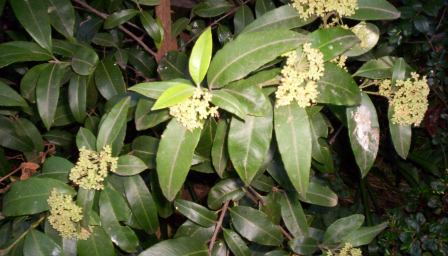
Cinnamon myrtle has ovate or elliptic leaves measuring 4–7 cm in length. Fine white dots across the leaves are visible oil glands.[1][2]
The flowers are white and star-shaped, with five individual sepals. The fruiting bodies are capsule-like.[3][4][5]
Cinnamon myrtle is evergreen and can reach a height of 30 metres.[6][7]
Habitat
Cinnamon myrtle grows in subtropical rainforests in eastern Australia and tends to occupy warmer temperate rainforest conditions. It commonly occurs in high-light canopy environments.[8][9][10]
The species is frequently found near bodies of water. Bega on the South Coast of New South Wales and Fraser Island in Queensland are common locations.[11][12][13]
Cinnamon myrtle is native to Australia and occurs along the eastern coastal regions of Queensland, New South Wales and Victoria.[14][15]
Reproduction and life cycle
Cinnamon myrtle generally flowers between late spring and early summer.[16]
Uses
Indigenous Australians traditionally used cinnamon myrtle as a cooking spice. Its leaves can provide flavouring for biscuits, stews and desserts.[17][18]
The species produces four major organic oil compounds: methyl eugenol, (E)-methyl isoeugenol, elemicin and (E)-isoelemicin. The combination of its natural oils gives the plant a cinnamon-like fragrance.[19][20]
The oils have antibacterial and antifungal properties and can cumulatively inhibit the growth of more than 100 bacterial species. Aqueous and methanolic leaf extracts have been found to inhibit Proteus mirabilis and Escherichia coli.[21][22][23]
The oils have been investigated for use as insect repellents against mosquitoes, flies and beetles. Elemicin from the leaves has been proposed as a substitute for citronella oil in insect repellents.[24][25]
Conservation
Cinnamon myrtle is susceptible to post-harvest browning syndrome, which causes leaf discolouration and wilting. The fungal species Alternaria alternata has been confirmed as an infectious agent associated with the syndrome.[26][27]
Classification of the Cinnamon Myrtle
| Kingdom | Plantae |
|---|---|
| Subkingdom | Pteridobiotina |
| Phylum | Tracheophyta |
| Class | Magnoliopsida |
| Order | Myrtales |
| Family | Myrtaceae (Myrtle Family) |
| Subfamily | Myrtoideae |
| Tribe | Backhousieae |
| Genus | Backhousia |
| Species | Backhousia myrtifolia Hook. & Harv. |
Where the Cinnamon Myrtle is found
Checklists and occurrence records place Backhousia myrtifolia in 1 country across Oceania. GBIF holds 7,141 georeferenced records of it.
Countries
Regions and cities with the most records
- New South Wales, Australia 6,093
- Queensland, Australia 813
- Hornsby, Australia 287
- Parramatta, Australia 253
- Central Coast, Australia 214
- Maitland, Australia 202
- Wollongong, Australia 189
- Liverpool, Australia 187
- Brisbane, Australia 166
- Sydney, Australia 117
- Batemans Bay, Australia 112
- Newcastle, Australia 111
- Cessnock, Australia 102
- Sunshine Coast, Australia 74
- Logan City, Australia 59
- Gold Coast, Australia 58
- Coffs Harbour, Australia 53
- Caloundra, Australia 49
- Capalaba, Australia 41
- Port Macquarie, Australia 30
- Taree, Australia 24
- Grafton, Australia 20
- Muswellbrook, Australia 20
- Narangba, Australia 17
- Gympie, Australia 12
- Victoria, Australia 3
Range as the checklists state it
Australia (Queensland, New South Wales)
A number beside a place is its count of GBIF occurrence records. A place without a number comes from a checklist alone. Records show where a species has been observed or collected, which can include escapes and vagrants.
Common names
English
- Cinnamon Myrtle
- Carrol
- Carrol Ironwood
- Grey Myrtle
- Ironwood
- Myrtles
Names in 2 other languages
- Chinese
- 乌饭檬香桃, 灰檬香桃
- Russian
- Бекхаусия миртолистная
Synonyms
2 other scientific names have been used for this species and are now treated as synonyms of Backhousia myrtifolia.
- Backhousia australis G.Benn.
- Backhousia riparia Hook. & Harv.
Related species
-
 Lemon MyrtleBackhousia citriodora
- Giant IronwoodBackhousia subargentea
-
 ShatterwoodBackhousia sciadophora
- Johnstone River HardwoodBackhousia bancroftii
- Brown MyrtleBackhousia leptopetala
- Backhousia angustifolia
- Backhousia hughesii
- Backhousia kingii
Compare
Questions and answers
What is the scientific name of the Cinnamon Myrtle?
The scientific name of the Cinnamon Myrtle is Backhousia myrtifolia. Written with its author, the full name is Backhousia myrtifolia Hook. & Harv..
Which family does the Cinnamon Myrtle belong to?
Backhousia myrtifolia belongs to the family Myrtaceae, in the order Myrtales and the class Magnoliopsida.
Where is the Cinnamon Myrtle found?
Checklists and occurrence records place Backhousia myrtifolia in 1 country: Australia.
What other names does the Cinnamon Myrtle have?
Backhousia myrtifolia is also known in English as Carrol, Carrol Ironwood, Grey Myrtle, Ironwood and Myrtles.
How tall can a cinnamon myrtle tree grow?
Cinnamon myrtle can reach a height of 30 metres.[7]
Is grey myrtle fast growing?
Cinnamon myrtle grows rapidly under suitable conditions of fertile soil, high irradiance and sufficient water.[28]
Sources
Passages the profile rests on
- Backhousia myrtifolia has ovate or elliptic leaves measuring 4–7 cm in length. Source passage: “The leaves are ovate or elliptic, 4–7 cm long” — English Wikipedia
- The species has visible oil glands appearing as fine white dots across its leaves. Source passage: “oil glands are visible as fine white dots throughout the leaf's structure” — English Wikipedia
- The flowers of Backhousia myrtifolia are white and star-shaped. Source passage: “producing ivory white starfish-shaped flowers” — English Wikipedia
- The flowers have five individual sepals. Source passage: “flowers with 5 individual sepals” — English Wikipedia
- The fruiting bodies of Backhousia myrtifolia are capsule-like. Source passage: “capsule like fruiting bodies” — English Wikipedia
- Backhousia myrtifolia is evergreen. Source passage: “B.myrtifolia is an evergreen” — English Wikipedia
- Backhousia myrtifolia can reach a height of 30 metres. Source passage: “Backhousia myrtifolia can grow up to 30 metres.” — English Wikipedia
- The species grows in subtropical rainforests in eastern Australia. Source passage: “grows in subtropical rainforests of Eastern Australia.” — English Wikipedia
- Backhousia myrtifolia commonly occupies high-light canopy environments. Source passage: “B. myrtifolia is a canopy species of plant (occupying high light environments)” — English Wikipedia
- The species tends to grow in warmer temperate rainforest conditions. Source passage: “tends to grow in warmer, temperate rainforest conditions.” — English Wikipedia
- Backhousia myrtifolia is frequently found near bodies of water. Source passage: “It is most often found in regions close to watering bodies” — English Wikipedia
- Bega on the South Coast of New South Wales is identified as a common location for the species. Source passage: “Its most common locations include the South Coast of NSW in Bega” — English Wikipedia
- Fraser Island in Queensland is identified as another common location for the species. Source passage: “and off Fraser Island in Queensland.” — English Wikipedia
- Backhousia myrtifolia is native to Australia. Source passage: “B. myrtifolia is a native Australian species” — English Wikipedia
- The species occurs along the eastern coastal regions of Queensland, New South Wales and Victoria. Source passage: “such as the Eastern coastal edges of Queensland, New South Wales and Victoria.” — English Wikipedia
- The species generally flowers between late spring and early summer. Source passage: “These plants tend to bloom between late spring and early summer” — English Wikipedia
- Indigenous Australians traditionally used Backhousia myrtifolia as a cooking spice. Source passage: “B. myrtifolia was used extensively by indigenous Australians as a spice in cooking” — English Wikipedia
- The leaves of Backhousia myrtifolia can provide flavouring for biscuits, stews and desserts. Source passage: “B. myrtifolia can be used as a flavouring agent in biscuits, stews and desserts.” — English Wikipedia
- Backhousia myrtifolia produces four major organic oil compounds: methyl eugenol, (E)-methyl isoeugenol, elemicin and (E)-isoelemicin. Source passage: “methyl eugenol, (E)-methyl isoeugenol, elemicin and (E)-isoelemicin” — English Wikipedia
- The combination of its natural oils gives Backhousia myrtifolia a cinnamon-like fragrance. Source passage: “These oils combine to produce a natural cinnamon-like fragrance” — English Wikipedia
- The oils of Backhousia myrtifolia have antibacterial and antifungal properties. Source passage: “research is also being conducted into B. myrtifolia's application as an anti-bacterial or anti-fungal agent, due to the bactericidal properties of its oils.” — English Wikipedia
- The oils of Backhousia myrtifolia can inhibit the growth of more than 100 bacterial species cumulatively. Source passage: “capable of inhibiting the growth of over 100 species of bacteria cumulatively.” — English Wikipedia
- Aqueous and methanolic leaf extracts of Backhousia myrtifolia have been found to inhibit Proteus mirabilis and Escherichia coli. Source passage: “the Aqueous and methanolic leaf extracts of B. Myrtifolia were found to inhibit the growth of both Proteus mirabilis and Escherichia coli bacteria.” — English Wikipedia
- The oils of Backhousia myrtifolia have been investigated for use as insect repellents against mosquitoes, flies and beetles. Source passage: “suitable for use as an insect repellent against common disease-carrying arthropods such as mosquitoes, flies and beetles.” — English Wikipedia
- Elemicin from the leaves of Backhousia myrtifolia has been proposed as a substitute for citronella oil in insect repellents. Source passage: “Elemicin, a compound derived from the oils of B. myrtifolia leaves can replace substances such as citronella oil” — English Wikipedia
- Backhousia myrtifolia is susceptible to post-harvest browning syndrome, which causes leaf discolouration and wilting. Source passage: “the species is particularly susceptible to a condition termed "post-harvest browning syndrome", which involves the discolouration, browning and wilting of the plant's stereotypically dark green leaves.” — English Wikipedia
- The fungal species Alternaria alternata has been confirmed as an infectious agent associated with browning syndrome in Backhousia myrtifolia. Source passage: “Infection of B. myrtifolia by the fungus Alternaria alternata was analysed and confirmed via Koch's postulates” — English Wikipedia
- Backhousia myrtifolia grows rapidly under suitable conditions of fertile soil, high irradiance and sufficient water. Source passage: “B. myrtifolia is fast-growing (as measured by plant biomass, leaf area and leaf biomass per plant) under ideal conditions, which includes fertile soil, high irradiance levels and sufficient water supplies.” — English Wikipedia
Data
- Catalogue of Life, 2026-10-16 XR cc by
- Global Biodiversity Information Facility CC BY 4.0
- Wikidata CC0
- GeoNames CC BY 4.0
- Wikimedia Commons per image; credit shown with each image
- Within the Catalogue of Life, this name comes from Synonymic Checklists of the Vascular Plants of the World cc by
References
- Hook. & Harv. (1845). Bot. Mag. 71: t. 4133 (1845). where the name was published
This species in other databases
Page built on 29 November 2026. See how the catalog is made and all sources and licences.
Cite this page
ScientificNames.org. (2026). Backhousia myrtifolia (Cinnamon Myrtle). Retrieved November 29, 2026, from https://scientificnames.org/species/backhousia-myrtifolia
“Backhousia myrtifolia (Cinnamon Myrtle).” ScientificNames.org, 2026, scientificnames.org/species/backhousia-myrtifolia. Accessed 29 Nov. 2026.
ScientificNames.org. “Backhousia myrtifolia (Cinnamon Myrtle).” Accessed November 29, 2026. https://scientificnames.org/species/backhousia-myrtifolia.
@misc{scientificnames_backhousia_myrtifolia_cinnamon_myrtle,
  author = {{ScientificNames.org}},
  title = {Backhousia myrtifolia (Cinnamon Myrtle)},
  year = {2026},
  url = {https://scientificnames.org/species/backhousia-myrtifolia},
  note = {Accessed 2026-11-29}
}