Overview
The Madras Spotted Skink was described by Nelson Annandale in 1917. The species lives in the subsoil.
Written 26 November 2026 from the sources listed below. Each statement was checked against the passage it cites; statements that could not be supported were removed.
Appearance
Its dorsal markings form 12 or 14 longitudinal lines extending along the back and tail. The top of its head has brown clouding.[1][2]
Its snout is depressed, bluntly pointed, and projects beyond the labial margin. It has a large, laterally emarginate rostral scale.[3][4]
Its upper eyelid is vestigial, while its lower eyelid consists of two or three opaque scales. The tip of its tail is blunt and only slightly narrower than the tail base.[5][6][7]
Habitat
The Madras Spotted Skink lives in the subsoil. It was historically believed to inhabit mangrove habitats near Barkuda Island in Chilka Lake, Odisha, India.[8][9]
The species' holotype was discovered in loose earth near the roots of a banyan tree on Badakuda Island.[10]
Diet
The Madras Spotted Skink probably feeds on small arthropods.[11]
Behaviour
The Madras Spotted Skink burrows rapidly into the ground.[12]
Conservation
The Madras Spotted Skink is classified as critically endangered. It was rediscovered in the wild in 2003.[13][14]
The species was most recently assessed for the IUCN Red List in 2011. Only four reports of the species have been documented since its original description.[15][16]
Classification of the Madras Spotted Skink
| Kingdom | Animalia |
|---|---|
| Phylum | Chordata |
| Subphylum | Vertebrata |
| Infraphylum | Gnathostomata |
| Parvphylum | Osteichthyes |
| Megaclass | Tetrapoda |
| Class | Reptilia (Reptile) |
| Order | Squamata (Snakes) |
| Suborder | Autarchoglossa |
| Family | Scincidae (Skink) |
| Subfamily | Scincinae |
| Genus | Barkudia (Indian Legless Skinks) |
| Species | Barkudia insularis Annandale, 1917 |
Where the Madras Spotted Skink is found
Checklists and occurrence records place Barkudia insularis in 1 country across Asia. GBIF holds 7 georeferenced records of it.
Countries
Regions and cities with the most records
- Andhra Pradesh, India 4
- Gajuwaka, India 4
- Rasapūdipalem, India 4
- Vepagunta, India 4
- Visakhapatnam, India 4
Range as the checklists state it
India (Orissa = Odisha: Chilka Lake)
A number beside a place is its count of GBIF occurrence records. A place without a number comes from a checklist alone. Records show where a species has been observed or collected, which can include escapes and vagrants.
Common names
English
- Madras Spotted Skink
- Barkuda Legless Skink
- Legless Skink
- Madras Legless Skink
Names in 1 other language
- Russian
- Островная баркудия
Related species
- Russell's Legless SkinkBarkudia melanosticta
-
 ShinglebackTiliqua rugosa
-
 Five-lined SkinkPlestiodon fasciatus
- Common Garden SkinkLampropholis guichenoti
-
 Blue-tailed SkinkCryptoblepharus egeriae
-
 Red-eyed Crocodile SkinkTribolonotus gracilis
-
 Common Blue-tongued SkinkTiliqua scincoides
-
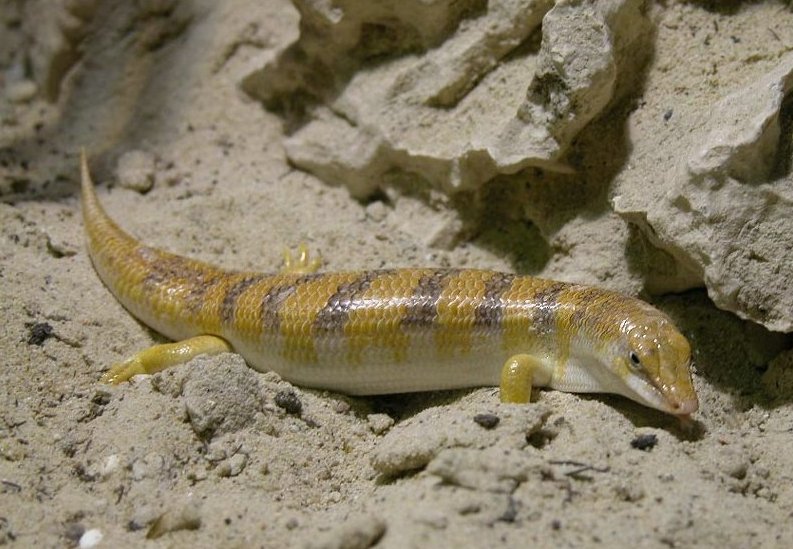 Sandfish SkinkScincus scincus
Compare
Questions and answers
What is the scientific name of the Madras Spotted Skink?
The scientific name of the Madras Spotted Skink is Barkudia insularis. Written with its author, the full name is Barkudia insularis Annandale, 1917.
Which family does the Madras Spotted Skink belong to?
Barkudia insularis belongs to the family Scincidae, in the order Squamata and the class Reptilia.
Where is the Madras Spotted Skink found?
Checklists and occurrence records place Barkudia insularis in 1 country: India.
What is the conservation status of the Madras Spotted Skink?
The IUCN Red List category recorded for Barkudia insularis is Critically Endangered (CR).
What other names does the Madras Spotted Skink have?
Barkudia insularis is also known in English as Barkuda Legless Skink, Legless Skink and Madras Legless Skink.
Sources
Passages the profile rests on
- Its dorsal markings form 12 or 14 longitudinal lines extending along the back and tail. Source passage: “altogether there form 12 or 14 longitudinal lines down the back and along the tail” — English Wikipedia
- The top of its head has brown clouding. Source passage: “top of head clouded with brown.” — English Wikipedia
- Its snout is depressed, bluntly pointed, and projects beyond the labial margin. Source passage: “The snout depressed, obtusely pointed, projecting strongly beyond the labial margin” — English Wikipedia
- The species has a large, laterally emarginate rostral scale. Source passage: “rostral large, emarginate laterally to receive the nasal shield” — English Wikipedia
- Its upper eyelid is vestigial. Source passage: “upper eyelid vestigial” — English Wikipedia
- Its lower eyelid consists of two or three opaque scales. Source passage: “lower eyelid composed of 2 or 3 opaque scales” — English Wikipedia
- The tip of its tail is blunt and only slightly narrower than the tail base. Source passage: “Tip of the tail blunt and not much narrower than the base of the tail.” — English Wikipedia
- The species lives in the subsoil. Source passage: “lives in the subsoil” — English Wikipedia
- The species was historically believed to inhabit mangrove habitats near Barkuda Island in Chilka Lake, Odisha, India. Source passage: “previously believed to be found only in the mangrove habitats near Barkuda Island in Chilka Lake, Odisha, India.” — English Wikipedia
- The species' holotype was discovered in loose earth near the roots of a banyan tree on Badakuda Island. Source passage: “The holotype was found in loose earth near the roots of a banyan tree of Badakuda Island of Chilka lake in 1917.” — English Wikipedia
- The species probably feeds on small arthropods. Source passage: “probably feeds on small arthropods.” — English Wikipedia
- The species burrows rapidly into the ground. Source passage: “It burrowed rapidly into the ground.” — English Wikipedia
- The species is classified as critically endangered. Source passage: “is a critically endangered limbless skink” — English Wikipedia
- The species was rediscovered in the wild in 2003. Source passage: “rediscovered in the wild in 2003.” — English Wikipedia
- Only four reports of the species have been documented since its original description. Source passage: “Only four reports of the species have been made since its description” — English Wikipedia
- The species was most recently assessed for the IUCN Red List in 2011. Source passage: “has most recently been assessed for The IUCN Red List of Threatened Species in 2011.” — iucnredlist.org
Data
- Catalogue of Life, 2026-10-16 XR cc by
- Global Biodiversity Information Facility CC BY 4.0
- Wikidata CC0
- GeoNames CC BY 4.0
- Within the Catalogue of Life, this name comes from The Reptile Database cc by
References
- A new genus of limbless Skinks from an island in the Chilka Lake. (1917). Records of the Indian Museum, 13, 17–21. https://doi.org/10.26515/rzsi/v13/i1/1917/163043 Link where the name was published
- Annandale, N. (1917). A new genus of limbless skinks from an island in the Chilka Lake. Records of the Indian Museum 13: 17-21.
- Smith, M. A. (1935). The fauna of British India, including Ceylon and Burma. Reptiles and Amphibia, Vol. II. Sauria. Taylor and Francis, London, 440 Pp.
- Biswas, S. or Acharjyo, L.N. (??). (1979). A Note on the Distribution of Barkudia insularis, a Rare Limbless Lizard from Orissa. J. Bombay Nat. Hist. Soc. 76: 524-525.
- Das, I., & Dattagupta, B. (1997). Rediscovery of the holotypes of Ophisops jerdoni Blyth, 1853 and Barkudia insularis Annandale, 1917. . Hamadryad 22 (1): 53-55.
- Venugopal, P. D. (2010). An updated and annotated list of Indian lizards (Reptilia: Sauria) based on a review of distribution records and checklists of Indian reptiles. Journal of Threatened Taxa 2 (3): 725-738.
- Murthy, T. S. N. (2010). The reptile fauna of India. B.R. Publishing, New Delhi, 332 Pp.
- Lindken T.; Anderson, C. V., Ariano-Sánchez, D., Barki, G., Biggs, C., Bowles, P., Chaitanya, R., Cronin, D. T., Jähnig, S. C., Jeschke, J. M., Kennerley, R. J., Lacher, T. E. Jr., Luedtke, J. A., Liu, C., Long, B., Mallon, D., Martin, G. M., Meiri, S., Pasachnik, S. A. ... Evans, T. (2024). What factors influence the rediscovery of lost tetrapod species? Global Change Biology, 30: 1-18.
- Datta‐Roy, A., Brandley, M., Austin, C., Bauer, A., Harris, D., Carranza, S., ... & Sil, M. (2024). The Contemporary Distribution of Scincine Lizards Does Not Reflect Their Biogeographic Origin. Journal of Biogeography 52: 767-779 (Print 2025).
This species in other databases
Page built on 29 November 2026. See how the catalog is made and all sources and licences.
Cite this page
ScientificNames.org. (2026). Barkudia insularis (Madras Spotted Skink). Retrieved November 29, 2026, from https://scientificnames.org/species/barkudia-insularis
“Barkudia insularis (Madras Spotted Skink).” ScientificNames.org, 2026, scientificnames.org/species/barkudia-insularis. Accessed 29 Nov. 2026.
ScientificNames.org. “Barkudia insularis (Madras Spotted Skink).” Accessed November 29, 2026. https://scientificnames.org/species/barkudia-insularis.
@misc{scientificnames_barkudia_insularis_madras_spotted_skink,
  author = {{ScientificNames.org}},
  title = {Barkudia insularis (Madras Spotted Skink)},
  year = {2026},
  url = {https://scientificnames.org/species/barkudia-insularis},
  note = {Accessed 2026-11-29}
}