Species · Crustaceans
Giant Isopod Bathynomus giganteus
The scientific name of the Giant Isopod is Bathynomus giganteus. It is a species of crustacean in the family Cirolanidae, order Isopoda. The name dates from 1879.
- Scientific name
- Bathynomus giganteus A. Milne-Edwards, 1879
- Common name
- Giant Isopod
- Genus
- Bathynomus
- Family
- Cirolanidae
- Order
- Isopoda
- Class
- Malacostraca
- Environment
- marine
- Recorded in
- 22 countries
- Name status
- accepted in the Catalogue of Life
Overview
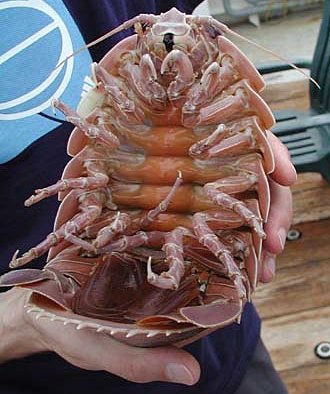
Bathynomus giganteus has large triangular compound eyes containing more than 4,000 individual facets.
Written 24 November 2026 from the sources listed below. Each statement was checked against the passage it cites; statements that could not be supported were removed.
Conservation
The species is not usually harvested commercially.[1]
Appearance
The Giant Isopod has a body divided into a head, thorax, and abdomen. Its large triangular compound eyes are positioned far apart and contain more than 4,000 individual facets.[2][3][4]
Its eyes can appear to glow when light reflects from the tapetum lucidum behind them.[5]
Typical adults measure between 19 and 36 centimetres in length. The largest confirmed individual measured approximately 50 centimetres.[6][7]
Diet
The Giant Isopod feeds on the remains of dead marine organisms that sink to the ocean floor.[8]
Behaviour
The Giant Isopod obtains food through scavenging. This contributes to nutrient recycling in deep-sea ecosystems.[9][10]
Reproduction and life cycle
The Giant Isopod reproduces by laying eggs. Mature females develop a pouch called a marsupium, in which eggs are stored until the young are ready to emerge.[11][12]
The young emerge as miniature versions of adults called mancae. The species bypasses a larval developmental stage.[13][14]
Newly emerged mancae can reach lengths of up to 60 millimetres and lack the seventh pair of pereiopods.[15][16]
Females carry approximately the same number of eggs as females of smaller isopod species. The eggs increase in size in approximate proportion to the increase in female body size.[17][18]
Classification of the Giant Isopod
| Kingdom | Animalia |
|---|---|
| Phylum | Arthropoda |
| Subphylum | Crustacea |
| Class | Malacostraca |
| Order | Isopoda |
| Suborder | Cymothoida |
| Superfamily | Cymothooidea |
| Family | Cirolanidae |
| Genus | Bathynomus (Giant Isopod) |
| Species | Bathynomus giganteus A. Milne-Edwards, 1879 |
Where the Giant Isopod is found
Checklists and occurrence records place Bathynomus giganteus in 22 countries. GBIF holds 1,441 georeferenced records of it.
Countries
- Anguilla 8
- Bahamas 47
- Belize 3
- Brazil 37
- China 81
- Colombia 330
- Costa Rica 5
- Cuba 15
- Dominica 6
- French Guiana 22
- Guadeloupe 13
- Honduras 6
- India 34
- Jamaica 7
- Mexico 365
- Nepal 47
- Nicaragua 16
- Panama 7
- Saint Barthelemy 5
- Suriname 5
- United States 374
- Venezuela 8
Regions and cities with the most records
- Tibet, China 81
- Bihar, India 32
- Raxaul, India 28
- Birgañj, Nepal 23
- Mothīhāri, India 19
- North Andros, Bahamas 13
- Florida, United States 4
- Ilhéus, Brazil 3
- Lucaya, Bahamas 3
- Nassau, Bahamas 3
A number beside a place is its count of GBIF occurrence records. A place without a number comes from a checklist alone. Records show where a species has been observed or collected, which can include escapes and vagrants.
Common names
English
- Giant Isopod
Names in 6 other languages
- Chinese
- 大王具足蟲
- Czech
- bathynomus obrovský
- French
- Bathynome géant
- German
- Riesenassel
- Japanese
- ダイオウグソクムシ, 大王具足虫
- Spanish
- Isópodo Gigante
Related species
-
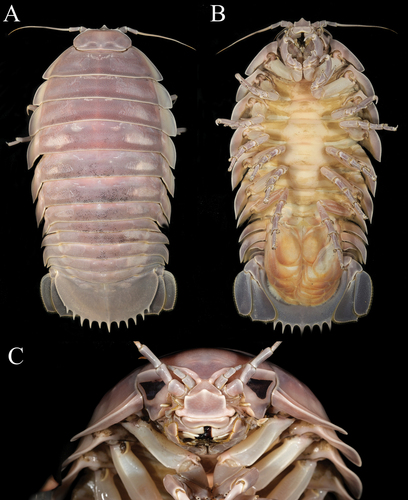 Darth Vader Supergiant IsopodBathynomus vaderi
- Bathynomus jamesi
- Bathynomus affinis
- Yucatan Giant IsopodBathynomus yucatanensis
- Bathynomus immanis
- Bathynomus decemspinosus
- Bathynomus brucei
- Smooth Giant IsopodBathynomus richeri
Compare
Questions and answers
What is the scientific name of the Giant Isopod?
The scientific name of the Giant Isopod is Bathynomus giganteus. Written with its author, the full name is Bathynomus giganteus A. Milne-Edwards, 1879.
Which family does the Giant Isopod belong to?
Bathynomus giganteus belongs to the family Cirolanidae, in the order Isopoda and the class Malacostraca.
Where is the Giant Isopod found?
Checklists and occurrence records place Bathynomus giganteus in 22 countries, including United States, Mexico, Colombia, China, Bahamas and Nepal.
What do giant isopods eat?
The Giant Isopod feeds on the remains of dead marine organisms that sink to the ocean floor.[8]
Sources
Passages the profile rests on
- The species is not usually harvested commercially. Source passage: “Giant isopods are not usually fished commercially.” — English Wikipedia
- The species has a body divided into a head, thorax, and abdomen. Source passage: “the body of Bathynomus giganteus is divided into three distinct regions; a head (cephalon), a thorax, and an abdomen (pleon).” — English Wikipedia
- The species has large triangular compound eyes positioned far apart. Source passage: “They have large triangular compound eyes that are spaced very far apart” — English Wikipedia
- Its eyes contain more than 4,000 individual facets. Source passage: “have over 4000 individual facets.” — English Wikipedia
- Its eyes can appear to glow when light reflects from the tapetum lucidum behind them. Source passage: “When light bounces off a highly-reflective layer called the tapetum lucidum at the back of their eyes, it makes them appear to glow.” — English Wikipedia
- Typical adult individuals measure between 19 and 36 centimetres in length. Source passage: “B. giganteus reaches a typical length between 19 and 36 cm” — English Wikipedia
- The largest confirmed individual measured approximately 50 centimetres in length. Source passage: “the largest confirmed was ca. 50 cm.” — English Wikipedia
- The species feeds on the remains of dead marine organisms that sink to the ocean floor. Source passage: “They feed on the remains of dead marine organisms that sink to the ocean floor” — English Wikipedia
- The species obtains food through scavenging. Source passage: “As scavengers, Bathynomus giganteus plays a crucial role in the deep-sea ecosystem.” — English Wikipedia
- Its scavenging contributes to nutrient recycling in deep-sea ecosystems. Source passage: “helping to recycle nutrients back into the ecosystem.” — English Wikipedia
- The species reproduces by laying eggs. Source passage: “Bathynomus reproduce via egg-laying.” — English Wikipedia
- Mature females develop a pouch called a marsupium in which eggs are stored until the young are ready to emerge. Source passage: “Mature females develop a pouch known as a marsupium, where the eggs are stored until the young are ready to emerge” — English Wikipedia
- The young emerge as miniature versions of adults called mancae. Source passage: “the young are ready to emerge as miniatures of the adults, known as manca” — English Wikipedia
- The species bypasses a larval developmental stage. Source passage: “completely bypassing a larval stage.” — English Wikipedia
- Newly emerged mancae can reach lengths of up to 60 millimetres. Source passage: “Mancae can reach lengths up to 60 mm” — English Wikipedia
- Mancae lack the seventh pair of pereiopods. Source passage: “are characterized by their lack of the seventh pair of pereiopods.” — English Wikipedia
- Females carry approximately the same number of eggs as females of smaller isopod species. Source passage: “carries approximately the same number of eggs in its marsupium.” — English Wikipedia
- The eggs increase in size in approximate proportion to the increase in female body size. Source passage: “The eggs, however, show an increase in size which appears to be almost proportional to the increase in body size.” — English Wikipedia
Data
- Catalogue of Life, 2026-10-16 XR cc by
- Global Biodiversity Information Facility CC BY 4.0
- Wikidata CC0
- GeoNames CC BY 4.0
- Wikimedia Commons per image; credit shown with each image
- Within the Catalogue of Life, this name comes from World Marine, Freshwater and Terrestrial Isopod Crustaceans database cc by
References
- Milne Edwards, A. (1879). Sur un isopode gigantesque, des grandes profondeurs de la mer. Comptes Rendus Hebdomadaires Des Séances de l’Académie Des Sciences, 88: 21–23. where the name was published
This species in other databases
- Catalogue of Life KXDW
- Wikidata Q1366514
- iNaturalist 571229
- WoRMS urn:lsid:marinespecies.org:taxname:259252
- ITIS 92261
Page built on 24 November 2026. See how the catalog is made and all sources and licences.
Cite this page
ScientificNames.org. (2026). Bathynomus giganteus (Giant Isopod). Retrieved November 24, 2026, from https://scientificnames.org/species/bathynomus-giganteus
“Bathynomus giganteus (Giant Isopod).” ScientificNames.org, 2026, scientificnames.org/species/bathynomus-giganteus. Accessed 24 Nov. 2026.
ScientificNames.org. “Bathynomus giganteus (Giant Isopod).” Accessed November 24, 2026. https://scientificnames.org/species/bathynomus-giganteus.
@misc{scientificnames_bathynomus_giganteus_giant_isopod,
  author = {{ScientificNames.org}},
  title = {Bathynomus giganteus (Giant Isopod)},
  year = {2026},
  url = {https://scientificnames.org/species/bathynomus-giganteus},
  note = {Accessed 2026-11-24}
}