Family · Crustaceans
Cirolanidae
Cirolanidae is a family in the superfamily Cymothooidea. The Catalogue of Life lists 601 species in it, 543 of them living.
- Scientific name
- Cirolanidae Dana, 1852
- Rank
- family
- Belongs to
- Cymothooidea
- Species
- 601
- Direct members
- 74
- Name status
- accepted in the Catalogue of Life
Overview
Wikidata describes Cirolanidae as “family of isopods”.
Best-known species of Cirolanidae
-
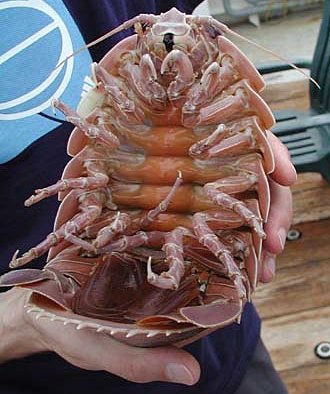 Giant IsopodBathynomus giganteus
-
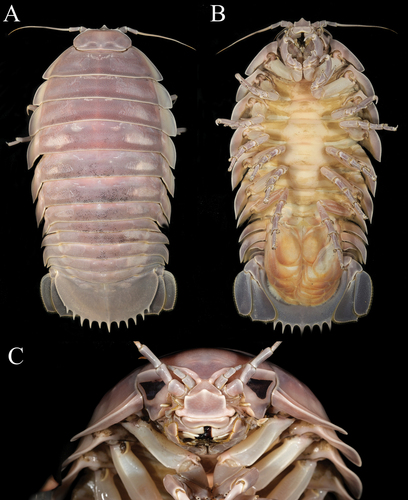 Darth Vader Supergiant IsopodBathynomus vaderi
- Sand PiranhaExcirolana chiltoni
-
 Speckled SelouseEurydice pulchra
- Bathynomus jamesi
- Bathynomus affinis
- Yucatan Giant IsopodBathynomus yucatanensis
-
 Madison Cave IsopodAntrolana lira
- Bathynomus immanis
- Bathynomus decemspinosus
- Bathynomus brucei
- Harford's IsopodCirolana harfordi
Members of Cirolanidae
74 in all. Those with an English name come first.
Classification
| Kingdom | Animalia |
|---|---|
| Phylum | Arthropoda |
| Subphylum | Crustacea |
| Class | Malacostraca |
| Order | Isopoda |
| Suborder | Cymothoida |
| Superfamily | Cymothooidea |
| Family | Cirolanidae Dana, 1852 |
Common names
Names in 4 other languages
- Chinese
- 漂水蝨科
- Japanese
- スナホリムシ科
- Korean
- 모래무지벌레과
- Polish
- eurydykowate
Synonyms
- Bathynomidae Wood Mason & Alcock, 1891
- Faucheriinae Racovitza, 1912
Sources
- Catalogue of Life, 2026-10-16 XR cc by
- Wikidata CC0
- Within the Catalogue of Life, this name comes from World Marine, Freshwater and Terrestrial Isopod Crustaceans database cc by
In other databases
Cite this page
ScientificNames.org. (2026). Cirolanidae. Retrieved November 24, 2026, from https://scientificnames.org/taxon/cirolanidae
“Cirolanidae.” ScientificNames.org, 2026, scientificnames.org/taxon/cirolanidae. Accessed 24 Nov. 2026.
ScientificNames.org. “Cirolanidae.” Accessed November 24, 2026. https://scientificnames.org/taxon/cirolanidae.
@misc{scientificnames_cirolanidae,
  author = {{ScientificNames.org}},
  title = {Cirolanidae},
  year = {2026},
  url = {https://scientificnames.org/taxon/cirolanidae},
  note = {Accessed 2026-11-24}
}