Species · Birds
Fernando Po Batis Batis poensis
The scientific name of the Fernando Po Batis is Batis poensis. It is a species of bird in the family Platysteiridae (wattle-eye), order Passeriformes. The name dates from 1903.
- Scientific name
- Batis poensis Alexander, 1903
- Common name
- Fernando Po Batis
- Genus
- Batis
- Family
- Platysteiridae (Wattle-eye)
- Order
- Passeriformes
- Class
- Aves
- Red List category
- LC Least Concern
- Recorded in
- 4 countries
- Name status
- accepted in the Catalogue of Life

Overview
Batis poensis is endemic to Bioko Island in Equatorial Guinea. It has predominantly black and white plumage, with glossy blue-black head and mantle and different breast-band colours in adult males and females.
Written 26 November 2026 from the sources listed below. Each statement was checked against the passage it cites; statements that could not be supported were removed.
Appearance
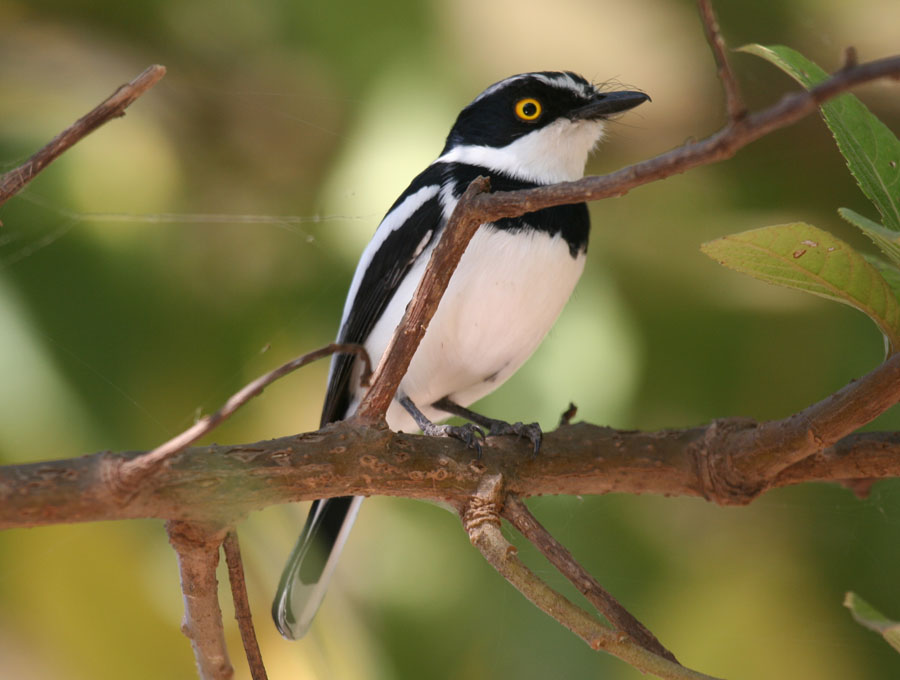
The Fernando Po Batis has predominantly black and white plumage. Its head and mantle are glossy blue-black, and it has a small white spot on its lores. Its back is blackish grey, with small white spots on the rump and lower back.[1][2][3][4]
Its black wings have a white stripe, and its black tail has narrow white lines on the outer feathers. It has a white belly and throat and a black face.[5][6][7]
Adult males have white underparts and a black breast band, while females have duller upperparts and a chestnut breast band. Juveniles resemble females but have duller-looking plumage.[8][9][10]
The species measures approximately 10.5 cm in length and has a reported body weight ranging from 8.8 to 9.4 g.[11][12]
Habitat
The Fernando Po Batis inhabits lowland forest on Bioko. Its habitat extends to the ecotone between lowland and montane forest.[13][14]
Diet
The Fernando Po Batis feeds on insects.[15]
Behaviour
The Fernando Po Batis is restless and shy. It forages within the canopy of tall trees and participates in mixed-species foraging flocks.[16][17][18]
It captures insects by gleaning foliage, flycatching, and picking prey from leaves while briefly hovering. It rubs and strikes large insects with hard exoskeletons against branches before dismembering them.[19][20]
Reproduction and life cycle
Both members of a breeding pair build the nest. The nest is constructed in the outer fork of a branch using bark strips and fibres.[21][22][23]
Fledged juveniles have been observed in October.[24]
Similar species
The Fernando Po Batis has sometimes been treated as the same species as the West African Batis. The two are currently considered distinct species.[25][26]
Classification of the Fernando Po Batis
| Kingdom | Animalia |
|---|---|
| Phylum | Chordata |
| Subphylum | Vertebrata |
| Infraphylum | Gnathostomata |
| Parvphylum | Osteichthyes |
| Megaclass | Tetrapoda |
| Class | Aves (Bird) |
| Order | Passeriformes (Passerine) |
| Family | Platysteiridae (Wattle-eye) |
| Genus | Batis (Batises) |
| Species | Batis poensis Alexander, 1903 |
Where the Fernando Po Batis is found
Checklists and occurrence records place Batis poensis in 4 countries across Africa. GBIF holds 51 georeferenced records of it.
Countries
Regions and cities with the most records
- Bioko Sur, Equatorial Guinea 14
- Bioko Norte, Equatorial Guinea 13
- Malabo, Equatorial Guinea 13
- Sassandra-Marahoue, Ivory Coast 3
Range as the checklists state it
Africa
A number beside a place is its count of GBIF occurrence records. A place without a number comes from a checklist alone. Records show where a species has been observed or collected, which can include escapes and vagrants.
Common names
English
- Fernando Po Batis
- BIBA
- Bioko Batis
Names in 22 other languages
- Catalan
- batis de Bioko
- Chinese
- 斐南德斯噴背鶲, 费尔蓬背鹟
- Croatian
- biočki batis
- Czech
- lesknáček ostrovní
- Danish
- Fernando Po-batis
- Dutch
- Biokovliegenvanger, Fernando Po-vliegenvanger, Fernando-Povliegenvanger
- Esperanto
- bioka platistejro
- Finnish
- biokontöpösieppo
- French
- Pririt de Fernando Po
- German
- Alexander-Würgerschnäpper, Alexanderbatis, Alexanderschnäpper, Biokoschnäpper
- Italian
- Batis di Fernando Po
- Japanese
- フェルナンドポーセワタビタキ
- Lithuanian
- salinis batis
- Polish
- krępnik plamisty
- Portuguese
- bátis-de-fernando-pó
- Russian
- Островной батис, Пестроспинный батис
- Serbian
- Batis sa ostrva Bioko
- Slovak
- strakošík zálivový
- Spanish
- Batis de Fernando Póo
- Turkish
- Fernando Po Batisi
- Ukrainian
- приріт кокосовий
- Welsh
- batis Bioko
Synonyms
One other scientific name has been used for this species and is now treated as a synonym of Batis poensis.
- Batis poensis poensis Alexander, 1903
Related species
-
 Cape BatisBatis capensis
-
 Chinspot BatisBatis molitor
-
 Pririt BatisBatis pririt
-
 Rwenzori BatisBatis diops
-
 Pale BatisBatis soror
-
 Senegal BatisBatis senegalensis
-
 Margaret's BatisBatis margaritae
-
 Grey-headed BatisBatis orientalis
Compare
Questions and answers
What is the scientific name of the Fernando Po Batis?
The scientific name of the Fernando Po Batis is Batis poensis. Written with its author, the full name is Batis poensis Alexander, 1903.
Which family does the Fernando Po Batis belong to?
Batis poensis belongs to the family Platysteiridae, in the order Passeriformes and the class Aves.
Where is the Fernando Po Batis found?
Checklists and occurrence records place Batis poensis in 4 countries: Equatorial Guinea, Ivory Coast, Ghana and Nigeria.
What is the conservation status of the Fernando Po Batis?
The IUCN Red List category recorded for Batis poensis is Least Concern (LC).
What other names does the Fernando Po Batis have?
Batis poensis is also known in English as BIBA and Bioko Batis.
What is the present name of Fernando Po?
Bioko. Bioko was formerly known as Fernando Pó.[27]
Sources
Passages the profile rests on
- The Bioko Batis has predominantly black and white plumage. Source passage: “with a mainly black and white plumage.” — English Wikipedia
- Its head and mantle are glossy blue-black. Source passage: “The head and mantle are glossy blue-black” — English Wikipedia
- It has a small white spot on its lores. Source passage: “with a small white loral spot” — English Wikipedia
- Its back is blackish grey and has small white spots on the rump and lower back. Source passage: “The back is blackish grey with small white spots on the rump and lower back.” — English Wikipedia
- Its black wings have a white stripe. Source passage: “The wings are black with a white stripe” — English Wikipedia
- Its black tail has narrow white lines on the outer feathers. Source passage: “the tail is black with narrow white lines on the outer tail.” — English Wikipedia
- The species has a white belly and throat and a black face. Source passage: “with a white belly and throat, black wings with a white bar, and a black face.” — ebird.org
- Adult males have white underparts and a black breast band. Source passage: “The male has white underparts with a black breast band.” — English Wikipedia
- Females have duller upperparts and a chestnut breast band. Source passage: “Females are similar to males but are duller above with a chestnut rather than black breast band.” — English Wikipedia
- Juveniles resemble females but have duller-looking plumage. Source passage: “Juveniles are similar to females but look dingier.” — English Wikipedia
- The Bioko Batis measures approximately 10.5 cm in length. Source passage: “They are 10.5 cm (4.1 in) long” — English Wikipedia
- Its reported body weight ranges from 8.8 to 9.4 g. Source passage: “weigh 8.8–9.4 g (0.31–0.33 oz).” — English Wikipedia
- The species inhabits lowland forest on Bioko. Source passage: “where it inhabits the lowland forest” — English Wikipedia
- Its habitat extends to the ecotone between lowland and montane forest. Source passage: “up to the ecotone with the montane forest” — English Wikipedia
- The Bioko Batis feeds on insects. Source passage: “It forages for insects” — English Wikipedia
- The Bioko Batis is restless and shy. Source passage: “The Fernando Pó batis is restless and shy” — English Wikipedia
- It forages within the canopy of tall trees. Source passage: “forages within the canopy of tall trees.” — English Wikipedia
- The species participates in mixed-species foraging flocks. Source passage: “It will join other species in mixed foraging flocks.” — English Wikipedia
- It captures insects by gleaning foliage, flycatching, and picking prey from leaves while briefly hovering. Source passage: “by gleaning foliage, by flycatching or by picking prey off leaves while briefly hovering.” — English Wikipedia
- It rubs and strikes large insects with hard exoskeletons against branches before dismembering them. Source passage: “Large insects with hard exoskeletons are rubbed and hit against a branch before being dismembered.” — English Wikipedia
- Both members of a breeding pair build the nest. Source passage: “by both birds in the pair” — English Wikipedia
- The nest is constructed in the outer fork of a branch. Source passage: “The nest is built in the outer fork of a branch” — English Wikipedia
- Nest materials include bark strips and fibres. Source passage: “using bark strips and fibres.” — English Wikipedia
- Fledged juveniles have been observed in October. Source passage: “fledged juveniles have been seen in October.” — English Wikipedia
- The Bioko Batis has sometimes been treated as the same species as the West African Batis. Source passage: “The Fernando Pó batis is some times lumped with the West African batis (Batis occulta)” — English Wikipedia
- The Bioko Batis and West African Batis are currently considered distinct species. Source passage: “but both are now considered distinct species.” — English Wikipedia
- Bioko was formerly known as Fernando Pó. Source passage: “Endemic to the island of Bioko, formerly known as Fernando Pó” — English Wikipedia
Data
- Catalogue of Life, 2026-10-16 XR cc by
- Global Biodiversity Information Facility CC BY 4.0
- Wikidata CC0
- GeoNames CC BY 4.0
- Wikimedia Commons per image; credit shown with each image
- Within the Catalogue of Life, this name comes from The Integrated Taxonomic Information System cc0
References
- Alexander, & Boyd. (1903). Bulletin of the British Ornithologists’ Club, Vol. 13, No. 94. where the name was published
- Gill, Frank, & and Minturn Wright. (2006). Birds of the World: Recommended English Names.
This species in other databases
Page built on 27 November 2026. See how the catalog is made and all sources and licences.
Cite this page
ScientificNames.org. (2026). Batis poensis (Fernando Po Batis). Retrieved November 27, 2026, from https://scientificnames.org/species/batis-poensis
“Batis poensis (Fernando Po Batis).” ScientificNames.org, 2026, scientificnames.org/species/batis-poensis. Accessed 27 Nov. 2026.
ScientificNames.org. “Batis poensis (Fernando Po Batis).” Accessed November 27, 2026. https://scientificnames.org/species/batis-poensis.
@misc{scientificnames_batis_poensis_fernando_po_batis,
  author = {{ScientificNames.org}},
  title = {Batis poensis (Fernando Po Batis)},
  year = {2026},
  url = {https://scientificnames.org/species/batis-poensis},
  note = {Accessed 2026-11-27}
}