Species · Birds
Senegal Batis Batis senegalensis
The scientific name of the Senegal Batis is Batis senegalensis. It is a species of bird in the family Platysteiridae (wattle-eye), order Passeriformes. The name dates from 1766.
- Scientific name
- Batis senegalensis (Linnaeus, 1766)
- Common name
- Senegal Batis
- Genus
- Batis
- Family
- Platysteiridae (Wattle-eye)
- Order
- Passeriformes
- Class
- Aves
- Red List category
- LC Least Concern
- Recorded in
- 15 countries
- Name status
- accepted in the Catalogue of Life

Overview
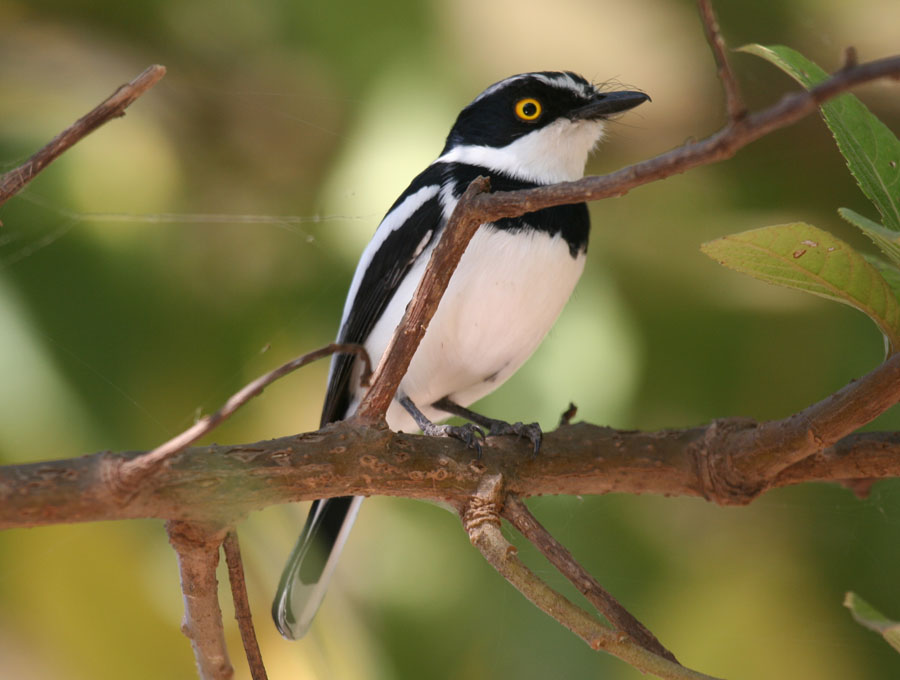
Batis senegalensis inhabits low, dry, thorny scrub, sparsely treed grasslands, and woody savannahs. It has characteristic black, white, and grey plumage.
Written 27 November 2026 from the sources listed below. Each statement was checked against the passage it cites; statements that could not be supported were removed.
Appearance
The Senegal Batis has characteristic black, white, and grey plumage. It measures approximately 10 cm in length and weighs between 8 and 11.4 grams.[1][2][3]
Adult males have a dark slate-grey forehead and crown, a broad white supercilium, and a glossy bluish-black facial mask. Their upper backs are slate-grey tinged with brown, while their lower backs and rumps are mottled grey, white, and black.[4][5][6][7]
Juveniles resemble adult females but have duller plumage.[8]
Habitat
The Senegal Batis inhabits low, dry, thorny scrub and sparsely treed grasslands. It also occurs in woody savannahs, including open acacia and baobab woodlands.[9][10][11]
The species occurs in both moist Guinea savanna and dry thorn savanna.[12]
Diet
The Senegal Batis is an arboreal forager that obtains most of its insect prey by gleaning foliage. It rarely forages on the ground.[13][14]
It catches flying insects through aerial sallies of up to 2 metres from a perch. Larger prey is sometimes impaled on thorns.[15][16]
Behaviour
The Senegal Batis maintains a territory throughout the year. Males patrol their territories daily from elevated open perches while singing.[17][18]
The Senegal Batis aggressively mobbs shrikes, particularly the Brubru. Fork-tailed Drongos have been recorded stealing prey from Senegal Batises.[19][20]
Reproduction and life cycle
The breeding season appears to extend from January through July. Both sexes participate in building the nest using dried grass and bark strips decorated with leaves and lichen.[21][22][23]
The nest is a small cup attached to a bush or tree using spider webs. Clutches normally contain two eggs.[24][25]
Only the female incubates the eggs, for approximately 15 days. The male guards the nest and provides food for the incubating female.[26][27]
During the first week after hatching, the male supplies all food for the female and chicks. After their first week, both parents forage and feed the chicks.[28][29]
Young birds remain in their parents' territory until the next breeding season begins.[30]
Classification of the Senegal Batis
| Kingdom | Animalia |
|---|---|
| Phylum | Chordata |
| Subphylum | Vertebrata |
| Infraphylum | Gnathostomata |
| Parvphylum | Osteichthyes |
| Megaclass | Tetrapoda |
| Class | Aves (Bird) |
| Order | Passeriformes (Passerine) |
| Family | Platysteiridae (Wattle-eye) |
| Genus | Batis (Batises) |
| Species | Batis senegalensis (Linnaeus, 1766) |
Where the Senegal Batis is found
Checklists and occurrence records place Batis senegalensis in 15 countries across Africa. GBIF holds 5,054 georeferenced records of it.
Countries
- Benin 150
- Burkina Faso 32
- Cameroon 85
- Gambia 758
- Ghana 1,211
- Guinea 117
- Guinea-Bissau 17
- Ivory Coast 88
- Mali 19
- Mauritania 29
- Niger 32
- Nigeria 1,699
- Senegal 725
- Sierra Leone 32
- Togo 60
Regions and cities with the most records
- Plateau State, Nigeria 881
- Savannah, Ghana 834
- Bukuru, Nigeria 736
- Jos, Nigeria 598
- Western, Gambia 471
- Saint-Louis, Senegal 309
- Brikama, Gambia 303
- Sanyang, Gambia 277
- Greater Accra, Ghana 271
- Gunjur, Gambia 269
- Busumbala, Gambia 253
- Sinchu Alagi, Gambia 246
- Abuko, Gambia 244
- Kunkujang, Gambia 243
- Faji Kunda, Gambia 241
- Welingara, Gambia 241
- Latri Sabiji, Gambia 236
- Sukuta, Gambia 236
- Talinding, Gambia 234
- Tanji, Gambia 232
- Bakoti, Gambia 229
- Sanchaba, Gambia 229
- Brufut, Gambia 227
- Manjai Kunda, Gambia 226
- Dippa Kunda, Gambia 219
- Serekunda, Gambia 208
- Saint-Louis, Senegal 187
- Bauchi, Nigeria 151
- Lower River, Gambia 148
- Kotu, Gambia 143
- Kanifing, Gambia 141
- Tambacounda, Senegal 140
- Damongo, Ghana 128
- New Jeshwang, Gambia 119
- Kedougou, Senegal 102
- Atakora, Benin 100
Range as the checklists state it
Africa
A number beside a place is its count of GBIF occurrence records. A place without a number comes from a checklist alone. Records show where a species has been observed or collected, which can include escapes and vagrants.
Common names
English
- Senegal Batis
- SEBA
Names in 22 other languages
- Chinese
- 塞內加爾噴背鶲, 塞内蓬背鹟
- Croatian
- obrvasti batis
- Czech
- lesknáček senegalský
- Dutch
- Senegalese Vliegenvanger
- Esperanto
- senegala platistejro
- Finnish
- senegalintöpösieppo
- French
- Gobemouche soyeux du Sénégal, Pririt du Sénégal
- German
- Senegal-Würgerschnäpper, Senegalschnäpper
- Italian
- Batis del Senegal
- Japanese
- シロエリセワタビタキ
- Lithuanian
- senegalinis batis
- Norwegian
- fulanibatis
- Polish
- krępnik uwieńczony
- Portuguese
- bátis-do-senegal, bátis-senegalês, papa-moscas-do-senegal
- Russian
- Сенегальский батис
- Serbian
- Senegalski batis
- Slovak
- strakošík savanový
- Spanish
- Batis senegalés
- Swedish
- savannbatis
- Turkish
- Senegal Batisi
- Ukrainian
- приріт сенегальський
- Welsh
- batis Senegal
Synonyms
2 other scientific names have been used for this species and are now treated as synonyms of Batis senegalensis.
- Batis senegalensis togoensis Neumann, OR, 1907
- Muscicapa senegalensis Linnaeus, 1766
Related species
-
 Cape BatisBatis capensis
-
 Chinspot BatisBatis molitor
-
 Fernando Po BatisBatis poensis
-
 Pririt BatisBatis pririt
-
 Rwenzori BatisBatis diops
-
 Pale BatisBatis soror
-
 Margaret's BatisBatis margaritae
-
 Grey-headed BatisBatis orientalis
Compare
Questions and answers
What is the scientific name of the Senegal Batis?
The scientific name of the Senegal Batis is Batis senegalensis. Written with its author, the full name is Batis senegalensis (Linnaeus, 1766).
Which family does the Senegal Batis belong to?
Batis senegalensis belongs to the family Platysteiridae, in the order Passeriformes and the class Aves.
Where is the Senegal Batis found?
Checklists and occurrence records place Batis senegalensis in 15 countries, including Nigeria, Ghana, Gambia, Senegal, Benin and Guinea.
What is the conservation status of the Senegal Batis?
The IUCN Red List category recorded for Batis senegalensis is Least Concern (LC).
What other names does the Senegal Batis have?
Batis senegalensis is also known in English as SEBA.
Sources
Passages the profile rests on
- The Senegal Batis has characteristic black, white, and grey plumage. Source passage: “with the distinctive black, white and grey colours and plumage patterns which are typical of the batises.” — English Wikipedia
- The Senegal Batis measures approximately 10 cm in length. Source passage: “measures 10 cm (3.9 in) in length” — English Wikipedia
- The Senegal Batis weighs between 8 and 11.4 grams. Source passage: “weighs 8–11.4 g (0.28–0.40 oz).” — English Wikipedia
- Adult males have a dark slate-grey forehead and crown with a broad white supercilium. Source passage: “The adult male has a dark slate grey forehead and crown with a long, broad white supercilium” — English Wikipedia
- Adult males have a glossy bluish-black facial mask. Source passage: “The face mask is glossy bluish-black.” — English Wikipedia
- Adult males have slate-grey upper backs tinged with brown. Source passage: “The mantle and upper back are slate grey tinged with brown” — English Wikipedia
- Adult males have mottled grey, white, and black lower backs and rumps. Source passage: “the lower back and rump are mottled grey, white and black.” — English Wikipedia
- Juveniles resemble adult females but have duller plumage. Source passage: “Juveniles are like duller females.” — English Wikipedia
- The Senegal Batis inhabits low, dry, thorny scrub. Source passage: “The Senegal batis inhabits low dry thorny scrub” — English Wikipedia
- The species occurs in sparsely treed grasslands. Source passage: “sparsely treed grasslands” — English Wikipedia
- The species inhabits woody savannahs, including open acacia and baobab woodlands. Source passage: “woody savannahs, including open acacia and baobab woodlands.” — English Wikipedia
- The species occurs in both moist Guinea savanna and dry thorn savanna. Source passage: “Found in all types of savanna, ranging from moist Guinea savanna to dry thorn” — ebird.org
- The species is an arboreal forager that obtains most insect prey by gleaning foliage. Source passage: “It is an arboreal forager and its insect prey is mostly gleaned from foliage” — English Wikipedia
- The Senegal Batis rarely forages on the ground. Source passage: “but almost never on the ground.” — English Wikipedia
- The species catches flying insects by making aerial sallies of up to 2 metres from a perch. Source passage: “making sallies of up to 2 m (6.6 ft) to catch prey from a perch” — English Wikipedia
- The Senegal Batis sometimes impales larger prey on thorns. Source passage: “has also been known to impale larger prey on thorns.” — English Wikipedia
- The Senegal Batis maintains a territory throughout the year. Source passage: “The Senegal batis maintains a territory throughout the year” — English Wikipedia
- Males patrol their territories daily from elevated open perches while singing. Source passage: “which the male patrols daily, sitting on high open perches and singing.” — English Wikipedia
- The Senegal Batis aggressively mobbs shrikes, particularly the Brubru. Source passage: “It will also aggressively mob shrikes, especially the Brubru” — English Wikipedia
- Fork-tailed Drongos have been recorded stealing prey from Senegal Batises. Source passage: “The fork-tailed drongo has been recorded as kelptoparasitising prey from the Senegal batis.” — English Wikipedia
- The breeding season appears to extend from January through July. Source passage: “The breeding season seems to run between January and July.” — English Wikipedia
- Both sexes participate in building the nest. Source passage: “The nest is built by both sexes” — English Wikipedia
- Nest construction involves dried grass and bark strips decorated with leaves and lichen. Source passage: “made of dried grass and strips of bark, decorated with leaves, lichen and bark” — English Wikipedia
- The nest is a small cup attached to a bush or tree using spider webs. Source passage: “It is a small neat cup, bound to the fork or thick stem of a bush or tree with spider webs.” — English Wikipedia
- Clutches normally contain two eggs. Source passage: “the clutch, which is normally two eggs” — English Wikipedia
- Only the female incubates the eggs, for approximately 15 days. Source passage: “Only the female incubates the clutch, which is normally two eggs, for 15 days.” — English Wikipedia
- The male guards the nest and provides food for the incubating female. Source passage: “The male guards the nest and feeds her” — English Wikipedia
- During the first week after hatching, the male supplies all food for the female and chicks. Source passage: “The male continues to provide all the food for the females and the young for the first week after hatching” — English Wikipedia
- Both parents forage and feed the chicks after their first week. Source passage: “after the first week, both sexes forage and feed the chicks.” — English Wikipedia
- Young birds remain in their parents' territory until the next breeding season begins. Source passage: “After fledging the young stay in the parents' territory until the start of the next breeding season.” — English Wikipedia
Data
- Catalogue of Life, 2026-10-16 XR cc by
- Global Biodiversity Information Facility CC BY 4.0
- Wikidata CC0
- GeoNames CC BY 4.0
- Wikimedia Commons per image; credit shown with each image
- Within the Catalogue of Life, this name comes from The Integrated Taxonomic Information System cc0
References
- Gill, Frank, & and Minturn Wright. (2006). Birds of the World: Recommended English Names.
This species in other databases
Page built on 27 November 2026. See how the catalog is made and all sources and licences.
Cite this page
ScientificNames.org. (2026). Batis senegalensis (Senegal Batis). Retrieved November 27, 2026, from https://scientificnames.org/species/batis-senegalensis
“Batis senegalensis (Senegal Batis).” ScientificNames.org, 2026, scientificnames.org/species/batis-senegalensis. Accessed 27 Nov. 2026.
ScientificNames.org. “Batis senegalensis (Senegal Batis).” Accessed November 27, 2026. https://scientificnames.org/species/batis-senegalensis.
@misc{scientificnames_batis_senegalensis_senegal_batis,
  author = {{ScientificNames.org}},
  title = {Batis senegalensis (Senegal Batis)},
  year = {2026},
  url = {https://scientificnames.org/species/batis-senegalensis},
  note = {Accessed 2026-11-27}
}