Species · Flowering plants
Purple Apple-berry Billardiera longiflora
The scientific name of the Purple Apple-berry is Billardiera longiflora. It is a species of flowering plant in the family Pittosporaceae (cheesewood family), order Apiales.
- Scientific name
- Billardiera longiflora Labill.
- Common name
- Purple Apple-berry
- Genus
- Billardiera
- Family
- Pittosporaceae (Cheesewood Family)
- Order
- Apiales
- Class
- Magnoliopsida
- Recorded in
- 1 country
- Name status
- accepted in the Catalogue of Life
Overview
The purple apple-berry (Billardiera longiflora Labill.) is a woody twining or climbing flowering plant in the family Pittosporaceae. It occurs in eucalypt woodland and forest in Tasmania and is also reported from cool, moist forests. It is distinguished from Billardiera macrantha by having shorter flowers.
Written 26 November 2026 from the sources listed below. Each statement was checked against the passage it cites; statements that could not be supported were removed.
Appearance
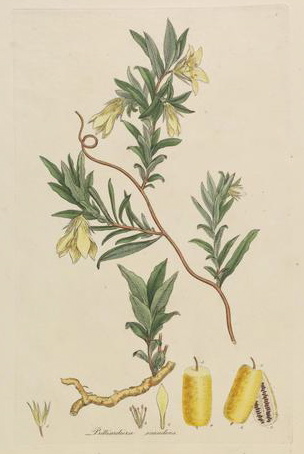
The purple apple-berry is a woody twining or climbing plant. Its new shoots are hairy but become smooth as they mature.[1][2]
At lower altitudes, the leaves are narrowly egg-shaped, with the narrower end towards the base. They measure 18–25 mm long and 5–6 mm wide, and their petioles measure 1–2 mm long.[3][4][5]
At higher altitudes, the leaves are almost linear and measure 15–35 mm long and 2–3 mm wide.[6][7]
The flowers are greenish-yellow, tube-shaped and pendent, and are arranged singly. They are borne on pendent stalks measuring 10–14 mm long.[8][9]
The sepals are egg-shaped and purplish-blue, measuring 3–5 mm long. The petals are greenish-yellow and turn blue as they age, measuring 16–24 mm long.[10][11][12][13]
The petals are joined at their base and have spreading lobes that do not turn backwards.[14]
The mature fruit is a glossy purple berry measuring 13–20 mm long. The seeds measure approximately 1.8 mm long.[15][16][17]
Habitat
The purple apple-berry occurs in eucalypt woodland and forest in Tasmania. It is also reported from cool, moist forests.[18][19]
Reproduction and life cycle
Flowering occurs mostly during summer.[20]
Similar species
The purple apple-berry is often confused with Billardiera macrantha, which occurs in south-eastern Australia, including Tasmania. The purple apple-berry is distinguished by having shorter flowers.[21][22]
Classification of the Purple Apple-berry
| Kingdom | Plantae |
|---|---|
| Subkingdom | Pteridobiotina |
| Phylum | Tracheophyta |
| Class | Magnoliopsida |
| Order | Apiales |
| Family | Pittosporaceae (Cheesewood Family) |
| Tribe | Billardiereae |
| Genus | Billardiera (Apple-berries) |
| Species | Billardiera longiflora Labill. |
Where the Purple Apple-berry is found
Checklists and occurrence records place Billardiera longiflora in 1 country across Oceania. GBIF holds 1,692 georeferenced records of it.
Countries
Regions and cities with the most records
- Tasmania, Australia 1,358
- Hobart, Australia 134
- Victoria, Australia 96
- Launceston, Australia 22
- Devonport, Australia 18
- Burnie, Australia 13
- New South Wales, Australia 12
- Australian Capital Territory, Australia 4
Range as the checklists state it
Australia (New South Wales, Victoria, Tasmania)
A number beside a place is its count of GBIF occurrence records. A place without a number comes from a checklist alone. Records show where a species has been observed or collected, which can include escapes and vagrants.
Common names
English
- Purple Apple-berry
- Mountain Blue Berry
Names in 4 other languages
- Chinese
- 澳洲山藍莓, 紫蘋果莓
- Finnish
- lyhtysollia
- Slovak
- bilardiéra dlhokvetá
- Swedish
- bärranka
Synonyms
3 other scientific names have been used for this species and are now treated as synonyms of Billardiera longiflora.
- Billardiera longiflora var. alpina Rodway
- Billardiera longiflora var. longiflora
- Labillardiera longiflora (Labill.) Roem. & Schult.
Related species
-
 Apple BerryBillardiera scandens
-
 Western Australian Bluebell CreeperBillardiera heterophylla
-
 Australian BluebellBillardiera fusiformis
- Common Apple-berryBillardiera mutabilis
-
 White-Flowered BillardieraBillardiera floribunda
- Mountain Apple-berryBillardiera macrantha
- Single-flower Apple-berryBillardiera uniflora
-
 Silky Apple-berryBillardiera sericophora
Compare
Questions and answers
What is the scientific name of the Purple Apple-berry?
The scientific name of the Purple Apple-berry is Billardiera longiflora. Written with its author, the full name is Billardiera longiflora Labill..
Which family does the Purple Apple-berry belong to?
Billardiera longiflora belongs to the family Pittosporaceae, in the order Apiales and the class Magnoliopsida.
Where is the Purple Apple-berry found?
Checklists and occurrence records place Billardiera longiflora in 1 country: Australia.
What other names does the Purple Apple-berry have?
Billardiera longiflora is also known in English as Mountain Blue Berry.
What type of berry is purple?
The mature fruit of the purple apple-berry is a glossy purple berry measuring 13–20 mm long.[15][16]
What plant grows purple berries?
The purple apple-berry (Billardiera longiflora) produces glossy purple berries when mature.[15]
Sources
Passages the profile rests on
- Billardiera longiflora is a woody twining or climbing plant. Source passage: “It is a woody twiner or climber that has variably-shaped, often elliptic leaves” — English Wikipedia
- The plant's new shoots are hairy but become smooth as they mature. Source passage: “Its new shoots hairy, but become glabrous with age.” — English Wikipedia
- The leaves at lower altitudes are narrowly egg-shaped, with the narrower end towards the base. Source passage: “at lower altitudes, narrowly egg-shaped with the narrower end towards the base” — English Wikipedia
- Leaves at lower altitudes measure 18–25 mm long and 5–6 mm wide. Source passage: “18–25 mm (0.71–0.98 in) long and 5–6 mm (0.20–0.24 in) wide” — English Wikipedia
- The petioles of leaves at lower altitudes measure 1–2 mm long. Source passage: “on a petiole 1–2 mm (0.039–0.079 in) long.” — English Wikipedia
- At higher altitudes, the leaves are almost linear. Source passage: “At higher altitudes, the leaves are almost linear” — English Wikipedia
- Leaves at higher altitudes measure 15–35 mm long and 2–3 mm wide. Source passage: “15–35 mm (0.59–1.38 in) long and 2–3 mm (0.079–0.118 in) wide.” — English Wikipedia
- The flowers are greenish-yellow, tube-shaped, pendent, and arranged singly. Source passage: “greenish-yellow, pendent, tube-shaped flowers arranged singly” — English Wikipedia
- The flowers are borne on pendent stalks measuring 10–14 mm long. Source passage: “on a pendent peduncle 10–14 mm (0.39–0.55 in) long.” — English Wikipedia
- The sepals are egg-shaped and purplish-blue. Source passage: “The sepals are egg-shaped, 3–5 mm (0.12–0.20 in) long and purplish-blue.” — English Wikipedia
- The sepals measure 3–5 mm long. Source passage: “3–5 mm (0.12–0.20 in) long and purplish-blue.” — English Wikipedia
- The petals are greenish-yellow and turn blue as they age. Source passage: “The petals are 16–24 mm (0.63–0.94 in) long, greenish-yellow, turning blue as they age” — English Wikipedia
- The petals measure 16–24 mm long. Source passage: “The petals are 16–24 mm (0.63–0.94 in) long” — English Wikipedia
- The petals are joined at their base, with spreading lobes that do not turn backwards. Source passage: “joined at the base, the lobes spreading but not turned back.” — English Wikipedia
- The mature fruit is a glossy purple berry. Source passage: “the mature fruit is a glossy purple berry” — English Wikipedia
- The mature berries measure 13–20 mm long. Source passage: “13–20 mm (0.51–0.79 in) long” — English Wikipedia
- The seeds measure approximately 1.8 mm long. Source passage: “the seeds about 1.8 mm (0.071 in) long.” — English Wikipedia
- The species occurs in eucalypt woodland and forest in Tasmania. Source passage: “This species of billardiera only occurs in eucalypt woodland and forest in Tasmania.” — English Wikipedia
- The species is reported from cool, moist forests. Source passage: “found in cool, moist forests” — inaturalist.org
- Flowering occurs mostly during summer. Source passage: “Flowering mostly occurs in summer” — English Wikipedia
- Billardiera longiflora is often confused with Billardiera macrantha, which occurs in south-eastern Australia, including Tasmania. Source passage: “This species is often confused with the similar Billardiera macrantha of south-eastern Australia, including Tasmania.” — English Wikipedia
- Billardiera longiflora is distinguished from Billardiera macrantha by having shorter flowers. Source passage: “this species has shorter flowers that the more common B. macrantha with which it is often confused.” — English Wikipedia
Data
- Catalogue of Life, 2026-10-16 XR cc by
- Global Biodiversity Information Facility CC BY 4.0
- Wikidata CC0
- GeoNames CC BY 4.0
- Within the Catalogue of Life, this name comes from Synonymic Checklists of the Vascular Plants of the World cc by
References
- Labill. (1805). Nov. Holl. Pl. 1: 64, t. 89 (1805). where the name was published
This species in other databases
- Catalogue of Life 5WKTX
- Wikidata Q4911546
- iNaturalist 323280
- World Flora Online wfo-0000565344
- GRIN 7227
Page built on 28 November 2026. See how the catalog is made and all sources and licences.
Cite this page
ScientificNames.org. (2026). Billardiera longiflora (Purple Apple-berry). Retrieved November 28, 2026, from https://scientificnames.org/species/billardiera-longiflora
“Billardiera longiflora (Purple Apple-berry).” ScientificNames.org, 2026, scientificnames.org/species/billardiera-longiflora. Accessed 28 Nov. 2026.
ScientificNames.org. “Billardiera longiflora (Purple Apple-berry).” Accessed November 28, 2026. https://scientificnames.org/species/billardiera-longiflora.
@misc{scientificnames_billardiera_longiflora_purple_apple_berry,
  author = {{ScientificNames.org}},
  title = {Billardiera longiflora (Purple Apple-berry)},
  year = {2026},
  url = {https://scientificnames.org/species/billardiera-longiflora},
  note = {Accessed 2026-11-28}
}