Species · Molluscs
Borsonella bartschi
Borsonella bartschi has no English name on record in the checklists used here. It is a species of mollusc in the family Borsoniidae, order Neogastropoda. The name dates from 1903.
- Scientific name
- Borsonella bartschi (R. Arnold, 1903)
- Genus
- Borsonella
- Family
- Borsoniidae
- Order
- Neogastropoda
- Class
- Gastropoda
- Environment
- marine
- Recorded in
- 1 country
- Name status
- accepted in the Catalogue of Life
Overview
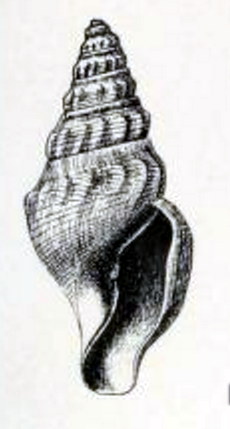
Borsonella bartschi occurs in the Pacific Ocean off Santa Barbara Island, California. It has a solid white shell beneath a pale straw-colored periostracum, with eight whorls and approximately nine nodular ribs on the penultimate whorl.
Written 27 November 2026 from the sources listed below. Each statement was checked against the passage it cites; statements that could not be supported were removed.
Appearance
The shell is solid and white beneath a pale straw-colored periostracum. It has eight whorls, excluding its lost nucleus, and a distinct suture with a slightly swollen margin.[1][2][3]
The axial sculpture includes approximately nine nodular ribs on the penultimate whorl, which become obsolete on the body whorl. Fine spiral striae are visible only in occasional spots, and faint vermicular sculpture is visible under magnification.[4][5][6]
The fasciole is somewhat constricted. The aperture is narrow, and the anal sulcus is moderately deep.[7][8]
The outer lip is thin and arcuate. The body and columella are smooth, and the columellar plait is concealed behind the columella, which tapers toward the front.[9][10][11]
The siphonal canal is short and wide.[12]
The shell reaches 22 mm in height, and the body whorl measures 13 mm in height.[13][14]
Habitat
Borsonella bartschi occurs in the Pacific Ocean off Santa Barbara Island, California.[15]
Classification of Borsonella bartschi
| Kingdom | Animalia |
|---|---|
| Phylum | Mollusca |
| Class | Gastropoda (Gastropod) |
| Subclass | Caenogastropoda |
| Order | Neogastropoda |
| Superfamily | Conoidea |
| Family | Borsoniidae |
| Genus | Borsonella |
| Species | Borsonella bartschi (R. Arnold, 1903) |
Where Borsonella bartschi is found
Checklists and occurrence records place Borsonella bartschi in 1 country. GBIF holds 13 georeferenced records of it.
Countries
A number beside a place is its count of GBIF occurrence records. A place without a number comes from a checklist alone. Records show where a species has been observed or collected, which can include escapes and vagrants.
Synonyms
4 other scientific names have been used for this species and are now treated as synonyms of Borsonella bartschi.
- Borsonella civitella Dall, 1919
- Borsonella nicoli Dall, 1919
- Pleurotoma (Borsonia) bartschi R. Arnold, 1903
- Pleurotoma bartschi R. Arnold, 1903
Related species
-
 Borsonella coronadoi
-
 Borsonella erosina
-
 Borsonella agassizii
-
 Borsonella barbarensis
-
 Borsonella diegensis
-
 Borsonella pinosensis
-
 Borsonella merriami
- Borsonella callicesta
Compare
Questions and answers
Where does Borsonella bartschi occur?
It occurs in the Pacific Ocean off Santa Barbara Island, California.[15]
How large is the shell?
The shell reaches 22 mm in height. The body whorl measures 13 mm in height.[13][14]
How many whorls does the shell have?
The shell has eight whorls, excluding its lost nucleus.[2]
Sources
Passages the profile rests on
- The shell of Borsonella bartschi is solid and white beneath a pale straw-colored periostracum. Source passage: “The solid shell is white, covered with a pale straw-colored periostracum.” — English Wikipedia
- The shell has eight whorls, excluding its lost nucleus. Source passage: “It contains eight whorls exclusive of the (lost) nucleus.” — English Wikipedia
- The shell has a distinct suture with a slightly swollen margin. Source passage: “The suture is distinct with a slightly swollen margin.” — English Wikipedia
- The axial sculpture includes approximately nine nodular ribs on the penultimate whorl, which become obsolete on the body whorl. Source passage: “The axial sculpture consists of (on the penultimate whorl about nine) nodular ribs, peripheral on the spire, becoming obsolete on the body whorl,” — English Wikipedia
- The shell has fine spiral striae that are visible only in occasional spots. Source passage: “The spiral sculpture consists of fine striae, visible only in occasional spots.” — English Wikipedia
- The shell exhibits faint vermicular sculpture visible under magnification. Source passage: “Beside this there are faint traces of vermicular sculpture visible under a glass,” — English Wikipedia
- The fasciole is somewhat constricted. Source passage: “The fasciole is somewhat constricted.” — English Wikipedia
- The aperture is narrow and the anal sulcus is moderately deep. Source passage: “The aperture is narrow. The anal sulcus is moderately deep.” — English Wikipedia
- The outer lip is thin and arcuate. Source passage: “The thin outer lip is arcuate.” — English Wikipedia
- The body and columella are smooth. Source passage: “The body and the columella are smooth.” — English Wikipedia
- The columellar plait is concealed behind the columella, which tapers toward the front. Source passage: “The plait is hidden behind the columella which is attenuate in front.” — English Wikipedia
- The siphonal canal is short and wide. Source passage: “The siphonal canal is short and wide.” — English Wikipedia
- The shell reaches 22 mm in height. Source passage: “The height of shell attains 22 mm;” — English Wikipedia
- The body whorl measures 13 mm in height. Source passage: “of the body whorl: 13 mm:” — English Wikipedia
- Borsonella bartschi occurs in the Pacific Ocean off Santa Barbara Island, California. Source passage: “This species occurs in the Pacific Ocean off Santa Barbara Island, California.” — English Wikipedia
Data
- Catalogue of Life, 2026-10-16 XR cc by
- Global Biodiversity Information Facility CC BY 4.0
- Wikidata CC0
- GeoNames CC BY 4.0
- Within the Catalogue of Life, this name comes from World Register of Marine Species cc by
This species in other databases
Page built on 28 November 2026. See how the catalog is made and all sources and licences.
Cite this page
ScientificNames.org. (2026). Borsonella bartschi. Retrieved November 28, 2026, from https://scientificnames.org/species/borsonella-bartschi
“Borsonella bartschi.” ScientificNames.org, 2026, scientificnames.org/species/borsonella-bartschi. Accessed 28 Nov. 2026.
ScientificNames.org. “Borsonella bartschi.” Accessed November 28, 2026. https://scientificnames.org/species/borsonella-bartschi.
@misc{scientificnames_borsonella_bartschi,
  author = {{ScientificNames.org}},
  title = {Borsonella bartschi},
  year = {2026},
  url = {https://scientificnames.org/species/borsonella-bartschi},
  note = {Accessed 2026-11-28}
}