Species · Molluscs
Borsonella coronadoi
Borsonella coronadoi has no English name on record in the checklists used here. It is a species of mollusc in the family Borsoniidae, order Neogastropoda. The name dates from 1908.
- Scientific name
- Borsonella coronadoi (Dall, 1908)
- Genus
- Borsonella
- Family
- Borsoniidae
- Order
- Neogastropoda
- Class
- Gastropoda
- Environment
- marine
- Recorded in
- 1 country
- Name status
- accepted in the Catalogue of Life

Overview
The species occurs in the Pacific Ocean off California. It is distinguished by a slender, pointed shell with approximately ten whorls, a long spire, and a rounded, low keel.
Written 27 November 2026 from the sources listed below. Each statement was checked against the passage it cites; statements that could not be supported were removed.
Appearance
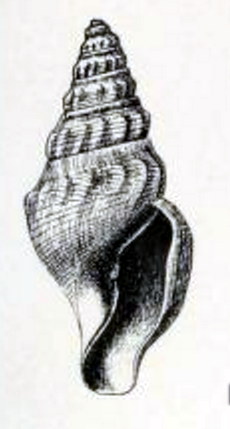
The shell is slender and pointed, with approximately ten whorls. It is pinkish white with a pale brown periostracum, and the spire is longer than the aperture.[1][2][3]
The nuclear whorls are smooth and swollen. Subsequent whorls have a rounded, low keel, usually positioned in front of their midpoint; the keel is slightly undulated on some early whorls but is not regularly nodulous.[4][5][6]
The shell surface has faint vermicular reticulation and obscure, regularly spaced spiral striae on the fasciole and anterior part of the whorl. The suture is distinct and non-appressed.[7][8][9]
The aperture is narrow, and the anal sulcus is deep and wide, extending to the suture. The outer lip is thin, sharp, and arcuately produced.[10][11][12]
The inner lip is slightly eroded and polished, without a callus. The columella has plication at its proximal end, and the shell axis is impervious.[13][14][15]
The shell reaches 29 mm in length and has a maximum diameter of 9 mm.[16][17]
Habitat
The species occurs in the Pacific Ocean off California.[18]
Classification of Borsonella coronadoi
| Kingdom | Animalia |
|---|---|
| Phylum | Mollusca |
| Class | Gastropoda (Gastropod) |
| Subclass | Caenogastropoda |
| Order | Neogastropoda |
| Superfamily | Conoidea |
| Family | Borsoniidae |
| Genus | Borsonella |
| Species | Borsonella coronadoi (Dall, 1908) |
Where Borsonella coronadoi is found
Checklists and occurrence records place Borsonella coronadoi in 1 country. GBIF holds 7 georeferenced records of it.
Countries
A number beside a place is its count of GBIF occurrence records. A place without a number comes from a checklist alone. Records show where a species has been observed or collected, which can include escapes and vagrants.
Synonyms
3 other scientific names have been used for this species and are now treated as synonyms of Borsonella coronadoi.
- Borsonella nychia Dall, 1919
- Borsonia (Borsonella) coronadoi Dall, 1908
- Borsonia coronadoi Dall, 1908
Related species
-
 Borsonella erosina
-
 Borsonella agassizii
-
 Borsonella barbarensis
- Borsonella bartschi
-
 Borsonella diegensis
-
 Borsonella pinosensis
-
 Borsonella merriami
- Borsonella callicesta
Compare
Questions and answers
How large is Borsonella coronadoi?
The shell reaches 29 mm in length, with a maximum diameter of 9 mm.[16][17]
Where does Borsonella coronadoi occur?
It occurs in the Pacific Ocean off California.[18]
Sources
Passages the profile rests on
- The shell is slender and pointed, with approximately ten whorls. Source passage: “The slender shell is acute with about ten whorls.” — English Wikipedia
- The shell is pinkish white and has a pale brown periostracum. Source passage: “Its color is pinkish white, with a pale brown periostracum.” — English Wikipedia
- The spire is longer than the aperture. Source passage: “The spire is longer than the aperture.” — English Wikipedia
- The nuclear whorls are smooth and swollen. Source passage: “The nuclear whorls are smooth, turgid” — English Wikipedia
- The subsequent whorls have a rounded, low keel, usually positioned in front of their midpoint. Source passage: “the subsequent turns carrying a rounded low keel, usually in front of the middle of the whorls” — English Wikipedia
- The keel is slightly undulated on some early whorls but is not regularly nodulous. Source passage: “On some of the early whorls the keel is slightly undulated, but not regularly nodulous.” — English Wikipedia
- The shell surface has faint vermicular reticulation. Source passage: “a faint vermicular reticulation of the surface.” — English Wikipedia
- The shell has obscure, regularly spaced spiral striae on the fasciole and anterior part of the whorl. Source passage: “both the fasciole and the anterior part of the whorl show indications under a lens of obscure regular distant spiral striae” — English Wikipedia
- The shell has a distinct, non-appressed suture. Source passage: “The distinct suture is not appressed.” — English Wikipedia
- The aperture is narrow. Source passage: “The aperture is narrow.” — English Wikipedia
- The anal sulcus is deep and wide and extends to the suture. Source passage: “The anal sulcus is deep and wide, reaching the suture” — English Wikipedia
- The outer lip is thin, sharp, and arcuately produced. Source passage: “The outer lip is thin, sharp, and arcuately produced.” — English Wikipedia
- The inner lip is slightly eroded and polished, without a callus. Source passage: “The inner lip is slightly eroded, polished, with no callus.” — English Wikipedia
- The columella has plication at its proximal end. Source passage: “There is plication at the proximal end of the columella.” — English Wikipedia
- The shell axis is impervious. Source passage: “The axis is impervious” — English Wikipedia
- The shell reaches 29 mm in length. Source passage: “The length of the shell attains 29 mm” — English Wikipedia
- The maximum shell diameter is 9 mm. Source passage: “its maximum diameter is 9 mm.” — English Wikipedia
- The species occurs in the Pacific Ocean off California. Source passage: “This species occurs in the Pacific Ocean off California.” — English Wikipedia
Data
- Catalogue of Life, 2026-10-16 XR cc by
- Global Biodiversity Information Facility CC BY 4.0
- Wikidata CC0
- GeoNames CC BY 4.0
- Wikimedia Commons per image; credit shown with each image
- Within the Catalogue of Life, this name comes from World Register of Marine Species cc by
This species in other databases
Page built on 29 November 2026. See how the catalog is made and all sources and licences.
Cite this page
ScientificNames.org. (2026). Borsonella coronadoi. Retrieved November 29, 2026, from https://scientificnames.org/species/borsonella-coronadoi
“Borsonella coronadoi.” ScientificNames.org, 2026, scientificnames.org/species/borsonella-coronadoi. Accessed 29 Nov. 2026.
ScientificNames.org. “Borsonella coronadoi.” Accessed November 29, 2026. https://scientificnames.org/species/borsonella-coronadoi.
@misc{scientificnames_borsonella_coronadoi,
  author = {{ScientificNames.org}},
  title = {Borsonella coronadoi},
  year = {2026},
  url = {https://scientificnames.org/species/borsonella-coronadoi},
  note = {Accessed 2026-11-29}
}