Species · Flowering plants
Dwarf Kurrajong Brachychiton bidwillii
The scientific name of the Dwarf Kurrajong is Brachychiton bidwillii. It is a species of flowering plant in the family Malvaceae (mallow family), order Malvales.
- Scientific name
- Brachychiton bidwillii Hook.
- Common name
- Dwarf Kurrajong
- Genus
- Brachychiton
- Family
- Malvaceae (Mallow Family)
- Order
- Malvales
- Class
- Magnoliopsida
- Red List category
- LC Least Concern
- Recorded in
- 2 countries
- Name status
- accepted in the Catalogue of Life

Overview
Dwarf kurrajong (Brachychiton bidwillii Hook.) is a semi-deciduous or evergreen shrub that can also grow as a small tree in the family Malvaceae. The species occurs in tropical areas of eastern Australia, particularly Queensland. It has a swollen water-storing caudex and produces showy flowers after its leaves drop in spring.
Written 26 November 2026 from the sources listed below. Each statement was checked against the passage it cites; statements that could not be supported were removed.
Appearance
Dwarf kurrajong is a semi-deciduous or evergreen shrub that can also grow as a small tree. It can reach heights of 4 to 7 metres and spread up to 4 metres.[1][2]
The plant has a swollen caudex that stores large quantities of water in its fleshy stems. It also develops tuberous roots.[3][4]
Its showy flowers appear after the leaves drop in spring. Some Southern Queensland plants occasionally develop deeply lobed leaves.[5][6]
The Maroochydore form has hairy, five-lobed leaves that are puce-coloured when juvenile. It produces pink flowers with a different shape and a long tube.[7][8]
Some plants from inland northern Queensland produce larger flowers. The Northern Coastal form has five deeply lobed leaves and small, bright red flowers that do not fade.[9][10]
Habitat
Dwarf kurrajong occurs in tropical areas of eastern Australia, particularly Queensland. The species is grown in full-sun conditions.[11][12]
Reproduction and life cycle
Flowering can continue for approximately four to six weeks. In frost-free conditions, flowering can occur from July through February in the Southern Hemisphere.[13][14]
Flower production becomes more abundant as the plant ages, with flowers appearing down to the trunk. The Leichhardt form flowers for three months from mid-spring in cold years.[15][16]
The species can be propagated through seeds and grafting. Heavy pruning can restrict flowering.[17][18]
Conservation
Dwarf kurrajong can tolerate frost down to at least −6 °C. It can tolerate drought from approximately one month of age.[19][20]
Uses
Dwarf kurrajong grows successfully in pots and tolerates pruning.[21]
The corky bark covering the trunk was used by Australian Aboriginal people to make canoes.[22]
Classification of the Dwarf Kurrajong
| Kingdom | Plantae |
|---|---|
| Subkingdom | Pteridobiotina |
| Phylum | Tracheophyta |
| Class | Magnoliopsida |
| Order | Malvales |
| Family | Malvaceae (Mallow Family) |
| Subfamily | Sterculioideae |
| Genus | Brachychiton (Bottletree) |
| Species | Brachychiton bidwillii Hook. |
Where the Dwarf Kurrajong is found
Checklists and occurrence records place Brachychiton bidwillii in 2 countries across Asia and Oceania. GBIF holds 498 georeferenced records of it.
Countries where it is native or its origin is not stated
Countries where it has been introduced
Regions and cities with the most records
- Queensland, Australia 444
- Sunshine Coast, Australia 22
- Brisbane, Australia 18
- Caloundra, Australia 18
- Logan City, Australia 15
- New South Wales, Australia 15
- Rockhampton, Australia 7
- Capalaba, Australia 6
- Narangba, Australia 5
- Toowoomba, Australia 3
2 more countries have a few records outside this range
These countries hold a few records of Brachychiton bidwillii but lie outside the range the checklists give for it. Such records are often zoo or garden specimens, museum material or vagrants, so the species is not counted as occurring there.
Range as the checklists state it
Taiwan [I]; Australia (Queensland)
A number beside a place is its count of GBIF occurrence records. A place without a number comes from a checklist alone. Records show where a species has been observed or collected, which can include escapes and vagrants.
Common names
English
- Dwarf Kurrajong
- Pink Lacebark
- Little Kurrajong
Names in 1 other language
- Russian
- Брахихитон Бидвилла
Synonyms
4 other scientific names have been used for this species and are now treated as synonyms of Brachychiton bidwillii.
- Brachychiton paradoxus subsp. bidwillii (Hook.) A.Terracc.
- Brachychiton paradoxus var. bidwillii (Hook.) A.Terracc.
- Clompanus bidwillii (Hook.) Kuntze
- Sterculia bidwillii (Hook.) Benth.
Related species
- Illawarra Flame TreeBrachychiton acerifolius
-
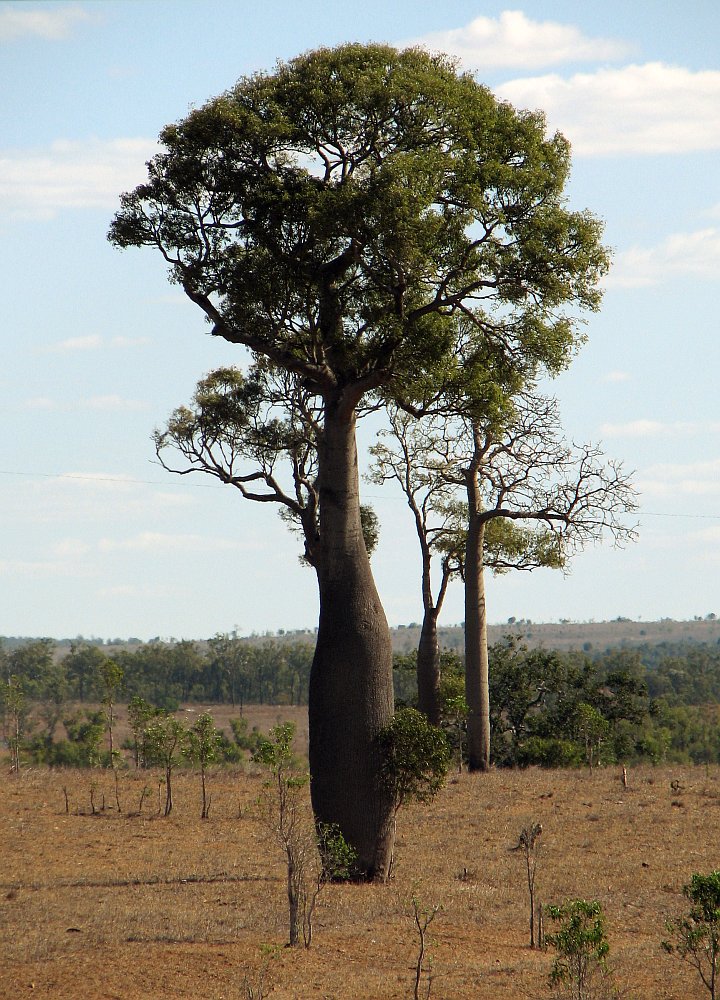 Queensland Bottle TreeBrachychiton rupestris
-
 KurrajongBrachychiton populneus
-
 LacebarkBrachychiton discolor
-
 Desert KurrajongBrachychiton gregorii
-
 Broad-leaved BottletreeBrachychiton australis
-
 Northern KurrajongBrachychiton diversifolius
-
 Red-flowering KurrajongBrachychiton megaphyllus
Compare
Questions and answers
What is the scientific name of the Dwarf Kurrajong?
The scientific name of the Dwarf Kurrajong is Brachychiton bidwillii. Written with its author, the full name is Brachychiton bidwillii Hook..
Which family does the Dwarf Kurrajong belong to?
Brachychiton bidwillii belongs to the family Malvaceae, in the order Malvales and the class Magnoliopsida.
Where is the Dwarf Kurrajong found?
Checklists and occurrence records place Brachychiton bidwillii in 2 countries, including Australia.
What is the conservation status of the Dwarf Kurrajong?
The IUCN Red List category recorded for Brachychiton bidwillii is Least Concern (LC).
What other names does the Dwarf Kurrajong have?
Brachychiton bidwillii is also known in English as Pink Lacebark and Little Kurrajong.
Are kurrajong trees deciduous?
Dwarf kurrajong is semi-deciduous or evergreen.[1]
Sources
Passages the profile rests on
- Brachychiton bidwillii is a semi-deciduous or evergreen shrub that can also grow as a small tree. Source passage: “It is a semi-deciduous or evergreen shrub, sometimes growing as a small tree” — English Wikipedia
- The plant can reach heights of 4 to 7 metres and spread up to 4 metres. Source passage: “reaches 4 metres (13 ft) to as high as 7 metres (23 ft) tall and spreads 4 metres (13 ft).” — English Wikipedia
- The plant has a swollen caudex that stores large quantities of water in its fleshy stems. Source passage: “The caudex is distended, where it can store large quantities of water in its fleshy stems.” — English Wikipedia
- The plant develops tuberous roots. Source passage: “since the plant develops tuberous roots.” — English Wikipedia
- Its flowers are showy and appear after the leaves drop in spring. Source passage: “After the leaves drop, the showy flowers appear in spring” — English Wikipedia
- Some Southern Queensland plants occasionally develop deeply lobed leaves. Source passage: “The Southern Queensland variety occasionally features deeply lobed leaves” — English Wikipedia
- The Maroochydore form has hairy, five-lobed leaves that are puce-coloured when juvenile. Source passage: “the ‘Maroochydore’ form has rather hairy, five-lobed leaves which are puce-coloured when juvenile” — English Wikipedia
- The Maroochydore form produces pink flowers with a different shape and a long tube. Source passage: “with pink flowers having a different shape than others, and a long tube.” — English Wikipedia
- Some plants from inland northern Queensland produce larger flowers. Source passage: “Larger flowers are present in some plants from the northern inland Queensland.” — English Wikipedia
- The Northern Coastal form has five deeply lobed leaves and small, bright red flowers that do not fade. Source passage: “The 'Northern Coastal' has five deeply lobed leaves with small bright red unfading flowers.” — English Wikipedia
- The species occurs in tropical areas of eastern Australia, particularly Queensland. Source passage: “found in tropical areas of eastern Australia, particularly Queensland.” — English Wikipedia
- The species is grown in full-sun conditions. Source passage: “Grown in USDA Zone 9–11 and in full sun” — English Wikipedia
- Flowering can continue for approximately four to six weeks. Source passage: “the showy flowers appear in spring for as long as 4 to 6 weeks.” — English Wikipedia
- In frost-free conditions, flowering can occur from July through February in the Southern Hemisphere. Source passage: “In frostless conditions, they can flower from as early as July to February in the Southern Hemisphere.” — English Wikipedia
- Flower production becomes more abundant as the plant ages, with flowers appearing down to the trunk. Source passage: “As the plant ages, flowers appear more profusely, appearing down to the trunk.” — English Wikipedia
- The Leichhardt form flowers for three months from mid-spring in cold years. Source passage: “The 'Leichhardt' form flowers for 3 months from mid-spring in a cold year.” — English Wikipedia
- The species can be propagated through seeds and grafting. Source passage: “It is easily propagated by seed and grafting.” — English Wikipedia
- Heavy pruning can restrict flowering. Source passage: “though heavy pruning may restrict flowering.” — English Wikipedia
- The plant can tolerate frost down to at least −6 °C. Source passage: “it is frost-resistant to at least −6 °C (21 °F)” — English Wikipedia
- The species can tolerate drought from approximately one month of age. Source passage: “drought tolerant from as young as a month old” — English Wikipedia
- The species grows successfully in pots and tolerates pruning. Source passage: “The plant does well with pruning and in pots” — English Wikipedia
- The corky bark covering the trunk was used by Australian Aboriginal people to make canoes. Source passage: “Its trunk, being covered in a corky bark, was used by Australian Aboriginals for canoes.” — English Wikipedia
Data
- Catalogue of Life, 2026-10-16 XR cc by
- Global Biodiversity Information Facility CC BY 4.0
- Wikidata CC0
- GeoNames CC BY 4.0
- Wikimedia Commons per image; credit shown with each image
- Within the Catalogue of Life, this name comes from Synonymic Checklists of the Vascular Plants of the World cc by
References
- Hook. Bot. Mag. t. 5133 (1859). where the name was published
This species in other databases
- Catalogue of Life 5X247
- Wikidata Q4953374
- iNaturalist 135373
- World Flora Online wfo-0000570243
- GRIN 101970
Page built on 27 November 2026. See how the catalog is made and all sources and licences.
Cite this page
ScientificNames.org. (2026). Brachychiton bidwillii (Dwarf Kurrajong). Retrieved November 27, 2026, from https://scientificnames.org/species/brachychiton-bidwillii
“Brachychiton bidwillii (Dwarf Kurrajong).” ScientificNames.org, 2026, scientificnames.org/species/brachychiton-bidwillii. Accessed 27 Nov. 2026.
ScientificNames.org. “Brachychiton bidwillii (Dwarf Kurrajong).” Accessed November 27, 2026. https://scientificnames.org/species/brachychiton-bidwillii.
@misc{scientificnames_brachychiton_bidwillii_dwarf_kurrajong,
  author = {{ScientificNames.org}},
  title = {Brachychiton bidwillii (Dwarf Kurrajong)},
  year = {2026},
  url = {https://scientificnames.org/species/brachychiton-bidwillii},
  note = {Accessed 2026-11-27}
}