Species · Insects
Alder Bent-wing Bucculatrix cidarella
The scientific name of the Alder Bent-wing is Bucculatrix cidarella. It is a species of insect in the family Bucculatricidae (ribbed cocoon-maker moths), order Lepidoptera. The name dates from 1839.
- Scientific name
- Bucculatrix cidarella (Zeller, 1839)
- Common name
- Alder Bent-wing
- Genus
- Bucculatrix
- Family
- Bucculatricidae (Ribbed Cocoon-maker Moths)
- Order
- Lepidoptera
- Class
- Insecta
- Recorded in
- 16 countries
- Name status
- accepted in the Catalogue of Life
Overview
Bucculatrix cidarella occurs in most of Europe, excluding the Iberian and Balkan Peninsulas, as well as Kazakhstan and Honshu in Japan. The adult moth has a wingspan of 8–9 mm and dark fuscous forewings with four whitish spots.
Written 27 November 2026 from the sources listed below. Each statement was checked against the passage it cites; statements that could not be supported were removed.
Appearance
The adult's head is dull ferruginous with fuscous colouring in the middle, and its antennal eyecaps are white. Its forewings are dark fuscous, with four whitish spots arranged as two pairs along the costa and dorsum.[1][2]
The adult's forewing cilia have an ochreous tinge. Its wingspan is 8–9 mm.[3][4]
The larva is yellowish-green with a reddish tinge toward the front, a darker dorsal line, whitish dots and a pale brown head.[5]
Diet
The larvae feed within leaves by creating gallery mines in their host plants.[6][7][8][9][10]
Behaviour
Adult moths are active from May through June.[11]
The larvae create gallery mines in the leaves of their host plants.[6]
Reproduction and life cycle
The species sometimes produces a second generation in August.[12]
Classification of the Alder Bent-wing
| Kingdom | Animalia |
|---|---|
| Phylum | Arthropoda |
| Subphylum | Hexapoda |
| Class | Insecta (Insect) |
| Order | Lepidoptera |
| Superfamily | Gracillarioidea |
| Family | Bucculatricidae (Ribbed Cocoon-maker Moths) |
| Genus | Bucculatrix (Eyebrow Moths) |
| Species | Bucculatrix cidarella (Zeller, 1839) |
Where the Alder Bent-wing is found
Checklists and occurrence records place Bucculatrix cidarella in 16 countries. GBIF holds 1,661 georeferenced records of it.
Countries
- Aland Islands 36
- Austria 64
- Belgium 17
- Denmark 51
- Estonia 23
- Finland 473
- France 21
- Germany 63
- Italy 3
- Norway 130
- Poland 38
- Portugal 5
- Russia 4
- Sweden 227
- The Netherlands 310
- United Kingdom 196
Regions and cities with the most records
- England, United Kingdom 159
- Berkel en Rodenrijs, The Netherlands 75
- Rauma, Finland 72
- Bergschenhoek, The Netherlands 63
- Barendrecht, The Netherlands 59
- Hoogvliet, The Netherlands 55
- Rhoon, The Netherlands 55
- Scheveningen, The Netherlands 55
- Rotterdam, The Netherlands 54
- Capelle aan den IJssel, The Netherlands 53
- Oud-Beijerland, The Netherlands 53
- Schiedam, The Netherlands 50
- Krimpen aan den IJssel, The Netherlands 47
- Spijkenisse, The Netherlands 47
- Ridderkerk, The Netherlands 44
- Waddinxveen, The Netherlands 44
- Alblasserdam, The Netherlands 40
- Hendrik-Ido-Ambacht, The Netherlands 40
- Alphen aan den Rijn, The Netherlands 38
- Zwijndrecht, The Netherlands 38
- Dordrecht, The Netherlands 37
- Papendrecht, The Netherlands 36
- Skåne, Sweden 36
- Sliedrecht, The Netherlands 35
- Winsford, United Kingdom 35
- Boskoop, The Netherlands 34
- Gelderland, The Netherlands 34
- Bavaria, Germany 31
- Kalmar, Sweden 31
- Northwich, United Kingdom 31
- Sandbach, United Kingdom 29
- Crewe, United Kingdom 26
- Halland, Sweden 25
- Utrecht, The Netherlands 25
- Congleton, United Kingdom 23
- Wales, United Kingdom 23
A number beside a place is its count of GBIF occurrence records. A place without a number comes from a checklist alone. Records show where a species has been observed or collected, which can include escapes and vagrants.
Common names
English
- Alder Bent-wing
Names in 8 other languages
- Czech
- chobotníček olšový
- Dutch
- Elzenooglapmot
- Finnish
- leppätöyhtökoi
- Hungarian
- égerrágó bordásmoly
- Japanese
- シラホシチビガ
- Lithuanian
- Alksninė skeletuojanti kandelė
- Slovak
- plôškavec jelšový
- Swedish
- alkronmal, alögonlappmal
Synonyms
One other scientific name has been used for this species and is now treated as a synonym of Bucculatrix cidarella.
- Lyonetia cidarella Zeller, 1839
Related species
-
 Daisy Bent-wingBucculatrix nigricomella
-
 Highland Bent-wingBucculatrix humiliella
-
 Oak Bent-wingBucculatrix ulmella
-
 Birch Bent-wingBucculatrix demaryella
-
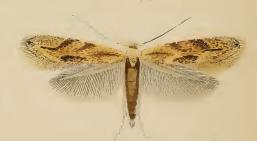 Hawthorn Bent-wingBucculatrix bechsteinella
-
 Lime Bent-wingBucculatrix thoracella
-
 Bucculatrix ulmifoliae
- Bucculatrix recognita
Compare
Questions and answers
What is the scientific name of the Alder Bent-wing?
The scientific name of the Alder Bent-wing is Bucculatrix cidarella. Written with its author, the full name is Bucculatrix cidarella (Zeller, 1839).
Which family does the Alder Bent-wing belong to?
Bucculatrix cidarella belongs to the family Bucculatricidae, in the order Lepidoptera and the class Insecta.
Where is the Alder Bent-wing found?
Checklists and occurrence records place Bucculatrix cidarella in 16 countries, including Finland, The Netherlands, Sweden, United Kingdom, Norway and Austria.
Sources
Passages the profile rests on
- The adult's head is dull ferruginous with fuscous colouring in the middle, and its antennal eyecaps are white. Source passage: “The head is dull ferruginous, mixed with fuscous in middle. Antennal eyecaps white.” — English Wikipedia
- The forewings are dark fuscous and have four whitish spots arranged as two pairs along the costa and dorsum. Source passage: “Forewings are dark fuscous; two whitish costal spots before middle and at 3/4, and two on dorsum somewhat anterior to these” — English Wikipedia
- The adult moth has a wingspan of 8–9 mm. Source passage: “The wingspan is 8–9 mm.” — English Wikipedia
- The adult's forewing cilia have an ochreous tinge. Source passage: “cilia ochreous-tinged.” — English Wikipedia
- The larva is yellowish-green with a reddish tinge toward the front, a darker dorsal line, whitish dots and a pale brown head. Source passage: “The larva is yellowish -green, anteriorly reddish-tinged; dorsal line darker; dots whitish. The head is pale brown.” — English Wikipedia
- The larvae create gallery mines in the leaves of their host plants. Source passage: “The larvae create a gallery mine in the leaves of alder” — English Wikipedia
- The larvae use common alder (Alnus glutinosa) as a leaf-mining host plant. Source passage: “common alder (Alnus glutinosa)” — English Wikipedia
- The larvae use grey alder (Alnus incana) as a leaf-mining host plant. Source passage: “grey alder (Alnus incana)” — English Wikipedia
- The larvae use green alder (Alnus viridis) as a leaf-mining host plant. Source passage: “green alder (Alnus viridis)” — English Wikipedia
- The larvae also mine the leaves of myrtle (Myrica gale). Source passage: “or myrtle (Myrica gale).” — English Wikipedia
- Adult moths are active from May through June. Source passage: “Adults are on wing May to June.” — English Wikipedia
- The species sometimes produces a second generation in August. Source passage: “At times there is a second generation in August.” — English Wikipedia
Data
- Catalogue of Life, 2026-10-16 XR cc by
- Global Biodiversity Information Facility CC BY 4.0
- Wikidata CC0
- GeoNames CC BY 4.0
- Within the Catalogue of Life, this name comes from Global Lepidoptera Index cc by
This species in other databases
Page built on 28 November 2026. See how the catalog is made and all sources and licences.
Cite this page
ScientificNames.org. (2026). Bucculatrix cidarella (Alder Bent-wing). Retrieved November 28, 2026, from https://scientificnames.org/species/bucculatrix-cidarella
“Bucculatrix cidarella (Alder Bent-wing).” ScientificNames.org, 2026, scientificnames.org/species/bucculatrix-cidarella. Accessed 28 Nov. 2026.
ScientificNames.org. “Bucculatrix cidarella (Alder Bent-wing).” Accessed November 28, 2026. https://scientificnames.org/species/bucculatrix-cidarella.
@misc{scientificnames_bucculatrix_cidarella_alder_bent_wing,
  author = {{ScientificNames.org}},
  title = {Bucculatrix cidarella (Alder Bent-wing)},
  year = {2026},
  url = {https://scientificnames.org/species/bucculatrix-cidarella},
  note = {Accessed 2026-11-28}
}