Species · Insects
Bucculatrix improvisa
Bucculatrix improvisa has no English name on record in the checklists used here. It is a species of insect in the family Bucculatricidae (ribbed cocoon-maker moths), order Lepidoptera. The name dates from 1963.
- Scientific name
- Bucculatrix improvisa Braun, 1963
- Genus
- Bucculatrix
- Family
- Bucculatricidae (Ribbed Cocoon-maker Moths)
- Order
- Lepidoptera
- Class
- Insecta
- Recorded in
- 1 country
- Name status
- accepted in the Catalogue of Life
Overview
Bucculatrix improvisa is a moth belonging to the family Bucculatricidae. The species occurs in North America and has been recorded in Ohio. Adult moths have a wingspan of 7–7.5 mm.
Written 27 November 2026 from the sources listed below. Each statement was checked against the passage it cites; statements that could not be supported were removed.
Appearance
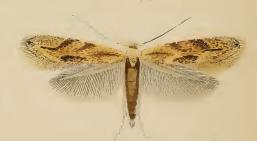
The forewings are golden brown or ocherous, with most scales tipped in dark brown. The hindwings are fuscous.[1][2]
Fully grown larvae are greenish red.[3]
Habitat
The species occurs in North America and has been recorded in Ohio.[4]
Diet
The larvae feed on the leaves of Tilia americana, Tilia neglecta and Tilia heterophylla.[5]
Behaviour
Adult moths have been recorded flying in July.[6]
The larvae initially feed by mining the leaves of their host plants. Each mine begins as a fine thread running alongside a vein before sharply diverging from it.[7][8]
Older larvae leave their mines and feed freely on the leaf surface in patches.[9]
The species overwinters in the pupal stage.[10]
Reproduction and life cycle
The species produces two generations annually.[11]
Pupation occurs inside a yellowish cocoon spun on the underside of a leaf.[12]
Classification of Bucculatrix improvisa
| Kingdom | Animalia |
|---|---|
| Phylum | Arthropoda |
| Subphylum | Hexapoda |
| Class | Insecta (Insect) |
| Order | Lepidoptera |
| Superfamily | Gracillarioidea |
| Family | Bucculatricidae (Ribbed Cocoon-maker Moths) |
| Genus | Bucculatrix (Eyebrow Moths) |
| Species | Bucculatrix improvisa Braun, 1963 |
Where Bucculatrix improvisa is found
Checklists and occurrence records place Bucculatrix improvisa in 1 country. GBIF holds 4 georeferenced records of it.
Countries
A number beside a place is its count of GBIF occurrence records. A place without a number comes from a checklist alone. Records show where a species has been observed or collected, which can include escapes and vagrants.
Related species
-
 Daisy Bent-wingBucculatrix nigricomella
-
 Highland Bent-wingBucculatrix humiliella
-
 Oak Bent-wingBucculatrix ulmella
-
 Birch Bent-wingBucculatrix demaryella
-
 Hawthorn Bent-wingBucculatrix bechsteinella
-
 Lime Bent-wingBucculatrix thoracella
-
 Bucculatrix ulmifoliae
- Bucculatrix recognita
Compare
Questions and answers
Who described Bucculatrix improvisa and when?
Annette Frances Braun described the species in 1963.[13]
What is the wingspan of the adult moth?
The adult moth has a wingspan of 7–7.5 mm.[14]
How many generations does the species produce annually?
The species produces two generations annually.[11]
How do the larvae feed?
The larvae initially mine the leaves of their host plants. Older larvae leave the mines and feed freely on the leaf surface in patches.[7][9]
How does the species overwinter?
The species overwinters in the pupal stage.[10]
Sources
Passages the profile rests on
- The forewings are golden brown or ocherous, with most scales tipped in dark brown. Source passage: “The forewings are golden brown or ocherous, the scales mostly tipped with dark brown.” — English Wikipedia
- The hindwings are fuscous. Source passage: “The hindwings are fuscous.” — English Wikipedia
- Fully grown larvae are greenish red. Source passage: “Full-grown larvae are greenish red.” — English Wikipedia
- The species occurs in North America and has been recorded in Ohio. Source passage: “is found in North America, where it has been recorded from Ohio.” — English Wikipedia
- The larvae feed on the leaves of Tilia americana, Tilia neglecta and Tilia heterophylla. Source passage: “The larvae feed on Tilia americana, Tilia neglecta and Tilia heterophylla.” — English Wikipedia
- Adult moths have been recorded flying in July. Source passage: “Adults have been recorded on wing in July.” — English Wikipedia
- The larvae initially feed by mining the leaves of their host plants. Source passage: “They mine the leaves of their host plant.” — English Wikipedia
- The larval leaf mine begins as a fine thread running alongside a vein before sharply diverging from it. Source passage: “The mine has the form of a fine thread, at first lying alongside the vein, then sharply diverging from it.” — English Wikipedia
- Older larvae leave their mines and feed freely on the leaf surface in patches. Source passage: “Older larvae leave the mine and live freely on the leaf, which is eaten in patches, leaving the upper epidermis.” — English Wikipedia
- The species overwinters in the pupal stage. Source passage: “The species overwinters in the pupal stage.” — English Wikipedia
- The species produces two generations annually. Source passage: “There are two generations per year.” — English Wikipedia
- Pupation occurs inside a yellowish cocoon spun on the underside of a leaf. Source passage: “Pupation takes place in a yellowish cocoon, which is spun on the underside of a leaf.” — English Wikipedia
- The species was described by Annette Frances Braun in 1963. Source passage: “It was described by Annette Frances Braun in 1963” — English Wikipedia
- The adult moth has a wingspan of 7–7.5 mm. Source passage: “The wingspan is 7–7.5 mm.” — English Wikipedia
Data
- Catalogue of Life, 2026-10-16 XR cc by
- Global Biodiversity Information Facility CC BY 4.0
- Wikidata CC0
- GeoNames CC BY 4.0
- Within the Catalogue of Life, this name comes from Global Lepidoptera Index cc by
This species in other databases
Page built on 28 November 2026. See how the catalog is made and all sources and licences.
Cite this page
ScientificNames.org. (2026). Bucculatrix improvisa. Retrieved November 28, 2026, from https://scientificnames.org/species/bucculatrix-improvisa
“Bucculatrix improvisa.” ScientificNames.org, 2026, scientificnames.org/species/bucculatrix-improvisa. Accessed 28 Nov. 2026.
ScientificNames.org. “Bucculatrix improvisa.” Accessed November 28, 2026. https://scientificnames.org/species/bucculatrix-improvisa.
@misc{scientificnames_bucculatrix_improvisa,
  author = {{ScientificNames.org}},
  title = {Bucculatrix improvisa},
  year = {2026},
  url = {https://scientificnames.org/species/bucculatrix-improvisa},
  note = {Accessed 2026-11-28}
}