Species · Insects
Bucculatrix infans
Bucculatrix infans has no English name on record in the checklists used here. It is a species of insect in the family Bucculatricidae (ribbed cocoon-maker moths), order Lepidoptera. The name dates from 1880.
- Scientific name
- Bucculatrix infans Staudinger, 1880
- Genus
- Bucculatrix
- Family
- Bucculatricidae (Ribbed Cocoon-maker Moths)
- Order
- Lepidoptera
- Class
- Insecta
- Name status
- accepted in the Catalogue of Life
Overview
The species occurs on the Balkan Peninsula and in Ukraine and Turkey. The adult moth has a wingspan of approximately 7 mm, and its larvae are olive green.
Written 28 November 2026 from the sources listed below. Each statement was checked against the passage it cites; statements that could not be supported were removed.
Appearance
The adult moth has a wingspan of approximately 7 mm. The larvae are olive green in colour.[1][2]
Habitat
The species occurs on the Balkan Peninsula and in Ukraine and Turkey.[3]
Diet
The larvae feed on Centaurea triniifolia.[4]
Behaviour
The larvae mine the leaves of their host plant. They can be found in July.[5][6]
Classification of Bucculatrix infans
| Kingdom | Animalia |
|---|---|
| Phylum | Arthropoda |
| Subphylum | Hexapoda |
| Class | Insecta (Insect) |
| Order | Lepidoptera |
| Superfamily | Gracillarioidea |
| Family | Bucculatricidae (Ribbed Cocoon-maker Moths) |
| Genus | Bucculatrix (Eyebrow Moths) |
| Species | Bucculatrix infans Staudinger, 1880 |
Related species
-
 Daisy Bent-wingBucculatrix nigricomella
-
 Highland Bent-wingBucculatrix humiliella
-
 Oak Bent-wingBucculatrix ulmella
-
 Birch Bent-wingBucculatrix demaryella
-
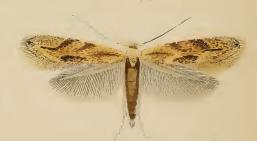 Hawthorn Bent-wingBucculatrix bechsteinella
-
 Lime Bent-wingBucculatrix thoracella
-
 Bucculatrix ulmifoliae
- Bucculatrix recognita
Compare
Questions and answers
What is the wingspan of the adult moth?
The adult moth has a wingspan of approximately 7 mm.[1]
What do the larvae feed on?
The larvae feed on Centaurea triniifolia.[4]
When can the larvae be found?
The larvae can be found in July.[6]
What colour are the larvae?
The larvae are olive green in colour.[2]
Where does the species occur?
It occurs on the Balkan Peninsula and in Ukraine and Turkey.[3]
Sources
Passages the profile rests on
- The adult moth has a wingspan of approximately 7 mm. Source passage: “The wingspan is about 7 mm.” — English Wikipedia
- The larvae are olive green in colour. Source passage: “They are olive green.” — English Wikipedia
- The species occurs on the Balkan Peninsula and in Ukraine and Turkey. Source passage: “It is found on the Balkan Peninsula and in Ukraine and Turkey.” — English Wikipedia
- The larvae feed on Centaurea triniifolia. Source passage: “The larvae feed on Centaurea triniifolia.” — English Wikipedia
- The larvae mine the leaves of their host plant. Source passage: “They mine the leaves of their host plant.” — English Wikipedia
- The larvae can be found in July. Source passage: “Larvae can be found in July.” — English Wikipedia
Data
- Catalogue of Life, 2026-10-16 XR cc by
- Wikidata CC0
- Within the Catalogue of Life, this name comes from Global Lepidoptera Index cc by
This species in other databases
Page built on 28 November 2026. See how the catalog is made and all sources and licences.
Cite this page
ScientificNames.org. (2026). Bucculatrix infans. Retrieved November 28, 2026, from https://scientificnames.org/species/bucculatrix-infans
“Bucculatrix infans.” ScientificNames.org, 2026, scientificnames.org/species/bucculatrix-infans. Accessed 28 Nov. 2026.
ScientificNames.org. “Bucculatrix infans.” Accessed November 28, 2026. https://scientificnames.org/species/bucculatrix-infans.
@misc{scientificnames_bucculatrix_infans,
  author = {{ScientificNames.org}},
  title = {Bucculatrix infans},
  year = {2026},
  url = {https://scientificnames.org/species/bucculatrix-infans},
  note = {Accessed 2026-11-28}
}