Species · Insects
Saltern Bent-wing Bucculatrix maritima
The scientific name of the Saltern Bent-wing is Bucculatrix maritima. It is a species of insect in the family Bucculatricidae (ribbed cocoon-maker moths), order Lepidoptera. The name dates from 1851.
- Scientific name
- Bucculatrix maritima Stainton, 1851
- Common name
- Saltern Bent-wing
- Genus
- Bucculatrix
- Family
- Bucculatricidae (Ribbed Cocoon-maker Moths)
- Order
- Lepidoptera
- Class
- Insecta
- Recorded in
- 14 countries
- Name status
- accepted in the Catalogue of Life
Overview
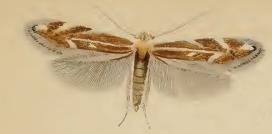
Bucculatrix maritima occurs across most of Europe, excluding the Balkan Peninsula, as well as in Russia and on the Japanese islands of Hokkaido and Honshu. Adults have a wingspan of 8–9 mm and light greyish-ochreous forewings with fuscous speckling and distinctive spots and markings.
Written 27 November 2026 from the sources listed below. Each statement was checked against the passage it cites; statements that could not be supported were removed.
Appearance
The head is pale greyish-ochreous and sometimes has a fuscous centre. The forewings are light greyish-ochreous with varying amounts of fuscous speckling.[1][2]
The forewings have a short median streak originating at the base. They also have whitish pairs of indistinct costal and dorsal spots before the middle and at three-quarters of their length, together with minute black plical and second discal stigmata.[3][4][5]
The hindwings are relatively dark grey.[6]
The larva is pale greyish-green with a darker dorsal line and a yellowish head. Its second segment is yellowish-grey and blackish-dotted.[7][8]
Habitat
The species occurs across most of Europe, excluding the Balkan Peninsula, as well as in Russia and on the Japanese islands of Hokkaido and Honshu.[9]
Diet
The larvae feed on sea aster (Aster tripolium).[10]
Behaviour
Adult moths are active in June and again in August.[11]
The larvae create mines within the leaves of their host plant.[12]
Reproduction and life cycle
The species produces two generations annually.[13]
Classification of the Saltern Bent-wing
| Kingdom | Animalia |
|---|---|
| Phylum | Arthropoda |
| Subphylum | Hexapoda |
| Class | Insecta (Insect) |
| Order | Lepidoptera |
| Superfamily | Gracillarioidea |
| Family | Bucculatricidae (Ribbed Cocoon-maker Moths) |
| Genus | Bucculatrix (Eyebrow Moths) |
| Species | Bucculatrix maritima Stainton, 1851 |
Where the Saltern Bent-wing is found
Checklists and occurrence records place Bucculatrix maritima in 14 countries. GBIF holds 561 georeferenced records of it.
Countries
- Aland Islands 8
- Austria 5
- Belgium 13
- Denmark 72
- Estonia 13
- Finland 108
- France 5
- Germany 5
- Hungary 3
- Norway 47
- Portugal 3
- Sweden 70
- The Netherlands 98
- United Kingdom 111
Regions and cities with the most records
- England, United Kingdom 62
- Zealand, Denmark 30
- Kalundborg, Denmark 23
- Västra Götaland, Sweden 23
- Kungsbacka, Sweden 21
- Vlissingen, The Netherlands 19
- Fylde, United Kingdom 18
- Friesland, The Netherlands 17
- Halland, Sweden 16
- Poulton-le-Fylde, United Kingdom 16
- South Denmark, Denmark 16
- Wales, United Kingdom 16
- Avedøre, Denmark 15
- Blackpool, United Kingdom 15
- Capital Region, Denmark 15
- Ishøj, Denmark 15
- Skåne, Sweden 15
- Taastrup, Denmark 15
- Vallensbæk, Denmark 15
- Den Helder, The Netherlands 13
- Fleetwood, United Kingdom 13
- Akershus, Norway 12
- Vestfold, Norway 12
- Zeeland, The Netherlands 12
- Odense, Denmark 11
- Thornton-Cleveleys, United Kingdom 10
- Rauma, Finland 9
- Saare, Estonia 8
- Trelleborg, Sweden 8
- Cleethorpes, United Kingdom 7
- Greve, Denmark 7
- Grimsby, United Kingdom 7
- Kalmar, Sweden 6
- Scotland, United Kingdom 6
- Clacton-on-Sea, United Kingdom 5
- Diksmuide, Belgium 5
1 more country has a few records outside this range
These countries hold a few records of Bucculatrix maritima but lie outside the range the checklists give for it. Such records are often zoo or garden specimens, museum material or vagrants, so the species is not counted as occurring there.
A number beside a place is its count of GBIF occurrence records. A place without a number comes from a checklist alone. Records show where a species has been observed or collected, which can include escapes and vagrants.
Common names
English
- Saltern Bent-wing
Names in 7 other languages
- Dutch
- Zeeasterooglapmot
- Finnish
- asteritöyhtökoi
- Hungarian
- sziki bordásmoly
- Japanese
- ウラギクチビガ
- Lithuanian
- Astrinė skeletuojanti kandelė
- Slovak
- plôškavec astrový
- Swedish
- strandasterkronmal, strandasterögonlappmal
Related species
-
 Daisy Bent-wingBucculatrix nigricomella
-
 Highland Bent-wingBucculatrix humiliella
-
 Oak Bent-wingBucculatrix ulmella
-
 Birch Bent-wingBucculatrix demaryella
-
 Hawthorn Bent-wingBucculatrix bechsteinella
-
 Lime Bent-wingBucculatrix thoracella
-
 Bucculatrix ulmifoliae
- Bucculatrix recognita
Compare
Questions and answers
What is the scientific name of the Saltern Bent-wing?
The scientific name of the Saltern Bent-wing is Bucculatrix maritima. Written with its author, the full name is Bucculatrix maritima Stainton, 1851.
Which family does the Saltern Bent-wing belong to?
Bucculatrix maritima belongs to the family Bucculatricidae, in the order Lepidoptera and the class Insecta.
Where is the Saltern Bent-wing found?
Checklists and occurrence records place Bucculatrix maritima in 14 countries, including United Kingdom, Finland, The Netherlands, Denmark, Sweden and Norway.
Sources
Passages the profile rests on
- The head is pale greyish-ochreous and sometimes has a fuscous centre. Source passage: “The head is pale greyish-ochreous, centre sometimes fuscous.” — English Wikipedia
- The forewings are light greyish-ochreous with varying amounts of fuscous speckling. Source passage: “Forewings are light greyish-ochreous, more or less irrorated with fuscous” — English Wikipedia
- The forewings have a short median streak originating at the base. Source passage: “a short median streak from base” — English Wikipedia
- The forewings have whitish pairs of indistinct costal and dorsal spots before the middle and at three-quarters of their length. Source passage: “pairs of costal and dorsal undefined spots before middle and at 3/4 whitish, often very indistinct” — English Wikipedia
- The forewings have minute black plical and second discal stigmata. Source passage: “plical and second discal stigmata minute, black.” — English Wikipedia
- The hindwings are relatively dark grey. Source passage: “Hindwings are rather dark grey.” — English Wikipedia
- The larva is pale greyish-green with a darker dorsal line and a yellowish head. Source passage: “The larva is pale greyish-green; dorsal line darker, head yellowish;” — English Wikipedia
- The larva's second segment is yellowish-grey and blackish-dotted. Source passage: “segment 2 yellowish-grey, blackish- dotted.” — English Wikipedia
- The species occurs across most of Europe, excluding the Balkan Peninsula, as well as in Russia and on the Japanese islands of Hokkaido and Honshu. Source passage: “It is found in most of Europe (except the Balkan Peninsula), Russia and Japan (the islands of Hokkaido and Honshu).” — English Wikipedia
- The larvae feed on sea aster (Aster tripolium). Source passage: “The larvae feed on sea aster (Aster tripolium).” — English Wikipedia
- Adult moths are active in June and again in August. Source passage: “Adults are on wing in June and again in August.” — English Wikipedia
- The larvae create mines within the leaves of their host plant. Source passage: “They mine the leaves of their host plant.” — English Wikipedia
- The species produces two generations annually. Source passage: “There are two generations per year.” — English Wikipedia
Data
- Catalogue of Life, 2026-10-16 XR cc by
- Global Biodiversity Information Facility CC BY 4.0
- Wikidata CC0
- GeoNames CC BY 4.0
- Wikimedia Commons per image; credit shown with each image
- Within the Catalogue of Life, this name comes from Global Lepidoptera Index cc by
This species in other databases
Page built on 28 November 2026. See how the catalog is made and all sources and licences.
Cite this page
ScientificNames.org. (2026). Bucculatrix maritima (Saltern Bent-wing). Retrieved November 28, 2026, from https://scientificnames.org/species/bucculatrix-maritima
“Bucculatrix maritima (Saltern Bent-wing).” ScientificNames.org, 2026, scientificnames.org/species/bucculatrix-maritima. Accessed 28 Nov. 2026.
ScientificNames.org. “Bucculatrix maritima (Saltern Bent-wing).” Accessed November 28, 2026. https://scientificnames.org/species/bucculatrix-maritima.
@misc{scientificnames_bucculatrix_maritima_saltern_bent_wing,
  author = {{ScientificNames.org}},
  title = {Bucculatrix maritima (Saltern Bent-wing)},
  year = {2026},
  url = {https://scientificnames.org/species/bucculatrix-maritima},
  note = {Accessed 2026-11-28}
}