Species · Insects
Bucculatrix noltei
Bucculatrix noltei has no English name on record in the checklists used here. It is a species of insect in the family Bucculatricidae (ribbed cocoon-maker moths), order Lepidoptera. The name dates from 1912.
- Scientific name
- Bucculatrix noltei Petry, 1912
- Genus
- Bucculatrix
- Family
- Bucculatricidae (Ribbed Cocoon-maker Moths)
- Order
- Lepidoptera
- Class
- Insecta
- Recorded in
- 12 countries
- Name status
- accepted in the Catalogue of Life

Overview
Bucculatrix noltei occurs from Finland to Belgium, Italy and the Crimea, and from the Netherlands to Central Russia. The adult moth has a wingspan of 5–6 mm.
Written 27 November 2026 from the sources listed below. Each statement was checked against the passage it cites; statements that could not be supported were removed.
Appearance
The adult moth has a wingspan of 5–6 mm.[1]
Diet
The larvae feed on common mugwort (Artemisia vulgaris).[2]
Behaviour
Adults are active from April to May and again from July to August. The species overwinters in the pupal stage.[3][4]
The larvae mine the leaves of their host plant. They can be found from June to October.[5][6]
Reproduction and life cycle
The species produces two generations per year.[7]
Classification of Bucculatrix noltei
| Kingdom | Animalia |
|---|---|
| Phylum | Arthropoda |
| Subphylum | Hexapoda |
| Class | Insecta (Insect) |
| Order | Lepidoptera |
| Superfamily | Gracillarioidea |
| Family | Bucculatricidae (Ribbed Cocoon-maker Moths) |
| Genus | Bucculatrix (Eyebrow Moths) |
| Species | Bucculatrix noltei Petry, 1912 |
Where Bucculatrix noltei is found
Checklists and occurrence records place Bucculatrix noltei in 12 countries. GBIF holds 611 georeferenced records of it.
Countries
- Austria 9
- Belgium 15
- Denmark 43
- Estonia 12
- Finland 159
- Germany 25
- Lithuania 6
- Norway 18
- Poland 37
- Russia 9
- The Netherlands 275
- Ukraine 3
Regions and cities with the most records
- Gelderland, The Netherlands 42
- Nykøbing Falster, Denmark 40
- Zealand, Denmark 40
- Hoogvliet, The Netherlands 32
- Oud-Beijerland, The Netherlands 32
- Rhoon, The Netherlands 32
- Luboń, Poland 25
- Poznań, Poland 25
- Swarzędz, Poland 25
- Drenthe, The Netherlands 24
- Overijssel, The Netherlands 22
- Hoogeveen, The Netherlands 18
- Groningen, The Netherlands 17
- Friesland, The Netherlands 16
- Hardenberg, The Netherlands 15
- Stadskanaal, The Netherlands 15
- Veendam, The Netherlands 15
- Drachten, The Netherlands 14
- Limburg, The Netherlands 14
- Winschoten, The Netherlands 14
- Leeuwarden, The Netherlands 10
- Utrecht, The Netherlands 7
- Lower Saxony, Germany 6
- Ludwigsfelde, Germany 6
- Saxony, Germany 6
- Svetogorsk, Russia 6
- Vilnius, Lithuania 6
- Brandenburg, Germany 5
- Kontiolahti, Finland 5
- Joensuu, Finland 4
- Flevoland, The Netherlands 3
- Haren, Germany 3
- Luhansk, Ukraine 3
- Lysychansk, Ukraine 3
- Lüneburg, Germany 3
- Meppen, Germany 3
A number beside a place is its count of GBIF occurrence records. A place without a number comes from a checklist alone. Records show where a species has been observed or collected, which can include escapes and vagrants.
Common names
Names in 6 other languages
- Dutch
- Bijvoetooglapmot
- Finnish
- pujotöyhtökoi
- Hungarian
- feketeüröm-bordásmoly
- Lithuanian
- Dykvietinė skeletuojanti kandelė
- Slovak
- plôškavec Nolteho
- Swedish
- gråbokronmal
Related species
-
 Daisy Bent-wingBucculatrix nigricomella
-
 Highland Bent-wingBucculatrix humiliella
-
 Oak Bent-wingBucculatrix ulmella
-
 Birch Bent-wingBucculatrix demaryella
-
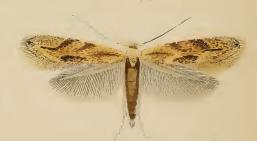 Hawthorn Bent-wingBucculatrix bechsteinella
-
 Lime Bent-wingBucculatrix thoracella
-
 Bucculatrix ulmifoliae
- Bucculatrix recognita
Compare
Sources
Passages the profile rests on
- The adult moth has a wingspan of 5–6 mm. Source passage: “The wingspan is 5–6 mm.” — English Wikipedia
- The larvae feed on common mugwort (Artemisia vulgaris). Source passage: “The larvae feed on Artemisia vulgaris.” — English Wikipedia
- Adults are active from April to May and again from July to August. Source passage: “Adults are on wing from April to May and again from July to August in two generations per year.” — English Wikipedia
- The species overwinters in the pupal stage. Source passage: “The species overwinters in the pupal stage.” — English Wikipedia
- The larvae mine the leaves of their host plant. Source passage: “They mine the leaves of their host plant.” — English Wikipedia
- Larvae can be found from June to October. Source passage: “Larvae can be found from June to October.” — English Wikipedia
- The species produces two generations per year. Source passage: “Adults are on wing from April to May and again from July to August in two generations per year.” — English Wikipedia
Data
- Catalogue of Life, 2026-10-16 XR cc by
- Global Biodiversity Information Facility CC BY 4.0
- Wikidata CC0
- GeoNames CC BY 4.0
- Wikimedia Commons per image; credit shown with each image
- Within the Catalogue of Life, this name comes from Global Lepidoptera Index cc by
This species in other databases
Page built on 29 November 2026. See how the catalog is made and all sources and licences.
Cite this page
ScientificNames.org. (2026). Bucculatrix noltei. Retrieved November 29, 2026, from https://scientificnames.org/species/bucculatrix-noltei
“Bucculatrix noltei.” ScientificNames.org, 2026, scientificnames.org/species/bucculatrix-noltei. Accessed 29 Nov. 2026.
ScientificNames.org. “Bucculatrix noltei.” Accessed November 29, 2026. https://scientificnames.org/species/bucculatrix-noltei.
@misc{scientificnames_bucculatrix_noltei,
  author = {{ScientificNames.org}},
  title = {Bucculatrix noltei},
  year = {2026},
  url = {https://scientificnames.org/species/bucculatrix-noltei},
  note = {Accessed 2026-11-29}
}