Species · Spiders and other arachnids
Four-dotted Grass Spider Burmattus albopunctatus
The scientific name of the Four-dotted Grass Spider is Burmattus albopunctatus. It is a species of arachnid in the family Salticidae (jumping spider), order Araneae. The name dates from 1895.
- Scientific name
- Burmattus albopunctatus (Thorell, 1895)
- Common name
- Four-dotted Grass Spider
- Genus
- Burmattus
- Family
- Salticidae (Jumping Spider)
- Order
- Araneae
- Class
- Arachnida
- Recorded in
- 11 countries
- Name status
- accepted in the Catalogue of Life
Overview
The Four-dotted Grass Spider is a medium-sized jumping spider belonging to the genus Burmattus. The species occurs across Asia, from northwestern India to the southwestern Japanese islands and south to the Malay Peninsula. Males are distinguished by a sabre-shaped embolus, a curved retrolateral tibial apophysis and curved bristles on the retrolateral cymbial projection.
Written 27 November 2026 from the sources listed below. Each statement was checked against the passage it cites; statements that could not be supported were removed.
Appearance
Males possess a distinctive sabre-shaped embolus on the palp. The male palp also has a long retrolateral tibial apophysis with a curved tip.[1][2]
Males have a cluster of curved bristles on the retrolateral cymbial projection.[3]
Habitat
The species inhabits secondary jungle, mangroves, tall grasslands and understorey vegetation.[4]
It has been recorded at elevations from sea level to approximately 1,500 metres.[5]
Its distribution extends across Asia, from northwestern India to the southwestern Japanese islands and south to the Malay Peninsula. Recorded countries and territories include India, China, Japan's Ryukyu Islands, Myanmar, Thailand, Vietnam, Malaysia and Singapore.[6][7]
Reproduction and life cycle
Females possess a deep, strongly hardened epigynal pocket situated anterior to the epigastric furrow. Their copulatory openings are slit-shaped and generally concealed beneath prominent hardened rims.[8][9]
The female vulva contains two pear-shaped receptacles joined by short, wide insemination ducts.[10]
Classification of the Four-dotted Grass Spider
| Kingdom | Animalia |
|---|---|
| Phylum | Arthropoda |
| Subphylum | Chelicerata |
| Class | Arachnida (Arachnid) |
| Order | Araneae (Spider) |
| Family | Salticidae (Jumping Spider) |
| Genus | Burmattus |
| Species | Burmattus albopunctatus (Thorell, 1895) |
Where the Four-dotted Grass Spider is found
Checklists and occurrence records place Burmattus albopunctatus in 11 countries across Asia. GBIF holds 126 georeferenced records of it.
Countries
- China 17
- Hong Kong 24
- India 5
- Indonesia 17
- Japan 5
- Malaysia 4
- Myanmar 1
- Singapore 7
- Taiwan 8
- Thailand 34
- Vietnam 4
Regions and cities with the most records
- Pat Heung, Hong Kong 23
- Ting Kau, Hong Kong 23
- Discovery Park, Hong Kong 22
- Tsuen Wan, Hong Kong 22
- Kam Tin, Hong Kong 21
- Mei Foo, Hong Kong 21
- San Tin, Hong Kong 21
- Shap Pat Heung, Hong Kong 21
- Shenzhen, China 21
- Shenzhen City Centre, China 21
- Tsing Yi Town, Hong Kong 21
- Fairview Park, Hong Kong 20
- Gangxia, China 20
- Ha Tsuen, Hong Kong 20
- Kwai Chung, Hong Kong 20
- Ping Shan, Hong Kong 20
- Sham Tseng, Hong Kong 20
- Shawei, China 20
- Shek Lei, Hong Kong 20
- Tai Wo Hau, Hong Kong 20
- Tin Shui Wai, Hong Kong 20
- Yeung Uk Tsuen, Hong Kong 20
- Yuen Long, Hong Kong 20
- Yuen Long Kau Hui, Hong Kong 20
- Yuen Long San Hui, Hong Kong 20
- Zhuzilin, China 18
- Fanling, Hong Kong 16
- Hong Lok Yuen, Hong Kong 16
- Mei Foo Sun Chuen, Hong Kong 16
- Tuen Mun San Hui, Hong Kong 16
- Fo Tan, Hong Kong 15
- Sheung Shui, Hong Kong 15
- Shuen Wan, Hong Kong 15
- Tai Mei Tuk, Hong Kong 15
- Tai Po, Hong Kong 15
- City One, Hong Kong 14
Range as the checklists state it
India, China, Japan (Ryukyu Is.), Myanmar, Thailand, Vietnam, Malaysia, Singapore
India, Myanmar, Thailand, Vietnam, China, Japan
China
A number beside a place is its count of GBIF occurrence records. A place without a number comes from a checklist alone. Records show where a species has been observed or collected, which can include escapes and vagrants.
Common names
English
- Four-dotted Grass Spider
Names in 2 other languages
- Chinese
- 波氏緬蛛
- Japanese
- ツルギハエトリ
Synonyms
4 other scientific names have been used for this species and are now treated as synonyms of Burmattus albopunctatus.
- Burmattus pococki (Thorell, 1895)
- Burmattus sinicus Prószyński, 1992
- Plexippus pococki Prószyński, 1984a
- Plexippus pocockii Thorell, 1895
Related species
- Burmattus pachytibialis
- Burmattus nitidus
-
 Bold JumperPhidippus audax
-
 Regal Jumping SpiderPhidippus regius
-
 Johnson JumperPhidippus johnsoni
-
 Zebra SpiderSalticus scenicus
-
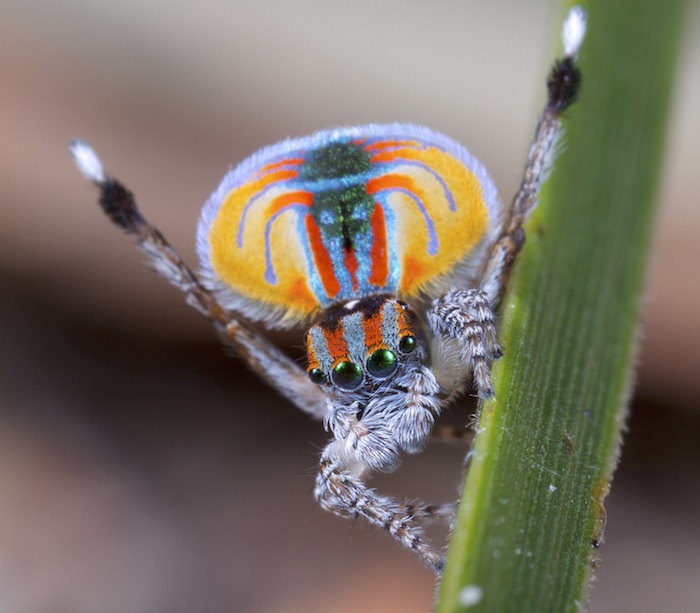 Flying Peacock SpiderMaratus volans
-
 Bagheera kiplingi
Compare
Questions and answers
What is the scientific name of the Four-dotted Grass Spider?
The scientific name of the Four-dotted Grass Spider is Burmattus albopunctatus. Written with its author, the full name is Burmattus albopunctatus (Thorell, 1895).
Which family does the Four-dotted Grass Spider belong to?
Burmattus albopunctatus belongs to the family Salticidae, in the order Araneae and the class Arachnida.
Where is the Four-dotted Grass Spider found?
Checklists and occurrence records place Burmattus albopunctatus in 11 countries, including Thailand, Hong Kong, China, Indonesia, Taiwan and Singapore.
Sources
Passages the profile rests on
- Males possess a distinctive sabre-shaped embolus on the palp. Source passage: “the palp has a distinctive sabre-like embolus” — English Wikipedia
- The male palp has a long retrolateral tibial apophysis with a curved tip. Source passage: “a long retrolateral tibial apophysis that bends at the tip” — English Wikipedia
- Males have a cluster of curved bristles on the retrolateral cymbial projection. Source passage: “a cluster of curved bristles located at the retrolateral cymbial projection.” — English Wikipedia
- The species inhabits secondary jungle, mangroves, tall grasslands, and understorey vegetation. Source passage: “The species inhabits various environments including secondary jungle, mangroves, tall grasslands, and understorey vegetation.” — English Wikipedia
- The species has been recorded at elevations from sea level to approximately 1,500 metres. Source passage: “It has been found at elevations ranging from sea level to approximately 1500 meters.” — English Wikipedia
- The species occurs across Asia, extending from northwestern India to the southwestern Japanese islands and south to the Malay Peninsula. Source passage: “It is widely distributed across Asia, from northwest India to the southwestern islands of Japan, and south to the Malay Peninsula.” — English Wikipedia
- Recorded countries and territories include India, China, Japan's Ryukyu Islands, Myanmar, Thailand, Vietnam, Malaysia, and Singapore. Source passage: “It has been recorded from India, China, Japan (Ryukyu Islands), Myanmar, Thailand, Vietnam, Malaysia, and Singapore.” — English Wikipedia
- Females possess a deep, strongly hardened epigynal pocket situated anterior to the epigastric furrow. Source passage: “a deep, heavily sclerotized epigynal pocket positioned forward from the epigastric furrow” — English Wikipedia
- Female copulatory openings are slit-shaped and generally concealed beneath prominent hardened rims. Source passage: “slit-like copulatory openings that are typically hidden beneath prominent sclerotized rims” — English Wikipedia
- The female vulva contains two pear-shaped receptacles joined by short, wide insemination ducts. Source passage: “a vulva consisting of two pear-shaped receptacles connected by short, wide insemination ducts.” — English Wikipedia
- Tamerlan Thorell originally described the species in 1895 under the name Plexippus albo-punctatus. Source passage: “The species was originally described by Tamerlan Thorell in 1895 as Plexippus albo-punctatus” — English Wikipedia
- The species was transferred to the genus Burmattus by Prószyński in 1992. Source passage: “later transferred to the genus Burmattus by Prószyński in 1992.” — English Wikipedia
- A 2024 taxonomic study by Logunov concluded that Burmattus albopunctatus and Burmattus pocockii represent the same species. Source passage: “Recent taxonomic research by Logunov in 2024 demonstrated that B. albopunctatus and B. pocockii represent the same species” — English Wikipedia
Data
- Catalogue of Life, 2026-10-16 XR cc by
- Global Biodiversity Information Facility CC BY 4.0
- Wikidata CC0
- GeoNames CC BY 4.0
- Within the Catalogue of Life, this name comes from The World Spider Catalog cc by
References
- Thorell, T. (1895b). Descriptive catalogue of the spiders of Burma, based upon the collection made by Eugene W. Oates and preserved in the British Museum. British Museum, London, 406 pp. doi: <a href="https://doi.org/10.5962/bhl.title.17492" target="_blank">10.5962/bhl.title.17492 Link where the name was published
This species in other databases
Page built on 28 November 2026. See how the catalog is made and all sources and licences.
Cite this page
ScientificNames.org. (2026). Burmattus albopunctatus (Four-dotted Grass Spider). Retrieved November 28, 2026, from https://scientificnames.org/species/burmattus-albopunctatus
“Burmattus albopunctatus (Four-dotted Grass Spider).” ScientificNames.org, 2026, scientificnames.org/species/burmattus-albopunctatus. Accessed 28 Nov. 2026.
ScientificNames.org. “Burmattus albopunctatus (Four-dotted Grass Spider).” Accessed November 28, 2026. https://scientificnames.org/species/burmattus-albopunctatus.
@misc{scientificnames_burmattus_albopunctatus_four_dotted_grass_spider,
  author = {{ScientificNames.org}},
  title = {Burmattus albopunctatus (Four-dotted Grass Spider)},
  year = {2026},
  url = {https://scientificnames.org/species/burmattus-albopunctatus},
  note = {Accessed 2026-11-28}
}