Species · Amphibians
Pyrenean Brook Salamander Calotriton asper
The scientific name of the Pyrenean Brook Salamander is Calotriton asper. It is a species of amphibian in the family Salamandridae (newts), order Caudata. The name dates from 1852.
- Scientific name
- Calotriton asper (Dugès, 1852)
- Common name
- Pyrenean Brook Salamander
- Genus
- Calotriton
- Family
- Salamandridae (Newts)
- Order
- Caudata
- Class
- Amphibia
- Red List category
- LC Least Concern
- Recorded in
- 3 countries
- Name status
- accepted in the Catalogue of Life

Overview
Calotriton asper is endemic to the Pyrenees and surrounding mountains, with a documented range including Andorra, France, and Spain. It has rough, tubercled skin, a flattened head, and a brightly coloured underside with a red, orange, or yellow central area.
Written 26 November 2026 from the sources listed below. Each statement was checked against the passage it cites; statements that could not be supported were removed.
Appearance
The Pyrenean Brook Salamander has a sturdy body, a flattened head, small eyes, and short limbs. Its skin is covered with small rough tubercles.[1]
Its upper body is usually olive, grey, charcoal, or muddy brown, sometimes with ochre mottling and an intermittent yellowish dorsal stripe. The underside has dark spots along both sides and a central area that is red, orange, or yellow.[2][3]
Males have a rounded cloacal swelling, whereas females have a conical one. Females are usually larger than males.[4][5]
Adults grow to approximately 16 cm in length. Approximately half of their total length consists of a laterally flattened tail.[6][7]
Habitat
The Pyrenean Brook Salamander usually inhabits slow-moving streams and shallow mountain lakes. It favours water temperatures below 15 °C and rocky or pebbly bottoms with sparse vegetation.[8][9]
The species occurs at elevations between 700 and 2,500 metres. Some populations live entirely inside caves.[10][11]
Diet
The Pyrenean Brook Salamander feeds on insects and other slow-moving invertebrates. Its larvae are entirely carnivorous.[12][13]
Behaviour
Although infrequently observed, the species is active during both daytime and nighttime. It is mostly aquatic during summer.[14][15]
Individuals sometimes undergo aestivation during hot weather in lower parts of their range. At higher elevations, they hibernate on land during winter and emerge in spring.[16][17]
Trout prey on the Pyrenean Brook Salamander, which is often scarce where trout are abundant. The species is sensitive to pesticides in water because they enter through its skin and accumulate in its tissues.[18][19]
Reproduction and life cycle
During courtship, males display their brightly coloured underparts before grasping females around the loins with their tails. Males transfer between one and four spermatophores directly into the female's cloaca, and copulation and spermatophore transfer can last several hours.[20][21][22]
Females lay between 20 and 40 eggs over several weeks. They attach the eggs to rocks or inside crevices using their extensible cloacas.[23][24]
Eggs hatch after approximately six weeks, and the larvae have external gills. Larvae may overwinter once or more before undergoing metamorphosis.[25][26][27]
Individuals reach sexual maturity at two or more years of age, depending on altitude, with females maturing later. Juveniles are dark-coloured and have a thin yellow line along their spines.[28][29]
Cave-dwelling populations breed over an extended period of the year.[30]
Conservation
The IUCN classifies the Pyrenean Brook Salamander as Least Concern. Its most recent assessment for the IUCN Red List was in 2023.[31][32]
Classification of the Pyrenean Brook Salamander
| Kingdom | Animalia |
|---|---|
| Phylum | Chordata |
| Subphylum | Vertebrata |
| Infraphylum | Gnathostomata |
| Parvphylum | Osteichthyes |
| Megaclass | Tetrapoda |
| Class | Amphibia (Amphibians) |
| Order | Caudata (Salamanders) |
| Family | Salamandridae (Newts) |
| Subfamily | Pleurodelinae |
| Genus | Calotriton (Western Brook Newts) |
| Species | Calotriton asper (Dugès, 1852) |
Where the Pyrenean Brook Salamander is found
Checklists and occurrence records place Calotriton asper in 3 countries. GBIF holds 9,224 georeferenced records of it.
Countries
Regions and cities with the most records
- Occitanie, France 4,045
- Aragon, Spain 880
- Lourdes, France 732
- Catalonia, Spain 600
- les Escaldes, Andorra 165
- Andorra la Vella, Andorra 154
- Olot, Spain 97
- Berga, Spain 69
- Manlleu, Spain 58
- Huesca, Spain 33
- Ordino, Andorra 33
- Vic, Spain 31
- Grand Est, France 27
- Centre-Val de Loire, France 25
- Hauts-de-France, France 22
- Pamiers, France 22
- La Massana, Andorra 20
- Canillo, Andorra 18
- Banyoles, Spain 14
- Barbastro, Spain 13
- Irun, Spain 12
- Salt, Spain 12
- Hondarribia, Spain 10
- Muret, France 9
- Cardedeu, Spain 7
- Gien, France 7
- Sant Julià de Loria, Andorra 7
- Île-de-France, France 7
- Alcorcón, Spain 6
- Arroyomolinos, Spain 6
- Boadilla del Monte, Spain 6
- Galapagar, Spain 6
- Las Rozas de Madrid, Spain 6
- Madrid, Spain 6
- Majadahonda, Spain 6
- Móstoles, Spain 6
A number beside a place is its count of GBIF occurrence records. A place without a number comes from a checklist alone. Records show where a species has been observed or collected, which can include escapes and vagrants.
Common names
English
- Pyrenean Brook Salamander
- Pyrenean Brook Newt
- Pyrenean Mountain Newt
- Pyrenean Mountain Salamander
- Pyrenean Newt
- Pyreneen Salamander
- Pyrenees Mountain Newt
- Pyrenees Mountain Salamander
Names in 18 other languages
- Arabic
- نيوط براني النهري
- Asturian
- guardafontes pirenaicu
- Catalan
- Tritó pirinenc
- Czech
- mlok bradavičnatý
- Danish
- Pyrenæsk bjergsalamander
- Dutch
- Pyreneeënbeeksalamande, Pyreneeënbeeksalamander
- Finnish
- pyreneidenmanteri
- French
- Calotriton des Pyrénées, Euprocte des Pyrénées
- German
- Pyrenäen-Gebirgsmolch
- Hungarian
- Pireneusi göte
- Italian
- Euprotto dei Pirenei, Tritone dei Pirenei
- Korean
- 피레네개울영원
- Polish
- Traszka pirenejska
- Portuguese
- Tritão-dos-pirinéus
- Russian
- Горный пиренейский тритон
- Slovenian
- Mlok pyrenejský
- Spanish
- Tritón Pirenaico
- arg
- Guardafuents pirenenco
Synonyms
25 other scientific names have been used for this species and are now treated as synonyms of Calotriton asper.
- Calotriton punctulatus (Dugès, 1852)
- Diemictylus asper (Dugès, 1852)
- Euproctus asper (Dugès, 1852)
- Euproctus asper asper (Dugès, 1852)
- Euproctus asper castelmouliensis Wolterstorff, 1925
- Euproctus asper f. castelmouliensis Wolterstorff, 1925
- Euproctus asper rugosa Bedriaga, 1895
- Euproctus aspera (Dugès, 1852)
- Euproctus pyrenaeus (Duméril, Bibron & Duméril, 1854)
- Hemitriton asper Dugès, 1852
- Hemitriton bibronii Dugès, 1852
- Hemitriton cinereus Dugès, 1852
- Hemitriton punctulatus Dugès, 1852
- Hemitriton rugosus Dugès, 1852
- Molge aspera (Dugès, 1852)
- Molge bolivari Boscá, 1918
- Salamandra tuberculata Dufour, 1847
- Triton asper (Dugès, 1852)
- Triton bibroni (Dugès, 1852)
- Triton cinereus (Dugès, 1852)
- Triton glacialis Philippe, 1847
- Triton puncticulatus (Dugès, 1852)
- Triton pyrenaeus Duméril, Bibron & Duméril, 1854
- Triton repandus Dugès, 1852
- Triton rugosus (Dugès, 1852)
Related species
-
 Montseny Brook NewtCalotriton arnoldi
-
 Fire SalamanderSalamandra salamandra
-
 Eastern NewtNotophthalmus viridescens
-
 Rough-skinned NewtTaricha granulosa
-
 Northern Crested NewtTriturus cristatus
-
 Smooth NewtLissotriton vulgaris
-
 Iberian Ribbed NewtPleurodeles waltl
-
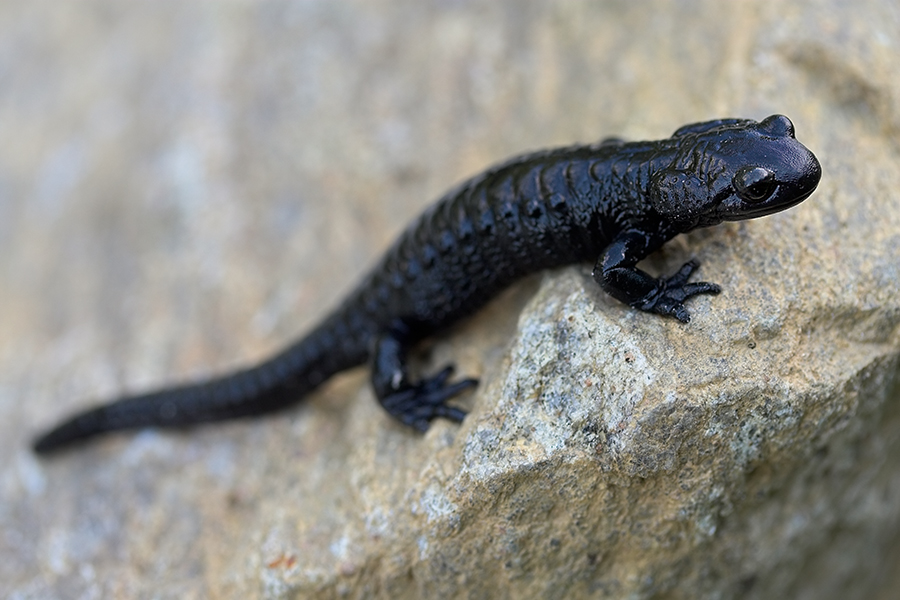 Alpine SalamanderSalamandra atra
Compare
Questions and answers
What is the scientific name of the Pyrenean Brook Salamander?
The scientific name of the Pyrenean Brook Salamander is Calotriton asper. Written with its author, the full name is Calotriton asper (Dugès, 1852).
Which family does the Pyrenean Brook Salamander belong to?
Calotriton asper belongs to the family Salamandridae, in the order Caudata and the class Amphibia.
Where is the Pyrenean Brook Salamander found?
Checklists and occurrence records place Calotriton asper in 3 countries: France, Spain and Andorra.
What is the conservation status of the Pyrenean Brook Salamander?
The IUCN Red List category recorded for Calotriton asper is Least Concern (LC).
What other names does the Pyrenean Brook Salamander have?
Calotriton asper is also known in English as Pyrenean Brook Newt, Pyrenean Mountain Newt, Pyrenean Mountain Salamander, Pyrenean Newt, Pyreneen Salamander and Pyrenees Mountain Newt.
Sources
Passages the profile rests on
- The species has a sturdy body, a flattened head, small eyes, short limbs, and skin covered with small rough tubercles. Source passage: “The body is sturdy with a flattened head and small eyes, and the limbs are short. There are no parotoid glands and the skin is covered with small, rough tubercles.” — English Wikipedia
- Its upper body is usually olive, grey, charcoal, or muddy brown, sometimes with ochre mottling and an intermittent yellowish dorsal stripe. Source passage: “The colour is very variable, the upper side usually being some shade of olive, grey, charcoal, or muddy brown, sometimes mottled with ochre, with an intermittent yellowish stripe down the spine.” — English Wikipedia
- The underside has dark spots along both sides and a central area that is red, orange, or yellow. Source passage: “The underside has a row of dark splotches at either side and the centre is red, orange, or yellow.” — English Wikipedia
- Males have a rounded cloacal swelling, whereas females have a conical one. Source passage: “The male has a rounded cloacal swelling while the female has a conical one.” — English Wikipedia
- Females are usually larger than males. Source passage: “The females are usually larger than the males.” — English Wikipedia
- Adults grow to approximately 16 cm in length. Source passage: “The Pyrenean brook salamander grows to about 16 cm (6.3 in) in length” — English Wikipedia
- Approximately half of the species' total length consists of its laterally flattened tail. Source passage: “half of which is the laterally flattened tail.” — English Wikipedia
- The species usually inhabits slow-moving streams and shallow mountain lakes. Source passage: “It is a mostly aquatic species usually frequenting slow-moving streams and shallow mountain lakes.” — English Wikipedia
- It favours water temperatures below 15 °C and rocky or pebbly bottoms with sparse vegetation. Source passage: “It favours water below 15 °C (59 °F) with scarce vegetation on rocky or pebbly bottoms.” — English Wikipedia
- Some populations live entirely inside caves. Source passage: “Some Pyrenean brook salamanders live entirely inside caves” — English Wikipedia
- The species occurs at elevations between 700 and 2,500 metres. Source passage: “found at altitudes ranging from 700 to 2,500 metres (2,300 to 8,200 ft).” — English Wikipedia
- The species feeds on insects and other slow-moving invertebrates. Source passage: “It feeds on insects and other slow-moving invertebrate prey” — English Wikipedia
- Its larvae are entirely carnivorous. Source passage: “the larvae have external gills and are entirely carnivorous.” — English Wikipedia
- Although infrequently observed, the species is active during both daytime and nighttime. Source passage: “The Pyrenean brook salamander is infrequently seen, though it is active by day, as well as by night.” — English Wikipedia
- The species is mostly aquatic during summer. Source passage: “It is mostly aquatic in summer.” — English Wikipedia
- Individuals sometimes undergo aestivation during hot weather in lower parts of their range. Source passage: “The Pyrenean brook salamander sometimes aestivates in hot weather in the lower parts of its range.” — English Wikipedia
- At higher elevations, individuals hibernate on land during winter and emerge in spring. Source passage: “It hibernates in winter on land at higher altitudes, emerging in the spring.” — English Wikipedia
- Trout prey on this species, which is often scarce where trout are abundant. Source passage: “and is itself eaten by trout, so it is often scarce in locations in which they are abundant.” — English Wikipedia
- The species is sensitive to pesticides in water because they enter through its skin and accumulate in its tissues. Source passage: “It is sensitive to pesticides in the water which are absorbed through the skin and accumulate in the tissues.” — English Wikipedia
- During courtship, males display their brightly coloured underparts before grasping females around the loins with their tails. Source passage: “During courtship, the male displays his brightly coloured underparts before grasping the female around the loins with his tail” — English Wikipedia
- Males transfer between one and four spermatophores directly into the female's cloaca. Source passage: “transferring one to four spermatophores directly into her cloaca” — English Wikipedia
- Copulation and spermatophore transfer can last several hours. Source passage: “in a process that lasts several hours.” — English Wikipedia
- Females lay between 20 and 40 eggs over several weeks. Source passage: “The female lays 20 to 40 eggs over the course of a few weeks” — English Wikipedia
- Females attach their eggs to rocks or inside crevices using their extensible cloacas. Source passage: “sticking them to rocks or inside crevices with her extensible cloaca.” — English Wikipedia
- Eggs hatch after approximately six weeks. Source passage: “The eggs hatch after about six weeks;” — English Wikipedia
- Larvae have external gills. Source passage: “the larvae have external gills” — English Wikipedia
- Larvae may overwinter once or more before undergoing metamorphosis. Source passage: “They may overwinter one or more times before metamorphosis” — English Wikipedia
- Individuals reach sexual maturity at two or more years of age, depending on altitude, with females maturing later. Source passage: “become mature in two or more years, depending on altitude, with the females taking longer.” — English Wikipedia
- Juveniles are dark-coloured and have a thin yellow line along their spines. Source passage: “The juvenile newts are a dark colour with a thin, yellow line along the spine.” — English Wikipedia
- Cave-dwelling populations breed over an extended period of the year. Source passage: “where they breed over a long period of the year due to lack of day length stimulus.” — English Wikipedia
- The IUCN classifies the species as Least Concern. Source passage: “The IUCN lists it as least concern.” — English Wikipedia
- The species was most recently assessed for the IUCN Red List in 2023. Source passage: “Pyrenean Brook Salamander Calotriton asper has most recently been assessed for The IUCN Red List of Threatened Species in 2023.” — iucnredlist.org
Data
- Catalogue of Life, 2026-10-16 XR cc by
- Global Biodiversity Information Facility CC BY 4.0
- Wikidata CC0
- GeoNames CC BY 4.0
- Wikimedia Commons per image; credit shown with each image
- Within the Catalogue of Life, this name comes from The Integrated Taxonomic Information System cc0
This species in other databases
Page built on 27 November 2026. See how the catalog is made and all sources and licences.
Cite this page
ScientificNames.org. (2026). Calotriton asper (Pyrenean Brook Salamander). Retrieved November 27, 2026, from https://scientificnames.org/species/calotriton-asper
“Calotriton asper (Pyrenean Brook Salamander).” ScientificNames.org, 2026, scientificnames.org/species/calotriton-asper. Accessed 27 Nov. 2026.
ScientificNames.org. “Calotriton asper (Pyrenean Brook Salamander).” Accessed November 27, 2026. https://scientificnames.org/species/calotriton-asper.
@misc{scientificnames_calotriton_asper_pyrenean_brook_salamander,
  author = {{ScientificNames.org}},
  title = {Calotriton asper (Pyrenean Brook Salamander)},
  year = {2026},
  url = {https://scientificnames.org/species/calotriton-asper},
  note = {Accessed 2026-11-27}
}