Species · Birds
Magellanic Woodpecker Campephilus magellanicus
The scientific name of the Magellanic Woodpecker is Campephilus magellanicus. It is a species of bird in the family Picidae (woodpecker), order Piciformes. The name dates from 1827.
- Scientific name
- Campephilus magellanicus (P. P. King, 1827)
- Common name
- Magellanic Woodpecker
- Genus
- Campephilus
- Family
- Picidae (Woodpecker)
- Order
- Piciformes
- Class
- Aves
- Red List category
- LC Least Concern
- Recorded in
- 2 countries
- Name status
- accepted in the Catalogue of Life

Overview
Campephilus magellanicus occurs in southern Chile and southwestern Argentina. It specializes in feeding on larvae of wood-boring insects inhabiting beech trees of the genus Nothofagus.
Written 26 November 2026 from the sources listed below. Each statement was checked against the passage it cites; statements that could not be supported were removed.
Appearance
The plumage is predominantly black, with a white wing patch and a grey, chisel-shaped bill. Adult males have a crimson head and crest, while adult females have predominantly black heads with red coloration near the base of the bill.[1][2][3]
Juveniles have smaller crests and browner plumage than adult females.[4]
Adults measure 36–45 cm in length. Adult males weigh 312–369 g, and adult females weigh 276–312 g.[5][6][7]
The wing chord measures 20.5–23 cm, the tail measures 13.9–16.8 cm, the bill measures 4.3–6 cm, and the tarsus measures 3.3–3.9 cm.[8][9][10][11]
Habitat
The Magellanic Woodpecker inhabits mature Nothofagus and Nothofagus-Austrocedrus forests. It is associated with old-growth southern beech forests in southern Chile and adjacent Argentina.[12][13]
Diet
Its principal foods include wood-boring grubs and adult beetles. It specializes in feeding on larvae of wood-boring insects inhabiting beech trees of the genus Nothofagus.[14][15]
Supplementary foods include sap and fruits. It occasionally eats small reptiles, bats, and the eggs and nestlings of passerine birds.[16][17]
Behaviour
The species is resident throughout its geographic range. Individuals spend most of the daytime searching for prey and commonly forage in pairs or small family groups.[18][19][20]
Individuals forage by visiting trees sequentially within forest stands. They preferentially select trees in more advanced stages of decay than nearby available trees and spend longer foraging at trees with larger diameters and more advanced decay.[21][22][23]
Foraging tree selection is influenced by visual information from neighboring trees. Individuals generally forage in live trees but also use fallen or broken dead trees.[24][25]
In spring, individuals search for prey on humid lower tree trunks after snow disappears from the ground. In Tierra del Fuego, they forage on decaying and dead trees around ponds inhabited by introduced American beavers.[26][27]
The species excavates tree cavities that serve as nesting and roosting sites for itself and other cavity-nesting species. It is the sole cavity excavator on Navarino Island.[28][29]
Reproduction and life cycle
Breeding occurs between October and January in the Southern Hemisphere spring and early summer. Breeding pairs are monogamous and share parental duties.[30][31]
Both sexes excavate their nesting cavities in tree trunks. These cavities are typically located 5–15 m above the ground.[32][33]
Females lay between one and four eggs, with most nests containing two. Incubation lasts 15–17 days.[34][35]
Young individuals leave the nest at 45–50 days of age. Adults normally breed every second year.[36][37]
Individuals become sexually mature after approximately two to three years of being raised by and assisting their parents. Successful breeding and pair bonding generally begin at four to five years of age.[38][39]
Conservation
The species is classified as being of least concern in the conservation assessment described in the document. Population reductions have been reported.[40][41]
Forest loss and fragmentation threaten the species in southern South America. Native forest clearance has caused its distribution to contract and become fragmented.[42][43]
The species is protected from hunting in both Chile and Argentina. It is described as endangered or vulnerable in regions of its Chilean distribution.[44][45]
Uses
The cavities excavated by the species provide nesting opportunities for secondary cavity-nesting birds and other animals.[46]
The species is culturally important to indigenous groups and is considered important for ecotourism.[47][48]
Classification of the Magellanic Woodpecker
| Kingdom | Animalia |
|---|---|
| Phylum | Chordata |
| Subphylum | Vertebrata |
| Infraphylum | Gnathostomata |
| Parvphylum | Osteichthyes |
| Megaclass | Tetrapoda |
| Class | Aves (Bird) |
| Order | Piciformes (Woodpeckers) |
| Family | Picidae (Woodpecker) |
| Subfamily | Picinae |
| Genus | Campephilus (Woodpeckers) |
| Species | Campephilus magellanicus (P. P. King, 1827) |
Where the Magellanic Woodpecker is found
Checklists and occurrence records place Campephilus magellanicus in 2 countries across South America. GBIF holds 12,777 georeferenced records of it.
Countries
Regions and cities with the most records
- Tierra del Fuego, Argentina 2,144
- Ushuaia, Argentina 1,806
- Santa Cruz, Argentina 1,507
- Los Lagos Region, Chile 1,303
- Rio Negro, Argentina 1,249
- Araucania, Chile 1,127
- Neuquen, Argentina 820
- Maule Region, Chile 708
- Aysén, Chile 692
- San Carlos de Bariloche, Argentina 552
- Los Ríos Region, Chile 354
- Chubut, Argentina 308
- Ñuble, Chile 289
- El Bolsón, Argentina 225
- Puerto Varas, Chile 185
- San Martín de los Andes, Argentina 182
- Pucón, Chile 155
- Puerto Montt, Chile 149
- Coyhaique, Chile 118
- Llanquihue, Chile 111
- Valdivia, Chile 110
- Punta Arenas, Chile 73
- Puerto Natales, Chile 61
- Biobio, Chile 56
- Ancud, Chile 31
- Castro, Chile 20
- Colbún, Chile 19
- Maullín, Chile 14
- Quellón, Chile 14
- Puerto Aysén, Chile 13
- Esquel, Argentina 10
- Villarrica, Chile 8
- Frutillar, Chile 6
- Coquimbo Region, Chile 5
- El Calafate, Argentina 5
- Molina, Chile 5
Range as the checklists state it
South America
A number beside a place is its count of GBIF occurrence records. A place without a number comes from a checklist alone. Records show where a species has been observed or collected, which can include escapes and vagrants.
Common names
English
- Magellanic Woodpecker
Names in 26 other languages
- Catalan
- picot negre de Magallanes
- Chinese
- 阿根廷啄木, 阿根廷啄木鸟, 麥哲倫啄木鳥
- Croatian
- mageljanska žuna
- Czech
- datel magellanský
- Danish
- Magellanspætte
- Dutch
- Magelhaenspecht
- Esperanto
- Magelana kampefilo, magelana pego
- Estonian
- pöögi-kuningrähn
- Finnish
- chilentulikärki
- French
- Pic de Magellan
- German
- Magellan-Specht, Magellanspecht
- Hungarian
- Magellán-harkály
- Italian
- Picchio di Magellano
- Japanese
- マゼランキツツキ
- Lithuanian
- magelaninis juodasis genys
- Norwegian
- magellanspett
- Polish
- dzięcioł magellański
- Portuguese
- pica-pau-de-magalhães, pica-pau-magalhânico
- Russian
- Магелланов дятел, Магелланов королевский дятел
- Serbian
- Patagonska žuna
- Slovak
- chochlák budum
- Spanish
- Carpintero gigante, Carpintero negro, Picamaderos de Magallanes
- Turkish
- Macellan Ağaçkakanı
- Ukrainian
- дятел-кардинал магеланський
- Welsh
- cnocell Magellan
- arn
- Rere
Synonyms
One other scientific name has been used for this species and is now treated as a synonym of Campephilus magellanicus.
- Picus magellanicus King, PP, 1827
Related species
-
 Ivory-billed WoodpeckerCampephilus principalis
-
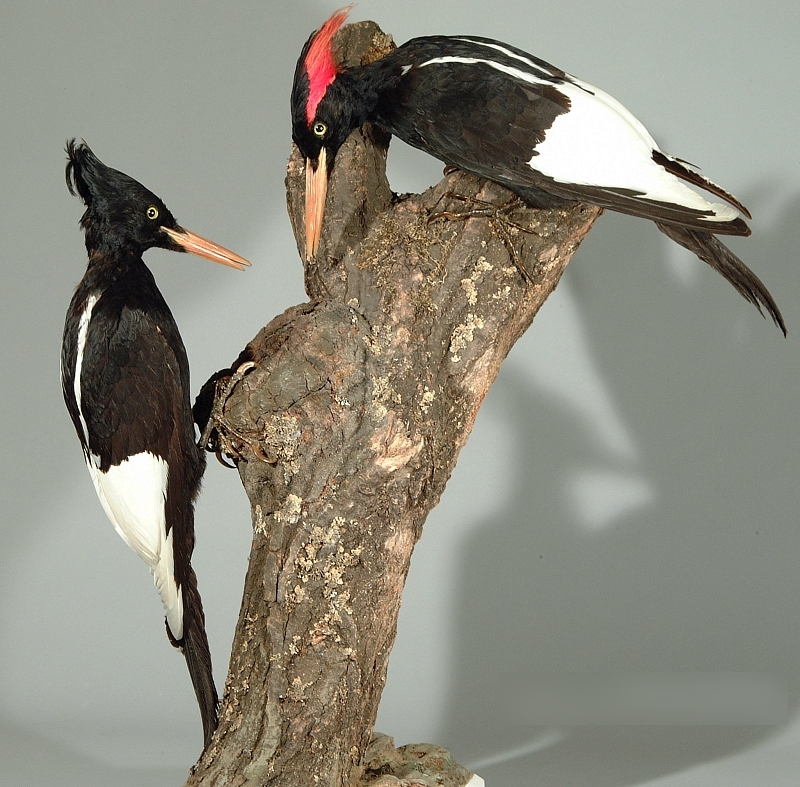 Imperial WoodpeckerCampephilus imperialis
-
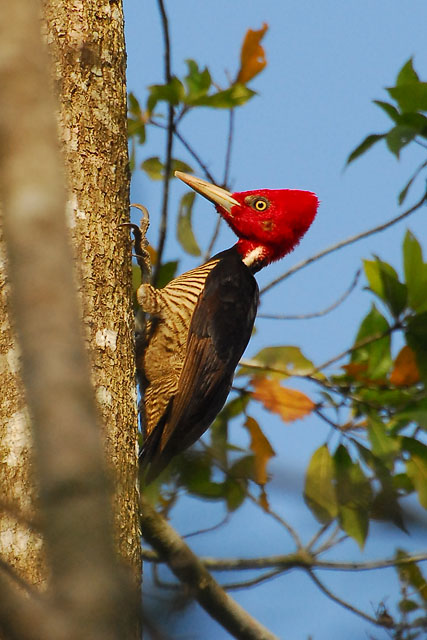 Pale-billed WoodpeckerCampephilus guatemalensis
-
 Crimson-crested WoodpeckerCampephilus melanoleucos
-
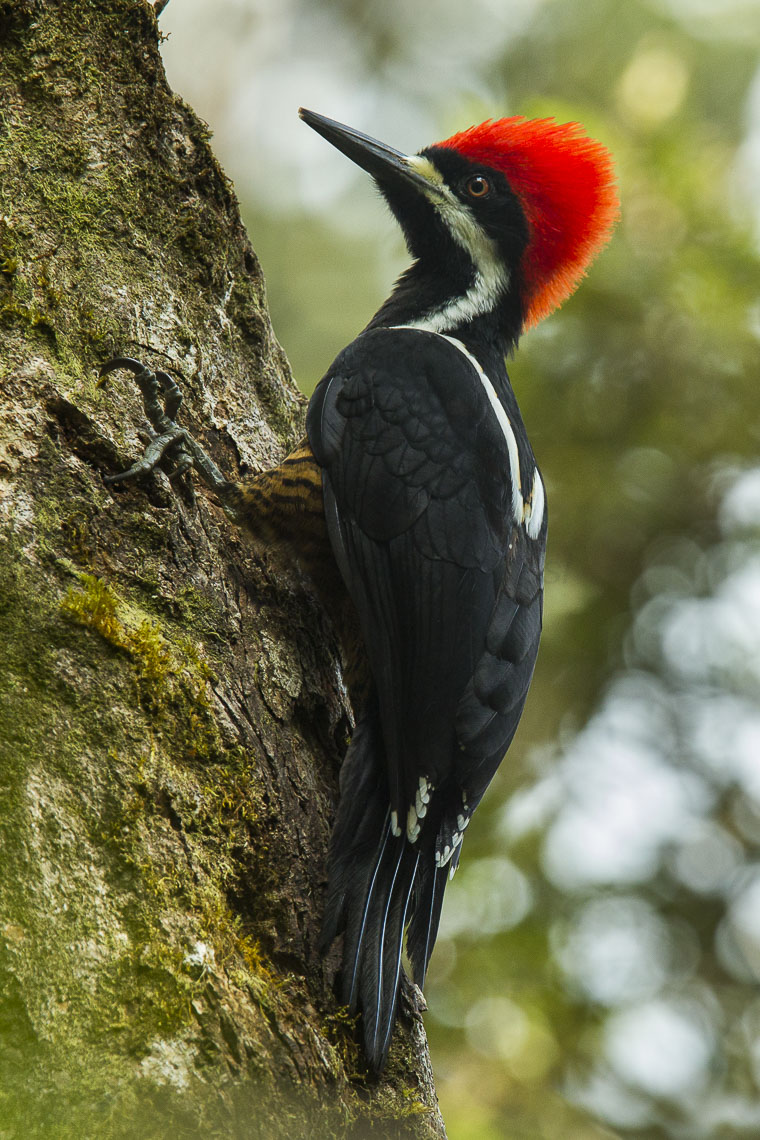 Powerful WoodpeckerCampephilus pollens
-
 Red-necked WoodpeckerCampephilus rubricollis
-
 Cream-backed WoodpeckerCampephilus leucopogon
-
 Crimson-bellied WoodpeckerCampephilus haematogaster
Compare
Questions and answers
What is the scientific name of the Magellanic Woodpecker?
The scientific name of the Magellanic Woodpecker is Campephilus magellanicus. Written with its author, the full name is Campephilus magellanicus (P. P. King, 1827).
Which family does the Magellanic Woodpecker belong to?
Campephilus magellanicus belongs to the family Picidae, in the order Piciformes and the class Aves.
Where is the Magellanic Woodpecker found?
Checklists and occurrence records place Campephilus magellanicus in 2 countries: Chile and Argentina.
What is the conservation status of the Magellanic Woodpecker?
The IUCN Red List category recorded for Campephilus magellanicus is Least Concern (LC).
How big are magellanic woodpeckers?
Adults measure 36–45 cm in length. Adult males weigh 312–369 g, while adult females weigh 276–312 g.[5][6][7]
Sources
Passages the profile rests on
- The plumage is predominantly black, with a white wing patch and a grey, chisel-shaped bill. Source passage: “This species is mainly pure black, with a white wing patch and a grey, chisel-like beak.” — English Wikipedia
- Adult males have a crimson head and crest. Source passage: “Males have a crimson head and crest.” — English Wikipedia
- Adult females have predominantly black heads with red coloration near the base of the bill. Source passage: “Females have a mainly black head, but an area of red coloration occurs near the base of the bill.” — English Wikipedia
- Juveniles have smaller crests and browner plumage than adult females. Source passage: “Juvenile Magellanic woodpeckers resemble females of the species, but have a smaller crest and have a browner tinge to their plumage.” — English Wikipedia
- Adults measure 36–45 cm in length. Source passage: “The Magellanic woodpecker is 36 to 45 cm (14 to 18 in) in length.” — English Wikipedia
- Adult males weigh 312–369 g. Source passage: “Males of this species weigh 312–369 g (11.0–13.0 oz)” — English Wikipedia
- Adult females weigh 276–312 g. Source passage: “females weigh 276–312 g (9.7–11.0 oz).” — English Wikipedia
- The wing chord measures 20.5–23 cm. Source passage: “the wing chord is 20.5 to 23 cm (8.1 to 9.1 in)” — English Wikipedia
- The tail measures 13.9–16.8 cm. Source passage: “the tail is 13.9 to 16.8 cm (5.5 to 6.6 in)” — English Wikipedia
- The bill measures 4.3–6 cm. Source passage: “the bill is 4.3 to 6 cm (1.7 to 2.4 in)” — English Wikipedia
- The tarsus measures 3.3–3.9 cm. Source passage: “the tarsus is 3.3 to 3.9 cm (1.3 to 1.5 in).” — English Wikipedia
- The species inhabits mature Nothofagus and Nothofagus-Austrocedrus forests. Source passage: “Magellanic woodpeckers inhabit mature Nothofagus and Nothofagus-Austrocedrus forests” — English Wikipedia
- The species is associated with old-growth southern beech forests in southern Chile and adjacent Argentina. Source passage: “The Magellanic Woodpecker is endemic to old-growth southern beech (Nothofagus spp.) forests of southern Chile and adjacent Argentina.” — chile.unt.edu
- Its principal foods include wood-boring grubs and adult beetles. Source passage: “they feed mainly on wood-boring grubs and adult beetles (Coleoptera)” — English Wikipedia
- The species specializes in feeding on larvae of wood-boring insects inhabiting beech trees of the genus Nothofagus. Source passage: “Magellanic woodpeckers are specialized to feed on larvae of wood-boring insects that live and promote decay in the bole or branches of beech trees (i.e., belonging to the Nothofagus genus)” — pmc.ncbi.nlm.nih.gov
- Supplementary foods include sap and fruits. Source passage: “including sap and fruits” — English Wikipedia
- The species occasionally eats small reptiles, bats, and the eggs and nestlings of passerine birds. Source passage: “as well as small reptiles, bats, and the eggs and nestlings of passerines.” — English Wikipedia
- The species is resident throughout its geographic range. Source passage: “it is resident within its range.” — English Wikipedia
- The species commonly forages in pairs or small family groups. Source passage: “These woodpeckers commonly feed in pairs or small family groups” — English Wikipedia
- Individuals spend most of the daytime searching for prey. Source passage: “they spend most of the daytime looking for prey.” — English Wikipedia
- Individuals forage by visiting trees sequentially within forest stands. Source passage: “Magellanic woodpeckers forage by sequentially visiting trees within forest stands” — pmc.ncbi.nlm.nih.gov
- Individuals preferentially select trees in more advanced stages of decay than nearby available trees. Source passage: “Woodpeckers selected trees with a later decay stage than available trees.” — pmc.ncbi.nlm.nih.gov
- Individuals spend longer foraging at trees with larger diameters and more advanced decay than other available trees. Source passage: “woodpeckers spent more time at trees with larger diameters and in a more advanced stage of decay than trees available along their routes.” — pmc.ncbi.nlm.nih.gov
- Foraging tree selection is influenced by visual information from neighboring trees. Source passage: “thus suggesting that woodpeckers use visual cues from neighboring trees.” — pmc.ncbi.nlm.nih.gov
- Individuals generally forage in live trees but also use fallen or broken dead trees. Source passage: “They generally use live trees, but also feed on dead substrates such as fallen or broken trees lying on the ground” — English Wikipedia
- In spring, individuals search for prey on humid lower tree trunks after snow disappears from the ground. Source passage: “Once the snow disappears from the ground in spring, Magellanic woodpeckers look for prey on humid lower tree trunks.” — English Wikipedia
- In Tierra del Fuego, individuals forage on decaying and dead trees around ponds inhabited by introduced American beavers. Source passage: “In Tierra del Fuego, Magellanic woodpeckers forage on decaying and dead trees around ponds hosting the introduced American beaver (Castor canadensis).” — English Wikipedia
- The species excavates tree cavities that serve as nesting and roosting sites for itself and other cavity-nesting species. Source passage: “Magellanic Woodpeckers excavate cavities in trees, which provide nest and roost sites for themselves and secondary cavity-nesters that are unable to excavate their own cavities.” — chile.unt.edu
- The species is identified as the sole cavity excavator on Navarino Island. Source passage: “the Magellanic Woodpecker is the sole cavity excavator on the island.” — chile.unt.edu
- Breeding occurs between October and January in the Southern Hemisphere spring and early summer. Source passage: “The Magellanic woodpecker breeds in the Southern Hemisphere's springtime, from October to January.” — English Wikipedia
- Breeding pairs are monogamous and share parental duties. Source passage: “The monogamous-breeding parents share all duties in nest excavation, incubation, territorial- and predator-defense, and young rearing.” — English Wikipedia
- Both sexes excavate their nesting cavities in tree trunks. Source passage: “Both sexes cooperate in excavating the nest in a tree trunk.” — English Wikipedia
- Nesting cavities are typically located 5–15 m above the ground. Source passage: “The nest cavity typically is from 5–15 m (16–49 ft) above the ground.” — English Wikipedia
- Females lay between one and four eggs, with most nests containing two. Source passage: “Females lay from one to four eggs, with a great majority of nests containing two eggs.” — English Wikipedia
- Incubation lasts 15–17 days. Source passage: “Incubation lasts for 15 to 17 days” — English Wikipedia
- Adults normally breed every second year. Source passage: “Adults normally breed every second year” — English Wikipedia
- Young individuals leave the nest at 45–50 days of age. Source passage: “The young fledge at 45 to 50 days.” — English Wikipedia
- Individuals become sexually mature after approximately two to three years of being raised by and assisting their parents. Source passage: “After 2-3 years of being raised by and then assisting their parents, the young Magellanic woodpeckers become sexually mature.” — English Wikipedia
- Successful breeding and pair bonding generally begin at four to five years of age. Source passage: “Successful breeding and pair bonds, however, do not usually occur until 4 to 5 years of age.” — English Wikipedia
- The species is classified as being of least concern in the conservation assessment described in the document. Source passage: “Currently, the species is listed as of least concern” — English Wikipedia
- Population reductions have been reported. Source passage: “but population reductions have been reported.” — English Wikipedia
- Forest loss and fragmentation threaten the species in southern South America. Source passage: “Forest loss and fragmentation are affecting the temperate forests of southern South America at an increasing rate, so these practices also represent a threat for the Magellanic woodpecker.” — English Wikipedia
- Native forest clearance has caused the species' distribution to contract and become fragmented. Source passage: “The distribution of the species has contracted and was fragmented as a consequence of native forest clearance” — English Wikipedia
- The species is protected from hunting in both Chile and Argentina. Source passage: “The species is protected from hunting in both Chile and Argentina” — English Wikipedia
- The species is described as endangered or vulnerable in regions of its Chilean distribution. Source passage: “listed as Endangered or Vulnerable throughout regions of its Chilean distribution” — chile.unt.edu
- The cavities excavated by this species provide nesting opportunities for secondary cavity-nesting birds and other animals. Source passage: “which provide nest and roost sites for themselves and secondary cavity-nesters that are unable to excavate their own cavities.” — chile.unt.edu
- The species is described as culturally important to indigenous groups. Source passage: “and culturally important to indigenous groups.” — chile.unt.edu
- The species is considered important for ecotourism. Source passage: “this woodpecker is considered a charismatic species, is central for ecotourism” — chile.unt.edu
Data
- Catalogue of Life, 2026-10-16 XR cc by
- Global Biodiversity Information Facility CC BY 4.0
- Wikidata CC0
- GeoNames CC BY 4.0
- Wikimedia Commons per image; credit shown with each image
- iNaturalist per image; credit shown with each image
- Within the Catalogue of Life, this name comes from The Integrated Taxonomic Information System cc0
References
- Gill, Frank, & and Minturn Wright. (2006). Birds of the World: Recommended English Names.
This species in other databases
Page built on 26 November 2026. See how the catalog is made and all sources and licences.
Cite this page
ScientificNames.org. (2026). Campephilus magellanicus (Magellanic Woodpecker). Retrieved November 26, 2026, from https://scientificnames.org/species/campephilus-magellanicus
“Campephilus magellanicus (Magellanic Woodpecker).” ScientificNames.org, 2026, scientificnames.org/species/campephilus-magellanicus. Accessed 26 Nov. 2026.
ScientificNames.org. “Campephilus magellanicus (Magellanic Woodpecker).” Accessed November 26, 2026. https://scientificnames.org/species/campephilus-magellanicus.
@misc{scientificnames_campephilus_magellanicus_magellanic_woodpecker,
  author = {{ScientificNames.org}},
  title = {Campephilus magellanicus (Magellanic Woodpecker)},
  year = {2026},
  url = {https://scientificnames.org/species/campephilus-magellanicus},
  note = {Accessed 2026-11-26}
}