Species · Birds
Powerful Woodpecker Campephilus pollens
The scientific name of the Powerful Woodpecker is Campephilus pollens. It is a species of bird in the family Picidae (woodpecker), order Piciformes. The name dates from 1845.
- Scientific name
- Campephilus pollens (Bonaparte, 1845)
- Common name
- Powerful Woodpecker
- Genus
- Campephilus
- Family
- Picidae (Woodpecker)
- Order
- Piciformes
- Class
- Aves
- Red List category
- LC Least Concern
- Recorded in
- 4 countries
- Name status
- accepted in the Catalogue of Life
Overview
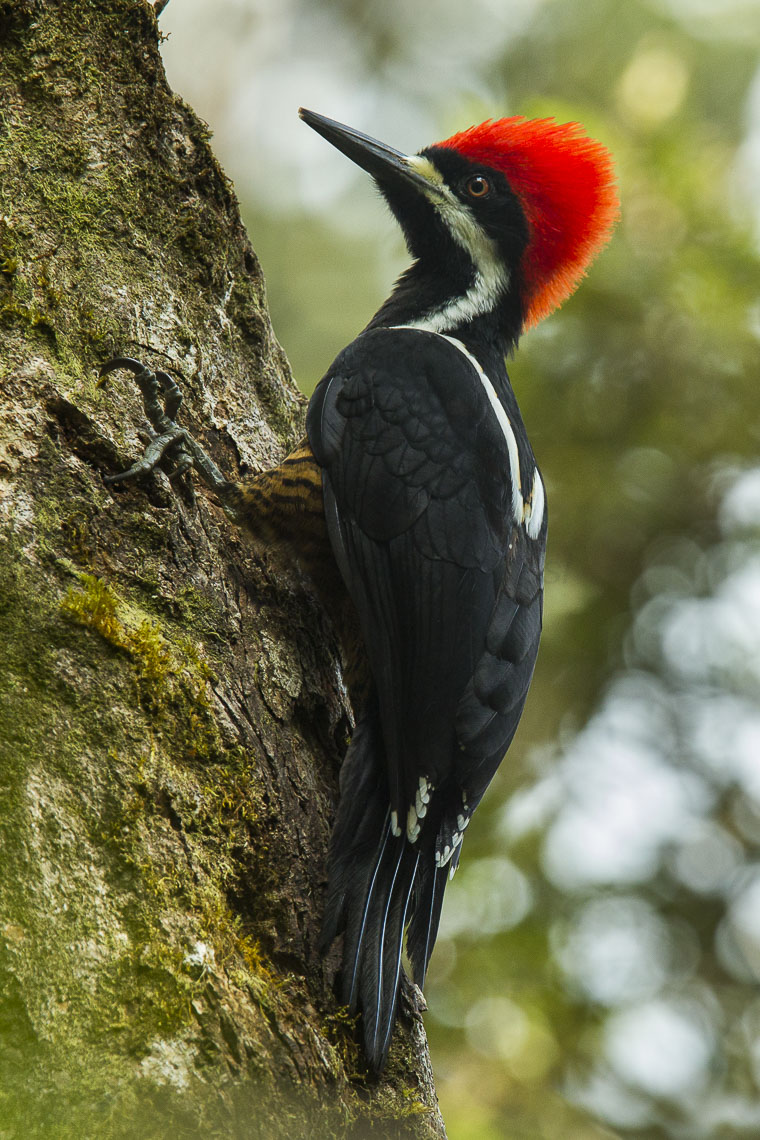
Campephilus pollens occurs in Colombia, Ecuador, Peru, and Venezuela. It measures approximately 32 cm in length and has a long, black, chisel-shaped bill.
Written 26 November 2026 from the sources listed below. Each statement was checked against the passage it cites; statements that could not be supported were removed.
Conservation
The Powerful Woodpecker is classified as Least Concern by the IUCN. Its population size is unknown and is believed to be decreasing.[1][2]
No immediate threats have been identified. The species is considered rare to local throughout its geographical range and occurs in a few protected areas.[3][4][5]
Appearance
Adult male Powerful Woodpeckers have red feathers extending from the forehead to the crest, whereas females have black feathers in these areas. Both sexes of the nominate subspecies have black and white facial plumage, including the throat.[6][7]
The nominate subspecies has a broad white facial band extending from the lores below the rear of the ear coverts and down the side of the neck. Its hindneck, mantle, scapulars, and upper back are black with narrow white stripes on both sides.[8][9]
The nominate subspecies has a white lower back and rump and black uppertail coverts. The upper surfaces of the wings are black, with white tips on the primary feathers and white spots or bars on some secondary feathers.[10][11]
The undersides of the wings are blackish with white bars. The center of the breast is black, while the remaining underparts are cinnamon-buff with black bars or chevrons.[12][13]
The Powerful Woodpecker has a long, black, chisel-shaped bill, a white or pinkish white iris, and dark gray legs.[14][15][16]
Juveniles are duller and browner than adults, with more numerous bars on their upperparts and wider bars on their underparts.[17]
The subspecies peruvianus has a cinnamon-buff lower back and rump, which often bear black bars. It often has cinnamon-buff bars on its black uppertail coverts.[18][19]
Habitat
The Powerful Woodpecker primarily inhabits the interior and edges of mature montane forests, humid and wet forests, and cloudforests. It also occurs in secondary forests and other more open forest habitats.[20][21]
The species occurs at elevations between 900 and 3,750 m and is found most frequently between 1,700 and 2,600 m.[22][23]
Behaviour
The Powerful Woodpecker remains in its range throughout the year. It forages at all levels of the forest interior, frequently in pairs.[24][25]
Its most common call is a nasal sound described as 'kyaaah' or 'peeyáw', which is often repeated. It produces a rapid 'kikikikikawh' call while flying.[26][27]
When excited, the Powerful Woodpecker produces a descending 'kikikiki-keh-keh-kah-kah' call. Its drumming consists of a brief double tap.[28][29]
Reproduction and life cycle
The breeding season of the Powerful Woodpecker is believed to extend from April through August. Described nests were located in dead tree trunks.[30][31]
One documented nest contained two eggs, while another contained a single nestling. Both parents apparently participated in incubating the eggs.[32][33][34]
The incubation period in one documented nest lasted at least 16 days. Young Powerful Woodpeckers fledged 34 to 37 days after hatching in one documented nest.[35][36]
Classification of the Powerful Woodpecker
| Kingdom | Animalia |
|---|---|
| Phylum | Chordata |
| Subphylum | Vertebrata |
| Infraphylum | Gnathostomata |
| Parvphylum | Osteichthyes |
| Megaclass | Tetrapoda |
| Class | Aves (Bird) |
| Order | Piciformes (Woodpeckers) |
| Family | Picidae (Woodpecker) |
| Subfamily | Picinae |
| Genus | Campephilus (Woodpeckers) |
| Species | Campephilus pollens (Bonaparte, 1845) |
Where the Powerful Woodpecker is found
Checklists and occurrence records place Campephilus pollens in 4 countries across South America. GBIF holds 11,357 georeferenced records of it.
Countries
Regions and cities with the most records
- Pichincha, Ecuador 4,142
- Caldas Department, Colombia 1,663
- Napo, Ecuador 1,607
- Villamaría, Colombia 1,522
- Manizales, Colombia 1,519
- Neira, Colombia 1,234
- Antioquia, Colombia 663
- Risaralda Department, Colombia 466
- Cundinamarca, Colombia 320
- Riosucio, Colombia 306
- Andes, Colombia 297
- Supía, Colombia 281
- Tolima Department, Colombia 279
- Chinchiná, Colombia 277
- Quindío Department, Colombia 269
- Circasia, Colombia 229
- Santa Rosa de Cabal, Colombia 192
- Valle del Cauca Department, Colombia 169
- Envigado, Colombia 166
- Medellín, Colombia 165
- Huila Department, Colombia 164
- Itagüí, Colombia 164
- Anaime, Colombia 147
- Cauca Department, Colombia 147
- Dosquebradas, Colombia 146
- La Estrella, Colombia 133
- Santander Department, Colombia 128
- Zamora Chinchipe, Ecuador 123
- Pereira, Colombia 122
- Nariño, Colombia 116
- Bello, Colombia 109
- Copacabana, Colombia 100
- Calarcá, Colombia 99
- Pomasqui, Ecuador 99
- Quito, Ecuador 99
- Amazonas, Peru 91
Range as the checklists state it
South America
A number beside a place is its count of GBIF occurrence records. A place without a number comes from a checklist alone. Records show where a species has been observed or collected, which can include escapes and vagrants.
Common names
English
- Powerful Woodpecker
Names in 24 other languages
- Catalan
- picot negre emplomallat
- Chinese
- 強力啄木, 红冠颈纹啄木鸟
- Croatian
- planinska žuna
- Czech
- datel bělohřbetý, datel horský
- Danish
- Hvidgumpet Spætte
- Dutch
- Bruingebandeerde Specht
- Esperanto
- potenca pego
- Estonian
- mägi-kuningrähn
- Finnish
- andientulikärki
- French
- Pic puissant
- German
- Zimtbindenspecht
- Italian
- Picchio possente
- Japanese
- クロビタイエボシゲラ
- Lithuanian
- rudadryžis juodasis genys
- Polish
- dzięcioł białowstęgi
- Portuguese
- pica-pau-poderoso
- Russian
- Коричневополосый королевский дятел, Коричневополосый флеоцеастес, Рыжеполосый дятел
- Serbian
- Velika andska žuna
- Slovak
- chochlák bielochrbtý
- Spanish
- Picamaderos poderoso
- Swedish
- inkaspett
- Turkish
- Güçlü Ağaçkakan
- Ukrainian
- дятел-кардинал білощокий
- Welsh
- cnocell nerthol
Synonyms
2 other scientific names have been used for this species and are now treated as synonyms of Campephilus pollens.
- Phloeoceastes pollens Bonaparte, CLJL, 1845
- Picus pollens Bonaparte, CLJL, 1845
Subspecies and varieties
- Campephilus pollens peruvianus subspecies
- Campephilus pollens pollens subspecies
Related species
-
 Ivory-billed WoodpeckerCampephilus principalis
-
 Imperial WoodpeckerCampephilus imperialis
-
 Magellanic WoodpeckerCampephilus magellanicus
-
 Pale-billed WoodpeckerCampephilus guatemalensis
-
 Crimson-crested WoodpeckerCampephilus melanoleucos
-
 Red-necked WoodpeckerCampephilus rubricollis
-
 Cream-backed WoodpeckerCampephilus leucopogon
-
 Crimson-bellied WoodpeckerCampephilus haematogaster
Compare
Questions and answers
What is the scientific name of the Powerful Woodpecker?
The scientific name of the Powerful Woodpecker is Campephilus pollens. Written with its author, the full name is Campephilus pollens (Bonaparte, 1845).
Which family does the Powerful Woodpecker belong to?
Campephilus pollens belongs to the family Picidae, in the order Piciformes and the class Aves.
Where is the Powerful Woodpecker found?
Checklists and occurrence records place Campephilus pollens in 4 countries: Ecuador, Colombia, Peru and Venezuela.
What is the conservation status of the Powerful Woodpecker?
The IUCN Red List category recorded for Campephilus pollens is Least Concern (LC).
Sources
Passages the profile rests on
- The Powerful Woodpecker is classified as Least Concern by the IUCN. Source passage: “The IUCN has assessed the powerful woodpecker as being of Least Concern.” — English Wikipedia
- The population size of the Powerful Woodpecker is unknown and is believed to be decreasing. Source passage: “but its population size is not known and is believed to be decreasing.” — English Wikipedia
- No immediate threats to the Powerful Woodpecker have been identified. Source passage: “No immediate threats have been identified.” — English Wikipedia
- The Powerful Woodpecker is considered rare to local throughout its geographical range. Source passage: “It is considered rare to local throughout its range” — English Wikipedia
- The species occurs in a few protected areas. Source passage: “and occurs in a few protected areas.” — English Wikipedia
- Adult male Powerful Woodpeckers have red feathers extending from the forehead to the crest, whereas females have black feathers in these areas. Source passage: “Adult males are red from their forehead to their crest; females are black there.” — English Wikipedia
- Both sexes of the nominate subspecies have black and white facial plumage, including the throat. Source passage: “Both sexes of the nominate subspecies have a black and white face including the throat;” — English Wikipedia
- The nominate subspecies has a broad white facial band extending from the lores below the rear of the ear coverts and down the side of the neck. Source passage: “the white is a wide band from the lores to below the rear of the ear coverts and from there down the side of the neck.” — English Wikipedia
- The nominate subspecies has a black hindneck, mantle, scapulars, and upper back with narrow white stripes on both sides. Source passage: “Both sexes have a black hindneck, mantle, scapulars, and upper back with narrow white stripes on either side.” — English Wikipedia
- The nominate subspecies has a white lower back and rump and black uppertail coverts. Source passage: “Their lower back and rump are white and their uppertail coverts black.” — English Wikipedia
- The upper surfaces of the wings are black, with white tips on the primary feathers and white spots or bars on some secondary feathers. Source passage: “Their wings' top surface is black with white tips on the primaries and some white spots or bars on the secondaries.” — English Wikipedia
- The undersides of the wings are blackish with white bars. Source passage: “Their wings' undersides are blackish with white bars.” — English Wikipedia
- The center of the breast is black, while the remaining underparts are cinnamon-buff with black bars or chevrons. Source passage: “The center of their breast is black and the rest of their underparts are cinnamon-buff with black bars or chevrons.” — English Wikipedia
- The Powerful Woodpecker has a long, black, chisel-shaped bill. Source passage: “Their bill is a long black chisel,” — English Wikipedia
- Its iris is white or pinkish white. Source passage: “their iris white or pinkish white,” — English Wikipedia
- Its legs are dark gray. Source passage: “and their legs dark gray.” — English Wikipedia
- Juveniles are duller and browner than adults and have more numerous bars on their upperparts and wider bars on their underparts. Source passage: “Juveniles resemble adults but are duller and browner with more bars on their upperparts and wider ones on their underparts.” — English Wikipedia
- The subspecies peruvianus has a cinnamon-buff lower back and rump, which often bear black bars. Source passage: “Subspecies P. c. peruvianus differs from the nominate with a cinnamon-buff lower back and rump, often with black bars,” — English Wikipedia
- The subspecies peruvianus often has cinnamon-buff bars on its black uppertail coverts. Source passage: “and also often cinnamon-buff bars on the black uppertail coverts.” — English Wikipedia
- The Powerful Woodpecker primarily inhabits the interior and edges of mature montane forests, humid and wet forests, and cloudforests. Source passage: “The species mostly inhabits the interior and edges of mature montane forest, humid and wet forest, and cloudforest.” — English Wikipedia
- The species also occurs in secondary forests and other more open forest habitats. Source passage: “It also occurs in secondary forest and other more open forest.” — English Wikipedia
- The Powerful Woodpecker occurs at elevations between 900 and 3,750 m. Source passage: “In elevation it ranges from 900 to 3,750 m (3,000 to 12,300 ft)” — English Wikipedia
- The species is found most frequently at elevations between 1,700 and 2,600 m. Source passage: “but is found mostly between 1,700 to 2,600 m (5,600 to 8,500 ft).” — English Wikipedia
- The Powerful Woodpecker remains in its range throughout the year. Source passage: “The powerful woodpecker is a year-round resident throughout its range.” — English Wikipedia
- The Powerful Woodpecker forages at all levels of the forest interior, frequently in pairs. Source passage: “The powerful woodpecker forages at all levels of the forest interior, often in pairs.” — English Wikipedia
- The most common call of the Powerful Woodpecker is a nasal sound described as 'kyaaah' or 'peeyáw', which is often repeated. Source passage: “The powerful woodpecker's most common call is a "nasal 'kyaaah' or 'peeyáw', often repeated".” — English Wikipedia
- The Powerful Woodpecker produces a rapid 'kikikikikawh' call while flying. Source passage: “It also makes a "fast 'kikikikikawh'" in flight” — English Wikipedia
- When excited, the Powerful Woodpecker produces a descending 'kikikiki-keh-keh-kah-kah' call. Source passage: “and a "descending 'kikikiki-keh-keh-kah-kah'" when excited.” — English Wikipedia
- The Powerful Woodpecker's drumming consists of a brief double tap. Source passage: “Its drum is "a brief double tap".” — English Wikipedia
- The breeding season of the Powerful Woodpecker is believed to extend from April through August. Source passage: “The powerful woodpecker's breeding season is believed to be from April to August.” — English Wikipedia
- The described nests of the Powerful Woodpecker were located in dead tree trunks. Source passage: “The only fully described nests were in dead tree trunks.” — English Wikipedia
- One documented nest of the Powerful Woodpecker contained two eggs. Source passage: “One nest had two eggs” — English Wikipedia
- Another documented nest contained a single nestling. Source passage: “and the other a single nestling.” — English Wikipedia
- Both parents apparently participated in incubating the eggs. Source passage: “It appears that both parents incubated the eggs.” — English Wikipedia
- The incubation period in one documented nest lasted at least 16 days. Source passage: “At the first nest the incubation period was at least 16 days” — English Wikipedia
- Young Powerful Woodpeckers fledged 34 to 37 days after hatching in one documented nest. Source passage: “and fledging occurred 34 to 37 days after hatch.” — English Wikipedia
Data
- Catalogue of Life, 2026-10-16 XR cc by
- Global Biodiversity Information Facility CC BY 4.0
- Wikidata CC0
- GeoNames CC BY 4.0
- Wikimedia Commons per image; credit shown with each image
- Within the Catalogue of Life, this name comes from The Integrated Taxonomic Information System cc0
References
- Gill, Frank, & and Minturn Wright. (2006). Birds of the World: Recommended English Names.
This species in other databases
Page built on 27 November 2026. See how the catalog is made and all sources and licences.
Cite this page
ScientificNames.org. (2026). Campephilus pollens (Powerful Woodpecker). Retrieved November 27, 2026, from https://scientificnames.org/species/campephilus-pollens
“Campephilus pollens (Powerful Woodpecker).” ScientificNames.org, 2026, scientificnames.org/species/campephilus-pollens. Accessed 27 Nov. 2026.
ScientificNames.org. “Campephilus pollens (Powerful Woodpecker).” Accessed November 27, 2026. https://scientificnames.org/species/campephilus-pollens.
@misc{scientificnames_campephilus_pollens_powerful_woodpecker,
  author = {{ScientificNames.org}},
  title = {Campephilus pollens (Powerful Woodpecker)},
  year = {2026},
  url = {https://scientificnames.org/species/campephilus-pollens},
  note = {Accessed 2026-11-27}
}