Species · Birds
Savanna Nightjar Caprimulgus affinis
The scientific name of the Savanna Nightjar is Caprimulgus affinis. It is a species of bird in the family Caprimulgidae (nightjar), order Caprimulgiformes. The name dates from 1821.
- Scientific name
- Caprimulgus affinis Horsfield, 1821
- Common name
- Savanna Nightjar
- Genus
- Caprimulgus
- Family
- Caprimulgidae (Nightjar)
- Order
- Caprimulgiformes
- Class
- Aves
- Red List category
- LC Least Concern
- Recorded in
- 20 countries
- Name status
- accepted in the Catalogue of Life

Overview
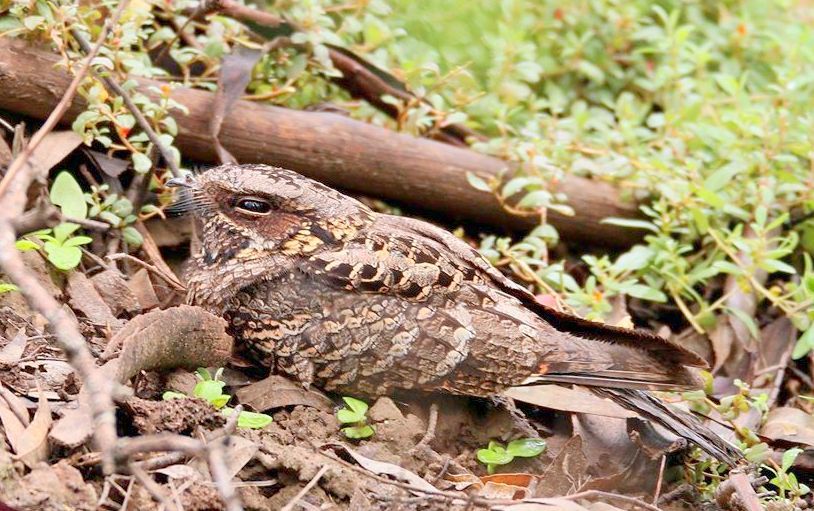
The Savanna Nightjar (Caprimulgus affinis Horsfield, 1821) is a bird in the family Caprimulgidae, order Caprimulgiformes and class Aves. The species occurs in South and Southeast Asia, with a range extending from northern Pakistan to Indonesia. It has vermiculated grey-brown plumage, and males have white patches on their throat, tail and wings.
Written 26 November 2026 from the sources listed below. Each statement was checked against the passage it cites; statements that could not be supported were removed.
Appearance
Males have white patches on their throat, tail and wings. Females have subtle throat patches, reddish-tinted feathers and no white tail patches.[1][2]
Juvenile and immature birds resemble adult females and lack white patches. The species measures 20–26 cm in body length, weighs between 54 and 110 g and has a wingspan of 64 cm.[3][4][5][6]
Habitat
The Savanna Nightjar inhabits lowland open grasslands in parts of its range. It also occupies sugar cane plantations and rocky soils around rivers and streams.[7][8][9]
Urban populations in Indonesia and Taiwan use the roofs of tall buildings as nesting sites. Urbanised birds prefer flat roofs.[10][11]
The species occurs in South and Southeast Asia and is widely distributed in China, Pakistan, India, Indonesia and Taiwan. Its range extends from northern Pakistan to Indonesia.[12][13][14]
The northern subspecies C. a. monticolus migrates through the Punjab plains to northeastern Pakistan for summer breeding.[15]
Diet
The Savanna Nightjar is insectivorous. Moths account for approximately 80–85% of its food composition.[16][17]
Its other food includes beetles, ants, grasshoppers, crickets, wasps and bees.[18]
Behaviour
The Savanna Nightjar is most active in feeding between dusk and dawn. It hunts insects by capturing them in flight through a technique called sallying.[19][20]
The species vocalises from early dusk until dawn, both while flying and while perched on the ground, in low vegetation or on urban structures. Its characteristic chwip call is used for territorial marking and attracting females.[21][22][23]
Female Savanna Nightjars emit soft squeaks during brooding. Parents feign injury to divert predators from their eggs and young.[24][25]
Reproduction and life cycle
Western populations breed between March and August, while eastern populations breed between March and January.[26][27]
Savanna Nightjars lay their eggs directly on the ground without constructing nests. They lay one or two pale pink eggs with blotches.[28][29]
Females incubate the eggs while males guard the nest. Chicks become active and mobile four days after hatching.[30][31]
Conservation
The Savanna Nightjar is classified as Least Concern on the IUCN Red List. Its population trend is stable.[32][33]
The extent of occurrence of the species as a resident or breeding bird is 20,100,000 km². Eight subspecies are recognised, and its IUCN Red List assessment was most recently conducted in 2024.[34][35][36]
Classification of the Savanna Nightjar
| Kingdom | Animalia |
|---|---|
| Phylum | Chordata |
| Subphylum | Vertebrata |
| Infraphylum | Gnathostomata |
| Parvphylum | Osteichthyes |
| Megaclass | Tetrapoda |
| Class | Aves (Bird) |
| Order | Caprimulgiformes (Nightjar) |
| Family | Caprimulgidae (Nightjar) |
| Genus | Caprimulgus (Nightjars) |
| Species | Caprimulgus affinis Horsfield, 1821 |
Where the Savanna Nightjar is found
Checklists and occurrence records place Caprimulgus affinis in 20 countries across Asia. GBIF holds 65,978 georeferenced records of it.
Countries
- Bangladesh 9
- Bhutan 39
- Cambodia 487
- China 270
- Hong Kong 988
- India 12,856
- Indonesia 4,673
- Iran 6
- Japan 3
- Laos 16
- Macao 6
- Malaysia 919
- Myanmar 27
- Nepal 228
- Pakistan 51
- Philippines 679
- Singapore 1,587
- Taiwan 42,294
- Thailand 778
- Vietnam 62
Regions and cities with the most records
- Taiwan, Taiwan 24,466
- Taichung, Taiwan 6,500
- Nantou, Taiwan 6,465
- Chang-hua, Taiwan 6,088
- Linnei, Taiwan 6,001
- Changhua, Taiwan 5,958
- Buzi, Taiwan 5,923
- Wufeng, Taiwan 5,847
- Yuanlin, Taiwan 5,739
- Zhongxing New Village, Taiwan 5,263
- Caotun, Taiwan 5,207
- Citong, Taiwan 5,134
- Douliu, Taiwan 5,041
- Tianzhong, Taiwan 4,914
- Xiluo, Taiwan 4,761
- Xizhou, Taiwan 4,723
- Beidou, Taiwan 4,643
- Yongjing, Taiwan 4,523
- Shetou, Taiwan 4,435
- Erlun, Taiwan 4,412
- Taibao, Taiwan 4,386
- Xihu, Taiwan 4,309
- Yongkang, Taiwan 4,203
- Tianwei, Taiwan 4,113
- Chiayi City, Taiwan 3,978
- Pitou, Taiwan 3,885
- Xingang, Taiwan 3,803
- Tainan, Taiwan 3,784
- Zhushan, Taiwan 3,524
- Chaozhou, Taiwan 3,496
- New Taipei City, Taiwan 3,471
- Banqiao, Taiwan 3,453
- Erlin, Taiwan 3,399
- Madhya Pradesh, India 3,233
- Shulin, Taiwan 3,114
- Taipei, Taiwan 2,823
1 more country has a few records outside this range
These countries hold a few records of Caprimulgus affinis but lie outside the range the checklists give for it. Such records are often zoo or garden specimens, museum material or vagrants, so the species is not counted as occurring there.
Range as the checklists state it
Southern Asia
A number beside a place is its count of GBIF occurrence records. A place without a number comes from a checklist alone. Records show where a species has been observed or collected, which can include escapes and vagrants.
Common names
English
- Savanna Nightjar
Names in 30 other languages
- Arabic
- سبد سافاني
- Catalan
- enganyapastors de sabana
- Chinese
- 南亞夜鷹, 南亞夜鷹〔林夜鷹〕, 林夜鷹, 林夜鹰, 臺灣夜鷹
- Croatian
- travnjački leganj
- Czech
- lelek savanový
- Danish
- Savannenatravn
- Dutch
- Savannenachtzwaluw
- Esperanto
- savana kaprimulgo
- Estonian
- rohtla-öösorr
- Finnish
- savannikehrääjä
- French
- Engoulevent affin
- German
- Savannen-Nachtschwalbe, Savannennachtschwalbe, Savannenziegenmelker
- Hungarian
- szavanna lappantyú
- Indonesian
- Cabak kota
- Italian
- Succiacapre di savana
- Japanese
- シロアゴヨタカ
- Lithuanian
- savaninis lėlys
- Malayalam
- ചുയിരാച്ചുക്ക്
- Norwegian
- gressnattravn
- Polish
- lelek krótkosterny
- Portuguese
- noitibó-da-savana
- Russian
- Саванный козодой
- Serbian
- Savanski leganj
- Slovak
- lelek stepný
- Spanish
- Chotacabras de sabana
- Swedish
- savannattskärra
- Thai
- นกตบยุงป่าโคก
- Turkish
- Savan Çobanaldatanı
- Ukrainian
- дрімлюга савановий
- Welsh
- troellwr glaswelltir
Subspecies and varieties
- Caprimulgus affinis affinis subspecies
- Caprimulgus affinis amoyensis subspecies
- Caprimulgus affinis griseatus subspecies
- Caprimulgus affinis mindanensis subspecies
- Caprimulgus affinis monticolus subspecies
- Caprimulgus affinis propinquus subspecies
- Caprimulgus affinis stictomus (Formosan Nightjar) subspecies
- Caprimulgus affinis timorensis subspecies
- Caprimulgus griseatus griseatus subspecies
Related species
-
 Pennant-winged NightjarCaprimulgus vexillarius
-
 European NightjarCaprimulgus europaeus
-
 Standard-winged NightjarCaprimulgus longipennis
-
 Egyptian NightjarCaprimulgus aegyptius
-
 Nechisar NightjarCaprimulgus solala
-
 Fiery-necked NightjarCaprimulgus pectoralis
-
 Indian NightjarCaprimulgus asiaticus
-
 Large-tailed NightjarCaprimulgus macrurus
Compare
Questions and answers
What is the scientific name of the Savanna Nightjar?
The scientific name of the Savanna Nightjar is Caprimulgus affinis. Written with its author, the full name is Caprimulgus affinis Horsfield, 1821.
Which family does the Savanna Nightjar belong to?
Caprimulgus affinis belongs to the family Caprimulgidae, in the order Caprimulgiformes and the class Aves.
Where is the Savanna Nightjar found?
Checklists and occurrence records place Caprimulgus affinis in 20 countries, including Taiwan, India, Indonesia, Singapore, Hong Kong and Malaysia.
What is the conservation status of the Savanna Nightjar?
The IUCN Red List category recorded for Caprimulgus affinis is Least Concern (LC).
What kind of bird is a nightjar?
The Savanna Nightjar is a bird in the family Caprimulgidae, order Caprimulgiformes and class Aves.[37]
What is a nightjar diet?
The Savanna Nightjar is insectivorous. Moths account for approximately 80–85% of its food composition, and it also eats beetles, ants, grasshoppers, crickets, wasps and bees.[16][17][18]
Where does the nightjar bird live?
The Savanna Nightjar occurs in South and Southeast Asia, with a range extending from northern Pakistan to Indonesia. It inhabits lowland open grasslands, sugar cane plantations and rocky soils around rivers and streams.[7][8][9][12][14]
Are nightjar birds rare?
The Savanna Nightjar is classified as Least Concern on the IUCN Red List and has a stable population trend.[32][33]
What are the different species of nightjars?
Eight subspecies of the Savanna Nightjar are recognised.[34]
Sources
Passages the profile rests on
- Male savanna nightjars have white patches on their throat, tail and wings. Source passage: “Male savanna nightjars have distinct white patches on their throat, tail and wings.” — English Wikipedia
- Female savanna nightjars have subtle throat patches, reddish-tinted feathers and no white tail patches. Source passage: “In comparison, females have subtle throat patches, a red tint to their feathers and a lack of white patches on the tail.” — English Wikipedia
- Juvenile and immature savanna nightjars resemble adult females and lack white patches. Source passage: “Immature and juvenile savanna nightjars resemble adult females, they lack white patches and have mottled colouration.” — English Wikipedia
- The savanna nightjar measures 20–26 cm in body length. Source passage: “The savanna nightjar measures 20-26cm in length” — English Wikipedia
- The species weighs between 54 and 110 g. Source passage: “has a body weight of 54-110g” — English Wikipedia
- The savanna nightjar has a wingspan of 64 cm. Source passage: “and a wingspan of 64cm” — English Wikipedia
- The species inhabits lowland open grasslands in parts of its range. Source passage: “where they occupy low-land open grasslands, sugar cane plantations, wheat fields, or rocky soils around rivers and streams.” — English Wikipedia
- Savanna nightjars occupy sugar cane plantations. Source passage: “sugar cane plantations” — English Wikipedia
- The species occurs on rocky soils around rivers and streams. Source passage: “rocky soils around rivers and streams.” — English Wikipedia
- Urban savanna nightjars in Indonesia and Taiwan use the roofs of tall buildings as nesting sites. Source passage: “the roofs of tall buildings have proven to be an ideal nesting site for savanna nightjars, a phenomenon observed in Indonesia and Taiwan.” — English Wikipedia
- Urbanised savanna nightjars prefer nesting on flat roofs. Source passage: “Urbanised savanna nightjars prefer to nest on flat roofs, most likely due to lack of predators.” — English Wikipedia
- The species has a range extending from northern Pakistan to Indonesia. Source passage: “The savanna nightjar has a widespread range stretching from northern Pakistan to Indonesia” — English Wikipedia
- The species is widely distributed in China, Pakistan, India, Indonesia and Taiwan. Source passage: “Populations are widely distributed in south China, Pakistan, India, Indonesia and Taiwan” — English Wikipedia
- The species occurs in South and Southeast Asia. Source passage: “found in South and Southeast Asia.” — inaturalist.org
- The northern subspecies C. a. monticolus migrates through the Punjab plains to northeastern Pakistan for summer breeding. Source passage: “C. a. Monticolus migrates through the Punjab plains to northeastern Pakistan for summer breeding.” — English Wikipedia
- The savanna nightjar is insectivorous. Source passage: “The savanna nightjar is a nocturnal, insectivorous bird” — English Wikipedia
- Moths account for approximately 80–85% of the savanna nightjar's food composition. Source passage: “Moths compose 80-85% of savanna nightjar food composition” — English Wikipedia
- The species also feeds on beetles, ants, grasshoppers, crickets, wasps and bees. Source passage: “but they also feed on beetles, ants, grasshoppers, crickets, wasps and bees.” — English Wikipedia
- The species is most active in feeding between dusk and dawn. Source passage: “most active in feeding from dusk to dawn.” — English Wikipedia
- Savanna nightjars hunt insects by capturing them in flight through a technique called sallying. Source passage: “Hunting by sight, their large eyes and massive gape allows them to capture insects in flight and near-darkness, a technique called sallying.” — English Wikipedia
- Savanna nightjars vocalise from early dusk until dawn. Source passage: “Savanna nightjars begin vocalisation during early dusk and can be heard throughout the night until dawn” — English Wikipedia
- The characteristic chwip call is used for territorial marking and attracting females. Source passage: “The characteristic "chwip" call is used for both marking territory and attracting females during breeding season.” — English Wikipedia
- Savanna nightjars vocalise while flying and while perched on the ground, in low vegetation or on urban structures. Source passage: “Savanna nightjars vocalise while in flight or perched on the ground, in low vegetation and urban structures like rooftops or poles.” — English Wikipedia
- Female savanna nightjars emit soft squeaks during brooding. Source passage: “Females vocalise less, emitting soft squeaks during brooding.” — English Wikipedia
- Savanna nightjar parents feign injury to divert predators from their eggs and young. Source passage: “Parents defend their eggs and young by feigning injury” — English Wikipedia
- The western populations breed between March and August. Source passage: “occurring from March–August in the western range” — English Wikipedia
- The eastern populations breed between March and January. Source passage: “and March–January in the eastern range.” — English Wikipedia
- Savanna nightjars lay their eggs directly on the ground without constructing nests. Source passage: “Nests are not constructed, instead eggs are laid on the ground” — English Wikipedia
- The species lays one or two pale pink eggs with blotches. Source passage: “1–2 pale pink, blotched eggs are laid” — English Wikipedia
- Female savanna nightjars incubate the eggs while males guard the nest. Source passage: “The eggs are incubated by the female, while the male parent guards the nest.” — English Wikipedia
- Savanna nightjar chicks become active and mobile four days after hatching. Source passage: “Being precocial, savanna nightjar chicks are active and mobile 4 days after hatching.” — English Wikipedia
- The savanna nightjar is classified as Least Concern on the IUCN Red List. Source passage: “The IUCN Red List has assessed the species to be of least concern” — English Wikipedia
- The species has a stable population trend. Source passage: “and its population trend is stable.” — English Wikipedia
- Eight subspecies of the savanna nightjar are recognised. Source passage: “Eight subspecies are recognised: C. a. monticolus, ...” — inaturalist.org
- The extent of occurrence of the species as a resident or breeding bird is 20,100,000 km². Source passage: “Extent of Occurrence (resident/breeding) 20,100,000 km².” — datazone.birdlife.org
- The IUCN Red List assessment for the savanna nightjar was most recently conducted in 2024. Source passage: “has most recently been assessed for The IUCN Red List of Threatened Species in 2024.” — iucnredlist.org
- The savanna nightjar has vermiculated grey-brown plumage that provides camouflage. Source passage: “Their vermiculated grey-brown plumage, characteristic of all nightjars, makes them difficult to tell apart from other species based on sight alone.” — English Wikipedia
Data
- Catalogue of Life, 2026-10-16 XR cc by
- Global Biodiversity Information Facility CC BY 4.0
- Wikidata CC0
- GeoNames CC BY 4.0
- Wikimedia Commons per image; credit shown with each image
- Within the Catalogue of Life, this name comes from The Integrated Taxonomic Information System cc0
References
- Horsfield, Thomas. 1821. Systematic arrangement and description of birds from the island of Java. Transactions of the Linnean Society of London 13(1): 133-200. where the name was published
- Gill, Frank, & and Minturn Wright. (2006). Birds of the World: Recommended English Names.
This species in other databases
Page built on 27 November 2026. See how the catalog is made and all sources and licences.
Cite this page
ScientificNames.org. (2026). Caprimulgus affinis (Savanna Nightjar). Retrieved November 27, 2026, from https://scientificnames.org/species/caprimulgus-affinis
“Caprimulgus affinis (Savanna Nightjar).” ScientificNames.org, 2026, scientificnames.org/species/caprimulgus-affinis. Accessed 27 Nov. 2026.
ScientificNames.org. “Caprimulgus affinis (Savanna Nightjar).” Accessed November 27, 2026. https://scientificnames.org/species/caprimulgus-affinis.
@misc{scientificnames_caprimulgus_affinis_savanna_nightjar,
  author = {{ScientificNames.org}},
  title = {Caprimulgus affinis (Savanna Nightjar)},
  year = {2026},
  url = {https://scientificnames.org/species/caprimulgus-affinis},
  note = {Accessed 2026-11-27}
}