Species · Birds
Nechisar Nightjar Caprimulgus solala
The scientific name of the Nechisar Nightjar is Caprimulgus solala. It is a species of bird in the family Caprimulgidae (nightjar), order Caprimulgiformes. The name dates from 1995.
- Scientific name
- Caprimulgus solala Ash Safford, Telfer Duckworth & Zewdie, 1995
- Common name
- Nechisar Nightjar
- Genus
- Caprimulgus
- Family
- Caprimulgidae (Nightjar)
- Order
- Caprimulgiformes
- Class
- Aves
- Red List category
- VU Vulnerable
- Name status
- accepted in the Catalogue of Life

Overview
Caprimulgus solala is endemic to Ethiopia and is considered probably endemic to Nechisar National Park. It was originally identified using wing length and the position of a white patch on its outer primary feathers.
Written 26 November 2026 from the sources listed below. Each statement was checked against the passage it cites; statements that could not be supported were removed.
Habitat
The Nechisar Nightjar is associated with subtropical natural habitat.[1]
Appearance
The species was originally identified using a combination of wing length and the position of a white patch on its outer primary feathers. Its original identification was based on a single wing recovered from a decomposing specimen.[2][3][4]
Conservation
A continuing decline in the number of mature individuals has been recorded in the global assessment. A continuing decline in habitat area, extent, or quality has also been recorded.[5][6]
Conservation sites have been identified throughout the species' entire range. The species occurs in at least one protected area.[7][8]
Classification of the Nechisar Nightjar
| Kingdom | Animalia |
|---|---|
| Phylum | Chordata |
| Subphylum | Vertebrata |
| Infraphylum | Gnathostomata |
| Parvphylum | Osteichthyes |
| Megaclass | Tetrapoda |
| Class | Aves (Bird) |
| Order | Caprimulgiformes (Nightjar) |
| Family | Caprimulgidae (Nightjar) |
| Genus | Caprimulgus (Nightjars) |
| Species | Caprimulgus solala Ash Safford, Telfer Duckworth & Zewdie, 1995 |
Where the Nechisar Nightjar is found
Checklists place Caprimulgus solala in Africa.
Range as the checklists state it
Africa
A number beside a place is its count of GBIF occurrence records. A place without a number comes from a checklist alone. Records show where a species has been observed or collected, which can include escapes and vagrants.
Common names
English
- Nechisar Nightjar
Names in 25 other languages
- Catalan
- enganyapastors de Nechisar
- Chinese
- 内基萨夜鹰, 奈吉沙夜鷹
- Croatian
- etiopski leganj
- Czech
- lelek nachisarský, lelek nechisarský
- Danish
- Nechisar Natravn, Solalanatravn
- Dutch
- Nechisarnachtzwaluw
- Esperanto
- neĉisara kaprimulgo
- Estonian
- nechisari öösorr
- Finnish
- nechisarinkehrääjä
- French
- Engoulevent du Nechisar
- German
- Nechisarnachtschwalbe, Nechisarziegenmelker
- Hungarian
- solala lappantyú
- Italian
- Succiacapre del Nechisar
- Japanese
- エチオピアヨタカ
- Lithuanian
- etiopinis lėlys
- Norwegian
- nechisarnattravn
- Polish
- lelek etiopski
- Portuguese
- noitibó-de-nechisar
- Russian
- Нечисарский козодой
- Serbian
- Nečisarski leganj
- Slovak
- lelek etiópsky
- Spanish
- Chotacabras de Nechisar
- Swedish
- nechisarnattskärra
- Turkish
- Neçisar Çobanaldatanı
- Ukrainian
- дрімлюга субтропічний
Related species
-
 Pennant-winged NightjarCaprimulgus vexillarius
-
 European NightjarCaprimulgus europaeus
-
 Standard-winged NightjarCaprimulgus longipennis
-
 Egyptian NightjarCaprimulgus aegyptius
-
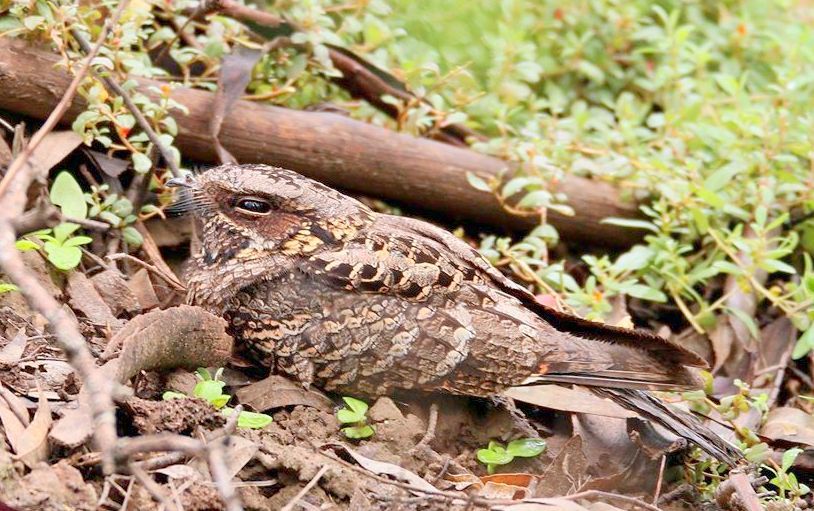 Fiery-necked NightjarCaprimulgus pectoralis
-
 Indian NightjarCaprimulgus asiaticus
-
 Large-tailed NightjarCaprimulgus macrurus
-
 Savanna NightjarCaprimulgus affinis
Compare
Questions and answers
What is the scientific name of the Nechisar Nightjar?
The scientific name of the Nechisar Nightjar is Caprimulgus solala. Written with its author, the full name is Caprimulgus solala Ash Safford, Telfer Duckworth & Zewdie, 1995.
Which family does the Nechisar Nightjar belong to?
Caprimulgus solala belongs to the family Caprimulgidae, in the order Caprimulgiformes and the class Aves.
What is the conservation status of the Nechisar Nightjar?
The IUCN Red List category recorded for Caprimulgus solala is Vulnerable (VU).
What is the Nechisar Nightjar?
The Nechisar Nightjar is a bird in the family Caprimulgidae and order Caprimulgiformes. It was first discovered in 1990 from a decomposing specimen found in Nechisar National Park.[3]
Sources
Passages the profile rests on
- The species is associated with subtropical natural habitat. Source passage: “Its natural habitat is subtropical.” — English Wikipedia
- The species was originally identified using a combination of wing length and the position of a white patch on its outer primary feathers. Source passage: “based on a combination of its wing length and the position of a white patch on the outer primaries.” — English Wikipedia
- The species was first discovered in 1990 from a decomposing specimen found in Nechisar National Park. Source passage: “The species was first discovered in 1990 when researchers discovered a decomposing specimen in the Nechisar National Park.” — English Wikipedia
- The original identification was based on a single wing recovered from the specimen and taken to the Natural History Museum in London. Source passage: “After bringing back a single wing from the specimen to the Natural History Museum in London” — English Wikipedia
- A continuing decline in the number of mature individuals has been recorded in the global assessment. Source passage: “Continuing decline of mature individuals” — iucnredlist.org
- A continuing decline in habitat area, extent, or quality has been recorded in the global assessment. Source passage: “Continuing decline in area, extent and/or quality of habitat” — iucnredlist.org
- Conservation sites have been identified throughout the species' entire range. Source passage: “Conservation sites identified : Yes, over entire range” — iucnredlist.org
- The species occurs in at least one protected area. Source passage: “Occurs in at least one protected area : Yes” — iucnredlist.org
- The species is endemic to Ethiopia. Source passage: “It is endemic to Ethiopia.” — English Wikipedia
- The species is considered probably endemic to Nechisar National Park. Source passage: “It is probably endemic to Nechisar National Park.” — English Wikipedia
- The only known specimen originated from the Nechisar Plains in southern Ethiopia. Source passage: “known from a single wing salvaged from a road corpse on the Nechisar Plains, southern Ethiopia, in 1990” — datazone.birdlife.org
Data
- Catalogue of Life, 2026-10-16 XR cc by
- Wikidata CC0
- Wikimedia Commons per image; credit shown with each image
- iNaturalist per image; credit shown with each image
- Within the Catalogue of Life, this name comes from The Integrated Taxonomic Information System cc0
References
- Safford, R. J., J. S. Ash, J. W. Duckworth, Mark G. Telfer & Chemere Zewdie. 1995. A new species of nightjar from Ethiopia. Ibis 137: 301-307. Link where the name was published
- Gill, Frank, & and Minturn Wright. (2006). Birds of the World: Recommended English Names.
This species in other databases
Page built on 26 November 2026. See how the catalog is made and all sources and licences.
Cite this page
ScientificNames.org. (2026). Caprimulgus solala (Nechisar Nightjar). Retrieved November 26, 2026, from https://scientificnames.org/species/caprimulgus-solala
“Caprimulgus solala (Nechisar Nightjar).” ScientificNames.org, 2026, scientificnames.org/species/caprimulgus-solala. Accessed 26 Nov. 2026.
ScientificNames.org. “Caprimulgus solala (Nechisar Nightjar).” Accessed November 26, 2026. https://scientificnames.org/species/caprimulgus-solala.
@misc{scientificnames_caprimulgus_solala_nechisar_nightjar,
  author = {{ScientificNames.org}},
  title = {Caprimulgus solala (Nechisar Nightjar)},
  year = {2026},
  url = {https://scientificnames.org/species/caprimulgus-solala},
  note = {Accessed 2026-11-26}
}