Species · Birds
Golden Nightjar Caprimulgus eximius
The scientific name of the Golden Nightjar is Caprimulgus eximius. It is a species of bird in the family Caprimulgidae (nightjar), order Caprimulgiformes. The name dates from 1826.
- Scientific name
- Caprimulgus eximius Temminck, 1826
- Common name
- Golden Nightjar
- Genus
- Caprimulgus
- Family
- Caprimulgidae (Nightjar)
- Order
- Caprimulgiformes
- Class
- Aves
- Red List category
- LC Least Concern
- Recorded in
- 7 countries
- Name status
- accepted in the Catalogue of Life

Overview
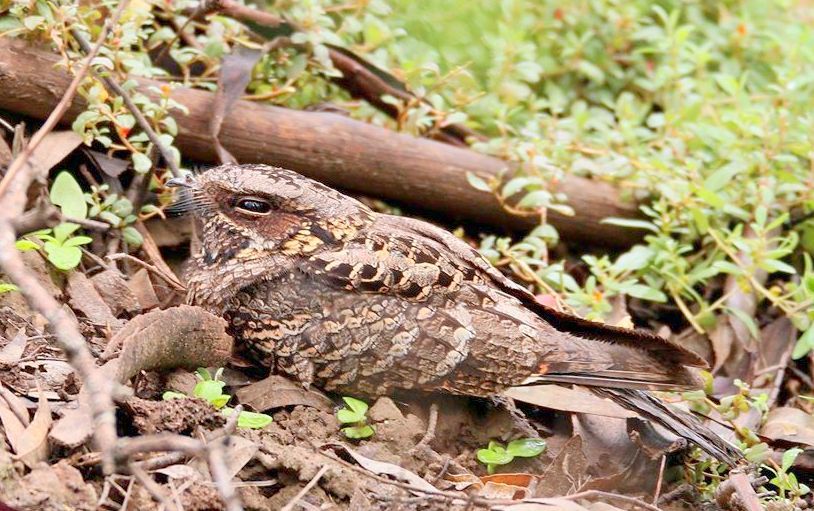
The Golden Nightjar (Caprimulgus eximius) is a bird in the family Caprimulgidae and order Caprimulgiformes. It occurs in the Sahel region of northern Sub-Saharan Africa, from northern Senegal and Mauritania in the west to Sudan in the east. Its golden plumage has silvery bands and conspicuous white wing patches and tail corners.
Written 26 November 2026 from the sources listed below. Each statement was checked against the passage it cites; statements that could not be supported were removed.
Appearance
The Golden Nightjar has tawny-buff upperparts and wing coverts marked with greyish-white, dark-brown-edged, speckled square spots. It measures between 23 and 25 cm in length.[1][2]
It has a large whitish throat patch and an upper breast patterned similarly to its upperparts, with an unmarked tawny-buff lower breast and belly. In flight, it displays a large white spot near the tips of its wings.[3][4][5]
Male and female Golden Nightjars have similar plumage.[6]
Habitat
The Golden Nightjar inhabits arid steppes and semi-desert environments. It also occupies rocky, gravelly, and stony terrain containing clumps of vegetation.[7][8]
It avoids dense scrub and woodland.[9]
Diet
The Golden Nightjar feeds primarily on larger insects.[10]
Behaviour
The Golden Nightjar is active at dawn, dusk, and throughout the night. During daylight hours, it roosts on the ground.[11][12]
When approached by animals, it tends to move away by shuffling rather than taking flight. It has also been recorded feeding over bodies of water at dusk.[13][14]
The Golden Nightjar produces a low-pitched churr song that may continue for an extended period. It delivers its song from the ground at dawn and dusk.[15][16]
Reproduction and life cycle
The Golden Nightjar normally lays a clutch of two eggs directly on the ground, usually near a vegetation clump.[17][18]
Egg laying has been recorded in April and May in western parts of its range and in March and April in Sudan.[19][20]
Conservation
The Golden Nightjar was most recently assessed for the IUCN Red List in 2024. BirdLife DataZone classifies it as having an extremely large range.[21][22]
Classification of the Golden Nightjar
| Kingdom | Animalia |
|---|---|
| Phylum | Chordata |
| Subphylum | Vertebrata |
| Infraphylum | Gnathostomata |
| Parvphylum | Osteichthyes |
| Megaclass | Tetrapoda |
| Class | Aves (Bird) |
| Order | Caprimulgiformes (Nightjar) |
| Family | Caprimulgidae (Nightjar) |
| Genus | Caprimulgus (Nightjars) |
| Species | Caprimulgus eximius Temminck, 1826 |
Where the Golden Nightjar is found
Checklists and occurrence records place Caprimulgus eximius in 7 countries across Africa. GBIF holds 427 georeferenced records of it.
Countries
Regions and cities with the most records
- Saint-Louis, Senegal 215
- Rosso, Mauritania 25
- Trarza, Mauritania 21
- Ndioum, Senegal 18
- Adrar, Mauritania 17
- Dagana, Senegal 8
- Richard-Toll, Senegal 7
- Mora, Cameroon 5
- Tiris Zemmour, Mauritania 4
- Borno State, Nigeria 3
- Louga, Senegal 3
Range as the checklists state it
Africa
A number beside a place is its count of GBIF occurrence records. A place without a number comes from a checklist alone. Records show where a species has been observed or collected, which can include escapes and vagrants.
Common names
English
- Golden Nightjar
- GONI
Names in 29 other languages
- Catalan
- enganyapastors daurat
- Chinese
- 金夜鷹, 金夜鹰
- Czech
- lelek zlatý
- Danish
- Gylden Natravn
- Dutch
- Gele Nachtzwaluw, Goudgele Nachtzwaluw
- Esperanto
- ora kaprimulgo
- Estonian
- kuld-öösorr
- Finnish
- kultakehrääjä
- French
- Engoulevent doré
- German
- Prachtnachtschwalbe, Prachtziegenmelker
- Hebrew
- תחמס זהוב
- Hungarian
- pompás lappantyú
- Icelandic
- Dulfari
- Irish
- Tuirne órbhuí
- Italian
- Succiacapre dorato
- Japanese
- キンイロヨタカ
- Lithuanian
- puošnusis lėlys
- Northern Sami
- Gollečahran
- Norwegian
- gullnattravn
- Polish
- lelek złocisty
- Portuguese
- noitibó-dourado
- Russian
- Великолепный козодой, Золотистый козодой
- Serbian
- Zlatni leganj
- Slovenian
- zlata podhujka
- Spanish
- Chotacabras dorado
- Swedish
- guldnattskärra
- Turkish
- Sarı Çobanaldatan
- Ukrainian
- дрімлюга золотистий
- Welsh
- troellwr euraid
Subspecies and varieties
- Caprimulgus eximius eximius subspecies
- Caprimulgus eximius simplicior subspecies
Related species
-
 Pennant-winged NightjarCaprimulgus vexillarius
-
 European NightjarCaprimulgus europaeus
-
 Standard-winged NightjarCaprimulgus longipennis
-
 Egyptian NightjarCaprimulgus aegyptius
-
 Nechisar NightjarCaprimulgus solala
-
 Fiery-necked NightjarCaprimulgus pectoralis
-
 Indian NightjarCaprimulgus asiaticus
-
 Large-tailed NightjarCaprimulgus macrurus
Compare
Questions and answers
What is the scientific name of the Golden Nightjar?
The scientific name of the Golden Nightjar is Caprimulgus eximius. Written with its author, the full name is Caprimulgus eximius Temminck, 1826.
Which family does the Golden Nightjar belong to?
Caprimulgus eximius belongs to the family Caprimulgidae, in the order Caprimulgiformes and the class Aves.
Where is the Golden Nightjar found?
Checklists and occurrence records place Caprimulgus eximius in 7 countries, including Senegal, Western Sahara, Mauritania, Sudan, Morocco and Cameroon.
What is the conservation status of the Golden Nightjar?
The IUCN Red List category recorded for Caprimulgus eximius is Least Concern (LC).
What other names does the Golden Nightjar have?
Caprimulgus eximius is also known in English as GONI.
What is a Nightjar diet?
The Golden Nightjar feeds primarily on larger insects.[10]
Sources
Passages the profile rests on
- The Golden Nightjar has tawny-buff upperparts and wing coverts marked with greyish-white, dark-brown-edged, speckled square spots. Source passage: “the upperparts and wing coverts are tawny buff marked with greyish-white, dark brown edged and speckled, square shaped spots.” — English Wikipedia
- The Golden Nightjar measures between 23 and 25 cm in length. Source passage: “which measures 23–25 cm in length.” — English Wikipedia
- The Golden Nightjar has a large whitish throat patch. Source passage: “It has a large whitish patch on its throat” — English Wikipedia
- The Golden Nightjar has an upper breast patterned similarly to its upperparts, with tawny-buff lower breast and belly lacking markings. Source passage: “the upper breast is similarly marked to the upperparts but this fades towards the unmarked tawny-buff lower breast and belly.” — English Wikipedia
- The Golden Nightjar displays a large white spot near the tips of its wings in flight. Source passage: “In flight it shows a large white spot towards the tips of the wings” — English Wikipedia
- Male and female Golden Nightjars have similar plumage. Source passage: “Both sexes are alike.” — English Wikipedia
- The Golden Nightjar inhabits arid steppes and semi-desert environments. Source passage: “The golden nightjar occurs in arid steppes and semi-desert” — English Wikipedia
- The Golden Nightjar also occupies rocky, gravelly, and stony terrain containing clumps of vegetation. Source passage: “also on rock, gravelly or stony terrain with clumps of vegetation.” — English Wikipedia
- The Golden Nightjar avoids dense scrub and woodland. Source passage: “It avoids dense scrub or woodland.” — English Wikipedia
- The Golden Nightjar feeds primarily on larger insects. Source passage: “its diet is made up of larger insects.” — English Wikipedia
- The Golden Nightjar is active at dawn, dusk, and throughout the night. Source passage: “The golden nightjar is active at dawn and dusk and through the night” — English Wikipedia
- The Golden Nightjar roosts on the ground during daylight hours. Source passage: “roosting on the ground during the day” — English Wikipedia
- When approached by animals, the Golden Nightjar tends to move away by shuffling rather than taking flight. Source passage: “tending to shuffle out of the way of approaching animals rather than flushing.” — English Wikipedia
- The Golden Nightjar has been recorded feeding over bodies of water at dusk. Source passage: “It has been recorded feeding over water bodies at dusk” — English Wikipedia
- The Golden Nightjar produces a low-pitched churr song that may continue for an extended period. Source passage: “The golden nightjar's song is low pitched churr which may last quite a long time” — English Wikipedia
- The Golden Nightjar delivers its song from the ground at dawn and dusk. Source passage: “is delivered at dawn and dusk from the ground.” — English Wikipedia
- The Golden Nightjar normally lays a clutch of two eggs. Source passage: “The normal clutch is 2 eggs” — English Wikipedia
- The Golden Nightjar lays its eggs directly on the ground, usually near a vegetation clump. Source passage: “which are laid on the ground, usually near a clump of vegetation.” — English Wikipedia
- Egg laying by the Golden Nightjar has been recorded in April and May in western parts of its range. Source passage: “Egg laying has been recorded in April–May in the west” — English Wikipedia
- Egg laying by the Golden Nightjar has been recorded in March and April in Sudan. Source passage: “March–April in Sudan.” — English Wikipedia
- The Golden Nightjar was most recently assessed for the IUCN Red List in 2024. Source passage: “Golden Nightjar Caprimulgus eximius has most recently been assessed for The IUCN Red List of Threatened Species in 2024.” — iucnredlist.org
- BirdLife DataZone classifies the Golden Nightjar as having an extremely large range. Source passage: “This species has an extremely large range” — datazone.birdlife.org
Data
- Catalogue of Life, 2026-10-16 XR cc by
- Global Biodiversity Information Facility CC BY 4.0
- Wikidata CC0
- GeoNames CC BY 4.0
- Wikimedia Commons per image; credit shown with each image
- Within the Catalogue of Life, this name comes from The Integrated Taxonomic Information System cc0
References
- Gill, Frank, & and Minturn Wright. (2006). Birds of the World: Recommended English Names.
This species in other databases
Page built on 26 November 2026. See how the catalog is made and all sources and licences.
Cite this page
ScientificNames.org. (2026). Caprimulgus eximius (Golden Nightjar). Retrieved November 26, 2026, from https://scientificnames.org/species/caprimulgus-eximius
“Caprimulgus eximius (Golden Nightjar).” ScientificNames.org, 2026, scientificnames.org/species/caprimulgus-eximius. Accessed 26 Nov. 2026.
ScientificNames.org. “Caprimulgus eximius (Golden Nightjar).” Accessed November 26, 2026. https://scientificnames.org/species/caprimulgus-eximius.
@misc{scientificnames_caprimulgus_eximius_golden_nightjar,
  author = {{ScientificNames.org}},
  title = {Caprimulgus eximius (Golden Nightjar)},
  year = {2026},
  url = {https://scientificnames.org/species/caprimulgus-eximius},
  note = {Accessed 2026-11-26}
}